

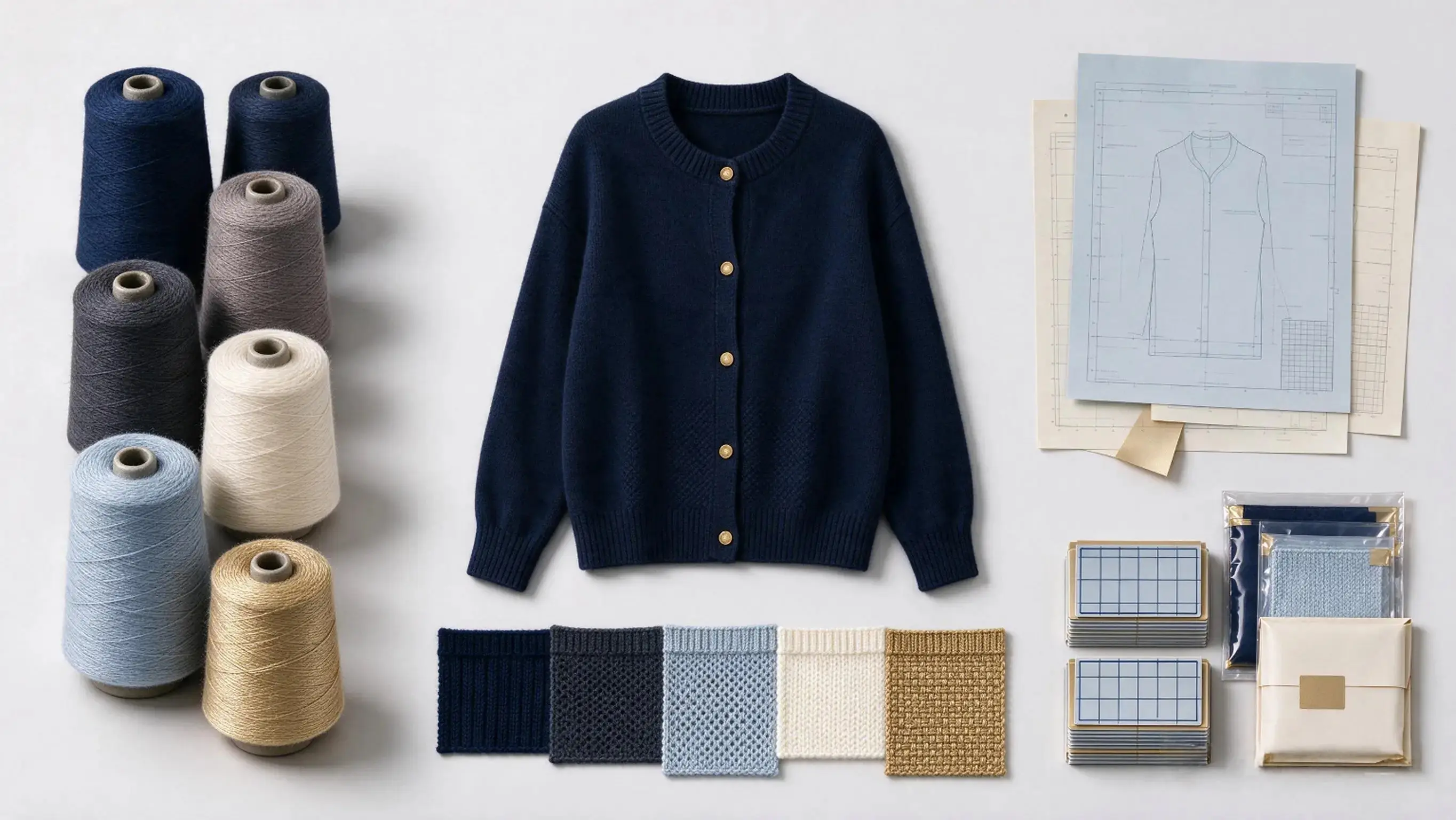
Quick Answer: A knitwear bulk order should enter production only after the factory has accepted a defined capacity window and the buyer has approved the production sample, yarn and color standards, measurements, test plan, labels, packaging, and current tech-pack revision. Any unresolved item should remain on hold or receive a documented, limited partial release.
This guide applies after a development sample and commercial direction exist, but before bulk yarn and production are released. It does not replace the full tech-pack, lead-time or quality-control procedures linked below. Its purpose is to help sourcing directors, production managers, wholesalers, importers and established fashion brands decide whether an order is genuinely ready for a capacity-backed commitment.
Key Takeaways
A reliable release decision connects commercial authority, product evidence, material commitment and factory capacity. The buyer should be able to identify the approved baseline, the person who accepted it and the operation that may proceed. The factory should be able to show the material route, production dependencies and current capacity condition. The four controls below are independent: completing one does not close the others, and a high readiness score cannot override an unresolved red-line gate.
Table of Contents
What Must Be Defined Before a Factory Reserves Bulk Capacity?
A factory can reserve meaningful capacity only when it can translate the order into a process route and a dated resource requirement. The minimum commercial information is the style and color quantity, size ratio, requested cargo-ready milestone, destination, order terms and named decision owners. The minimum technical information is the current tech-pack revision, approved construction, yarn specification, gauge and machine compatibility, measurement table, finishing route, test plan, labels and packaging. The factory must then confirm where the order fits across programming, knitting, linking or assembly, wet finishing, inspection and packing. A knitting-machine slot alone is not proof that the complete order can move through every downstream operation.
Commercial Information
- Purchase-order reference, legal buyer entity and agreed commercial conditions.
- Units by style, color and size—not one undivided collection total.
- Required cargo-ready milestone and the event that starts the production commitment.
- Named buyer approver and backup for fit, color, testing, artwork and packaging.
- Authorized scope for yarn purchasing, custom dyeing, trims, testing and third-party services.
Technical Information
- One controlled tech-pack version with construction, bill of materials and revision history.
- Approved yarn identity, color route, gauge, stitch structure and finishing direction.
- Approved sample purpose and status, with unresolved deviations listed separately.
- Finished measurements, grade rules, tolerances and measuring conditions.
- Test methods, specimen stage, acceptance criteria and report owner.
- Final label copy, artwork versions, placement and packaging specification.
Read the full guide here : Knitwear Tech Pack RFQ Checklist
Is the Knitwear Bulk Order Ready for Release?
Use a readiness score only as a control aid; the release decision still depends on whether any critical gate remains open. Score each category against dated records, not verbal confidence. A high total cannot override a missing approved production sample, unresolved bulk yarn or color, absent measurement standard, incomplete mandatory test decision, unapproved legal label, or unaccepted factory capacity window. Those are red-line items. The scorecard is most useful in cross-functional meetings because it makes ownership visible: product development closes the specification, quality closes the evidence plan, procurement authorizes materials, and production planning confirms the route and slot.
| Control Area | Weight | Evidence Required | Red-Line Condition |
|---|---|---|---|
| Commercial scope | 15 | PO, quantity matrix, terms, milestone and approval owners | Quantity or release authority is unclear |
| Technical specification | 20 | Frozen tech pack, BOM, artwork and revision record | Two teams are using different revisions |
| Sample and fit | 20 | Approved physical or controlled digital sample record, fit comments and deviations | Required approval sample is not signed off |
| Yarn and color | 15 | Yarn specification, approved color standard, consumption basis and lot plan | Bulk material differs from the approved basis |
| Quality and testing | 15 | Risk-based test plan, methods, criteria, stage and responsible party | A mandatory decision is deferred until after bulk |
| Labels and packaging | 10 | Approved legal copy, artwork, placement, barcode and pack specification | Required label content remains unknown |
| Capacity acceptance | 5 | Written route, slot condition, dependencies and release date | Only machine count or a verbal promise is supplied |
Decision rule: 90–100 = ready only when no red-line condition is open; 75–89 = conditional and the named gaps must close before their affected release; below 75 = hold.
Comparison basis: one defined style-and-color program at the point of bulk release.
Evidence source: the current PO, tech pack, approval ledger, sample records, material records, test plan and factory capacity acceptance.
Limitations: this is a buyer-control framework, not an industry standard, certification or substitute for a factory-specific feasibility review.
How Should Buyers Check Capacity and Yarn Booking?
Capacity and yarn should be checked as two connected commitments, but neither should be reduced to one headline number. Capacity depends on the complete production route: programming, compatible knitting equipment, linking or assembly, wet processing, finishing, quality control and packing. Yarn booking depends on approved, size-weighted consumption; the confirmed order matrix; a documented project allowance; color and dye-lot requirements; and a replenishment decision. Before authorizing either commitment, ask what evidence supports it, which approvals it assumes, how long the offer remains valid and what happens if the buyer changes the specification.
Capacity-Confirmation Checklist
- Confirm the style is compatible with the proposed machine gauge, needle set-up, program and construction route.
- Ask for the capacity window by operation, including known bottlenecks after knitting.
- Separate available machine time from the capacity already committed to other accepted orders.
- Define whether the OEM knitwear capacity booking is provisional, reserved or released, and what event changes that status.
- Identify the last approval date that protects the slot and the replanning rule if that date is missed.
- Confirm whether subcontracted or nominated operations are involved and how their capacity is controlled.
Yarn-Booking Checklist
- Match fibre composition, yarn count and ply, supplier reference, color reference and certification requirements to the approved specification.
- Base consumption on a bulk-representative, conditioned garment and the actual size ratio where available.
- Record what the allowance covers: knitting loss, winding, trials, linking, finishing, repair, testing or retained material.
- Define whether all required yarn can be supplied from one controlled lot and how different lots will be segregated.
- For custom color, define lab-dip approval, bulk-shade review and the party authorized to accept a deviation.
- Agree whether replenishment is technically and commercially realistic before relying on it as the shortage solution.
Project Calculation
Bulk yarn booking quantity = Σ (approved finished yarn consumption for each size × confirmed quantity for that size) + documented project allowance
Use factory-validated consumption, actual machine and process conditions, and a project-specific allowance. Do not estimate bulk requirements from machine count or one unconditioned sample, and do not copy a waste percentage from an unrelated style.
Dye-lot and replenishment limitation: A later replenishment may use a different raw-material or dye lot and can introduce shade, hand-feel or performance variation. The buyer and factory should define lot segregation, comparison standards, approval authority and finished-garment evaluation before mixing or replacing material. Availability from the same yarn supplier does not guarantee an identical bulk result.
What Should Buyers Approve Before Knitwear Bulk Production?
Buyers should approve the product standard and the evidence plan before authorizing full knitwear bulk production. The approval package should distinguish appearance, fit, measurements, material, color, performance, labels and packaging because each decision controls a different risk. An approval message should identify the style, color, sample or document ID, revision, accepted deviations, approver, date and operation being released. If the buyer wants an early or partial release, the authorization should state the quantity or process allowed to proceed and the commercial consequence if the unresolved item later fails.
| Gate | Required Evidence | What It Releases | Hold Condition |
|---|---|---|---|
| Sample and construction | Identified approval sample, construction comments and accepted deviations | The approved make-up and workmanship baseline | Sample uses non-bulk yarn, finish or construction without disclosure |
| Yarn and color | Yarn identity, lab dip or approved standard, bulk-lot review rule | Material purchase, dyeing or controlled bulk use | Color route or lot equivalence remains unresolved |
| Fit and measurements | Fit comments, POM table, grade rules, tolerances and measuring condition | Pattern and size-set baseline | Comments conflict with the current measurement revision |
| Testing | Method, edition, specimen stage, acceptance criterion and failure action | Testing execution and defined production risk controls | A method is named but no pass criterion or authority is recorded |
| Labels | Final fibre, care, origin and responsible-party copy; artwork and placement | Label ordering and attachment | Target-market requirements or final copy remain open |
| Packaging | Folding, bag, barcode, assortment, carton and shipping-mark specification | Packing-material purchase and packing | Retailer or logistics data is incomplete |
| Final production release | Approval ledger linked to the current tech pack and accepted capacity window | The defined full or partial bulk scope | An upstream red-line gate remains open |
Comparison basis: the risk controlled by each gate and the operation that the approval authorizes.
Evidence source: approved samples, the current tech pack and BOM, color records, measurement specification, test plan, label artwork, packaging specification and approval ledger.
Limitations: sample names differ between buyers. Define the purpose, bulk-correct materials and release authority instead of relying only on terms such as “PPS” or “confirmation sample.” Market-specific legal requirements must be confirmed for the actual product and destination.
For dimensional-change work, ISO 3759 covers preparation, marking and measuring, while ISO 5077 covers calculation of dimensional change after the selected washing and drying procedure. Neither standard supplies a universal commercial pass limit. The buyer must record the applicable procedure and acceptance source.
For labels, the applicable decision depends on the destination market. The U.S. Federal Trade Commission apparel-labeling resources and Regulation (EU) No 1007/2011 are primary starting points for U.S. and EU fibre-labeling review. They do not replace product-specific legal assessment.
Read the full guide here : Knitwear Quality Control SOP
How Should Changes Be Controlled After Approval?
Any change after approval should reopen only the gates it affects, but it must not enter production through an informal message. A yarn substitution may change shade, hand feel, dimensional behavior, care, fiber labeling and test evidence. A measurement change may alter pattern, grading, consumption and packing. A packaging change may affect material purchasing, barcode approval and carton configuration. The factory should first contain the old version, assess work in progress and identify the impact. The buyer then approves, rejects or limits the change in writing before a revised specification becomes the production baseline.
Log the Request
Record the requested change, reason, initiator, affected style and current revision.
Contain the Baseline
Stop the affected purchase, program, lot or operation until disposition is clear.
Assess the Impact
Review material, WIP, fit, testing, labels, cost, capacity and schedule.
Approve the Disposition
Approve, reject or limit the change and identify any required sample or retest.
Issue the New Revision
Update the tech pack, BOM, approval ledger and production instructions together.
Verify Restart
Confirm that the correct revision reaches materials, production, QC and packing.
Real limitation: A change approved by the design team may still require separate commercial, quality or compliance authorization. Approval means little unless the affected stock, work in progress, samples, test reports and documents are traceable to the new revision.
How Do Delays and Peak Loading Affect Bulk Sweater Production?
A buyer delay or material change can move the order by more than the number of late days because capacity is booked in connected production windows. A late color decision can delay yarn dyeing; a missed sample approval can release a knitting or linking slot to another accepted order; and a packaging change can prevent finished goods from being packed even when garments are complete. Peak-season loading increases this sensitivity because replacement windows may be limited. After any missed gate, the factory should recheck the critical operation, downstream capacity, external bookings and revised cargo-ready milestone instead of simply adding the delay to the old date.
- Buyer approval delay: record the original due date, actual approval date and affected capacity window.
- Material change: reassess availability, sample equivalence, consumption, testing and color approval before confirming a new date.
- Peak-season loading: distinguish a provisional forecast from a written slot accepted against the released specification.
- External dependency: recheck yarn mill, testing laboratory, nominated trim supplier, inspection agency and forwarder cutoffs where applicable.
- Partial release: state which quantity or operation may proceed and which unresolved risk remains with the buyer.
Read the full guide here : Knitwear Production Lead Time
What Should Be in the Final Buyer Release Package?
The final release package should let production, quality and procurement identify exactly what is authorized without searching through disconnected emails. Use one index that links the current tech pack, BOM, measurement specification, approved sample, yarn and color references, test plan, labels, packaging, order matrix, accepted deviations and capacity confirmation. Each item should show its version, owner and approval date. The release statement should identify whether authorization covers yarn purchase, selected preparation work, a limited production quantity or full bulk. This package becomes the shared reference for first output, inline control, final inspection and any later claim.
- Current PO and quantity matrix by style, color and size.
- Frozen tech pack and BOM with revision history.
- Approved sample ID, photographs and accepted deviations.
- Yarn, color, dye-lot and replenishment-control record.
- Measurement table, grade rules, tolerances and measuring condition.
- Risk-based test plan with methods, criteria and required reports.
- Approved label copy, artwork, placement and packaging specification.
- Capacity acceptance, approval calendar and release statement.
Buyer FAQs About Knitwear Bulk Orders
Most bulk-order questions can be answered by separating product approval, material commitment and production release. A sample proves only what it was made to prove; a yarn booking secures only the specified material route; and a capacity acceptance protects only the conditions written into that commitment. Buyers should ask what evidence applies to the actual bulk order, which decision owner can release the next operation and what happens when an assumption changes. The following answers use that control logic rather than treating one approval email as permission for every stage.
How important is a sample before a bulk order?
A sample is essential when it establishes an approved reference for construction, fit, measurements, hand feel, finishing and workmanship. Its authority depends on purpose and material equivalence. A proto made in substitute yarn may prove construction but not bulk color, shrinkage or hand feel. Record what the sample approves and which gates remain open.
How can buyers get sweater samples before a bulk order?
Send a versioned tech pack, measurements, yarn direction, color reference, construction details, sample purpose and approval criteria. Ask the factory to state which inputs will be bulk-correct, which are substitutes, how comments will be recorded and whether another sample is required after a material or fit change.
What should buyers approve before bulk knitwear production?
Approve the current specification, production sample, fit and measurements, bulk yarn and color standards, testing plan and acceptance criteria, label copy, packaging and the documented capacity window. Each approval should identify the style, revision, evidence, approver, date and operation released.
Can a factory reserve capacity before every approval is complete?
A factory may hold a provisional window if the missing decisions, expiry condition and financial commitment are documented. That is different from releasing production. If an approval misses its deadline, the factory should reconfirm the live slot and downstream operations rather than assume the original date remains protected.
Can bulk yarn be ordered before the pre-production sample is approved?
Only through a documented material release that defines the accepted risk. It may be reasonable when yarn identity and color are already approved and the remaining sample issue cannot change consumption or material suitability. It is higher risk when fit, stitch density, garment weight, finishing or color is still open.
What happens if the buyer changes the specification after production starts?
Contain the affected work, identify material and work in progress, reopen the relevant gates and issue a written impact assessment. The revised baseline should state the cost, schedule, retesting, rework and disposition consequences before production restarts.
How can a buyer verify a bulk knitwear manufacturer’s capacity?
Ask the manufacturer to map the order to compatible equipment and every downstream operation, disclose the slot conditions and dependencies, and confirm the accepted window in writing. Machine count alone cannot prove available capacity, material readiness, linking load, finishing capacity or packing readiness for the buyer’s specific order.
Submit a Bulk-Readiness Package for Review
Send the current tech pack, order matrix, approved sample reference, yarn and color status, testing requirements, label and packaging files, target cargo-ready milestone and named approvers. YouTricot can review the remaining release gaps and confirm which evidence is still required before yarn or production is authorized. Any capacity or delivery commitment remains subject to technical feasibility, material availability, agreed commercial conditions and a live capacity review.
Frank, Founder of YouTricot
Frank brings more than 20 years of knitwear-industry and operational experience across Prato, Italy and Dalang, Dongguan, China. He writes practical sourcing guidance for brands that need clearer technical decisions, documented approvals and dependable production control. Connect on LinkedIn.
Official technical and regulatory sources checked on 5 October 2026. Standards, regulations and buyer requirements can change; confirm the current edition, jurisdiction and product-specific applicability before making a compliance or shipment decision.