

QUICK ANSWER
Neither model is automatically better. China knitwear factory direct sourcing gives buyers the strongest control over development, quality and cost transparency when the supplier is verified as the actual producer. Traders consolidate mixed orders; agents coordinate when you lack in-house expertise. Choose by verifying who signs the contract, controls production and answers for defects.
Key Takeaways
1. No sourcing model is automatically cheaper or safer. Factory, trader and agent differ in who signs your contract, who controls production and who answers for defects — compare those three points before comparing prices.
2. “Factory direct” is a claim to verify, not a price guarantee. It supports cost transparency when the seller is the producer, but it does not prove in-house capacity, full process ownership or export competence.
3. Four checks separate real factories from intermediaries. Legal-entity registration, production address, bank beneficiary and subcontractor disclosure — each has a document to request and an independent way to confirm it.
4. Traders and agents earn their margin on coordination, not manufacturing. They add value on mixed or fragmented orders and when you lack a sourcing team; they also add a margin layer and dilute technical accountability.
5. Match the model to capability, complexity and risk. Score all three before you look at price, then write the contract counterparty, bank beneficiary and exporter of record into your documents.
Table of Contents
2. What China Knitwear Factory Direct Proves — and What It Does Not
3. How to Verify the Supplier Is the Actual Factory
4. When a Trader or Sourcing Agent Adds Real Value
5. Choosing a Model: Capability, Complexity, Risk
6. Buyer FAQs: Factory, Trader or Agent
1. What the Three Sourcing Models Actually Mean
Factory direct, trading company and sourcing agent describe three different contracting structures, not three grades of quality. In a factory-direct model you contract with the china knitwear manufacturer that owns the knitting floor: quotations, samples, revisions and complaints all land with the enterprise that runs the machines. In a trading-company model you contract with an intermediary that buys from factories and resells to you, which inserts a margin layer between your specification and the producer. In an agency model the factory remains your counterparty while the agent coordinates sourcing, inspection and communication for a disclosed fee. Two questions therefore decide everything: who signs the sales contract and proforma invoice, and who is contractually liable when quality or delivery fails.
| Dimension | Factory direct | Trading company | Sourcing agent |
|---|---|---|---|
| Your contract counterparty | The manufacturing enterprise that owns the knitting floor | The trading company, which buys from factories and resells to you | The factory signs the sales contract; the agent holds a separate service agreement with you |
| Controls development and sampling | Yes — knitting, linking, washing and finishing sit under one plant, unless declared otherwise | Partly — depends on which factory the trader selects | Coordinates sampling but does not control machines, workers or process decisions |
| Cost and pricing visibility | Highest — one margin layer; quotations traceable to yarn, gauge and finishing | Lowest — the resale margin between factory and buyer is rarely disclosed | Medium — commission or service fee should be disclosed in the mandate |
| Accountability for defects | The factory — direct contractual liability for the goods it made | The trader — but remedies depend on its own assets and its back-to-back contract | Shared and often unclear unless the agency mandate defines it |
| Export documents | The factory or its licensed export agent appears as exporter of record | The trading company appears as exporter of record | Varies — factory, agent or export broker, so state it in writing |
| Best suited for | Focused knitwear programs with stable specifications | Mixed-product, multi-category consolidation under one purchase order | Buyers without an in-house Mandarin-speaking sourcing or QC team |
Basis, evidence and limitations: Basis: standard contracting structures in China knitwear exports. Evidence: contract and document logic — who issues the proforma invoice, who appears as exporter, who holds quality liability — not any single supplier’s marketing claim. Limitations: hybrid structures are common. Many factories ship through a licensed export agent while keeping full production control, some trading companies operate genuine QC teams, and some agents quote cost-plus with full transparency. Treat this table as a map of incentives, not a verdict on any specific company.
2. What China Knitwear Factory Direct Proves — and What It Does Not
Factory direct pricing supports cost transparency because there is one margin layer and the quotation can be traced to yarn, gauge, linking, washing and finishing. Engineering answers also come from the people who run the machines, so a gauge change, a shrinkage-control measure or a yarn substitution is quoted and executed by the same team. But a factory-direct claim by itself proves less than buyers assume. It does not prove that every process is in-house: washing, linking and embroidery are routinely subcontracted even by genuine factories. It does not prove the lowest landed cost, because on fragmented, multi-product orders a trader’s consolidation can beat a single factory’s economics. And it does not prove capacity, which is a function of machine inventory and utilization, not of ownership structure.
| Factory-direct claim | What it supports | What it still does not prove |
|---|---|---|
| “Factory-direct price” | Fewer margin layers and a quotation traceable to yarn, gauge, linking and finishing | Lowest landed cost — consolidation, yarn minimums and setup economics can favor a trader on fragmented orders |
| “In-house production” | Process control, when backed by a machine list and floor access | That every process is internal — washing, linking, embroidery and printing are routinely subcontracted even by real factories |
| “Large capacity” | Scale, but only when machine inventory, gauge mix and utilization are shown | Headline machine counts without utilization data or an order book |
| “Factory means better quality” | Direct engineering accountability for decisions that shape the garment | That quality is better — quality depends on process control and inspection, not on ownership structure |
Basis, evidence and limitations: Basis: what each claim changes in the contracting structure. Evidence: each claim is testable with the documents listed in Table 3. Limitations: the absence of a claim is not disqualifying — a genuine factory with plain marketing can still be the right supplier, while a polished intermediary can still fail the checks in Table 3.
At YouTricot, for example, quotations are issued by the factory that runs the machines — a Stoll and Shima Seiki computerized flat knitting floor — so a gauge question is answered by the engineering team rather than relayed through a middleman. How that factory-direct quotation becomes a landed price then depends on the Incoterm you buy on. Read the full guide here : [ EXW vs FOB vs CIF quotes ]
3. How to Verify the Supplier Is the Actual Factory
Verification is documentary before it is physical. Every legitimate Chinese company carries an 18-digit unified social credit code on its business license, and that number can be checked free of charge in the National Enterprise Credit Information Publicity System (www.gsxt.gov.cn), the official company registry run by the State Administration for Market Regulation. Confirm that the license holder, the bank-account beneficiary and the name on the proforma invoice are the same legal entity. Then confirm the production address with a live video walkthrough or an on-site audit — third-party firms such as Bureau Veritas run structured factory audits for apparel buyers who cannot travel. The U.S. International Trade Administration makes the same recommendation at government level in its China Country Commercial Guide: verify credentials independently and insist on knowing which company you are actually contracting with.
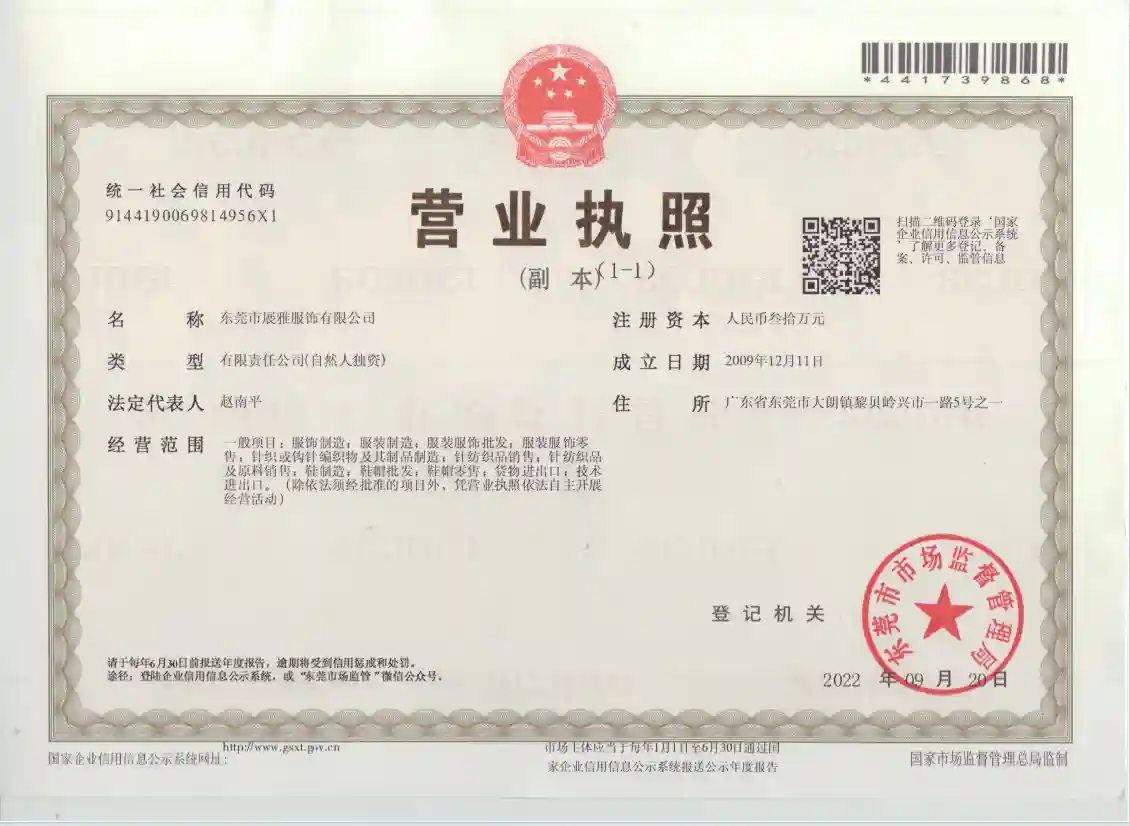
The document behind Check 1: YouTricot publishes the business license of its Dongguan manufacturing entity. The 18-digit unified social credit code at the top left is exactly what a buyer looks up in the official enterprise registry — gsxt.gov.cn, printed at the foot of the license itself.
| Check | Evidence to request | Independent confirmation | Red flags |
|---|---|---|---|
| Legal entity | Business license with the 18-digit unified social credit code; the English name used on the proforma invoice | Look the code up in the official enterprise registry (gsxt.gov.cn) | Bank-account name differs from the license holder; business scope lists trading but no manufacturing |
| Production address | Registered address plus the actual plant address; a dated visit or live video walkthrough | A recent third-party audit report from a named certification body (e.g., amfori BSCI or ISO 9001) | “Factory visits” happen only in a showroom; the registered address is an office tower in another city |
| Bank beneficiary | The account name on the proforma invoice, ideally confirmed by a bank letter | The account name must equal the licensed legal entity | Payment to a personal account, a newly opened account or an unrelated “finance company” |
| Export responsibility | A written statement of who appears as exporter on the customs declaration | A blank sample of the customs declaration used for HS chapter 61 or 62 shipments | Refusal to state the exporter of record before the deposit |
| Subcontracting | Written disclosure of which processes are in-house and which are not | A contract clause giving you approval rights over subcontracting and sub-supplier changes | “Everything is in-house” combined with an inability to name the washing or finishing partner |
| Equipment and capacity | A machine list with brand, gauge range and quantity; a dated floor video | The same machines visible in a live walkthrough, matched to the quotation | Stock photographs, no gauge details, or refusal of a live video call |
Basis, evidence and limitations: Basis: documents every established China knitwear factory can issue within days. Evidence: supplier documents cross-checked against the official enterprise registry and named certification bodies. Limitations: audit reports are point-in-time snapshots and a registry entry confirms registration, not performance — neither replaces your own sample approval or an inspection plan.
Red-flag checklist: stop and re-verify before paying
- The bank-account name does not match the business license.
- The registered business scope covers trading only, with no manufacturing items.
- The registered address is an office in a different city from the claimed factory.
- The supplier refuses a live video walkthrough or will not fix a visit date in advance.
- “Everything is in-house,” yet the supplier cannot name its washing or finishing partner.
- No written subcontracting disclosure and no approval clause offered.
- Pressure to pay a deposit before the business documents are issued.
- A price far below the yarn-cost logic of your specification — an unexplained below-market price is a data point, not a discount.
Complete this documentary verification before your first payment, then extend it into a structured pre-order review. Read the full guide here : [ what to ask a sweater factory before ordering ]
4. When a Trader or Sourcing Agent Adds Real Value
Intermediaries are not a defect in the supply chain; they are a service. A trading company or a knitwear sourcing agent earns its margin when your order is fragmented — knitwear plus woven garments plus accessories that no single factory covers — or when you have no Mandarin-speaking sourcing and QC team, or when you are testing a new category and need market guidance. The U.S. Commercial Service’s China Country Commercial Guide reaches the same conclusion from the buyer’s side: intermediaries are legitimate, but credentials must be verified independently and the division of responsibility put in writing. What an intermediary cannot add is engineering accountability. It does not operate knitting machines, so development and quality answers ultimately pass through the factory it selects.
| Situation | Why an intermediary can help | What you still keep control of |
|---|---|---|
| Mixed-product orders | One purchase order, one shipment and consolidated QC across knitwear, wovens and accessories | Written disclosure of every factory behind the order |
| Fragmented volumes | Consolidation lets small quantities reach workable production sizes at each supplier | Exporter-of-record and bank-beneficiary clarity for every sub-supplier |
| No in-house sourcing team | Local coordination, faster issue-handling and language cover | A written mandate: disclosed fee, defined inspection duty, direct factory visibility |
| First order in a new category | Market guidance, compliance orientation and realistic costing | Independent verification of the actual factory behind the intermediary |
Basis, evidence and limitations: Basis: order structure and buyer capability, not supplier marketing. Evidence: the coordination tasks listed are standard intermediary services; the controls are the same checks as Table 3. Limitations: a capable trading company with its own QC team can outperform a poorly run direct relationship — the model does not guarantee the outcome, the executed contract and inspections do.
5. Choosing a Model: Capability, Complexity, Risk
Choose the model by scoring three variables before you look at any price: your own capability (can you write a complete tech pack, review business documents and arrange inspection?), the complexity of the order (one focused knitwear program, or many categories and processes?), and your tolerance for risk relative to the value of the order. Price comes last, because a cheaper invoice with the wrong counterparty is the most expensive way to buy knitwear. The flow below turns those variables into a decision, and it shapes every later step of knitwear factory sourcing: quoting, sampling, inspection and export. Whichever branch you take, keep the verification checks from Table 3 and write the division of responsibility into the contract — the discipline behind China knitwear factory direct sourcing, knowing the producer, the beneficiary and the exporter, does not change.
Limitations of this decision rule: it is a planning heuristic, not legal advice. Hybrid structures are legal and common — a factory shipping through an export agent, or an agency contract with direct factory counterparties — and they change who holds which responsibility. Your proforma invoice and sales contract should state who bears quality liability, which law and arbitration forum apply, and who appears as exporter on the customs declaration. For orders that matter to your business, have a qualified international trade lawyer review the documents before the deposit is paid.
Once the model is chosen and the documents check out, the remaining risk lives on the factory floor. Our 64-point checklist walks through all eight areas of a knitwear plant, from yarn traceability to packing traceability. Read the full guide here : [ knitwear factory evaluation criteria ]
6. Buyer FAQs: Factory, Trader or Agent
Sweater manufacturer vs trading company: how can a buyer confirm which one you are dealing with?
Ask for the business license and check the 18-digit unified social credit code in the official enterprise registry, confirm the bank beneficiary matches the license holder, request a live video walkthrough of the knitting floor with a machine list showing brand and gauge, and ask which processes — washing, linking, embroidery — are subcontracted. A trading company can answer some of these honestly, but it cannot produce a knitting floor. When the contract must sit with a genuine china knitwear manufacturer, that difference settles the question.
Is factory direct pricing always cheaper for knitwear?
No. Factory direct removes one margin layer, so for a focused, reasonably sized knitwear program it usually gives the best price-to-transparency ratio. But on fragmented orders below each factory’s minimums, consolidation through a trader can land a lower total cost, and yarn minimums, special dyeing and setup costs dilute the advantage at small quantities. Compare quotations on the same Incoterm and specification before concluding.
When does a sourcing agent add value?
When you lack an in-house sourcing and QC team, when your order spans multiple suppliers or categories, or when you are entering a new product category for the first time. The value is coordination, consolidation and local problem-handling — provided the fee is disclosed, the inspection duty is defined in writing and you retain direct visibility of the factory. An agent who blocks your access to the factory is adding risk, not value.
Do all Chinese knitwear factories hold their own export license?
No, and the absence of one does not automatically make a factory a trader. Many genuine manufacturers ship through a licensed export agent for documentation while keeping full production control. What matters is who controls production and who your counterparty is. The exporter of record should simply be stated in writing, together with the export documentation responsibility, before you pay any deposit.
What documents should I verify before paying a deposit?
At minimum: the business license checked against the official registry, a proforma invoice whose account name matches the license holder, a written specification or tech-pack reference, the inspection standard and AQL level, the payment terms and sampling terms including the fee basis, and a statement of who appears as exporter of record. Treat missing documents as information: what a supplier will not put in writing is the answer.
Can a factory-direct order still be subcontracted?
Yes. Washing, linking, embroidery, printing and some finishing processes are routinely subcontracted even by genuine factories, and doing so can be perfectly professional. The requirement is disclosure before quotation and your written approval right over any change of subcontractor. “Everything is in-house” from a supplier who cannot name its washing partner is the specific combination that warrants a site audit.
What MOQ should I expect from a china knitwear manufacturer?
Terms vary by factory and program. YouTricot’s standard opening MOQ is 50 pieces per style, per color, for programs that pass technical feasibility review; yarn, structure, color count, gauge and finishing choices can move the MOQ, cost and timing, and each program is confirmed before quotation. Sampling carries a symbolic sampling fee, fully deductible from later bulk production orders. Ask any factory-direct supplier to state the equivalent terms in writing.
Put the Documents on the Table Before You Choose
Send your complete tech pack and target specification to YouTricot. We will confirm which processes run in-house on our own computerized flat knitting floor, issue a factory-direct quotation traceable to yarn, gauge and finishing, state our standard opening MOQ of 50 pieces per style, per color for feasible programs, and tell you plainly if a trading or agency structure would serve your program better. Complete specifications get complete answers — including the ones that push work toward a different sourcing model.
Frank, Founder of YouTricot
Frank has spent 20 years in high-end knitwear manufacturing across Prato, Italy and Dalang, Dongguan, and founded YouTricot to give independent brands and importers factory-direct access to computerized flat knitting technology with verifiable production terms. Every sourcing guide on this site is written from the factory side of the negotiation.
Connect with Frank on LinkedIn : Connect with Frank on LinkedIn