
Quick Answer
A knitwear ODM manufacturer develops agreed design options and technical specifications from a brand’s commercial brief. The brand provides customer, product, budget and launch requirements; the factory proposes materials, stitches, patterns and samples. Development proceeds through documented approvals, while confidentiality, ownership, exclusivity and file access require separate written terms.
This guide is for brand founders, retailers and product teams that have selected ODM and need to organize development before issuing a production order.
Key Takeaways
- The brand owns the commercial brief and its approval decisions. Factory-supported development still needs a defined customer, product direction, cost basis, size range and decision maker.
- Factory development must have named deliverables. Specify whether the project includes material proposals, finished swatches, pattern making, needle drafting, prototypes, fit revisions and a final specification package.
- A design suggestion, a feasibility review and brand approval are different records. A proposed stitch does not authorize sampling or bulk production.
- Product approval and design rights need separate controls. Identify existing assets, new development outputs, permitted reuse, exclusivity and access to editable files before commissioning work.
Table of Contents
What must a brand provide before ODM development starts?
The minimum commercial brief for knitwear ODM identifies the intended customer, garment category, visual direction, fit expectations, sales market, cost target, order assumptions and launch milestone. It does not need to contain a finished knitting program or every technical measurement. It does need to distinguish fixed requirements from decisions the factory is authorized to recommend. Name a brand approver and define the output expected from the first development stage. This gives the factory a usable design problem and helps the brand compare proposals against the same commercial objective.
- Customer and use: Describe who will wear the garment, where it will be sold, the season and the intended wearing experience. “Premium knitwear” alone does not define an end use.
- Product direction: Provide category, silhouette, front/back references and marked details. Explain whether a reference shows a desired neckline, proportion, texture or construction; identify elements that must not be copied.
- Fit direction: Identify the base size, size range and intended ease. Supply a fit reference or measurements where available. Ask the factory to propose the missing points of measure, grading and tolerances for approval.
- Material and care: State required composition, prohibited materials, hand-feel direction, color references and intended care claim. Mark unresolved yarn and stitch decisions “factory to recommend,” with an approval owner.
- Commercial basis: Separate target retail price from the target garment purchase price. Give currency, quantities by style/color/size, packing expectations, delivery location and quotation basis. A retail target alone cannot determine the factory price.
- Development scope: List requested concepts, swatches, prototypes, fitting support and final files. State the desired launch milestone and who will confirm labeling, testing and market requirements.
Working rule: Every unresolved field needs a proposed decision, an owner and a due stage. For example: “Yarn to be recommended by the factory; brand to approve the finished swatch before prototype knitting.”
For the specification and quotation fields that must eventually be completed, read the full guide here : Knitwear Tech Pack and RFQ Checklist.
What does a knitwear ODM manufacturer develop, and what does the brand approve?
A knitwear ODM supplier can be commissioned to develop material options, stitch concepts, garment patterns, needle drafting and samples within an agreed scope. The brand sets the commercial direction and approves the proposed product; the factory evaluates technical feasibility and records manufacturing risks. The useful comparison is therefore between inputs, development deliverables and approval evidence, rather than between supplier labels. Use the matrix below to negotiate the actual assignment. A responsibility allocated to one party does not remove the other party’s obligation to disclose relevant constraints or meet its agreed commitments.
Comparison basis: responsibilities within one proposed ODM project, from commercial brief to approved development handover. Evidence sources: YouTricot’s published OEM/ODM development description and STOLL’s design-to-production workflow, reviewed October 11, 2026. Limitations: this is an editorial planning framework, not a contractual allocation or a promise that every listed service or file is included.
| Workstream | Brand provides or decides | Factory develops or evaluates | Approval evidence to retain |
|---|---|---|---|
| Design direction | Customer, category, silhouette, marked references and non-negotiable details. | Concept options or adaptations of an identified existing design base. | Selected concept, identified base and permitted adaptations. |
| Materials and colors | Composition constraints, hand-feel priorities, colors and intended care. | Yarn options, availability information, color route and risk notes. | Approved yarn specification and physical color reference; substitution rules. |
| Stitch concepts | Desired texture, visual weight, stretch and artwork direction. | Structure proposals and swatches using the proposed yarn and finishing route. | Identified finished swatch, appearance/handle comments and unresolved risks. |
| Pattern making | Fit reference, base size, silhouette priorities and size range. | Garment/panel shapes, construction proposals, measurements and grade recommendations. | Fit comments, points of measure, measurement methods and approved revision. |
| Needle drafting and programming | Approved shape, structure and placement requirements. | Stitch/row planning, shaping and structure instructions, and machine-program development as agreed. | Technical review status, sample-linked program revision and agreed file-access terms. |
| Sampling and fit | Consolidated comments and named approval decisions. | Prototype, measurement report, finishing trials and agreed revisions. | Sample ID, material deviations, fit status and separate aesthetic approval. |
| Performance and documentation | Destination markets, intended claims and approval authority. | Identify technical risks and provide agreed material/process records and testing support. | Agreed test plan, required evidence and unresolved items; no blanket compliance sign-off. |
| Development handover | Final product selection, budget acceptance and authorization for the next stage. | Reconcile specification, bill of materials, sample references, cost assumptions and deviations. | Dated specification package and explicit release scope acknowledged by both parties. |
Pattern making and needle drafting are related but distinct. Pattern making defines garment geometry and construction. In this guide, needle drafting means translating the approved knitted shape and structure into stitch/row and shaping instructions for technical execution. Confirm the factory’s terminology and the files included; a machine program is a further implementation deliverable.
STOLL describes design programs as a base for machine programs that knitting technicians check and process. That supports a separate technical-review step; it does not establish which software a particular factory uses or transfer any design rights.
How should an ODM project move through approval stages?
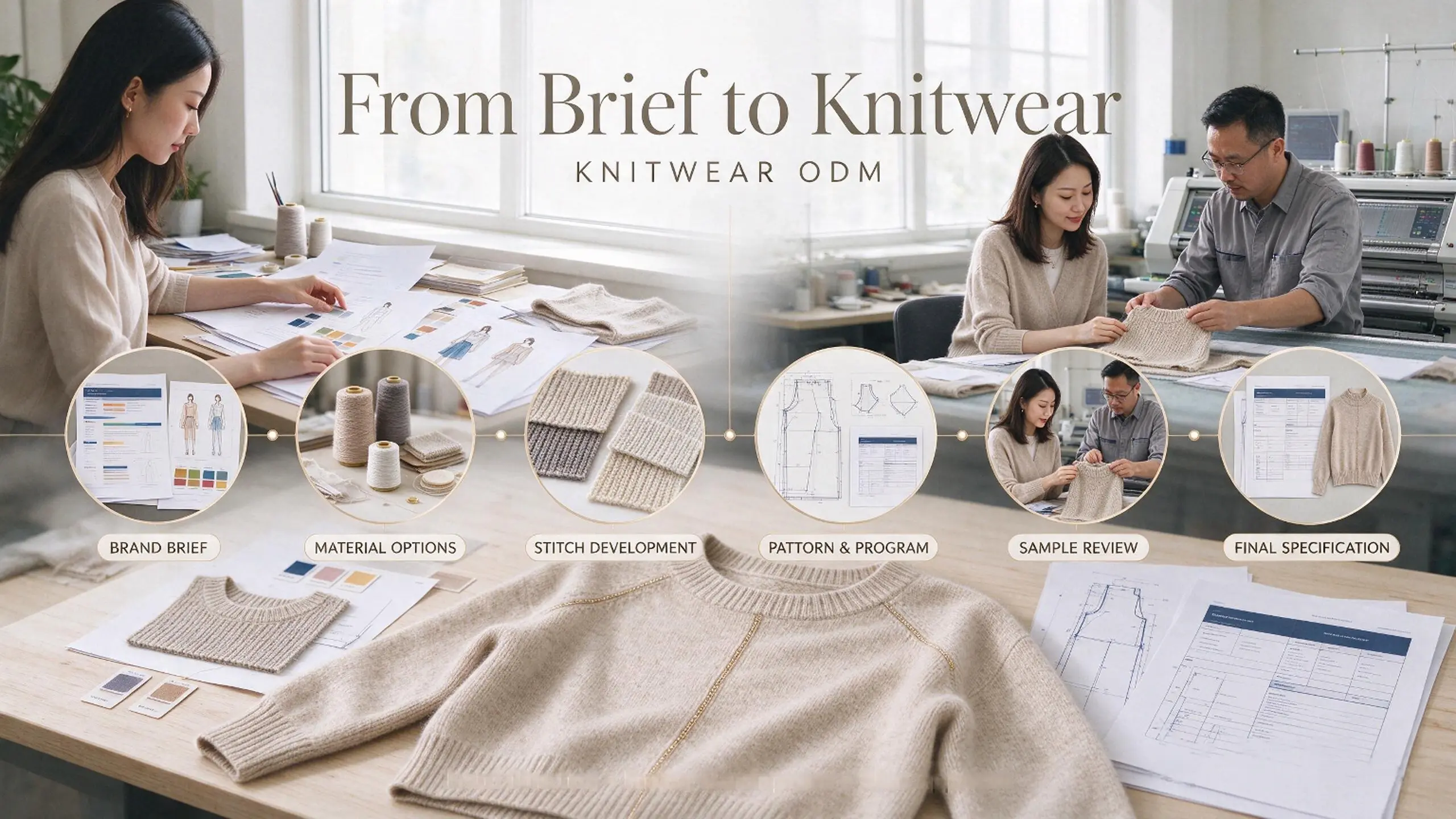
An ODM project should advance through recorded decisions that authorize a defined next action. Agree the brief and rights framework, select the material and stitch direction, review a prototype, resolve fit and size requirements, and reconcile the final development package. Each gate needs an output, a named approver and a release scope. Keep creative selection separate from technical feasibility and commercial acceptance. A photograph, a favorable fitting comment or a message saying “looks good” is too ambiguous to authorize every subsequent activity. The workflow below is a recommended control sequence, adaptable to the project.
1. Brief and development mandate
Factory output: scope response listing proposed deliverables, missing inputs and feasibility questions.
Brand decision: approve the direction, commercial assumptions and written development terms. Confirm confidentiality arrangements before sharing sensitive files.
Release: concept or swatch development only; record any excluded work.
2. Material and stitch selection
Factory output: identified yarn candidates, finished swatches, color options and technical concerns.
Brand decision: select the direction and agree what needs physical or test confirmation.
Release: prototype development using named inputs. A swatch approval alone does not establish garment fit.
3. Prototype and fit review
Factory output: sample, measurements and a list of deviations from intended production materials or processes.
Brand decision: issue one consolidated comment sheet distinguishing design changes from failure to meet an agreed requirement.
Release: a named revision or next sample stage. Track fit, appearance and material status separately.
4. Size range and product evidence
Factory output: proposed grading, risk-based size samples and agreed performance evidence.
Brand decision: approve the size specification and resolve requirements for the intended market and care claim.
Release: preparation of the final reference package. A base-size approval does not automatically approve every size or claim.
5. Final development handover
Factory output: reconciled specification, bill of materials, reference sample, approved color/trim records and updated quotation.
Brand decision: confirm that approvals and documents describe the same product and resolve open deviations.
Release: the specifically named activity, such as pre-production preparation. Bulk authorization requires its own explicit release and agreed prerequisites.
Three records, three purposes: “Design suggested” records an option. “Technically feasible” records the factory’s assessment and conditions. “Brand approved” records the selected product and authorized next action. None should be used as shorthand for the other two.
Write approvals as: style ID + specification revision + sample/swatches IDs + approved scope + open items + approver + date + authorized next action.
For the production checkpoints that follow development, read the full guide here : Knitwear Quality Control SOP. The published process is a first-party description; request project-specific records when assessing execution.
Which design-control questions need written answers?
Design control in ODM requires separate answers about confidentiality, ownership, permitted use, exclusivity and access to development files. A factory may contribute an existing pattern or design base while the brand contributes artwork and funds new adaptations. Document those contributions and agree the treatment of each output before commissioning work. Product approval should identify the selected garment; rights terms should identify who may use the underlying assets and on what basis. The questions below are a negotiation checklist, not legal guarantees. Have qualified counsel review the agreement for the relevant parties and jurisdictions.
Ownership and file delivery
- What existed before the project? Identify the brand’s artwork and fit references separately from factory base patterns, existing programs and third-party inputs.
- Who controls new outputs? Specify ownership or licensing of new patterns, adaptations and technical files, including when any agreed transfer takes effect. List the editable files to be delivered and their formats; distinguish access to a file from permission to use it elsewhere.
WIPO recommends distinguishing contributed background IP from newly developed foreground IP and specifying supplier rights and exit arrangements. Source: WIPO — IP Agreements with Suppliers, July 14, 2026; accessed October 11, 2026.
Exclusivity and reuse
- What exactly is exclusive? Identify the design or modifications covered, products, territories, channels, duration and any agreed conditions. Resolve whether color changes or related styles fall inside the restriction.
- What reuse and transfer are permitted? Agree catalog/showroom use, future adaptations, third-party production and subcontractor permissions. If portability matters, confirm that both the rights and usable technical documentation support it.
WIPO’s licensing guidance distinguishes ownership from permission to use IP and recommends defining rights, scope, territory, sublicensing and term. Source: WIPO — IP Licensing Strategies, July 15, 2026; accessed October 11, 2026.
Confidentiality and project exit
- Who may access confidential material? Identify authorized teams and subcontractors, permitted purposes and storage/access arrangements. Confirm whether samples or photographs may be displayed or published.
- What happens at project closure? Agree return or deletion of files, treatment of necessary retained records and backup copies, continuing confidentiality obligations and a contact for handling unauthorized disclosure.
WIPO describes confidentiality agreements alongside practical measures such as restricted access and confidential document marking; an NDA alone is not an operational security system. Source: WIPO — Trade Secrets FAQs, accessed October 11, 2026.
How should costing and revision control work during development?
ODM costing should track the product definition on which each estimate is based. Ask the factory to identify yarn, consumption assumptions, stitch/construction route, size mix, finishing, trims, testing and packing scope. Keep development charges separate from the quoted garment price and any delivery costs. When the brand changes an approved requirement, request the cost, schedule and approval impact before implementation. When a sample fails an agreed requirement, record the discrepancy separately and resolve responsibility under the development agreement. This makes commercial decisions traceable without assuming that every revision is included.
Cost-review framework, not a quoted price:
Estimated garment cost = yarn consumption allowance × quoted yarn cost + knitting + assembly + finishing + trims + allocated testing/documentation + packing + agreed commercial overhead and margin.
Identify the size/color mix and wastage basis behind consumption. Confirm which items are included in the supplier’s price; do not add them again if already included. List development and delivery-related charges separately.
For YouTricot projects involving sampling charges, the symbolic sampling fee is fully deductible from later bulk production orders. Confirm the documented deduction mechanism, development scope and revision terms. This does not imply completely free sampling or unlimited redesigns.
Keep one change log: request ID, originating specification revision, requested change, reason, factory impact assessment, brand decision and replacement revision. Require acknowledgment of the current version; withdraw superseded instructions from the working folder.
Illustrative decision: if a brand requests a different yarn after prototype approval, hold the affected work while the factory identifies which swatch, measurements, costing and evidence need updating. Reopen those approvals rather than silently treating the change as equivalent.
Buyer FAQs about working with an ODM knitwear factory
Working with an ODM knitwear factory means buying a defined development service as well as planning a manufactured product. The recurring questions concern the starting brief, the origin of design options, sample evidence, technical-file access and the meaning of approval. The answers below clarify those boundaries for founders and retail teams without a finished tech pack. Apply them to the quoted scope and written agreement for the actual project. A supplier’s use of “ODM,” a successful prototype or a paid invoice does not settle every technical or contractual question.
1. Can knitwear ODM start without a finished tech pack?
Yes, if the factory accepts a commercial brief and the scope includes developing missing specifications. Mark unresolved fields and their approvers. A complete, approved specification is still needed before the corresponding production activity is released.
2. How do I get ODM sweater designs that fit my brand?
Request concepts against a defined customer, category, fit and price basis. Ask whether each option is an existing design base or newly commissioned work. Compare relevant finished swatches and prototypes rather than choosing from images alone.
3. How do you work with an ODM knitwear factory when your team lacks technical expertise?
Name a brand decision maker and commission specific technical deliverables. Arrange competent fit and product review if the team cannot assess them internally. Factory recommendations help develop the product; they still need informed approval.
4. Does paying for sweater ODM development give us exclusive ownership?
Do not assume so. Agree ownership, license scope and exclusivity for identified outputs in writing, including any factory-owned base. Payment, product approval and rights transfer are separate matters; obtain legal review where the rights are commercially important.
5. Should a knitwear ODM manufacturer hand over editable patterns and programs?
File delivery should be specified in the scope, including format, timing and usage rights. A PDF specification or physical sample is not an editable program. Confirm practical compatibility before relying on files for production at another site.
6. Is a digital design enough to approve an ODM sweater?
It can support visual selection, but does not by itself establish physical fit, handle or care performance. Define which finished swatches, garment samples and test evidence are needed before approving the intended product and production stage.
ODM project brief checklist: what to send for a development review
An actionable ODM project brief combines the brand’s commercial direction with an explicit request for factory development outputs. Submit one dated package, identify missing decisions and attach the references needed to resolve them. The immediate objective is a scope-and-feasibility response that names deliverables, evidence, approval owners and commercial assumptions. It is not an unconditional production commitment. Use the checklist below before requesting development, and require the factory’s response to follow the same style IDs and document revisions. That creates a practical starting point for moving toward complete approved specifications.
- ☐ Brand/project contact, style IDs, season, brief revision and date.
- ☐ Customer profile, product category, market, intended use and launch milestone.
- ☐ Marked visual references, source information, distinctive details and copy restrictions.
- ☐ Fit direction, base size, size range and available measurements or fit references.
- ☐ Material, color, texture and care requirements; fixed choices versus “factory to recommend.”
- ☐ Target purchase-cost basis, currency, style/color/size quantities, packing and delivery assumptions.
- ☐ Requested concepts, swatches, pattern making, needle drafting, samples and final files.
- ☐ Confidentiality arrangements, contributed assets, proposed rights, exclusivity and file-access requirements.
- ☐ Named creative, fit, technical-evidence and commercial approvers; agreed next actions at each gate.
- ☐ Required material/process evidence, proposed tests and responsibility for destination-market review.
- ☐ Development terms, sampling-charge treatment, revision boundaries and change-control method.
- ☐ Requested factory response: feasibility concerns, missing inputs, deliverable list, approval plan and quotation assumptions.
If a low-MOQ opening order is part of the brief: YouTricot’s applicable starting point is 50 pieces per style per color, subject to stock-yarn availability, colors, structure, trims, testing, finishing and technical feasibility. Confirm the project-specific conditions; yarn, dyeing or component minimums can constrain the plan.
Request an ODM scope review with your completed brief
Submit the checklist and marked references to YouTricot. Ask for a written response separating brand inputs, factory deliverables, feasibility concerns, required evidence and approval stages. Resolve open specifications and rights terms before authorizing the next activity.
Frank, Founder of YouTricot
Practical guidance for brands planning knitwear development, sourcing and production.
YouTricot Blog