

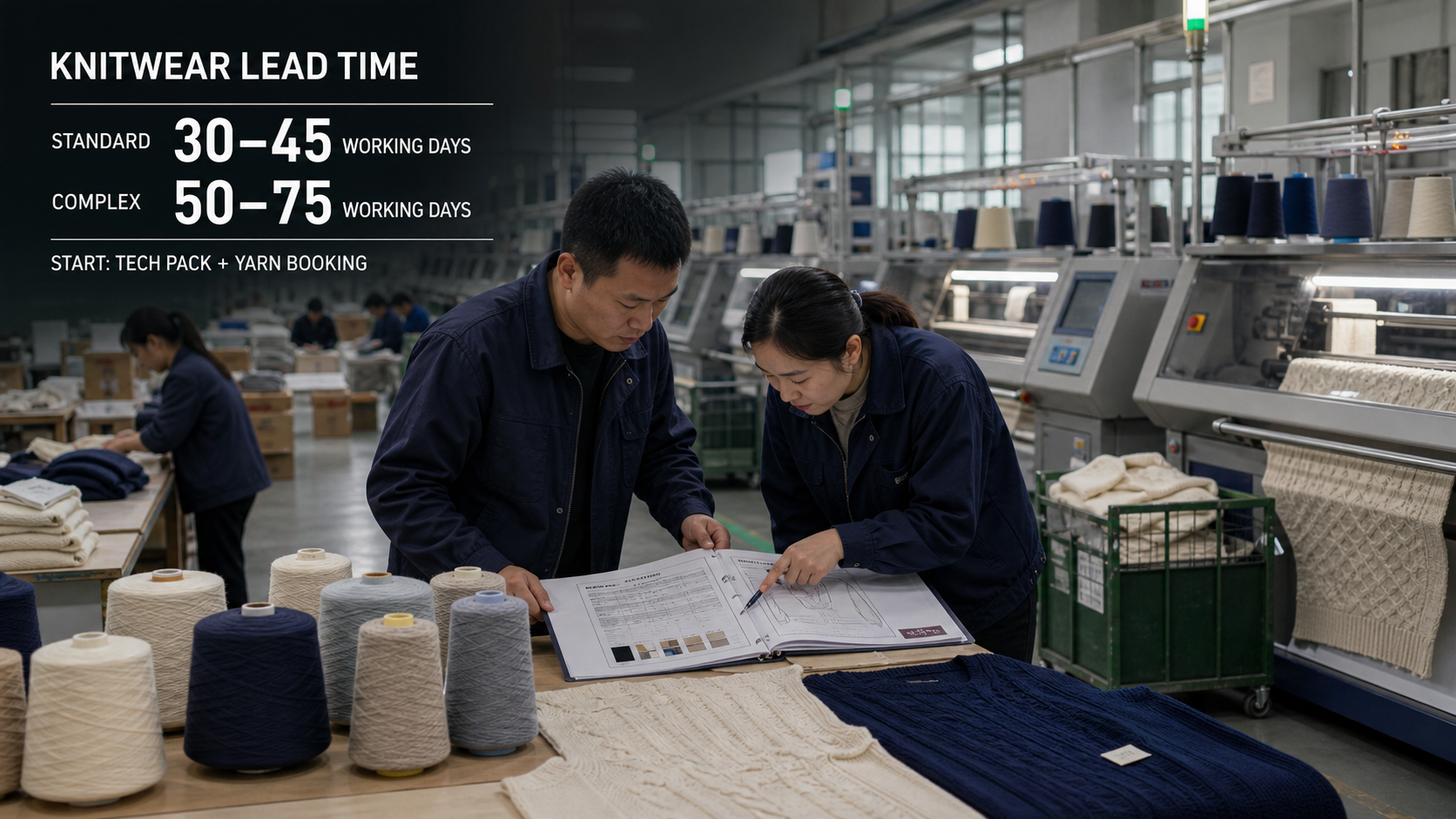
Knitwear production lead time should start only after the production tech pack is approved and yarn booking is authorized—not simply on the purchase-order date. The usable schedule must then identify which factory stages are included, which buyer approvals can pause progress, and whether “shipment” means cargo-ready, forwarder handover or arrival at destination. For planning, a standard style may require approximately 30–45 factory working days after the agreed start gate, while a complex style may require 50–75 factory working days. These ranges exclude buyer approval holds, public holidays, third-party testing, reinspection and international transit unless the quotation explicitly states otherwise. They are planning ranges, not delivery guarantees. The confirmed schedule is project-specific because yarn availability, construction, quantity, approval speed, machine fit, finishing and inspection requirements can change the critical path.
Key Takeaways
- A PO date is a commercial milestone, not a reliable factory production start date. The production clock should begin only when the latest tech pack and required technical details are approved, the yarn booking instruction is confirmed, and the factory accepts the capacity window. If the design, color standard, size specification or yarn direction remains open, the factory cannot protect a meaningful completion date. Buyers should ask every supplier to write both the trigger and the exclusions beside the quoted lead time: “30–45 factory working days from approved production tech pack and confirmed yarn booking, excluding buyer approval holds and international transit,” for example. This one sentence prevents many disagreements about whether pre-order sampling, late comments or material sourcing were included.
- Factory working time and buyer approval time must appear on separate schedule lanes. Sampling, programming, knitting, linking, finishing, QC and packing are factory-side activities. Fit comments, lab-dip decisions, confirmation-sample approval, pre-production-sample approval and packaging-artwork sign-off belong to the buyer lane. A two-day approval target that takes eight days creates six days of buyer-side delay, but the final impact can be longer if the missed approval also loses a reserved machine slot. A Gantt-style plan should therefore show owners, due dates and dependencies rather than one undifferentiated “lead time” number.
- Standard and complex styles need different planning tracks. A stock-yarn jersey or simple cable style can move through development and bulk production more predictably than custom-dyed cashmere, intarsia, multi-color jacquard, brushed finishes, hand-applied details or a new construction that needs repeated wash and fit trials. Typical stage ranges should never be added mechanically because yarn procurement, confirmation samples, programming and preparation may overlap. The factory should identify the critical path and state which approvals must be completed before bulk knitting can begin. Complexity, not only order quantity, determines whether a fast schedule is technically credible.
- Brands should work backward from the target launch date, not forward from the PO. First reserve the brand’s receiving and merchandising buffer. Next subtract the forwarder-confirmed transport and customs allowance, then the factory’s cargo-ready lead time, then the sampling and approval calendar. The result is the latest safe date for a quote-ready tech pack and material decision. Keep additional contingency for custom dyeing, third-party testing, peak-season scheduling and rework. A launch calendar built this way makes responsibility visible and gives the buyer time to simplify the style, select an available yarn or change the transport plan before the deadline becomes impossible.
Table of Contents
- 1. When Does Knitwear Production Lead Time Start?
- 2. What Does Each Numbered Production Stage Take?
- 3. How Should Factory Time and Buyer Approval Time Be Separated?
- 4. Which Delay-Risk Nodes Should Buyers Check?
- 5. How Can a Buyer Work Backward From a Launch Date?
- 6. How Does the May 2026 Stoll Expansion Affect Capacity?
- 7. What Should a Buyer Request Before Accepting a Shipment Date?
- Frequently Asked Questions
- Request a Project-Specific Lead-Time Review
- About the Author
1. When Does Knitwear Production Lead Time Start?
Production lead time starts at a documented readiness gate: the production tech pack is approved, yarn booking is authorized, required commercial conditions are met, and the factory confirms the capacity slot. A PO can arrive days or weeks earlier while fit, color, yarn, labels or construction remain unresolved. The quotation should also state whether the confirmation sample and pre-production sample are inside the quoted clock, and whether bulk knitting waits for their approval. If any input changes after the gate, the factory should issue a schedule-impact update. This definition gives both parties one auditable start date instead of arguing later about which email “started production.”
Start-Gate Checklist
| Readiness item | Required evidence | Owner | If missing |
|---|---|---|---|
| Production tech pack frozen | Current version number, date and approval record | Buyer | Clock does not start |
| Yarn booking authorized | Composition, count, color, quantity and booking instruction | Buyer + factory | Material path remains open |
| Color standard confirmed | Pantone, lab dip, swatch or other agreed standard | Buyer | Dyeing or knitting may wait |
| Confirmation-sample status defined | Approved, approved with comments, or still required | Buyer + factory | Bulk release is ambiguous |
| PPS requirement defined | Sample scope, due date and approval authority | Buyer + factory | Production hold may appear later |
| Capacity window accepted | Gauge, machine type and planned slot recorded | Factory | Requested date is not protected |
| Labels and packaging critical dates set | Artwork, legal copy, barcode and packing approval dates | Buyer | Packing can become the final bottleneck |
Read the full guide here : Knitwear Tech Pack RFQ Checklist
2. What Does Each Numbered Production Stage Take?
A useful knitwear production process separates development, material preparation, sample approvals, bulk manufacturing and shipment handover into numbered stages with owners and ranges. The table below uses factory working days and compares a standard track with a complex track. In this guide, one factory working day means a scheduled production day under the factory calendar; it is not the same as one elapsed calendar day. “Complex” can mean custom-dyed or imported yarn, intarsia, multi-color jacquard, brushed finishing, handwork, unusual trims or a construction that needs repeated trials. The ranges overlap and must not be added as a simple total. The critical path—not the sum of every row—determines the cargo-ready date. The project quotation and approved time-and-action calendar always override these planning assumptions.
Knitwear Production Lead Time: Standard vs Complex Timeline
| No. | Stage | Main owner | Standard style: typical range | Complex style: typical range | Clock treatment |
|---|---|---|---|---|---|
| Pre-Start Development and Approval | |||||
| 1 | PO logged and project opened | Buyer + factory | 1–2 days | 1–2 days | Commercial milestone; not the production start |
| 2 | Tech-pack review, closure of outstanding specifications and production freeze | Buyer + factory | 2–5 days | 5–10 days | Pre-start readiness gate |
| 3 | Sampling rounds | Factory | 7–12 days per round | 10–18 days per round | Normally pre-production development; quote separately |
| 4 | Buyer comments after each sample round | Buyer | 2–5 days per round | 3–7 days per round | Buyer-side time; factory clock paused where approval is required |
| Post-Trigger Material and Production Schedule | |||||
| 5 | Yarn procurement after booking authorization | Factory + yarn supplier | 7–14 days for available or in-stock yarn | 20–35 days for custom-dyed, imported or specialty yarn | Starts after the buyer authorizes yarn booking; yarn arrival is not required on Day 0 and procurement is often on the critical path |
| 6 | Confirmation sample | Factory | 5–8 days | 8–12 days | Define in quotation; may overlap yarn preparation |
| 7 | Confirmation-sample approval | Buyer | 2–4 days | 3–7 days | Buyer-side hold before dependent work |
| 8 | Pre-production sample (PPS) | Factory | 5–7 days | 7–12 days | Usually inside pre-production schedule; may overlap preparation |
| 9 | PPS approval and bulk release | Buyer | 1–3 days | 2–5 days | Buyer-side hold; bulk knitting does not proceed without required release |
| 10 | Bulk knitting | Factory | 7–15 days | 15–30 days | Factory-side production time |
| 11 | Linking, seaming and assembly | Factory | 3–7 days | 7–14 days | Factory-side; can follow knitting in batches |
| 12 | Washing, relaxation, finishing and pressing | Factory | 3–6 days | 5–10 days | Factory-side; cannot be compressed without technical review |
| 13 | In-line/final QC and required inspection review | Factory + buyer/inspector | 2–4 days | 3–6 days | Factory-side baseline; failed checks or external testing add time |
| 14 | Packing and carton release | Factory | 1–3 days | 2–5 days | Factory-side; waits for approved labels, barcodes and packing instructions |
| 15 | Export documents and shipment handover | Factory + forwarder | 1–3 days | 2–5 days | Ends at the agreed handover point; international transit is separate |
Planning total from the agreed start trigger to cargo-ready: approximately 30–45 factory working days for a standard style and 50–75 factory working days for a complex style, assuming approvals arrive by their deadlines and no material, test or rework exception changes the critical path.
Timing basis and source: These are YouTricot internal planning bands based on current custom-knitwear production workflows and reviewed on 18 August 2026. They are intended for preliminary planning, not as universal industry standards or contractual delivery commitments. A factory working day is a scheduled production day. Buyer approval holds, public holidays, third-party testing, reinspection and international transit are excluded unless the quotation explicitly includes them.
Elapsed-calendar formula: Total elapsed calendar time = factory working days converted through the factory calendar + buyer approval overruns + approved specification-change impact + external testing or reinspection time + transport and customs time.
Real limitation: These ranges are suitable for early planning, not for a contractual delivery promise. Style count, unit quantity, color split, yarn supplier, gauge, machine compatibility, linking load, wet-finishing capacity, testing scope and the live factory order mix must be reviewed before a date is confirmed.
Confirmation Sample vs Pre-Production Sample
| Sample gate | Main purpose | Typical release decision |
|---|---|---|
| Confirmation sample | Closes fit, construction, stitch appearance and intended hand feel | Confirms the design direction before bulk-production preparation |
| Pre-production sample (PPS) | Uses bulk-production yarn, trims, labels and the intended finishing method where required | Releases the approved specification for bulk production |
Some buyers use different sample names or combine these two gates. The quotation should define the required physical reference, materials and approval authority instead of relying on the sample name alone.
3. How Should Factory Time and Buyer Approval Time Be Separated?
Use two Gantt lanes: one for work controlled by the factory and one for decisions controlled by the buyer. In the example below, “Week 1” begins only after the tech-pack-and-yarn-booking start gate. The week bands show illustrative elapsed calendar windows when approvals arrive on time. Approval markers are holds, not productive factory days, and any approval overrun extends the calendar beyond the displayed window. If the buyer meets the agreed service level, factory activities can remain inside the planned window; if the buyer is late, every dependent task moves. Some activities overlap, which is why a visual lane is more accurate than adding all stage durations. Replace these illustrative weeks with project dates in the final time-and-action calendar.
Gantt-Style Responsibility Breakdown
| Workstream / gate | Standard-style window | Complex-style window | Responsibility | Dependency and schedule effect |
|---|---|---|---|---|
| Development samples before start gate | Weeks −6 to −2 | Weeks −12 to −3 | Factory | Number of rounds depends on technical and fit outcomes |
| Buyer comments on samples | 2–5 working days per receipt | 3–7 working days per receipt | Buyer | Late or consolidated comments move the freeze date |
| Tech pack frozen + yarn booking confirmed | Day 0 | Day 0 | Buyer + factory | Official production-clock trigger |
| Yarn procurement / custom dyeing | Weeks 1–2 | Weeks 1–5 | Factory + yarn supplier | Custom color and mill minimums can control the critical path |
| Confirmation sample | Weeks 1–2 | Weeks 1–3 | Factory | May overlap yarn activity if suitable yarn is available |
| Confirmation approval marker | End of Week 2 | End of Week 3 | Buyer | Hold until named approver responds |
| PPS preparation | Weeks 2–3 | Weeks 3–5 | Factory | Uses bulk-production yarn, components and construction |
| PPS approval marker | End of Week 3 | End of Week 5 | Buyer | Required bulk-release gate where agreed |
| Bulk knitting | Weeks 3–6 | Weeks 5–10 | Factory | Requires released specification, yarn and suitable machine slot |
| Linking and assembly | Weeks 5–7 | Weeks 8–12 | Factory | Can begin by batch after knitted panels pass checks |
| Finishing and relaxation | Weeks 6–8 | Weeks 10–13 | Factory | Wet processes and stabilization require protected time |
| Final QC / inspection | Weeks 8–9 | Weeks 13–14 | Factory + buyer/inspector | Failed results, rework or retest create a new path |
| Packing and forwarder handover | Week 9 | Weeks 14–15 | Factory + forwarder | Cargo-ready or handover milestone; not destination arrival |
Read the full guide here : Knitwear Factory Evaluation Criteria
4. Which Delay-Risk Nodes Should Buyers Check?
The highest-risk schedule nodes are approvals, custom materials, peak-season capacity and specification changes after release. Each can create more than a one-for-one delay because a missed decision may affect yarn dyeing, programming, machine allocation, linking sequence, wash trials or inspection booking. A useful delay checklist records the warning signal, owner, latest decision date and fallback before production begins. The buyer should ask for a written impact assessment whenever a released requirement changes. “We will try” is not a revised schedule; a valid update identifies the affected stages, any cost or quality implication, and the new cargo-ready assumption.
Delay-Risk-Node Checklist
| Check | Risk node | Early warning | Buyer action before the deadline | Likely schedule effect if unresolved |
|---|---|---|---|---|
| ☐ | Late fit, color or PPS approval | Named approver unavailable; comments arrive from multiple people | Name one approval owner and a backup; set an agreed 1–5-day response time by sample type | Direct pause plus possible loss of machine or inspection slot |
| ☐ | Custom-dyed yarn | Lab dip not approved; mill MOQ or shade standard remains open | Approve color method early; ask for an available-yarn alternative and separate pricing | Adds dyeing/approval path; failed shade may require redyeing |
| ☐ | Peak-season machine scheduling | Requested gauge is heavily booked; capacity not reserved in writing | Freeze priority styles first; ask for the exact slot-release condition | Queue time can expand even when machine knitting time is unchanged |
| ☐ | Spec change during bulk production | New measurements, stitch, color, trim or artwork after PPS release | Use formal change control and request cost, work-in-progress and date impact before approval | Reprogramming, material loss, rework and resequencing |
| ☐ | Yarn lot or trim inconsistency | Multiple lots, delayed labels, zippers or packaging | Confirm lot strategy and component critical dates before bulk release | Production or packing hold; shade sorting or replacement |
| ☐ | Finishing instability | Measurement or hand feel changes after wash trial | Approve wash recipe, shrinkage basis and tolerance before bulk | Extra trials, relaxation, rework or rejected pieces |
| ☐ | QC or inspection failure | Repeated in-line defects; inspection criteria agreed too late | Define defect classes, test methods and acceptance plan before production | Sorting, repair, reinspection or partial remake |
| ☐ | Forwarder or document mismatch | Booking not made; carton data or named handover point unclear | Confirm shipment mode, Incoterm, named place and document cutoffs | Cargo can be ready but unable to depart |
For lot-by-lot acceptance sampling, buyers can define an Acceptance Quality Limit (AQL)-indexed plan using ISO 2859-1:2026, but acceptance sampling does not replace process control, product-specific defect definitions or required testing. Official source published January 2026; source checked 18 August 2026.
5. How Can a Buyer Work Backward From a Launch Date?
Build the approval calendar backward in four layers: brand readiness, transport, factory production and pre-production development. Start with the in-market launch date and subtract the brand’s receiving, allocation, photography or merchandising buffer. Then subtract the forwarder-confirmed transit and customs allowance to obtain the cargo-ready deadline. Subtract the project-specific factory lead time to obtain the production start deadline. Finally, place sample rounds, yarn decisions and approval service levels before that start gate. Do not use a generic ocean or air duration: routing, season, port conditions, customs and the agreed trade term require a current logistics estimate.
Buyer Work-Back Calendar
| Step | Deadline formula | Buyer must confirm | Standard-track planning | Complex-track planning |
|---|---|---|---|---|
| 1 | Target launch date = L | Sales-channel go-live date | Fixed by brand | Fixed by brand |
| 2 | Required warehouse arrival = L − brand buffer | Receiving, allocation, photography and merchandising time | Brand-defined; often reserve at least 1–2 weeks | Brand-defined; add more if multi-market allocation is complex |
| 3 | Cargo-ready deadline = warehouse arrival − forwarder-confirmed transit/customs allowance | Mode, route, named place, customs and contingency | Obtain a live logistics plan | Obtain a live logistics plan; do not reuse a prior season blindly |
| 4 | Production start deadline = cargo-ready deadline − confirmed factory elapsed time | Agreed trigger and whether PPS/inspection are included | Allow about 6–9 calendar weeks for 30–45 working days | Allow about 10–15 calendar weeks for 50–75 working days |
| 5 | Tech-pack and yarn freeze = on or before production start deadline | Final measurements, construction, colors, yarn and booking approval | No open critical items | No open critical items; freeze high-risk details earlier |
| 6 | Development start = production start deadline − sample-round calendar | Number of rounds, sample type, courier time and approver | Commonly plan 1–2 rounds plus 2–5 working days per approval | Plan additional rounds/trials plus 3–7 working days per approval |
| 7 | Internal escalation date = each approval due date − 1 working day | Named approver and backup | Prevent silent holds | Prevent missed dyeing, machine or inspection windows |
Buyer Approval Service-Level Calendar
| Approval item | Recommended buyer response target after receipt | What a complete decision contains |
|---|---|---|
| Development/fit sample | 2–5 working days | One consolidated comment file, measurements and accept/revise decision |
| Lab dip or yarn shade | 2–3 working days | Approved standard or precise rejection reason |
| Confirmation sample | 2–4 working days | Fit, construction, hand feel and remaining exceptions |
| PPS | 1–3 working days | Written bulk release or a controlled hold list |
| Labels and packaging artwork | 2–4 working days | Final legal copy, placement, barcode and print files |
| Inspection result / release | 1–2 working days | Accept, rework, reinspect or escalate under the agreed plan |
Incoterms® allocate costs, risks and obligations, but the contract still needs an exact named place and a documented schedule. Consult the ICC Incoterms® 2020 overview when aligning the shipment handover point. Official source checked 18 August 2026.
Read the full guide here : Private Label Sweater Manufacturer Guide
6. How Does the May 2026 Stoll Expansion Affect Capacity?
The May 2026 addition of 80 Stoll machines—50 in 12 gauge and 30 in 7 gauge—expands parallel computerized flat knitting capacity and gives YouTricot more flexibility to match suitable styles to available gauges. It can reduce queue pressure for eligible programs and support a broader order mix, but it does not make every order faster. Custom yarn dyeing, buyer approvals, programming complexity, linking, wet finishing, testing, packing and freight remain separate constraints. A slot also depends on the current order mix and whether the style is technically suited to the available machines. The delivery date is therefore confirmed only after tech-pack approval, yarn booking and a live capacity review; the expansion is not an unconditional fast-delivery promise.
Capacity interpretation for buyers:
| What the expansion may improve | What it does not automatically shorten |
|---|---|
| Parallel knitting availability for suitable 12-gauge and 7-gauge programs | Buyer approval time |
| Gauge-matched scheduling across a mixed collection | Custom dyeing or imported-yarn procurement |
| Flexibility for selected small-batch and repeat programs | Programming and trial needs for a new complex structure |
| Recovery options when a compatible machine slot is available | Linking, handwork, wet finishing, testing or reinspection |
| Capacity planning during busy development periods | International freight, customs or destination receiving |
Internal capability reference, published May 2026 and updated July 2026.
Read the full guide here : High-End Knitwear OEM Production Upgrade
7. What Should a Buyer Request Before Accepting a Shipment Date?
Accept a shipment date only when the supplier provides a written time-and-action calendar tied to a defined start gate, approval owners and handover milestone. The calendar should show the current tech-pack version, yarn status, sample gates, factory stages, buyer response deadlines, inspection scope, packing readiness and forwarder cutoffs. Ask which stages overlap, which event controls the critical path, and what happens if an approval misses its date. The final line should state whether the commitment is ex-factory, cargo-ready, FOB handover or destination arrival. This turns a vague lead-time number into an operational plan that both teams can update.
Schedule-Acceptance Checklist
- Confirm the exact production-clock trigger in writing.
- Record the tech-pack version and every unresolved technical point.
- Separate factory working days from buyer approval days.
- Identify stock yarn, custom-dyed yarn and material supplier dependencies.
- Mark the confirmation-sample and PPS release gates.
- Name the critical path and the capacity slot condition.
- Define QC, third-party inspection, testing and reinspection time.
- State whether the end date means cargo-ready, handover or destination arrival.
- Add change-control rules for specifications revised after release.
- Reissue the calendar whenever a critical assumption changes.
Next step: Send one current tech pack, yarn direction, style/color/size quantity split, required sample gates, target launch date, destination and preferred shipment mode. Request a schedule feasibility review before treating any lead-time range as confirmed.
Frequently Asked Questions
The questions below resolve the most common scope disputes behind knitwear lead time production planning. In every answer, the governing document should be the project-specific quotation and time-and-action calendar rather than a generic website range. Buyers should keep three dates separate: the PO date, the production start date and the cargo-ready or shipment-handover date. They should also keep three owners separate: the buyer, the factory and third parties such as yarn suppliers, testing laboratories, inspectors and forwarders. This separation makes delays traceable and helps both teams recover the schedule without hiding technical risk.
1. Does production lead time start when the PO is issued?
No. The PO opens the commercial project, but the production clock should begin only after the production tech pack is approved, yarn booking is authorized, required commercial conditions are met and the factory confirms the capacity window. The quotation should state this trigger explicitly.
2. Is sampling included in production lead time?
Usually, development sample rounds occur before the bulk-production clock, while a confirmation sample or PPS may be included in the quoted schedule. There is no universal convention. Ask the factory to list each sample type, its duration and whether buyer approval pauses the clock.
3. How long does a standard knitwear order take?
For early planning, a standard style may require about 30–45 factory working days from the approved tech-pack-and-yarn-booking trigger to cargo-ready status, excluding buyer approval holds, public holidays, third-party testing, reinspection and international transit unless specifically included. The confirmed duration depends on yarn availability, style count, quantity, color split, gauge, finishing, inspection and live capacity.
4. Why does custom-dyed yarn extend the schedule?
Custom dyeing can require color submission, lab-dip approval, mill scheduling, minimum dye quantity, dyeing, drying, winding, shipment to the factory and shade verification. A rejected lab dip or bulk shade creates another approval loop, so the yarn path can become the critical path.
5. Does a late buyer approval delay shipment by the same number of days?
Not always. A three-day late approval creates at least a three-day hold, but the total impact can be longer if a dyeing batch, machine slot, linking sequence, inspection booking or vessel cutoff is missed. The factory should issue a revised critical-path date after the delay.
6. Can bulk knitting begin before PPS approval?
Only if the buyer and factory have documented a controlled partial release and accepted the risk. For most custom programs, beginning full bulk knitting before the required PPS approval can repeat a fit, construction or finishing problem across the order. The release rule should be agreed before production.
7. Does “shipment date” mean arrival at the buyer’s warehouse?
Not necessarily. It may mean ex-factory, cargo-ready, handover to the forwarder, loading at the port or another contractual point. State the Incoterm, named place, transport mode and milestone definition. International transit, customs and destination receiving should be planned separately unless specifically included.
Request a Project-Specific Lead-Time Review
A dependable production schedule must be built from the actual style, material path, approval plan and launch deadline. Send your latest tech pack, yarn direction, quantity by style, color and size, required sample gates, target launch date, destination and preferred shipping method. The team can then review the likely critical path, identify buyer-side approval deadlines and assess whether the requested cargo-ready date is feasible. Any proposed timeline remains subject to technical review, yarn availability, confirmed commercial conditions and a live capacity check before it becomes an accepted production commitment.
About the Author
Frank, Founder of YouTricot, has 20 years of knitwear-industry and operational experience spanning Prato, Italy, and Dalang, Dongguan, China. He writes for fashion-brand founders, product developers, sourcing teams and procurement managers who need commercially useful explanations of knitwear sampling, yarn selection, production control and supplier evaluation. His articles translate factory processes into buyer-side decisions without treating indicative ranges as universal guarantees. This guide was prepared from current project-planning practice and reviewed on 18 August 2026; the final schedule for any order remains subject to its approved specification, material path, capacity review and agreed commercial terms.