

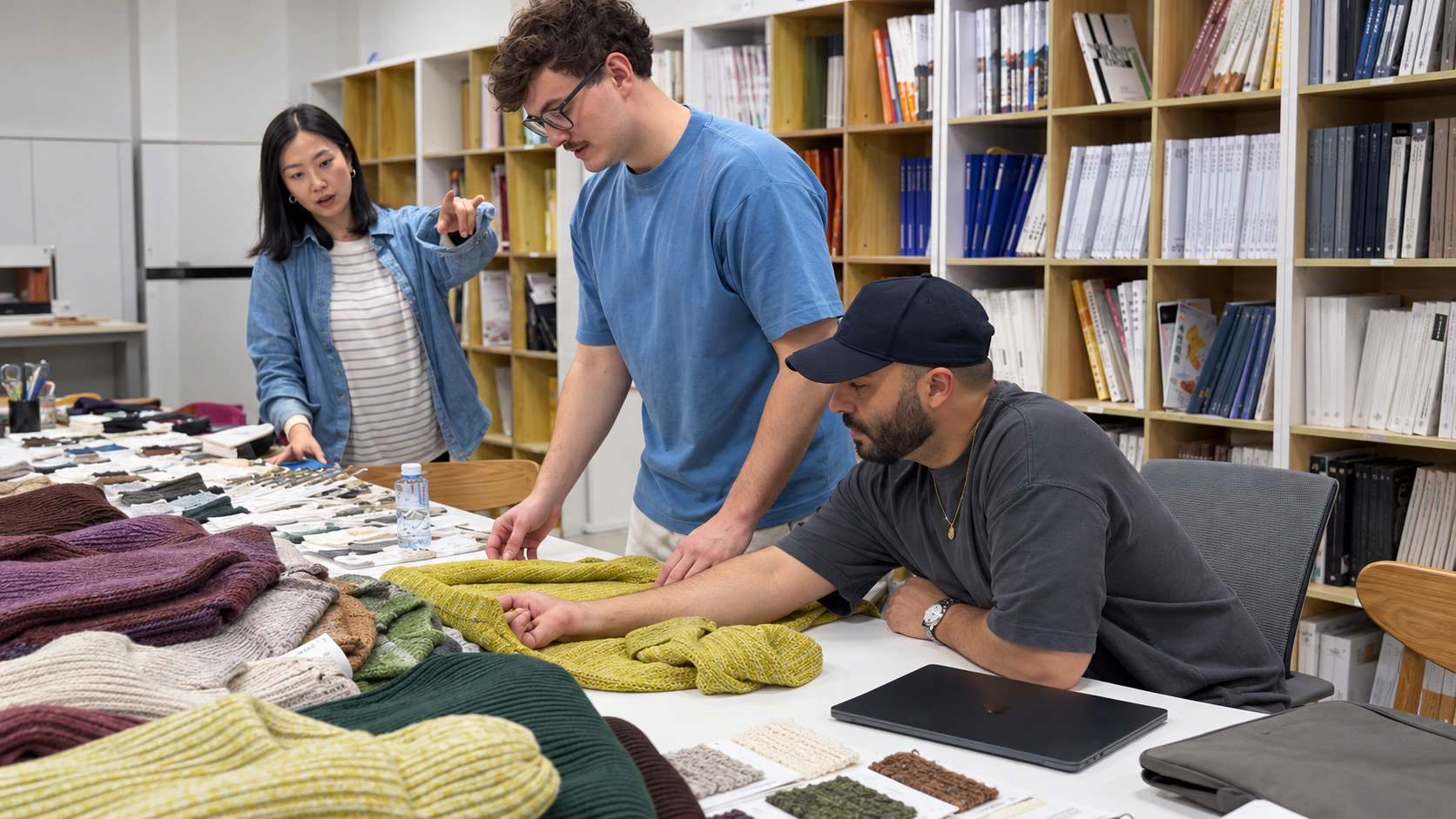
How do you move a high-end knitwear OEM project from a design brief to bulk approval? Resolve missing specifications together, agree what each sample must prove, and return one clear set of comments. Before bulk production, bring the approved garment, technical file, materials and production conditions into agreement. A sample can look right while its yarn, labels or grading remain unresolved; approve each part explicitly.
This guide addresses five problems that can stall development: incomplete information, a mismatch between budget and expectations, repeated sampling, unclear feedback, and labels or packaging that are not ready. It is for brand founders, designers and sourcing teams working through those decisions with a factory.
For the complete sourcing and production journey, start with the China Knitwear OEM & Sweater OEM Guide. Here, the focus is the working agreement behind a premium product: what you want, what is feasible, who supplies it and what must be confirmed next.
Illustrative project throughout: a brand is developing a fully fashioned crew neck sweater. It has a reference garment, a preferred hand feel and a launch window, but some specifications are open. All project details and measurements below are hypothetical teaching examples, not customer results, a quotation or universal acceptance limits.
1. Resolve Incomplete Specifications Before Sampling
A photograph can communicate a silhouette, but it cannot tell the factory the finished weight, stretch, inside construction or feel you expect. A reference garment adds useful evidence, but you still need to say which features to retain and which to change. Do not leave the factory to decide whether the reference represents fit, stitch, colour or the entire product.
You can begin a development discussion without a finished knitwear tech pack. The first task is to identify the gaps and agree who will resolve them. Pattern making, needle drafting and a workable material proposal may require technical input; they should not become invisible assumptions inside an early price estimate.
| Area | Buyer input | Decision to resolve together |
|---|---|---|
| Fit and dimensions | Base size, intended wearer and fit reference; mark what you like or dislike. | Points of measure, measurement method, grade rules and agreed tolerances. |
| Yarn and knitted surface | Reference yarn or garment, composition preference and desired feel or appearance. | Yarn article, count and ply; suitable gauge, structure, density and finished weight target. |
| Shape and details | Front and back views; neckline, rib, cuff, hem and shaping details. | Construction route, panel shaping, linking and any details that need a trial. |
| Colour and finish | Physical colour reference and the intended surface or handle. | Stock or custom colour route; finished swatch and wash/finish direction. |
| Commercial brief | Quantities by style and colour, size allocation, destination and required arrival window. | Feasibility, quotation assumptions, approval deadlines and unresolved commitments. |
Mark every open item as buyer to provide, factory to propose or buyer approval required, with an owner and decision date. A request for “factory recommendation” should result in a proposal for review, not automatic permission to substitute materials.
In our illustrative project, the brand likes the reference sweater’s neckline and shoulder but wants a cleaner surface. It should preserve those approved shape details while evaluating yarn and finish options. Calling the whole garment “the reference” would hide that distinction.
Check the partner before relying on its technical response
Ask the shortlisted factory to explain the open points in your actual brief and show relevant work. If supplier qualification is still unresolved, use the existing knitwear factory evaluation criteria. This article assumes that evaluation is being handled separately; it does not replace it.
For the full submission structure, use the knitwear tech pack and RFQ checklist. Keep the resulting specification under a style number and revision, rather than spreading the final instructions across chat messages.
2. Align the Budget with the Product You Expect
Before asking the factory to reduce a quotation, identify what the price represents. A cheaper offer may use a different yarn, lower weight, simpler structure or excluded testing. It is useful only if the resulting garment still meets your product brief. State whether your target is an ex-factory garment price or a broader delivered cost; compare quotations using the same Incoterm, quantity and inclusions.
Choose the qualities that cannot change: perhaps the neckline and drape, an identifiable stitch texture, or a specific fibre claim. Then ask for alternatives against the remaining variables. Do not require a lower price, the same inputs and an unchanged result without discussing whether that combination is feasible.
| Proposed change | Possible effect | What to approve |
|---|---|---|
| A different yarn or blend | Handle, surface, drape, weight, performance and label information may change. | Finished swatch, revised specification and any affected sample or test. |
| Lower garment weight or a different stitch density | Coverage, stretch, texture, dimensions and recovery can change. | Finished appearance and fit; do not approve weight reduction alone. |
| Simpler construction or fewer details | Less work may change shaping, seam placement or the design identity. | A marked drawing or trial that makes the difference visible. |
| Fewer colours or stock-supported inputs | Material commitments and scheduling may become easier, subject to availability. | Actual shade, lot, quantity basis and commercial conditions. |
For the example sweater, the brand might keep its neckline and proportions fixed while comparing two yarn options. Ask the factory to identify what each finished swatch demonstrates and what remains untested. A softer swatch is not sufficient evidence that the finished sweater will retain its intended shape.
At YouTricot, an order of 50 pieces per style per color is conditional on yarn availability, colour, structure, trims, testing, finishing and the technical route being feasible. Separate yarn or component minimums may still apply. Record these commitments before treating a small garment quantity as the complete cost exposure.
3. Give Each Sample Round a Purpose and a Schedule
Repeated sampling is not always a sign of poor work. A difficult construction may need trials. The problem is a round that starts without a clear question, or a revision that changes yarn, fit and finish together without recording their effects. Before making the next sample, agree what it needs to prove and which earlier approvals remain valid.
| Stage | Main decision | Limit of the approval |
|---|---|---|
| Finished swatch or construction trial | Does the proposed yarn, stitch and finish create a suitable fabric? | It does not prove garment fit, grading or assembly. |
| Prototype or fit sample | Do silhouette, proportions and construction work in the stated size? | Temporary yarn, colour or trims must be disclosed; approval covers only evaluated aspects. |
| Revised sample | Have the numbered comments been resolved without disturbing approved details? | Identify changes that require another measurement, swatch, fit check or test. |
| Pre-production reference | Are the specified materials, finish and details ready to become the bulk standard? | Record exceptions and any size, colour or test approvals still outstanding. |
Why can knitwear sampling take longer than expected?
Separate the time needed to obtain inputs from the time needed to make the garment. A schedule should identify yarn or shade readiness, technical development, knitting and assembly, washing and conditioning, measurement and checks, dispatch, and buyer review. Ask what starts each stage and whether a quoted completion date means sample ready or delivered to your team.
Custom colour work, missing measurements, unavailable trims or a changed finish can move the next stage. When a decision changes, request a revised milestone plan stating what is affected. Courier transit and buyer review should be visible allowances, not hidden inside an unexplained “sampling time”. No single duration applies to every specification.
What happens when a sample needs another revision?
First establish whether the sample missed a documented requirement, the requirement was ambiguous, or the buyer is requesting a new design choice. These situations need different discussions. Compare the sample with the agreed file before deciding who pays for another round or whether the original schedule remains possible. Do not assume every correction is chargeable or every design change is included.
YouTricot uses a symbolic sampling fee, fully deductible from later bulk production orders. Confirm the sample scope, revision arrangements, deduction handling and shipping separately. Deductibility does not mean unlimited development rounds or universally free sampling.
For our example, a request to make the sweater both softer and shorter needs two explicit decisions. If a new finish is proposed, first check its effect on dimensions and surface, then confirm whether the pattern needs changing. Shortening the pattern before that trial could create another avoidable sample round.
4. Give Feedback the Factory Can Act On
Start the review by checking the sample number, technical-pack revision, yarn and any declared substitutions. Evaluate it in the stated finished condition using the agreed measurement method. Where conditioning is needed, agree the handling before comparing dimensions. Photographs help locate an issue, but they do not replace a physical reference for hand feel.
Separate observations from proposed solutions. “The shoulder seam sits too far down on the fit model” describes a fit issue; “reduce shoulder width by 2 cm” prescribes a correction that may also affect the armhole. Explain the intended outcome and ask the technical team to confirm the connected changes before remaking the garment.
| Item | Useful buyer comment | Factory response needed |
|---|---|---|
| Chest measurement | Sample S01, revision B: half chest measures 52 cm; the agreed target is 50 cm. See photo 03 showing the agreed measurement points. | Confirm the measurement and investigate the difference before proposing a correction; check connected dimensions. |
| Surface and hand feel | The surface is hairier than approved swatch W02. Retain the approved neckline and fit. Please assess a cleaner surface against W02. | Compare yarn, density and finishing records. Explain any effect on softness, weight or dimensions. |
| Hem behaviour | The hem lifts during the recorded fitting movement. See video reference V01; do not change body length yet. | Review rib dimensions, structure, recovery and attachment before proposing a trial. |
Keep one comment file and close each item
Have one buyer contact consolidate the team’s comments. Give each item a number, photo reference, priority and status. Include a “keep unchanged” list so the factory does not reinterpret approved parts. The factory’s reply should state the proposed action, anything it cannot achieve, and any cost or timing effect requiring approval.
A useful closing instruction: “Please reply against items 01–03 before starting S02. Keep the approved neckline and sleeve length unchanged. Confirm the proposed yarn and finishing trial, the dimensions to be rechecked and the revised dispatch date. We will approve the next step after reviewing your response.”
If the sample fails, avoid sending only “please improve”. Record which requirement was not met and whether the sample must be remade or a smaller trial can answer the remaining question. Repeated verbal comments without a revised file leave both parties unsure which version is current.
5. Confirm Who Develops and Supplies Labels and Packaging
Can custom knitwear with a private label include every branding component? Only if those services are agreed. Making a garment, developing a woven label, producing a care label and sourcing a packaging bag are separate tasks. A private-label discussion should name the actual work included instead of assuming a complete accessory-development service.
YouTricot’s service boundary: YouTricot does not provide custom development of woven labels, care labels or packaging bags. Arrange responsibility for that development separately. Before ordering these items, confirm sourcing responsibilities and whether buyer-supplied components can be accepted and used for the agreed garment and packing process.
Please agree separately whether procurement, receipt of buyer-supplied items, label attachment and packing are included in your order. Confirm those activities individually before committing to an outside supplier. The brand should also arrange review and approval of its artwork, fibre information, care instructions and destination-specific label content; do not infer the required wording from a reference garment.
| Component | Confirm before ordering | Readiness check |
|---|---|---|
| Woven brand label | Approved artwork, dimensions, fold type, material, colour and placement. | Physical approval where needed; attachment suitability, required quantity and agreed allowance. |
| Care and composition label | Approved content, languages, symbols where applicable, material, size and attachment position. | Content matches the product and intended market; comfort and attachment can be assessed on the relevant sample. |
| Packaging bag | Garment dimensions when folded, bag size, closure, material, artwork and buyer or market requirements. | Check a packed reference for fit and handling; approve artwork and confirm supply arrangements. |
Work backwards from the stage that needs each component. A label sewn into a seam may be needed before assembly; a bag is normally needed for packing, while an earlier sample may be needed to approve its fit. Agree delivery details, identification by style or size, receiving checks and the response to shortages or rejected items.
If the final label is unavailable for a fit sample, record the temporary item and the approval it cannot provide. Do not let a temporary solution become the bulk instruction by default. For our example, fit may be approved while the label remains open; the final construction or packing cannot be treated as approved where the missing component affects it.
6. Close the Open Decisions Before Bulk Production
Knitwear sample approval should connect a physical reference to an executable file. A message saying “looks good” may approve the appearance while leaving yarn, grading or labels unresolved. State what is approved, what remains open, and exactly which work may proceed. Update the quotation and purchase order if the agreed product has changed.
| Decision | Required agreement | Reason to pause |
|---|---|---|
| Product version | Approved sample ID; current tech pack, measurements, grading and construction details. | Sample comments and production instructions conflict. |
| Materials and colours | Yarn article, composition, count, ply, colour and lot controls; permitted substitutions, if any. | A proposed substitute has not been reviewed against affected requirements. |
| Finish and quality | Approved finished appearance, handle reference, measurement method, tolerances and relevant test criteria. | The approved result cannot be connected to a repeatable route or required evidence is missing. |
| Components and packing | Responsibility, approved references, quantities, availability and attachment or packing instructions. | A required label or bag is unapproved, unsuitable or unavailable for its production stage. |
| Commercial scope and release | Current price basis, sample-fee deduction, quantities, schedule, inspection and named approval owners. | Changes have not been reconciled or release responsibilities remain unclear. |
Check fully fashioned construction before repeating a defect
Fully fashioned knitwear uses panels shaped during knitting and then assembled; it does not automatically mean seamless construction. Ask how the factory will control the approved shaping programme and revision, panel dimensions, shaping points and transferred stitches. Check for holes or dropped loops before linking, then review loop pickup, alignment and seam stretch after assembly.
For a premium sweater, evaluate the neckline, shoulder, armhole and hem against the approved reference, not just a general photograph. Measure the assembled garment after the agreed finishing and conditioning. Checks should represent the relevant sizes, colours and lots under the agreed plan. These are proposed controls, not evidence that YouTricot or another factory has passed a specific test.
What if bulk production differs from the approved sample?
Identify and separate affected work before approving a remedy. Record the style, colour, size, yarn lot, finishing batch, quantity known to be affected and what has not yet been checked. Keep approved, affected and unaffected samples available for comparison. Do not assume the whole order is faulty, or that the issue is isolated, before establishing its extent.
If washed dimensions drift, first confirm the measurement method and compare yarn, knitting and finishing records. If hand feel differs by colour, check lot and processing differences before changing the wash recipe. If linking distorts a shaped panel, compare the panel before and after assembly. These observations guide investigation; they do not establish the cause on their own.
Agree a trial correction on a defined quantity and recheck its effects on fit, surface, shade, handle and relevant performance before wider rework. Additional washing or pressing may create new problems. Record the approved disposition, validation result, responsible person and schedule impact. A commercial concession does not override an applicable safety or legal requirement.
Use the seven-step knitwear quality control SOP for the wider inspection workflow. If acceptance sampling is agreed, ISO 2859-1:2026 provides an AQL-indexed framework; the inspection level, defect classifications and acceptance criteria still need to be specified. Sampling does not guarantee a defect-free shipment.
Keep evidence types separate. Process records describe what was controlled; the buyer’s specification defines agreed requirements; supplier certificates support only their valid scope; law sets the applicable obligations. OEKO-TEX Standard 100 concerns harmful-substance testing within its certification scope. The Responsible Wool Standard and Good Cashmere Standard concern their respective wool and cashmere programmes. None automatically certifies YouTricot or every shipment. The EU knitwear compliance and supplier evidence guide covers the broader market-specific review.
Discuss the Decisions Holding Up Your Project
Send the current sketches or tech pack, reference photos or garment details, target hand feel, proposed quantities, budget basis and required delivery window. If a sample already exists, include its version and one consolidated comment file. List unresolved yarn, construction, label and packaging decisions, including the work you need from other suppliers.
YouTricot can discuss the garment-development brief and identify what needs technical review or further confirmation. Agree the support scope, sample deliverables and next decision before committing to another round.
About the Author
Frank, Founder of YouTricot · YouTricot Blog
Frank brings 20 years of knitwear industry and operational experience across Prato, Italy, and Dalang, Dongguan, China.