
Key Takeaways
- A China knitwear manufacturer should be evaluated on technical capability, quality control, communication and commercial flexibility rather than quotation alone. technical knitwear development, broad yarn access, flexible production and export support within one supply chain. A qualified factory can translate a tech pack into pattern making, needle drafting, sampling, knitting, linking, washing, inspection and packing. The sourcing advantage is not simply a lower quotation; it is the ability to coordinate design, material, construction, quality and delivery before bulk production begins. This makes China particularly relevant for custom sweaters, cardigans, private-label collections and technically detailed knitwear for EU and US markets.
- The safest knitwear OEM process uses an approved sample as the production benchmark. Buyers should confirm yarn composition, gauge, stitch structure, measurements, color, labels, packaging and finishing before authorizing bulk production. Quality control should begin during material and sample development rather than relying on a final inspection alone. A clear tech pack, realistic sample comments and documented approvals reduce the risk of inconsistent sizing, unexpected shrinkage, pilling, incorrect labels or differences between the approved sample and the finished shipment.
- China, Europe and Southeast Asia serve different knitwear sourcing priorities. China generally offers an integrated combination of yarn sourcing, computerized flat knitting, finishing and export infrastructure. European production can provide proximity and specialist craftsmanship for European brands, usually with a different cost structure. Southeast Asian capabilities vary significantly by country, production cluster and reliance on imported inputs. Buyers should compare the actual factory, yarn source and order specification rather than selecting a region on headline price alone.
- Low MOQ knitwear can reduce inventory risk, but feasibility depends on yarn, color, gauge, construction and finishing requirements. Stock yarns and common blends are usually easier to accommodate than custom-dyed fibers or complex jacquard, intarsia and finishing programs. Small-batch production is most valuable when a brand wants to test a capsule collection and reorder successful styles later. YouTricot supports custom sweaters, cardigans, cashmere, merino wool, wool blends, silk blends, private-label programs, flexible small batches and sampling-led development for international fashion brands.
What Is China Sweater and Knitwear Custom OEM?
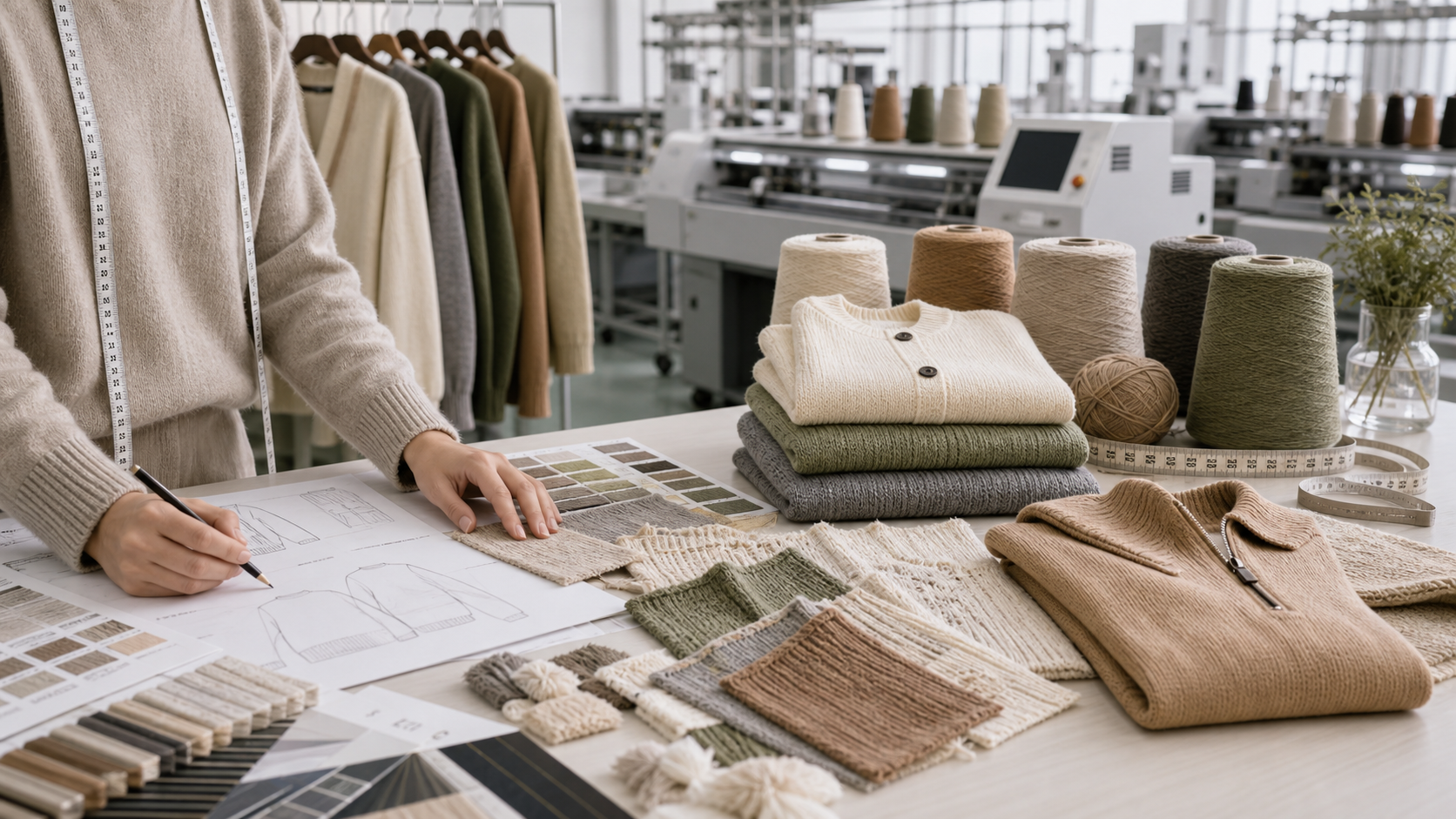
China sweater OEM is a production model in which a factory manufactures knitwear according to a buyer’s design, tech pack, measurements, yarn specifications and branding requirements. The buyer controls the product direction, while the custom knitwear manufacturer handles technical development and production. Depending on the project, factory support may include yarn sourcing, pattern making, needle drafting, gauge selection, sampling, knitting, linking, washing, finishing, inspection and packing. This model helps fashion brands address common sourcing problems before bulk production begins.
- Custom sweater and cardigan development
- Private-label branding and packaging
- Lower or more flexible MOQ
- Clear yarn and gauge recommendations
- Consistent grading and measurements
- Pilling and shrinkage control
- Compliance documentation
- Repeat-order scalability
Related guide: High-End Knitwear OEM from China for European Brands.
How Does the Knitwear OEM Production Process Work?
A professional knitwear OEM project follows a controlled sequence from technical review to final shipment. Each stage should produce a clear approval or production reference before the order advances. The approved sample is especially important because it establishes the expected fit, construction, hand feel and finishing standard for bulk production. Skipping confirmations may save time initially but can create measurement, material or appearance disputes later. The following seven-step workflow applies to most custom sweater, cardigan and private-label knitwear programs.
- Design brief and tech pack review: The buyer provides sketches, reference samples, measurements, size charts, yarn direction, target price and brand requirements.
- Yarn and material selection: The factory recommends suitable fibers according to hand feel, season, retail positioning, MOQ and target market.
- Pattern making and needle drafting: Technicians convert the design into a workable knit structure, including gauge, stitch density, panel shape and construction.
- Sampling: A first sample is produced for evaluation of fit, length, sleeves, neckline, stitch density, yarn feel and finishing.
- Pre-production confirmation: The buyer approves color, sizing, labels, care instructions, packaging and production details.
- Bulk production: The factory completes knitting, linking, washing, finishing, inspection and packing against the approved standard.
- A production workflow does not automatically define when the delivery clock begins. Buyers should separate development, yarn procurement, factory working time, approval holds, inspection and international transit before accepting a shipment date.Read the full guide here : Knitwear Production Lead Time
- Final inspection and shipment: Measurements, appearance, color consistency, labels, packaging and documents are checked before dispatch.
Which Craftsmanship Factors Determine Knitwear Quality?
Knitwear quality depends on the interaction between yarn, gauge, stitch engineering, linking, washing and finishing. Unlike basic cut-and-sew apparel, a sweater’s fabric and garment shape are created together during knitting. An unsuitable gauge, unstable stitch or incorrect machine setting can change garment weight, dimensions, texture and durability. Buyers should therefore evaluate technical development capability, not only the appearance of a showroom sample or the factory’s equipment list.
| Craftsmanship factor | What it controls | What buyers should confirm |
|---|---|---|
| Gauge selection | Weight, texture, density and seasonal suitability | Whether the gauge matches the yarn, stitch and intended silhouette |
| Stitch development | Surface design, elasticity and structural stability | Capability in rib, cable, jacquard, intarsia, pointelle and textured stitches |
| Pattern making | Shape, fit and garment proportions | Measurements, panel construction and size grading |
| Needle drafting | Translation of the design into machine-ready knitting instructions | Stitch placement, shaping and repeat accuracy |
| Linking and seaming | Comfort, durability and seam appearance | Even joining without rough, bulky or distorted seams |
| Washing and finishing | Hand feel, shrinkage, shape and presentation | Approved wash result and dimensional stability |
Coarse gauges generally suit chunky winter knitwear, mid gauges suit commercial sweaters and cardigans, and fine gauges suit lightweight premium styles.
Which Materials Are Used in Custom Knitwear Production?
The best knitwear material is the one that balances hand feel, season, retail price, durability, MOQ and brand positioning. Cashmere and silk blends support luxury collections, while merino wool offers softness and versatility for premium everyday knitwear. Wool and cotton blends can provide more accessible commercial options, and recycled yarns may support sustainability-oriented collections. Acrylic blends are commonly considered for cost-sensitive programs. The final choice must also account for yarn availability, color requirements, gauge and finishing behavior.
| Material | Typical positioning | Main sourcing consideration |
|---|---|---|
| Cashmere | Luxury sweaters and premium cardigans | Fiber quality, softness, pilling and care requirements |
| Merino wool | Premium everyday knitwear | Fiber fineness, comfort, shrinkage and seasonality |
| Wool blends | Classic winter sweaters | Blend ratio, warmth, durability and target price |
| Cotton blends | Breathable basics and transitional styles | Weight, elasticity and dimensional stability |
| Silk blends | Lightweight premium knitwear | Delicacy, drape, gauge and finishing |
| Recycled yarns | Sustainability-focused collections | Fiber documentation, consistency and performance |
| Acrylic blends | Cost-sensitive sweater programs | Hand feel, pilling and market positioning |
Material selection should be completed before sampling because changing the yarn can also change stitch definition, measurements, weight and finishing results.
How Does China Compare with Europe and Southeast Asia?
China usually provides an integrated option for custom knitwear OEM, while Europe emphasizes regional expertise and proximity and Southeast Asian supply-chain structures vary by country. These are general sourcing patterns, not fixed rules for every supplier. Quality, cost, lead time and MOQ depend on the factory, yarn source, production schedule and design complexity. Buyers should request comparable quotations based on the same tech pack and confirm whether yarn procurement, sampling, testing, packaging and shipping are included.
| Factor | China | Europe | Southeast Asia |
|---|---|---|---|
| Quality | Broad range from commercial production to premium computerized flat knitting; results depend on supplier controls | Established specialist and high-end expertise in several regional clusters; results vary by workshop | Capability varies by country, production cluster and product category |
| Cost | Often balances technical capability, material access and production cost | Operating and labor structures commonly produce higher quotations for comparable specifications | Labor may be competitive, while imported yarn or specialist processing can affect total cost |
| Lead time | Can be efficient when yarn, knitting and finishing are available within the local supply chain | Regional proximity may reduce transport time for European buyers; production remains capacity-dependent | Timing may increase when yarn, trims or specialist finishing must come from another market |
| MOQ | Flexible options may be available with stock yarns, common colors and suitable constructions | Some specialist workshops accept small runs, usually with a higher unit cost | Policies vary; some suppliers are configured for larger-volume apparel programs |
Regional sourcing note: The WTO reports high domestic value-added content in China’s textile and clothing exports and greater reliance on foreign inputs in several Southeast Asian exporting economies. The European Commission describes Europe’s textile ecosystem as highly SME-based, while the ASEAN Investment Report documents differences in upstream and downstream integration across ASEAN apparel supply chains. These sources provide regional context; an individual factory must still be evaluated on its own capability.
- WTO Textiles and Clothing Sectoral Profile
- European Commission: Textiles Industrial Ecosystem
- ASEAN Investment Report 2025
What Should a Knitwear Quality-Control Checklist Include?
A knitwear quality-control checklist should cover materials, construction, measurements, performance, labeling, packaging and market compliance before shipment. Quality control must begin before bulk production because a final inspection cannot fully correct an unsuitable yarn, unstable stitch structure or incorrect approved specification. EU and US buyers should define tolerances and testing needs early, then use the approved sample and confirmed documentation as references throughout production.
Pre-Production and Bulk-Order Checklist
- ☐ Confirm yarn composition and supplier information.
- ☐ Approve yarn color and expected color consistency.
- ☐ Confirm gauge, stitch density and construction.
- ☐ Define garment measurements and size tolerances.
- ☐ Review shrinkage after washing and finishing.
- ☐ Evaluate pilling performance where required.
- ☐ Confirm color-fastness requirements.
- ☐ Approve labels, fiber content and care instructions.
- ☐ Confirm trims, packaging and carton requirements.
- ☐ Identify restricted-substance requirements.
- ☐ Confirm testing or certification needs.
- ☐ Compare bulk production with the approved sample.
- ☐ Check final appearance, measurements and packing.
- ☐ Verify export and shipment documentation.
OEKO-TEX® STANDARD 100 addresses testing for harmful substances. EU buyers can consult the EU Strategy for Sustainable and Circular Textiles, while US buyers can review the FTC Clothing and Textiles guidance.
Why Do EU and US Brands Source Knitwear from China?
EU and US brands source knitwear from China because its mature manufacturing base can combine yarn procurement, technical knitting, finishing, inspection, packaging and export support. This integration is particularly useful for brands developing custom sweaters, private-label knitwear, cashmere, merino wool, wool blends or seasonal capsule collections. China can also support brands moving away from large inventory commitments through small-batch development and repeat orders after market testing, subject to factory and material feasibility.
- Custom sweater and cardigan development
- Private-label collections
- Low MOQ knitwear using feasible yarn programs
- Sampling-led product development
- Cashmere and wool-blend styles
- Seasonal capsule collections
- Repeat orders after demand testing
- Coordinated cost and quality control
Related guide: Small-Batch Knitwear OEM in China.
How Can Buyers Reduce China Knitwear OEM Risk?
Buyers reduce sourcing risk by evaluating technical capability, commercial terms and communication before placing a bulk order. A China knitwear manufacturer should be evaluated on technical capability, quality control, communication and commercial flexibility rather than quotation alone.The most reliable selection process uses a clear tech pack, supplier questions, sample evaluation and written approvals to test whether the factory can move consistently from design to production.
-
- Confirm MOQ rules by style, color, size and yarn.
- Request a realistic sampling schedule based on material availability.
- Evaluate yarn recommendations against price and market positioning.
- Confirm pattern-making and needle-drafting capability.
- Approve a complete sample before bulk production.
- Define measurements, tolerances and finishing standards.
- Review quality-control stages and inspection records.
- Confirm export-document and packaging support.
- Test the supplier’s ability to communicate clearly in English.
- Ask for relevant experience with EU or US buyers.
Practical example: Custom Knitwear Manufacturer Case Study.
Buyers preparing a factory shortlist should compare MOQ conditions, gauge coverage, production capability, certification evidence and quotation scope—not price alone.
Read the full guide here : Top Knitwear Manufacturers in China
FAQ: China Sweater OEM and Knitwear OEM
The following answers address common buyer questions about factory selection, sampling, MOQ, pricing and RFQ preparation. Because factories, yarns and designs differ, buyers should treat every quotation and production schedule as project-specific. The most reliable assessment comes after the supplier has reviewed the tech pack, yarn direction, color requirements, size range, construction, finishing and target delivery date.
What is the difference between sweater OEM and knitwear OEM?
Sweater OEM mainly refers to the development and production of sweaters, pullovers and cardigans. Knitwear OEM is a broader category that may also include knitted tops, hoodies, dresses, skirts, scarves and other knitted garments. Both models normally begin with a buyer-controlled design or tech pack. The manufacturer then supports technical interpretation, yarn selection, pattern making, needle drafting, sampling, knitting, assembly, finishing and packing. Buyers should use “knitwear OEM” when discussing a multi-category knitted collection and “sweater OEM” when the requirement is limited primarily to sweaters and cardigans.
Can China knitwear OEM factories support low MOQ orders?
Some China knitwear OEM factories support low MOQ orders, but the feasible quantity depends on yarn, color, gauge, design complexity and finishing requirements. Stock yarns, standard colors and common blends are generally easier to arrange in small batches. Custom-dyed yarn, uncommon fibers, elaborate jacquard or intarsia patterns and special washing may require larger commitments or higher unit costs. Buyers should ask whether the MOQ applies per style, color or total order. Small-batch production works best when the first order tests demand and successful styles can be reordered later.
How long does sweater sampling usually take?
Sweater sampling time depends on yarn availability, pattern making, needle drafting, stitch complexity, trims, washing, finishing and the number of revision rounds. A clear tech pack and confirmed yarn direction help prevent avoidable delays because the technical team can evaluate the design before programming and knitting begin. Simple styles using available yarn may progress faster than cashmere blends, jacquard, intarsia, textured stitches or special finishing. Buyers should request a project-specific schedule and distinguish the first-sample date from the time needed for comments, revisions and final approval.
How much does China sweater OEM production cost?
China sweater OEM cost is determined by yarn type, yarn consumption, gauge, stitch complexity, MOQ, trims, linking, washing, finishing, testing, packaging and commercial terms. Cashmere and technically complex jacquard styles usually cost more than common wool blends, cotton blends or programs using available stock yarn. Buyers should send the same tech pack, measurements, material specification and packaging requirements to every shortlisted factory. They should also confirm whether the offer covers sampling, labels, testing, export packing and the selected trade term instead of comparing unit prices without matching scope.
How should buyers compare knitwear factory quotations?
Buyers should compare quotations only after confirming that every supplier has priced the same yarn composition, yarn count, gauge, stitch structure, measurements, size range, color quantity, trims, finishing, packaging and trade term. A lower unit price may exclude testing, labels, special washing, export cartons or delivery to the agreed port. Ask each factory to identify assumptions, exclusions, MOQ by color and any price change between the trial order and a repeat order. A comparison table with identical specifications is more reliable than selecting the lowest headline figure.
What information should a brand include in a knitwear RFQ?
A useful knitwear RFQ should include the tech pack, front and back sketches, measurements, size chart, yarn composition, target hand feel, color references, gauge or garment-weight direction, stitch details, trims, labels, packaging, order quantity, target price and required delivery date. Reference samples or close-up construction photographs can clarify difficult details. The buyer should also state the destination market and any testing or certification needs. Complete information allows the factory to identify technical risks and produce a more accurate quotation, MOQ assessment and sampling schedule.
What should EU and US brands check before bulk production?
EU and US brands should confirm fiber content, care labeling, measurements, size tolerances, shrinkage, pilling, color fastness, packaging, testing requirements and import documentation before bulk production. Requirements should be written into the order specification and aligned with the approved sample. EU buyers may also need to consider restricted substances, durability, product responsibility and sustainability documentation. US buyers should pay particular attention to fiber-content disclosure, care instructions and product labeling. The importing brand should verify the rules that apply to its product and destination market.
Request a Technical Knitwear Feasibility Review
If your brand is dealing with high minimum orders, slow sampling, unclear yarn choices, inconsistent quality or EU and US compliance concerns, begin with a technical feasibility review. The review can assess yarn availability, gauge selection, stitch construction, sample requirements, finishing risks, suitable production quantities and the information still needed before sampling.
Prepare the following information for a more useful assessment:
- Tech pack or design sketches
- Reference sample or construction photographs
- Preferred yarn composition and hand feel
- Size chart and target measurements
- Expected quantity by style and color
- Target market, price positioning and delivery date
Request a Technical Knitwear Feasibility Review
Should Your Brand Choose OEM or ODM?
Compare OEM vs ODM knitwear by design capability, launch timeline, development budget and IP control.