

Published: August 25, 2026 | Updated: August 25, 2026 | Reviewed by: Frank, Founder of YouTricot
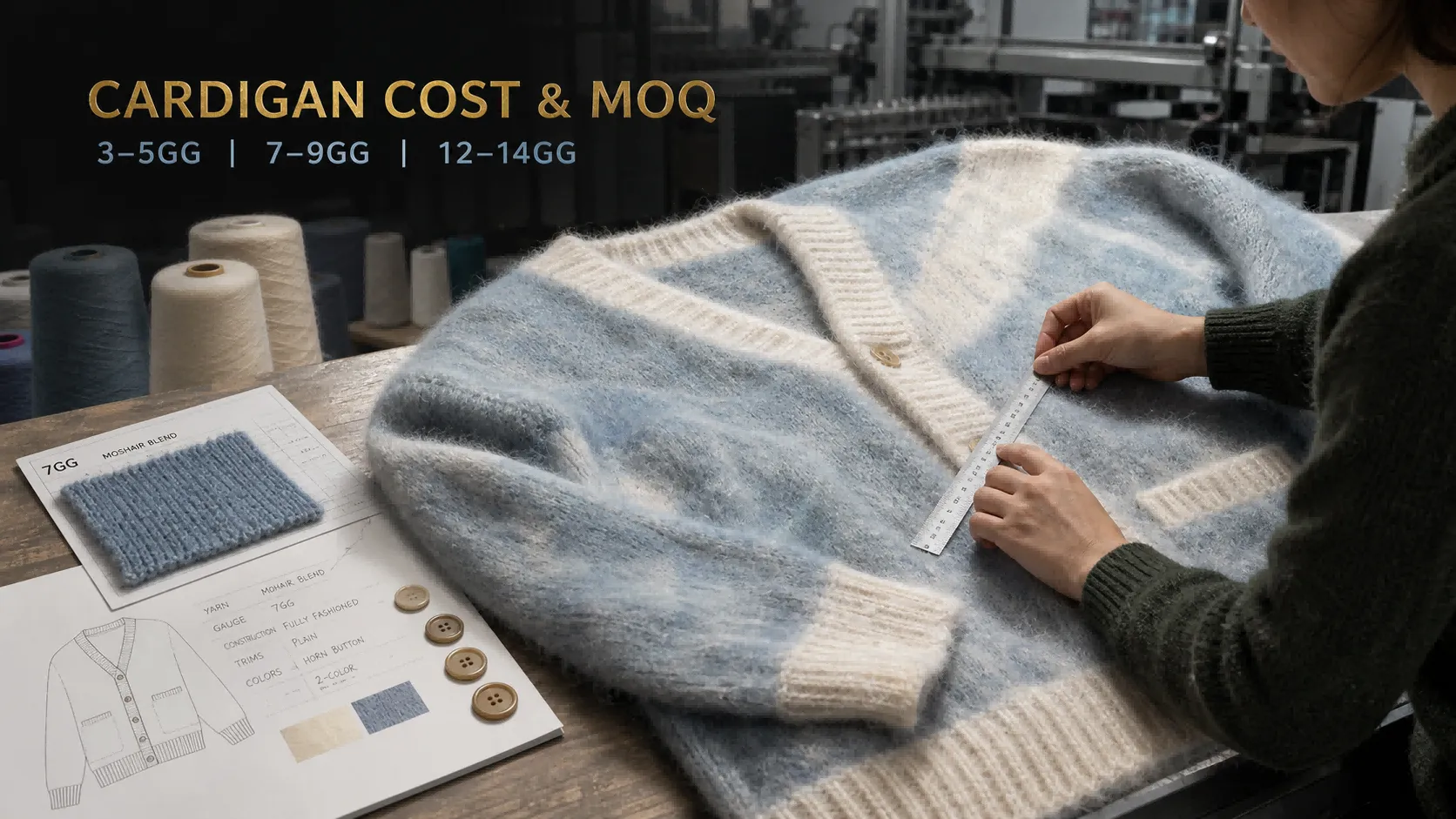
Quick answer: The cost and MOQ of a custom knit cardigan are driven mainly by yarn type and consumption, knitting gauge, construction method, trims, and color or artwork complexity. A sketch alone cannot establish these variables. Before quoting, a buyer should define the target gauge, yarn composition and count, fully fashioned or cut-and-sew construction, placket width and attachment, button and buttonhole specifications, rib structure, colors, sizes, and testing requirements. This guide gives fashion buyers, product developers, and sourcing managers a quote-ready framework that reduces assumptions, repeated sampling, and component-driven MOQ surprises.
MOQ condition: YouTricot can consider orders from 50 pieces per style per colour only when the yarn, colour, structure, trims, testing, finishing and technical route are feasible. This is a conditional garment starting point, not a promise for every design; upstream material and component minimums must be confirmed in the quotation.
Key Takeaways
A reliable cardigan quotation is built from linked technical decisions, not from a front-and-back sketch. The three takeaways below explain how yarn, gauge, construction, trims, and specification quality change consumption, programming, labor, sampling risk, and supplier minimums. Use them as a practical pre-RFQ decision check for design and sourcing teams before asking a custom cardigan manufacturer for a firm unit price or MOQ, especially when the style includes premium yarn, custom hardware, several colors, or engineered artwork.
1Cardigan cost and MOQ are controlled by different but connected inputs.
Yarn type and actual consumption usually create the largest direct cost, while custom colors, buttons, metal button plating, labels, and packaging can create MOQ pressure through outside suppliers. Gauge, stitch density, and construction determine machine time, linking or sewing labor, and garment weight. Intarsia, multiple colors, brushing, and plated knitting with multiple yarns add programming, handling, and inspection. A lower-MOQ program is most practical when the buyer approves available yarn colors, standard trims, a focused size-and-color assortment, and a construction that can be repeated without new tooling for every variation.
2Gauge, yarn, and construction must be approved as one system.
Use 3–5GG as a starting band for chunky cardigans, 7–9GG for classic mid-weight styles, and 12–14GG for fine cardigans, but never select gauge independently from yarn count, number of ends, stitch structure, density, and finishing. Fully fashioned shaping can reduce cutting waste and create cleaner knitted edges, yet it may require more programming and linking. Cut-and-sew can simplify some silhouettes but introduces offcuts and seam allowances. The manufacturer should confirm the proposed route with a knitted swatch, seam trial, post-wash measurements, and an updated consumption calculation.
3A measurable cardigan specification is the fastest route to a comparable quote.
Define finished placket width, buttonhole construction and orientation, button diameter and attachment, rib type and depth, band attachment, measurements, grading, colors, artwork, labels, packaging, testing, and order breakdown. Replace vague phrases such as “premium,” “soft,” or “slightly chunky” with measurable targets or an approved physical reference. Mark undecided fields as open to factory recommendation. The first sample should verify fit, hand-feel, weight, shrinkage, buttoning behavior, seam bulk, rib recovery, and color appearance before trims and yarn are committed for bulk production.
Table of Contents
- How should gauge and yarn be matched?
- Fully fashioned vs cut-and-sew
- Cardigan technical specification table
- Factory reality: why machine route matters
- Design-choice-to-cost-impact matrix
- How design choices affect MOQ
- Cost drivers ranked highest to lowest
- Questions to ask before quoting
- Testing, limitations, and quote conditions
- Frequently asked questions
Read the full guide here :
China Sweater OEM & Knitwear OEM Guide 2026
How Should Gauge and Yarn Be Matched for a Cardigan?
Machine gauge generally refers to the number of needles per inch across the needle bed. Use 3–5GG as a starting band for chunky cardigans, 7–9GG for classic mid-weight cardigans, and 12–14GG for fine styles, then validate the choice against yarn count, number of ends, fiber behavior, stitch structure, opacity, weight, and post-wash density. Gauge alone does not guarantee thickness or quality: two 12GG cardigans can have different weights and stability. Request a swatch recording the proposed yarn, stitch, tension, finished courses and wales per measured area, wash method, and dimensional change.
| Gauge Band | Typical Cardigan Direction | Yarn Compatibility Questions | Cost and Risk Notes | Approval Evidence |
|---|---|---|---|---|
| 3–5GG | Chunky, tactile, oversized, cable, or winter statement cardigan. | Is the yarn thick enough, or will multiple ends be knitted together? Can the fiber tolerate the intended abrasion and finishing? | Machine knitting can be relatively open, but yarn consumption, thick linking, and seam bulk may be high. | Full-size stitch swatch, seam trial, finished weight, and button-placket stability check. |
| 7–9GG | Classic commercial cardigan, versatile layering weight, balanced texture and drape. | Does yarn count support the required cover, recovery, and rib tension without excessive ends? | Often commercially flexible, but complex cables, intarsia, or double structures still add machine time. | Washed swatch, density record, recovery check, and placket hang test. |
| 12–14GG | Fine-gauge cardigan, lightweight premium layer, smooth business or womenswear style. | Is the yarn sufficiently fine, even, and strong for the needle setup? Will the selected blend snag or distort? | Fine needles and higher stitch counts can increase knitting time and sensitivity to yarn consistency. | Close-up surface review, dimensional-change test, snag assessment where relevant, and linked-seam sample. |
Real limitation: the 3–5GG, 7–9GG, and 12–14GG ranges are development starting points, not universal yarn rules. Machine model, needle bed, yarn count system, number of ends, twist, hairiness, stitch structure, take-down tension, washing, and finishing can change the workable combination. The manufacturer should confirm feasibility by swatch rather than accepting a gauge solely because it appears in a sketch.
Read the full guide here :
Knitwear Yarn OEM Guide for Custom Production
Fully Fashioned vs Cut-and-Sew: Which Construction Changes Cost More?
Fully fashioned construction usually reduces cutting waste because panels are shaped during knitting, while cut-and-sew normally creates more offcuts because knitted fabric or broad panels are cut to pattern. Fully fashioned work can require more needle drafting, transfer programming, machine time, and skilled linking; cut-and-sew may suit loose, simple, or fabric-like silhouettes. Fully fashioned is not the same as seamless whole-garment knitting: a fully fashioned cardigan can still consist of separately knitted panels joined by linking. The lowest-cost route depends on yarn value, shape complexity, seam appearance, quantity, and required repeatability.
| Decision Area | Fully Fashioned Cardigan | Cut-and-Sew Cardigan | Quotation Consequence |
|---|---|---|---|
| Panel creation | Panels are shaped during knitting with programmed increases, decreases, transfers, or holding. | Knitted fabric or broad panels are cut to paper-pattern shapes. | Fully fashioned shifts cost toward programming and machine time; cut-and-sew shifts cost toward cutting and sewing. |
| Material waste | Usually lower cutting waste, but yarn ends, setup, rejected panels, and finishing loss still exist. | Usually higher cutting waste because pattern pieces leave offcuts. | High-value yarn makes cutting yield more commercially important. |
| Seams and hand-feel | Linked seams can be flatter and visually consistent with knitted edges when executed well. | Sewn seams include seam allowances and may feel more substantial or rigid. | Seam method, yarn bulk, reinforcement, and target comfort affect labor and approval. |
| Design flexibility | Strong for knit-engineered shaping, fashion marks, and repeatable panel geometry. | Useful for some fabric-like silhouettes, unusual cut lines, or fast pattern alterations. | Complex curves or frequent size changes may favor one route depending on programming and pattern setup. |
| MOQ behavior | Programming cost and machine scheduling must be spread across the order. | Marker efficiency, fabric minimums, and sewing setup affect the viable run. | Neither route guarantees a lower MOQ without evaluating the complete style. |
What Belongs in a Cardigan Technical Specification Table?
A quote-ready knitwear tech pack should convert every visible cardigan feature into a measurable construction instruction. At minimum, record gauge, yarn, body construction, stitch density, placket width, buttonhole type and orientation, button material and size, rib structure and depth, band attachment, measurements, colors, artwork, labels, finishing, and test requirements. Include a reference image or drawing for each unusual detail and state which fields are fixed versus open to factory recommendation. This prevents the manufacturer from pricing one interpretation while the buyer expects another, which is a common source of repeat sampling, revised consumption, and late MOQ increases.
| Specification Field | Buyer Must Record | Why It Matters to Cost or MOQ | Approval Evidence |
|---|---|---|---|
| Gauge and machine route | Target GG, acceptable alternative, and whether the value is mandatory or subject to swatch approval. | Determines yarn compatibility, needle setup, knitting time, density, and machine allocation. | Machine record plus approved washed swatch. |
| Yarn specification | Fiber percentages, yarn count and system, ply or ends, supplier/reference, color code, hand-feel, and certification need. | Controls raw-material cost, consumption, dye-lot minimum, lead time, and testing. | Yarn card, lab dip, supplier documents, and swatch. |
| Body construction | Fully fashioned, cut-and-sew, whole-garment where applicable, panel map, seams, and reinforcement points. | Changes programming, waste, linking, sewing, machine time, and seam appearance. | Construction sketch and inside-out sample photos. |
| Placket | Finished width, total length, overlap, stitch structure, edge finish, roll control, and top/bottom termination. | Changes yarn consumption, button placement, stability, knitting operations, and finishing. | Dimensioned front drawing and sample measurement. |
| Buttonholes | Quantity, orientation, finished opening, spacing, position from edge, knitted-in or finished method, reinforcement, and tolerance. | Affects programming or sewing labor, appearance, durability, and sample revisions. | Buttoning trial using the production button. |
| Buttons | Material, diameter, thickness, two-hole/four-hole/shank, logo, color, metal finish or button plating, sew thread, attachment method, and spares. | Custom molds, logos, metal button plating, and special materials can create separate trim MOQ and lead time. | Approved physical trim, artwork, finish standard, and attachment pull requirement if specified. |
| Ribbing | 1×1, 2×2, Milano or other structure; gauge relationship; relaxed width; finished depth; tension; and recovery target. | Rib take-up changes yarn consumption, dimensions, stretch, machine setup, and placket balance. | Washed rib swatch and recovery/measurement check. |
| Band attachment | Integral knit-on band, separately knitted and linked band, sewn-on band, tubular finish, seam allowance, and reinforcement. | Changes panel programming, linking or sewing labor, seam bulk, and repairability. | Inside and outside construction photos plus approved sample. |
| Artwork and colors | Solid, stripe, intarsia, jacquard, embroidery, placement map, repeat, color key, and size scaling rule. | Controls carriers/feeders, programming, yarn allocation, matching, machine time, and defects. | Production artwork, color standard, and placement measurement. |
| Measurements and grading | Base size, points of measure, tolerance, size range, grading increments, and measurement method. | Missing grading rules can trigger new patterns, samples, and consumption calculations. | Signed size chart and post-wash garment measurements. |
| Finishing and testing | Wash, fulling, brushing, pressing, care route, dimensional-change, pilling, colorfastness, chemical, and buyer-specific tests. | Adds process trials, laboratory cost, lead time, and possible material restrictions. | Approved finish standard, test protocol, and report where required. |
| Labels and packaging | Brand label, care label, country-of-origin information, hangtag, spare button, folding, bag, barcode, and carton marks. | Each custom component may carry its own minimum and proofing cost. | Approved artwork, physical proofs, and packing sample. |
Illustrative example only: the values below show how a buyer can turn a sketch into quoteable fields. They are not universal production recommendations and must be confirmed by swatch, sample, yarn availability, and the manufacturer’s machine route.
| Field | Illustrative Buyer Entry | Factory Confirmation Required |
|---|---|---|
| Gauge | Target 7GG; 9GG alternative acceptable only if the approved hand-feel and weight are maintained. | Machine route, stitch density, yarn compatibility, and post-wash swatch. |
| Yarn | 100% superfine merino wool; stock color preferred; target hand-feel matched to the supplied reference. | Available yarn count, number of ends, dye lot, consumption, and required documents. |
| Construction | Fully fashioned front, back, and sleeves with linked seams; not seamless whole-garment construction. | Fashion marks, panel map, seam type, reinforcement, and size grading. |
| Placket | 32 mm finished width, separately knitted and linked, with controlled edge roll. | Stitch structure, tension, overlap, top/bottom termination, and wash stability. |
| Buttons and buttonholes | Six 20 mm four-hole stock buttons; horizontal knitted-in buttonholes; one spare button per garment. | Opening size, spacing, attachment thread, pull requirement, stock availability, and trim minimum. |
| Ribbing | 1×1 rib; same yarn family; 55 mm cuff depth and 60 mm hem depth after finishing. | Gauge relationship, relaxed width, take-up, recovery, and body-to-rib attachment. |
| Range and quantity | Two stock colors, four sizes, with quantity stated by color and size in the RFQ. | MOQ basis by style, color, dye lot, trim, and total program. |
| Approval and testing | Washed stitch swatch, first fit sample, size set where required, dimensional-change and pilling plan, approved trim card. | Test method, pass criteria, tolerances, sample sequence, lead time, and exclusions. |
Why Does the Factory’s Machine Route Matter Before Quoting?
A quote should match a real machine route, not a generic claim that the factory can make every gauge. YouTricot uses computerized flat knitting technology and added 80 Stoll machines in May 2026—50 in 12 gauge and 30 in 7 gauge—so a proposed cardigan should be assigned to the gauge, yarn, stitch program, and linking route that can reproduce the approved sample. This does not make every 7GG or 12GG design automatically feasible. Intarsia carriers, transfer operations, needle condition, yarn consistency, panel width, finishing, and available scheduling still affect capacity, cost, and MOQ.
Read the full guide here :
High-End Knitwear OEM Production Upgrade
How Does Each Design Choice Affect Cardigan Cost, MOQ, and Sampling?
The most expensive design choice is not always the one with the highest MOQ pressure. Premium yarn usually has high unit-cost impact, while a custom button may have modest garment cost but high trim MOQ. Intarsia adds programming and machine time, while keeping the colour areas within the knitted panel, whereas multiple yarn blends can raise both sourcing and tension-control complexity. Use the matrix below to separate unit-cost impact from MOQ pressure and sampling risk. The ratings are directional for a typical custom program; a manufacturer must recalculate them after reviewing yarn availability, artwork, measurements, order breakdown, and finishing.
| Design Choice | Unit-Cost Impact | MOQ Pressure | Sampling Risk | Best Buyer Action | Quotation Confirmation |
|---|---|---|---|---|---|
| Premium cashmere or high-value natural fiber | High | Medium–High | High | Approve supplier, yarn count, color route, consumption target, and post-wash hand-feel. | Approved yarn reference, availability and consumption basis; fibre price alone does not set MOQ. |
| Custom-spun proprietary yarn blend | High | High | High | Confirm the spinning-mill minimum, blend tolerances, yarn lead time, and allocation across styles. | Mill batch minimum and allocation agreed before garment MOQ is confirmed. |
| Plated knitting with stock yarns | Medium | Low–Medium | Medium–High | Confirm stock continuity, number of yarn ends, feeder plan, tension, and the approved washed swatch. | Stock quantities by colour and yarn end, feeder trial and washed swatch. |
| 3–5GG chunky body | Medium–High | Medium | Medium | Check consumption, seam bulk, weight, and button support. | Consumption estimate, seam trial and feasible knitting slot. |
| 12–14GG fine-gauge body | Medium–High | Medium | High | Confirm yarn evenness, machine feasibility, density, snag risk, and dimensional stability. | Yarn specification, washed density and machine-route approval. |
| Fully fashioned shaping | Medium–High | Medium | Medium–High | Freeze the block, fashion marks, seam method, and size grading before bulk programming. | Approved block, grading and linking method; setup cost allocated to the order. |
| Cut-and-sew construction | Medium | Medium | Medium | Approve marker/yield assumptions, seam allowance, edge stabilization, and inside finish. | Cutting yield, fabric or panel minimum and approved seam sample. |
| Intarsia panel with several colors | High | Medium–High | High | Supply final vector artwork, color key, scale, placement, and back-side appearance requirement. | Programmed swatch, colour allocation and knitting-time estimate. |
| Custom logo button mold | Medium | High | Medium | Ask for mold ownership, supplier minimum, overrun, lead time, and reorder terms. | Written tooling charge, supplier batch minimum and excess-button handling. |
| Special metal button plating | Medium | High | High | Approve a physical finish standard and confirm chemical or market restrictions before ordering. | Approved finish, batch minimum and applicable component test requirements. |
| Separate linked placket and rib bands | Medium | Low–Medium | Medium–High | Approve band tension, seam bulk, edge roll, and wash behavior. | Washed band dimensions, recovery and attachment trial. |
How to use the matrix: High, Medium and Low are directional development judgments, not measured price bands or fixed MOQ multipliers. Confirm a priced specification, supplier minimums and sample evidence for the actual style. Compare quotations on the same style–colour quantities, size ratio, yarn, consumption basis, construction, finish, tests, packaging and delivery term.
Which Cardigan Design Choices Increase MOQ?
MOQ increases when the garment depends on inputs or setups with their own economic minimum. Custom buttons may require a mold and supplier batch; metal button plating may require a minimum finishing lot; and intarsia adds programming, color carriers, and slower output. A custom-spun proprietary blend is constrained by the spinning mill’s batch minimum, while plated knitting with stock yarns is more often constrained by separate cone quantities, color availability, feeder setup, and tension trials. To protect a low-MOQ cardigan launch, use available yarns, one shared button, limited colors, a stable base block, and artwork that can run across sizes without repeated engineering.
MOQ means minimum order quantity. For a cardigan RFQ, separate the garment minimum for each style–colour combination from yarn, dye-lot, trim, packaging, testing and finishing minimums. A sweater factory MOQ in China is not a national standard: it depends on the selected inputs and production route. For YouTricot, the conditional starting point is 50 pieces per style per colour, subject to feasibility of the yarn, colour, structure, trims, testing, finishing and technical route. Confirm the size allocation and any higher supplier minimums in writing before committing to the assortment.
| MOQ Trigger | Where the Minimum Comes From | Lower-MOQ Alternative | Trade-Off |
|---|---|---|---|
| Custom logo button | Tooling, mold, color batching, polishing, or button supplier run. | Stock button plus branded hangtag or shared button across the collection. | Less exclusive hardware. |
| Special metal button plating | Plating batch, finish setup, compliance documentation, and reject allowance. | Approved stock finish from an established trim supplier. | Narrower finish choice. |
| Intarsia panels | Programming, carriers, slower knitting, yarn allocation, and panel matching. | Reduce colors, simplify artwork, or use a placement technique only if hand-feel and durability remain acceptable. | Different reverse appearance or design character. |
| Custom-spun proprietary blend | Spinning-mill batch minimum, blend setup, custom color, and allocation across the order. | Use an available stock blend with a similar approved hand-feel. | Composition, hand-feel, and color may change. |
| Plated knitting with stock yarns | Separate cone quantities, stock continuity, feeder setup, color allocation, and tension trials. | Use fewer yarn ends or one available blended yarn. | Surface effect, color interaction, and hand-feel may change. |
| Many colorways | Separate dye lots, cone allocation, color matching, setup, and packing splits. | Launch fewer colors and add successful colors in a repeat order. | Smaller initial assortment. |
| Unique trim for every color | Each trim color or finish is purchased as a separate SKU. | Choose one neutral trim that works across the palette. | Less color-specific detailing. |
Cardigan Cost Drivers Ranked From Highest to Lowest Impact
For a typical custom cardigan program, this knitwear manufacturing cost breakdown places yarn type and actual consumption first, followed by knitting and construction time. Gauge and density, artwork complexity, trims, finishing, development, and packaging generally follow. This is a directional ranking, not a fixed percentage formula. A metal-logo-button program can move trims higher; a simple cashmere cardigan can make yarn overwhelmingly dominant; and a low-value yarn with difficult intarsia may make machine time the larger driver. Ask the manufacturer to show which assumptions were used for consumption, construction, trim sourcing, testing, and order breakdown so competing quotes remain comparable.
- Yarn type, yarn price, and net consumption. Fiber composition, yarn count, number of ends, garment dimensions, stitch density, waste allowance, washing loss, and rejected-panel allowance determine the true material cost.
- Knitting and construction time. Fully fashioned shaping, transfers, cables, double structures, linked seams, cut-and-sew operations, and slow-running patterns increase machine or labor minutes.
- Gauge, density, and garment weight. Fine gauge can create many stitches and demand consistent yarn; chunky gauge can consume substantial yarn and create heavy seams. Cost does not rise in a straight line with gauge number.
- Artwork, color count, and pattern engineering. Intarsia, jacquard, engineered stripes, placement graphics, matching across seams, and size scaling require programming, setup, and closer inspection.
- Buttons, placket details, and other trims. Stock trims are usually manageable; custom molds, engraving, unusual materials, special metal button plating, multiple sizes, and compliance tests can quickly change the trim budget.
- Washing, brushing, fulling, pressing, and special finishes. More trials and handling increase cost, while unstable treatments can raise rejection and dimensional risk.
- Development, testing, labels, and order fragmentation. New blocks, repeated revisions, size sets, performance tests, custom packaging, many sizes, and small quantities per color add cost or reduce operational efficiency.
What Should Every Buyer Ask a Custom Cardigan Manufacturer Before Quoting?
Ask questions that reveal the manufacturer’s technical assumptions, external supplier dependencies, and approval process. The factory should explain the proposed gauge and yarn route, construction, consumption basis, trim minimums, sample stages, tolerances, tests, and what is excluded from the quote. Avoid relying on a single unit price without knowing whether yarn, buttons, labels, packaging, testing, freight, duties, or revisions are included. Also ask how changes after sampling will be repriced. A useful answer should connect each cost or MOQ condition to a specific material, machine, process, supplier, or order split rather than using a generic “complex design” surcharge.
- ✓ Which gauge do you recommend for this yarn, stitch, weight, and hand-feel, and what swatch evidence supports it?
- ✓ What yarn specification, number of ends, density, consumption, and waste allowance are included in the quote?
- ✓ Is the cardigan fully fashioned, cut-and-sew, or another route, and how will each panel and seam be made?
- ✓ How will the placket and rib be knitted, attached, measured, and controlled for recovery after washing?
- ✓ What button and buttonhole specifications are proposed, and what trim MOQ, tooling, metal button plating, lead-time, and reorder conditions apply?
- ✓ How do intarsia, jacquard, stripes, plated knitting, or custom yarn blends change programming time, production speed, and MOQ?
- ✓ Is MOQ calculated per style, color, yarn dye lot, trim, or total program, and what changes trigger repricing?
- ✓ Which sample stages are included, how many revisions are allowed, and which changes trigger a new charge?
- ✓ Which measurements, tolerances, dimensional-change, pilling, colorfastness, trim, and buyer-specific tests will be used?
- ✓ Which labels, packaging, testing, freight, duties, and development costs are included or excluded from the quote?
- ✓ Can the same yarn, block, placket construction, or trim be shared across styles to reduce setup and MOQ pressure?
- ✓ What approval documents will be signed before bulk production: yarn card, lab dip, trim card, size set, pre-production sample, and packing sample?
What Testing and Limitations Should Be Confirmed Before Bulk Production?
No gauge band, construction method, or cost ranking can replace testing the selected yarn and complete cardigan. Confirm the applicable wash procedure, dimensional-change method, pilling method, colorfastness requirements, trim safety, labeling rules, and buyer-specific tolerances before bulk production. The cited ISO standards define test methods; acceptance limits and sampling plans must be agreed against the buyer specification and any applicable legal or retailer requirements. A result from one yarn, color, or finish should not automatically be applied to another. For regulated claims or retailer protocols, use the current standard edition, an approved laboratory where required, and documented component evidence rather than treating a supplier statement as final evidence. A supplier certificate does not automatically certify YouTricot, the complete cardigan or every shipment.
| Reference | Why It Is Relevant | Buyer Use |
|---|---|---|
| ISO 6330:2021 | Specifies domestic washing and drying procedures for textile testing. | Agree the care simulation used before evaluating cardigan size and appearance. |
| ISO 3759:2011 | Covers preparation, marking, and measuring for dimensional-change tests and remains current after its 2022 confirmation. | Define how garment measurements are taken before and after treatment. |
| ISO 12945-2:2020 | Specifies a modified Martindale method for assessing pilling, fuzzing, and matting propensity. | Select the method and agree the buyer’s required performance level. |
| OEKO-TEX Standard 100 | Covers textiles and accessory materials tested for harmful substances, including components such as buttons when they are part of the certified article. | Verify certificate scope and validity instead of assuming every component is covered. |
| U.S. FTC Apparel and Labeling Guidance | Summarizes U.S. requirements for fiber content, country of origin, responsible business identity, and care instructions. | Use when the cardigan will be marketed in the United States; other markets require their own review. |
Source check date: 25 August 2026. Standards and legal requirements can change; confirm the current edition and destination-market obligations before production.
Read the full guide here :
Brushed Cashmere Process, Benefits and Care
Frequently Asked Questions About Cardigan Cost, MOQ, and Specifications
Most cardigan quotation disputes come from unanswered technical questions rather than arithmetic. Buyers commonly ask whether higher gauge always costs more, whether fully fashioned construction always lowers waste, how custom buttons affect garment MOQ, and what a manufacturer needs before quoting. The concise answers below are suitable for early supplier screening, but they remain subject to the selected yarn, machine, stitch, order breakdown, trim source, finish, and market requirements. Use them to prepare an RFQ, then require the manufacturer to confirm assumptions in writing before approving a sample or placing a bulk order.
1. What information does a custom cardigan manufacturer need for an accurate quote?
Provide a tech pack or structured brief with measurements, target gauge, yarn composition and count, stitch map, construction method, placket and rib specifications, button details, colors, artwork, size range, quantity by color and size, finishing, labels, packaging, testing, destination market, and delivery term. Mark any undecided field as open for recommendation. A sketch can start a discussion, but it cannot support a firm comparable quote when these variables are missing.
2. Does a higher gauge always make a cardigan more expensive?
No. Fine gauges can increase stitch count, knitting time, and sensitivity to yarn quality, but chunky gauges can consume more yarn and require bulky linking or structural support. The cost depends on yarn value, number of ends, density, garment weight, stitch complexity, machine speed, and finishing. Compare proposed swatches and consumption rather than pricing by gauge number alone.
3. Is fully fashioned construction always better than cut-and-sew?
No. Fully fashioned construction can reduce cutting waste and create clean knitted shaping, but it may require more programming, machine time, and linking. Cut-and-sew can suit some silhouettes and adjustments, although it generally produces more offcuts and seam allowances. The better method is the one that achieves the required shape, hand-feel, repeatability, waste target, and commercial volume.
4. Why can custom buttons increase the cardigan MOQ?
The button supplier may require a minimum batch for a custom mold, logo, color, material, polishing, or plated finish. That minimum exists independently of the knitting factory’s garment MOQ. Ask whether the quoted minimum is per design, size, color, or finish, and whether excess buttons can be stored and reused. Stock buttons or one shared custom button across several styles can reduce fragmentation.
5. How do intarsia panels affect cardigan cost?
Intarsia adds artwork translation, programming, multiple yarn carriers, color handling, slower machine output, yarn-end management, and closer panel inspection. Large clean color areas can be well suited to intarsia because the reverse does not require long jacquard floats, but complexity rises with more colors, small shapes, frequent changes, and size-dependent placement. Submit final artwork and request a programmed swatch before confirming price.
6. How should sampling fees be described?
For custom development, the correct wording is a symbolic sampling fee that is fully deductible from a later bulk production order. The fee should not be presented as waived. Buyers should also ask which sample stage and revision scope the fee covers, what changes create additional development work, and when the deduction is applied.
Turn Your Cardigan Sketch Into a Quote-Ready Specification
Send your sketch, target yarn, gauge direction, placket and button references, size chart, colors, quantity breakdown, destination market, and launch date. Our technical team can review the assumptions and identify the decisions that affect sampling, cost, and MOQ before production planning begins. You will receive the clearest feasibility feedback when the brief distinguishes fixed brand requirements from fields that remain open to technical recommendation, and when the requested quantity is broken down by style, color, and size.
Frank
Founder of YouTricot
Knitwear manufacturing practitioner with 20 years of industry and operational experience across Prato, Italy and Dalang, Dongguan, China. Focus areas include premium yarn development, computerized flat knitting technology, OEM/ODM execution, sampling, and low-MOQ production planning.