

Quick Answer
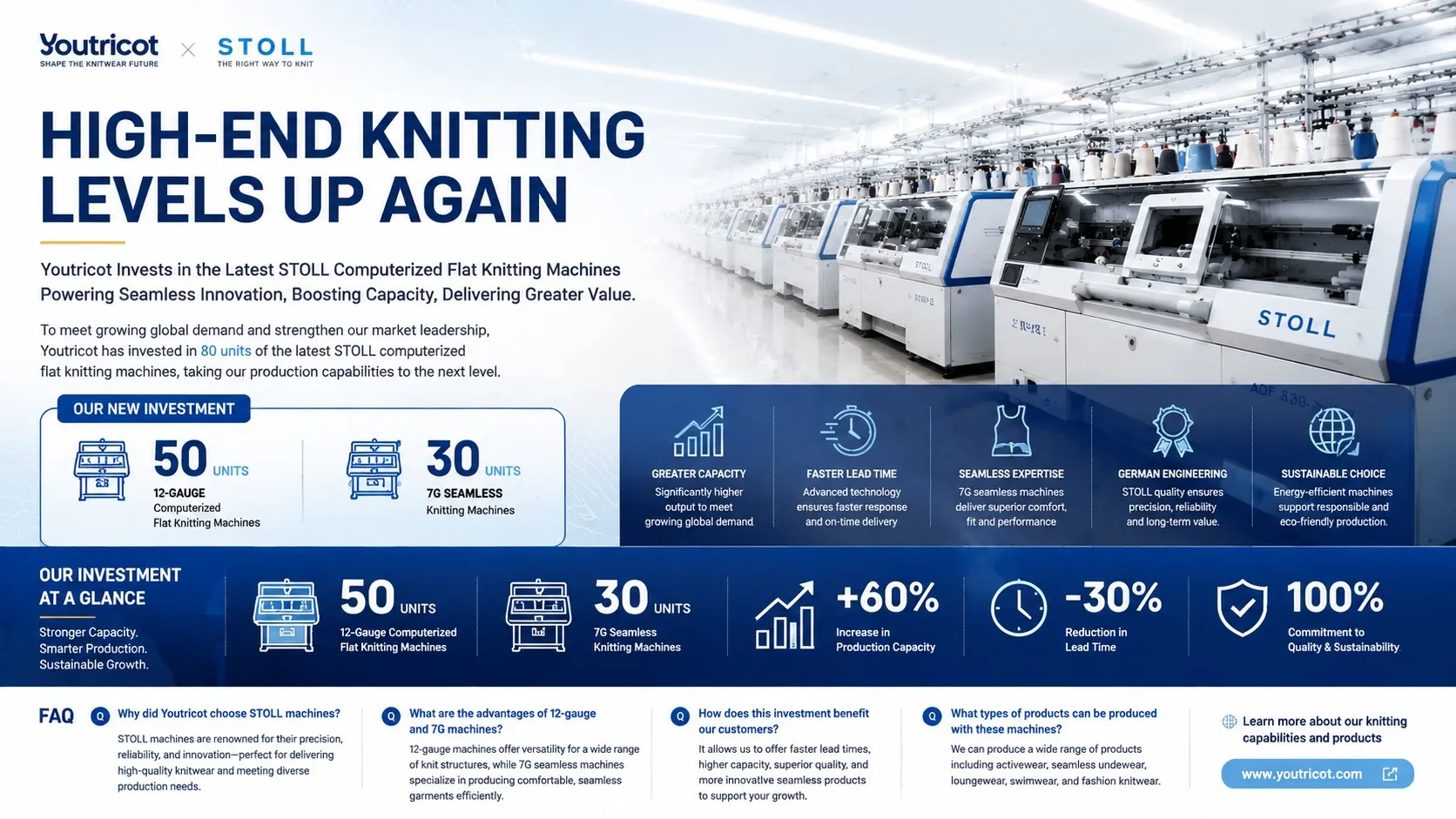
YouTricot’s May 2026 high-end knitwear OEM upgrade added 80 STOLL machines: 50 in 12G and 30 in 7G. For buyers, this means broader gauge options, more sampling capacity and greater flexibility for multi-style collections. The fleet totals 200 computerized flat knitting machines, covering 3G to 18G. Capacity remains product-dependent: up to 12,000 pieces per month is a planning benchmark, while selected repeatable styles may achieve an approximately 20–30% shorter cycle after materials and settings are stabilized.
Key Takeaways
1. The May 2026 high-end knitwear OEM upgrade gives buyers broader gauge coverage and more production-planning flexibility.
The factory added 80 STOLL flat knitting machines—50 in 12 gauge and 30 in 7 gauge—to support premium sweaters, cardigans, pullovers, textured styles and selected seamless applications. The standardized equipment count is now 200 computerized flat knitting machines: 120 Shima Seiki units and 80 STOLL units, covering 3G to 18G. For sourcing teams, the practical value is a wider choice of yarn weights, fabric structures and seasonal product types within one manufacturing setup.
2. The 12G and 7G mix helps brands develop both refined and more structured knitwear collections.
The 12G machines are suited to mid-fine and fine-gauge products requiring a smooth surface, clear stitch definition and lighter hand feel, including Merino wool, cashmere and wool-blend styles. The 7G machines are better suited to thicker yarns, loftier structures, textured pullovers and warmer autumn/winter pieces. Buyers can therefore plan capsule collections across multiple weights without treating every gauge as a separate sourcing project.
3. The equipment expansion is intended to improve consistency and scheduling, but output still depends on product complexity.
Before regular production, selected wool, cashmere and blended yarns were tested for stitch density, yarn tension, shrinkage, hand feel and pattern stability. The planning benchmark is up to 12,000 high-end knitwear pieces per month, depending on yarn, gauge, pattern structure, finishing and order mix. For selected repeatable styles, production cycles may be approximately 20–30% shorter; this is a conditional planning estimate, not a universal lead-time guarantee.
4. Multi-style and small-batch buyers gain the most when they provide complete technical information early.
A seasonal buyer developing 8–15 styles can use 12G for refined lightweight pieces, 7G for heavier textures and suitable equipment for selected seamless or complete-garment structures. The benefit is strongest when the factory receives a tech pack, measurements, yarn composition, target gauge, reference images, color plan and delivery window before sampling. Machine capacity improves execution, while accurate product specifications remain essential for reliable samples, repeat orders and bulk-production consistency.
Table of Contents
This production update matters because high-end knitwear OEM buyers do not purchase machine capacity in isolation; they purchase predictable fit, hand feel, pattern accuracy and delivery planning. The May 2026 installation expands the factory’s options for fine and mid-gauge products while supporting heavier seasonal structures. It also creates more room for sample development and multi-style scheduling. The following sections explain what changed, where the buyer benefits are most relevant, and which technical and commercial conditions still influence capacity, cycle time and final garment quality.
What Buyer Benefits Does the Upgrade Deliver?
For buyers evaluating an OEM knitwear manufacturer, the primary benefit is greater control across product development and production planning. The upgrade supports international brands that need several styles, different yarn weights and controlled quantities without lowering premium-quality expectations. The most relevant benefits are:
- More scheduling room for samples during peak development periods.
- Better gauge matching for lightweight, mid-weight and textured products.
- More consistent stitch structure, sizing, tension and pattern repeat.
- Stronger support for capsule collections and limited-quantity seasonal programs.
- Clearer routing from approved samples to repeatable bulk specifications.
These gains depend on confirmed yarn, measurements, finishing standards and production-ready technical files; machine quantity alone cannot replace disciplined product engineering.
What Was Installed in May 2026?
The factory completed the installation of 80 STOLL flat knitting machines in May 2026. The equipment mix was selected to expand practical gauge coverage, improve small-batch flexibility and create more stable sampling capacity. Equipment-related setup and commissioning support was provided with assistance from Cixing. The production team tested selected wool, cashmere and blended yarns before regular use, focusing on stitch density, yarn tension, shrinkage control, hand feel and pattern stability.
| Installation fact | Standardized specification |
|---|---|
| STOLL machines added | 80 computerized flat knitting machines |
| Gauge mix | 50 units of 12G and 30 units of 7G |
| Total computerized fleet | 200 units: 120 Shima Seiki and 80 STOLL |
| Overall gauge coverage | 3G to 18G |
| Factory location | Dalang, Dongguan, Guangdong, China |
How Do 12G and 7G STOLL Flat Knitting Machines Differ?
12G is generally used for finer surfaces, while 7G supports heavier yarns and more pronounced texture. Gauge choice must still be validated against yarn count, stitch construction, target hand feel, garment weight and finishing behavior. The comparison below gives buyers a practical starting point rather than a substitute for swatching and technical review.
| Buyer consideration | 12G STOLL machines | 7G STOLL machines |
|---|---|---|
| Typical surface | Smoother and more refined | Loftier and more textured |
| Typical weight | Light to mid-weight | Mid-heavy to heavier |
| Common materials | Fine wool, Merino wool, cashmere and wool/cashmere blends | Thicker wool yarns, chunky cashmere blends and textured yarns |
| Common products | Pullovers, lightweight cardigans and refined jacquards | Structured cardigans, textured pullovers and autumn/winter styles |
How Does the Upgrade Improve Quality in High-End Knitwear OEM Production?
Additional programmable flat knitting capacity improves process control when machine settings are supported by disciplined testing and inspection. The production workflow connects pattern programming, needle drafting, yarn-tension adjustment, stitch-density confirmation and shrinkage evaluation before bulk output. Buyers should expect the factory to verify four areas:
01
Yarn and gauge compatibility
Whether the selected yarn runs reliably at the proposed gauge.
02
Measurements after finishing
Whether sample measurements remain stable after washing and finishing.
03
Stitch and pattern consistency
Whether stitch structures and patterns reproduce consistently.
04
Repeat-order settings
Whether approved settings can be documented for repeat orders.
The official STOLL CMS family reference also emphasizes productivity, flexibility and reliability in fully fashioned knitting.
When Should Buyers Consider Seamless or Complete-Garment Knitting?
Seamless or complete-garment knitting is most useful when comfort, clean construction and pattern continuity justify the added programming requirements. Depending on machine configuration, yarn and garment structure, selected products can be knitted closer to their final shape and may require fewer sewing operations. Suitable applications include luxury sweaters, fitted knitwear, premium base layers and designs where shoulder or side-seam smoothness is important.
Buyers should not assume that every style benefits from this method: fully fashioned panels may remain more appropriate for certain silhouettes, yarns or cost targets. See the official STOLL knit and wear® overview and SHIMA SEIKI knitting-machine reference for technical context.
What Capacity and Timing Should Buyers Expect?
The planning benchmark is up to 12,000 high-end knitwear pieces per month, but buyers should treat capacity as product-dependent rather than fixed. Actual output changes with yarn availability, style complexity, gauge, pattern structure, size range, color count, finishing requirements and the overall order mix. For selected repeatable styles, production cycles may be approximately 20–30% shorter after settings and materials have been stabilized.
New or complex developments may require additional swatches, fit corrections and wash testing. Buyers should therefore request a style-level feasibility review and production schedule instead of converting the monthly maximum into a guaranteed lead time for every order.
How Should Buyers Plan a Multi-Style Collection?
A multi-style collection should be planned by grouping products according to yarn, gauge, structure and approval status. A European boutique buyer developing 8–15 styles might route fine Merino or cashmere pieces to 12G, heavier textured designs to 7G and suitable constructions to seamless equipment. Before requesting samples, prepare:
- Tech packs, measurements and grading rules.
- Target yarn compositions, colors and hand-feel references.
- Proposed gauge, stitch details and construction notes.
- Quantity by style, color and size.
- Sample approval and delivery deadlines.
For material planning, read the knitwear yarn OEM guide. For flexible-order strategy, review the small-batch knitwear case study.
Read the full guide here : knitwear yarn OEM guide
Read the full guide here : small-batch knitwear case study
Frequently Asked Questions
These answers address the questions sourcing managers commonly ask before connecting machine specifications to an actual OEM program. Equipment counts show available production resources, but they do not replace style-level analysis. Buyers should confirm yarn count, gauge, stitch structure, finishing, size range, quantity and delivery window before relying on a preliminary capacity estimate. The most dependable quotation and schedule are built from a complete tech pack or a physical reference sample, followed by swatching and technical review.
How many STOLL flat knitting machines were added in the May 2026 upgrade?
The May 2026 installation added 80 STOLL computerized flat knitting machines: 50 units in 12 gauge and 30 units in 7 gauge. Under the standardized company equipment count, the full computerized flat-knitting fleet comprises 200 machines—120 Shima Seiki units and 80 STOLL units—with overall gauge coverage from 3G to 18G. The new STOLL mix is intended to strengthen sampling, premium-yarn development, small-batch scheduling and multi-style production.
Buyers should still confirm which machine and gauge are appropriate for each garment because yarn count, stitch construction, sizing and finishing requirements determine the final production route.
What knitwear products are best suited to 12G machines?
12G machines are generally suitable for mid-fine and fine-gauge knitwear that needs a smooth surface, controlled stitch definition and a lighter hand feel. Common applications include fine wool sweaters, Merino wool pullovers, cashmere or wool/cashmere blends, lightweight cardigans, refined jacquards and premium smooth-surface styles. However, “12G” alone does not define the result.
The factory must also assess yarn count, ply, twist, stitch structure, garment measurements, desired weight and wash shrinkage. A swatch and measurement review should be completed before the buyer approves the gauge for sampling or bulk production.
What knitwear products are best suited to 7G machines?
7G machines are generally better for thicker yarns, loftier fabrics and products that need a stronger three-dimensional or textured effect. Typical applications include mid-heavy wool sweaters, chunky cashmere blends, textured pullovers, structured cardigans, warmer autumn/winter collections and heavier fashion pieces.
A 7G specification does not automatically guarantee softness, warmth or stability; those outcomes also depend on fiber quality, yarn construction, stitch density, garment design, washing and finishing. Buyers should compare a finished and washed sample—not only an unfinished panel—before approving the production specification.
Will the additional machines automatically shorten every lead time?
No. Additional machines create more scheduling options, but every lead time still depends on yarn availability, programming, sample revisions, color count, order quantity, finishing, inspection and logistics. The original production plan indicates that selected repeatable styles may achieve an approximately 20–30% shorter cycle after yarns, programs and settings are stabilized. That estimate should not be applied automatically to first-time or technically complex designs.
Buyers should request a dated production plan after sample approval and material confirmation, with clear milestones for knitting, linking or assembly, washing, finishing, final inspection and dispatch.
Does the upgrade support small-batch and multi-style knitwear orders?
Yes. The additional 12G and 7G capacity is intended to improve flexibility for capsule collections, boutique programs and seasonal ranges that contain multiple styles in controlled quantities. A typical multi-style project may combine lighter 12G garments, heavier 7G textures and selected seamless constructions. The best results come from grouping styles by yarn, gauge and finishing route, then approving technical files and samples in a planned sequence.
Buyers should provide quantities by style, color and size because fragmented colorways or many size variations can affect material allocation, machine scheduling and the final production timeline.
What should a buyer submit for a technical feasibility review?
A buyer should submit a tech pack or clear reference sample, garment measurements, size chart, target yarn composition, color requirements, stitch or pattern references, expected quantity by style and color, labeling needs, target price range and preferred delivery date. If the gauge is not confirmed, the technical team can evaluate whether 12G, 7G or another available gauge better matches the intended surface and weight.
A complete submission allows the factory to identify programming, yarn, shrinkage and construction risks before sampling and to prepare a more realistic quotation, sample route and production schedule.
About the Author
Frank, Founder of YouTricot
Frank is the founder of YouTricot, a premium knitwear OEM/ODM manufacturer with 20 years of experience across Prato, Italy and Dalang, Dongguan, China. YouTricot operates 120 Shima Seiki and 80 Stoll computerized flat knitting machines, covering gauges from 3G to 18G, and specializes in cashmere, merino wool and silk-blend knitwear for EU and US fashion brands.
Request a Technical Review for Your Next Knitwear Collection
Share your tech pack, reference sample, target yarn, size chart, order quantity and required delivery window before sampling begins. The production team can review gauge suitability, pattern programming, needle drafting, yarn behavior, construction risks and the likely route from prototype to bulk production. This early evaluation is particularly useful for cashmere, Merino wool, wool blends, multi-style capsule collections and products considering seamless or complete-garment construction.
Request an initial knitwear production feasibility review for your next collection.