
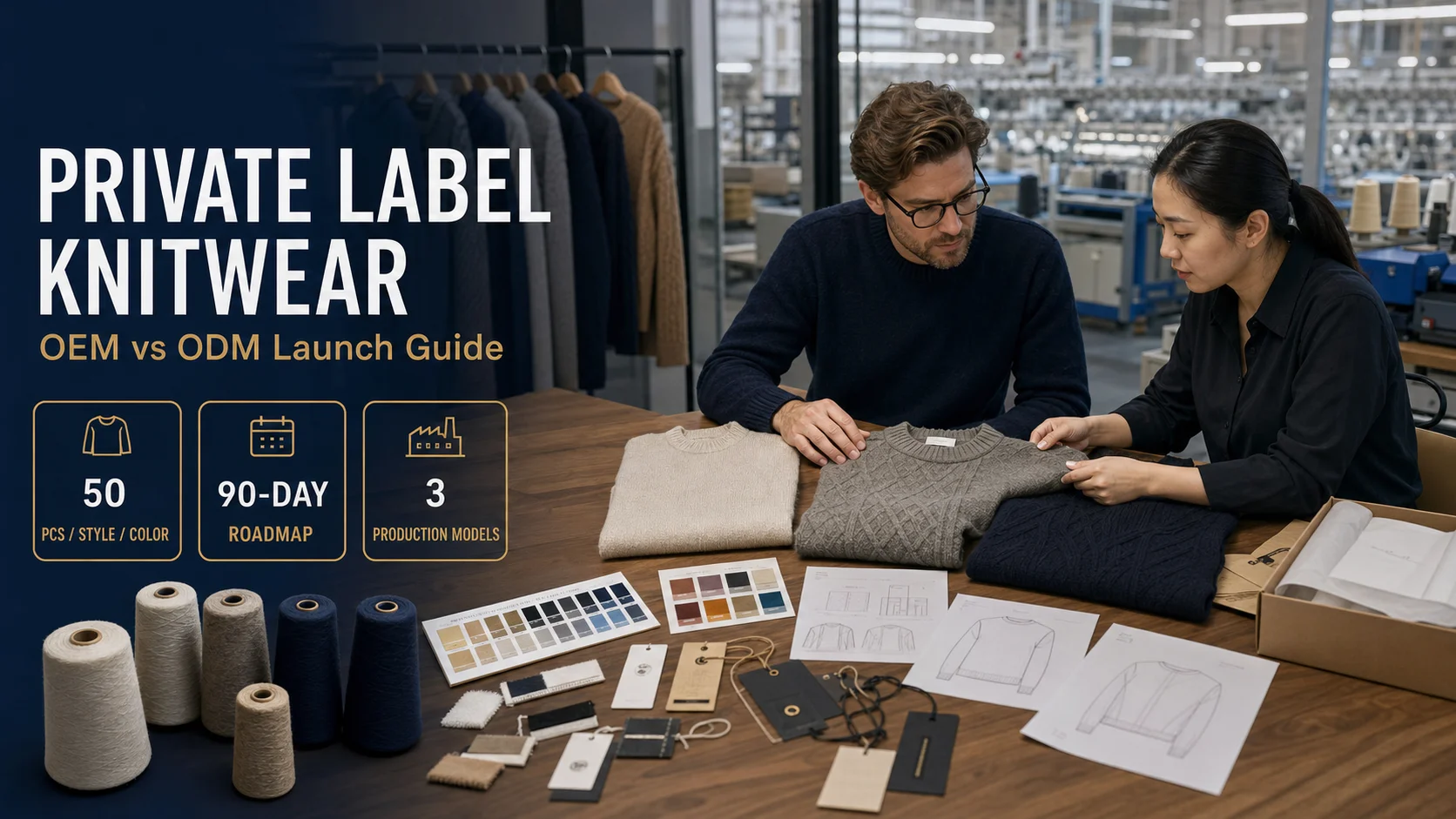
Quick answer: For brands launching private label knitwear, the first decision is whether to use private label production, OEM or ODM. Choose private label when speed and a proven factory style matter most, OEM when your team owns a production-ready design, and ODM when the manufacturer must help develop the product. The launch should then move through product selection, brand customization, compliance labelling, packaging, quality control and logistics. The minimum order is 50 pieces per style per color across all three routes, subject to yarn, construction and component feasibility.
Key Takeaways
A private label sweater launch works best when product development, branding, intellectual property, compliance and delivery are managed as one project. These three conclusions provide a decision-ready summary for brand founders, product developers and sourcing managers before they commit to sampling, branded components or bulk production.
1. Select the manufacturing model according to your real design capability. Private label normally commercializes an existing factory style with limited development. OEM manufactures a buyer-owned design from a complete tech pack. ODM involves factory-led product development or substantial adaptation for the buyer. Private label is usually fastest, OEM provides the greatest buyer control, and ODM reduces the need for an in-house technical team. In private label and ODM projects, exclusivity and design ownership must be confirmed contractually rather than assumed.
2. Control the launch through six documented approval gates. Product selection establishes the technical base; branding identifies every custom component; compliance review confirms the required label information; packaging protects the garment and retail presentation; quality control establishes the bulk standard; and logistics moves the approved goods into the destination warehouse. Each stage should produce a dated approval record. This prevents the factory from working from fragmented messages and gives the buyer a traceable standard for resolving production discrepancies.
3. Budget beyond the FOB garment price and treat 90 days as a planning target. Illustrative FOB ranges are $8–$15 per unit for stock-design private label, $12–$25 for modified private label and $18–$40 for fully developed ODM. These are not binding quotations. Labels, packaging, testing, freight, duties, taxes and warehousing may be separate. A 90-day launch is feasible only when materials are available, specifications remain stable, approvals are prompt and the selected freight route fits the final delivery window.
Table of Contents
› Manufacturing Decision Tree
› Six-Step Process Flowchart
› Step 1: Product Selection
› Step 2: Brand Customization
› Step 3: Compliance Labelling
› Step 4: Packaging Design
› Step 5: Quality Control
› Step 6: Shipping and Warehousing
› Manufacturing Cost Breakdown
› Trademark and Design Rights
› 90-Day Launch Timeline
› Low-MOQ Manufacturing Support
› Frequently Asked Questions
Private Label Knitwear vs OEM vs ODM: Which Model Should You Choose?
Private label is best for speed, OEM for buyer-controlled design and ODM for factory-supported development. Private label normally starts with a catalogue style and applies the buyer’s branding with limited product changes. OEM converts the buyer’s tech pack into production. ODM uses the manufacturer’s design and technical resources to create or substantially adapt a product for the buyer. The difference affects development cost, specification responsibility, time to market and intellectual-property control. In every model, the minimum order is 50 pieces per style per color, but feasibility still depends on yarn, gauge, construction, trims and packaging.
| Model | Design Ownership | MOQ | Illustrative FOB Range | Time to Market | Best For |
|---|---|---|---|---|---|
| Private Label | Factory base design; buyer owns its trademark and supplied brand assets. Exclusivity requires an agreement. | 50 pieces per style per color, subject to feasibility | $8–$15 per unit | Shortest; most compatible with a 90-day plan | Startups, boutiques and test capsules |
| OEM | Buyer-owned design, tech pack and artwork, subject to documented third-party rights | 50 pieces per style per color, subject to feasibility | Modified programs may plan within $12–$25 per unit | Medium; depends on tech-pack accuracy and revisions | Brands with a technical design team |
| ODM | Factory-originated or jointly developed design; ownership and reuse rights must be contracted | 50 pieces per style per color, subject to feasibility | $18–$40 per unit for fully developed programs | Medium to longer; development requires buyer approvals | Brands with a commercial direction but no production-ready design |
Decision Tree Based on Design Capability, Budget and Speed
Choose OEM.
Choose stock-design private label.
Choose ODM.
Use a modified private label or hybrid OEM route.
Buyers who need to define design ownership, development responsibility and approval scope can continue with the following comparison.
Read the full guide here : OEM vs ODM knitwear
Private Label Sweater Process Flowchart
A private label launch should pass through six approval gates in a fixed order. Product selection establishes the technical base; branding and compliance determine what appears on the garment; packaging protects the product and supports retail operations; quality control establishes the bulk-production benchmark; and logistics moves the approved goods into the destination warehouse. Each gate should produce a dated record showing what was approved, by whom and in which version. Changes requested after approval may affect the price or timeline and should be documented before production continues.
Step 1: Select Products from the Factory Catalogue
Begin with customer demand rather than the size of the catalogue. Compare each sweater by silhouette, yarn, gauge, target retail price, climate and wearing occasion. Request references for shortlisted styles and confirm which elements are fixed. For an eligible project, the minimum order is 50 pieces per style per color. Before sampling, ask the factory to identify yarn availability, shade limitations, size grading, construction constraints and the exact approval standard. A symbolic sampling fee may apply and must be fully deductible from later bulk production orders.
- Define the customer, retail channel and target selling price.
- Shortlist commercially distinct products rather than minor variations.
- Confirm yarn composition, yarn count, gauge and garment weight.
- Define colors and sizes before requesting a formal quotation.
- Record the factory style code and reference version.
- Request a feasibility assessment for special stitches and finishes.
Step 2: Customize Woven Labels, Hang Tags and Brand Components
Brand customization should be treated as a technical specification rather than a final decoration task. Supply vector logo artwork, approved colors, component dimensions, fold type, edge finish and attachment position. The branding pack may include a woven main label, size label, care label, hang tag, barcode sticker, poly bag and dust bag. Confirm whether each component is buyer-supplied or factory-procured and whether its procurement method works with the 50-piece-per-style-and-color order. Approve a physical or photographed strike-off before bulk application because label color, weave density and placement affect perceived product quality.
| Component | Information to Approve | Common Risk |
|---|---|---|
| Woven main label | Logo, dimensions, fold and sewing position | Scratchy edge, distorted logo or visible stitches |
| Hang tag | Stock, finish, string, barcode and retail-price area | Incorrect barcode or color shift |
| Poly bag | Dimensions, warning text, closure and barcode | Market warning omitted or poor garment fit |
| Dust bag | Material, print, drawstring and finished dimensions | Dye transfer or unsuitable size |
Step 3: Approve Compliance Labelling for the Target Market
The brand or importer must approve the final label against every destination market’s requirements. A private label sweater normally needs verified fibre composition, country of origin, care information and size identification, but the exact rules differ between the US, EU and UK. The US also requires the identity of the manufacturer or responsible marketer for most textile and wool products. EU fibre wording may require translation into the official language of each consumer market. Care-symbol systems are not interchangeable across every jurisdiction, so label copy should be reviewed before printing rather than after bulk garments are completed.
- Fibre composition: use recognized fibre names and verified percentages.
- Country of origin: confirm the correct manufacturing-origin statement.
- Care information: support instructions with a defensible care assessment.
- Size label: use the brand’s approved size and grading system.
- Responsible business identity: include it where required.
- Language: prepare market-appropriate wording before production.
Official references reviewed on 31 August 2026:
Step 4: Design Retail and Transit Packaging
Packaging must protect the sweater while preserving the brand experience and warehouse efficiency. Begin with the approved garment fold and dimensions, then design the poly bag, dust bag, tissue, carton and barcode placement around the physical product. Premium packaging should not create compression marks, moisture risk or unnecessary shipping volume. Separate retail-presentation requirements from export-carton requirements so decorative materials do not weaken transit protection. For a 50-piece-per-style-and-color order, verify how branded components will be procured without creating avoidable packaging inventory.
- Approve the garment fold and finished pack dimensions.
- Confirm moisture protection and ventilation requirements.
- Validate poly-bag warning text for the destination market.
- Check SKU, size, color and barcode placement.
- Define carton quantity, carton markings and shipping marks.
- Test dust-bag and tissue colorfastness against light yarns.
- Support recycling and sustainability claims with evidence.
- Match pack configuration to warehouse receiving requirements.
Step 5: Set Quality Control Standards Before Bulk Production
The approved pre-production sample and written specification must become the bulk quality standard. Quality control should begin with yarn identity, shade and knitting tension, then continue through panel measurement, linking, washing, finishing, labelling and packing. Define tolerances before production instead of deciding what is acceptable at final inspection. Premium knitwear checks should cover hand feel, shrinkage, pilling risk, seam appearance, neckline recovery, measurements, color consistency and surface defects. Any claimed OEKO-TEX Standard 100, RWS or GCS scope should be supported by project-relevant documents.
Buyers who need a fibre-to-packing inspection framework can review the complete control sequence below.
Read the full guide here : knitwear quality control SOP
Step 6: Arrange Shipping, Customs and Warehousing
Book logistics only after the packing list, commercial invoice, origin information and final inspection status are aligned. Confirm the Incoterm, importer of record, commodity code, customs value, freight mode, insurance, delivery address and warehouse appointment process. FOB garment prices do not include every landed-cost item, so calculate freight, duty, import tax, brokerage and receiving charges separately. Send carton dimensions and weights to the forwarder before booking. A 90-day launch leaves limited recovery time during the final phase; customs holds, peak-season capacity or ocean transit may require additional buffer.
For official import planning, consult the European Commission’s importing guidance or the UK import process, depending on the destination.
The following project example shows how sampling, production, inspection and delivery connect to an online retail launch.
Read the full guide here : private label knitwear launch case study
Knitwear Manufacturing Cost Breakdown for a Private Label Launch
The minimum order is 50 pieces per style per color in every tier, while development complexity drives the price difference. Stock-design private label carries the lowest development burden. Modified private label adds changes such as yarn, fit, color or branded details. Fully developed ODM includes more design and technical work. The figures below are illustrative FOB planning ranges rather than current quotations. They exclude any line not expressly included in the offer, including development, labels, packaging, testing, freight, duties, import taxes, brokerage and warehousing.
| Tier | Development Scope | MOQ | FOB Range | 50-Piece Subtotal | Planning Conditions |
|---|---|---|---|---|---|
| Stock-Design Private Label | Existing design, feasible stock yarn and brand application | 50 pieces per style per color | $8–$15 per unit | $400–$750 | Depends on yarn, garment weight, gauge, finishing and branding. |
| Modified Private Label | Existing base with agreed fit, yarn, color or detail changes | 50 pieces per style per color | $12–$25 per unit | $600–$1,250 | Changes require technical and component feasibility review. |
| Fully Developed ODM | Factory-supported design, engineering, sampling and production preparation | 50 pieces per style per color | $18–$40 per unit | $900–$2,000 | Yarn, construction, design rights and testing require project review. |
Sample cost-sheet formula
Landed launch cost = FOB merchandise subtotal + confirmed development charges + branded labels and tags + packaging + testing + freight + duty and import tax + customs clearance + warehouse receiving.
Brand Registration, Trademark Filing and Design Ownership
Start trademark clearance before sharing final brand assets, but do not confuse filing with completed registration. A brand may shortlist factories before its trademark is registered, particularly under suitable confidentiality terms. It should nevertheless search the proposed mark and prepare or submit the relevant filing before authorizing branded bulk goods. US filings use the USPTO, EU trade marks use EUIPO and UK applications use UKIPO. Trademark rights are territorial, and registration is never guaranteed.
Trademark Filing Checklist
- Search identical and confusingly similar marks in relevant classes.
- Confirm the legal owner of the proposed trademark.
- File through the USPTO, EUIPO or UKIPO.
- Do not use the registered trademark symbol until registration permits it.
- Keep dated records of logo files, artwork and commercial use.
Copyright and Design Rights
Copyright does not automatically protect every garment shape in every country. Original textile prints, graphics, sketches, photographs and some surface designs may receive copyright protection, while a garment’s visual appearance may be better addressed through registered or unregistered design rights. The manufacturing agreement should define ownership and permitted reuse of tech packs, needle-drafting files, stitch maps, patterns, artwork and ODM developments. Review the World Intellectual Property Organization’s fashion IP guidance for further context.
90-Day Private Label Sweater Launch Timeline
A 90-day launch is achievable only when decisions, materials and logistics remain controlled. The plan assumes rapid buyer feedback, feasible material availability, a stable specification and a shipping route that fits the final window. Trademark registration will not normally be completed within the production schedule, so the milestone is filing rather than registration. If samples need major redevelopment, materials are delayed or transit exceeds the available window, move the retail date instead of compressing quality control.
| Workstream | Days 1–15 | Days 16–30 | Days 31–45 | Days 46–75 | Days 76–90 |
|---|---|---|---|---|---|
| Factory Selection and Sample Request | Active | — | |||
| Sample Revision and Trademark Filing | — | Active | — | ||
| PP Sample Approval and Bulk Order | — | Active | — | ||
| Production and Quality Control | — | Active | — | ||
| Shipping, Customs and Retail Preparation | — | Active | |||
How a Low MOQ Knitwear Manufacturer Supports Private Label Brands
YouTricot supports overseas B2B buyers that need a practical route from product selection to retail-ready packing. The private label program includes a stock-design catalogue containing more than 30 styles, a 50-piece-per-style-and-color opening order for feasible projects, bilingual label preparation for EU, US and UK briefs, and coordinated woven labels, hang tags, poly bags, dust bags and packaging. Low-MOQ OEM and ODM projects still require technical review because yarn, gauge, construction and components affect feasibility. Sampling uses a symbolic sampling fee that is fully deductible from later bulk production orders.
Brands preparing their first technical brief can review the available development and production support below.
Read the full service guide here : private label knitwear OEM and ODM services
Prepare a Quote-Ready Private Label Brief
If you are deciding how to start a knitwear brand, send your preferred style, yarn direction, target retail price, colors, sizes, branding files, destination market and planned launch date. A technical review should confirm which details are ready for sampling and which still affect price, compliance or timing.
Frequently Asked Questions
These answers address the decisions buyers most often need to make before beginning a private label sweater project. The approved quotation, manufacturing agreement, label artwork and importer’s compliance review remain the controlling documents for a specific order.
What is the difference between OEM and ODM knitwear?
OEM manufactures a buyer-owned design from a tech pack, while ODM involves the factory in creating or substantially adapting the product as well as manufacturing it. Private label normally applies the buyer’s branding to an existing factory design with limited development.
How many pieces is the minimum order for knitwear?
The minimum order is 50 pieces per style per color. Technical feasibility still depends on yarn, gauge, construction, color, trims and packaging.
Can a startup launch private label knitwear without a tech pack?
Yes. A startup can select an existing catalogue design or use an ODM route. It should still provide a customer profile, reference images, target price, preferred fit, yarn direction, colors, sizes and launch date.
Is knitwear sampling free?
No absolute free-sampling promise should be assumed. Custom development uses a symbolic sampling fee that is fully deductible from later bulk production orders.
Must the trademark be registered before contacting a factory?
No. A brand may evaluate factories before registration, but it is prudent to search the mark and prepare or submit the appropriate filing before authorizing branded bulk production.
Who is responsible for sweater compliance labels?
Responsibility can fall on the brand, manufacturer, importer or retailer depending on the market and supply-chain role. Label information should be verified before printing.
How do you calculate sweater manufacturing cost?
Sweater manufacturing cost is calculated from yarn type and consumption, knitting gauge, construction complexity, finishing, trims, branding, packaging, testing and order quantity. FOB price should be separated from the landed cost.
Can a private label sweater line launch within 90 days?
It can when materials are available, specifications remain stable, approvals are prompt and the freight route fits the final window. Major revisions, testing delays or customs issues can lengthen the schedule.
Official Sources and Verification Date
Trademark, intellectual-property, textile-labelling and import references were reviewed on 31 August 2026. Regulations and official forms can change, so buyers should revisit the relevant authority before approving labels or filing an application.
- United States Patent and Trademark Office
- European Union Intellectual Property Office
- UK Intellectual Property Office
- World Intellectual Property Organization
- US Federal Trade Commission Apparel Labelling
- European Union Textile Label Requirements
- UK Government Textile Labelling
About the Author
Frank, Founder of YouTricot
Frank has 20 years of knitwear industry and operational experience across Prato, Italy, and Dalang, Dongguan, China. He writes for fashion-brand founders, designers, product developers and sourcing teams that need practical guidance on yarn selection, pattern making, needle drafting, private label development, OEM and ODM responsibilities, sampling, quality control, cost and international delivery.