
Quick Answer
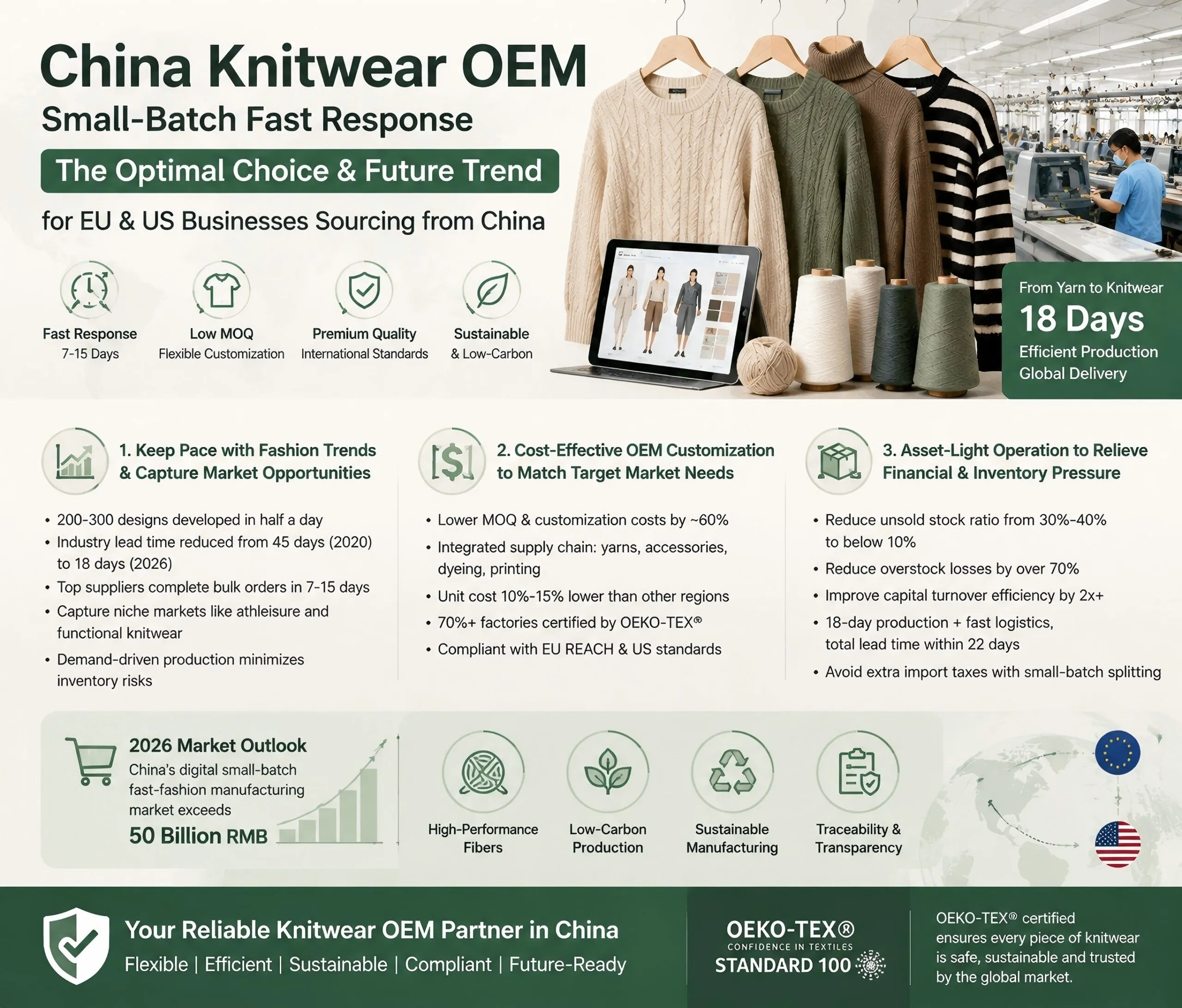
Small-batch knitwear OEM in China allows EU and US fashion brands to produce custom sweaters, cardigans and related knitwear in controlled quantities, test real demand and reorder proven styles instead of committing to a large speculative run. YouTricot’s MOQ is 50 pieces per style per color, subject to yarn availability and technical feasibility. Brands still need a complete tech pack, approved yarn and sample, reliable quality control, compliant labeling and a documented reorder plan. Sampling is available for a symbolic sampling fee, fully deductible from later bulk production orders.
Key Takeaways
1. Small-batch knitwear OEM helps fashion brands test demand before committing to larger seasonal production runs.
Instead of forecasting an entire collection months in advance, brands can use controlled quantities to assess which colours, yarn compositions, silhouettes and price points perform best. This reduces exposure to unsold inventory, warehouse pressure and forced markdowns. The model is especially useful for startups, boutiques, DTC labels and wholesalers that need professional yarn sourcing, pattern making, needle drafting, sampling and quality control without making one high-risk bulk commitment.
2. Small-batch production is an inventory and launch strategy, while low MOQ is a manufacturer’s commercial capability.
A low MOQ factory may accept a smaller order subject to yarn availability, custom dyeing, stitch complexity, garment structure and finishing requirements. Small-batch OEM describes how a brand uses that capability: launch a focused quantity, collect customer and sales feedback, then reorder proven styles. This distinction prevents buyers from treating a low stated minimum as proof that a supplier can support a demand-led production program.
3. China’s knitwear supply chain is valuable because it can coordinate the complete workflow within one production network.
Yarn sourcing, knitting, linking, washing, finishing, inspection, labeling and packing all remain necessary at lower quantities. For EU and US buyers, the right factory should make technical development, material options, compliance documents and repeat-order planning visible before a sample or first production run is approved.
4. The first order should have a clear learning objective.
Buyers should decide whether they are testing a colourway, yarn composition, cardigan versus pullover, knitted hoodie, target retail price or a new market. The goal is not to make every order permanently small; it is to use early production data to decide whether a style should be reordered, adjusted or discontinued. This creates a more controllable path from sample approval to scalable bulk production.
Table of Contents
What Is Small-Batch Knitwear OEM?
Why Source Small-Batch OEM in China?
Small-Batch OEM vs Low MOQ
How Small Batches Reduce Inventory Risk
Fast Sampling for Trend-Led Collections
EU and US Compliance
Small-Batch OEM Partner Checklist
Limitations and Planning Conditions
Small-Batch Knitwear OEM FAQ
About the Author
Plan a Small-Batch Program
Small-Batch vs Large-Batch Knitwear Production
The best production size depends on whether a brand is validating demand or replenishing a style with proven sales evidence. Large production can lower the factory unit price, but it also increases capital exposure when colour, size ratio, retail price or product-market fit is uncertain. Small-batch production normally carries a higher unit cost because development and setup are spread over fewer garments, yet it gives a buyer more information before scaling.
The table below compares the commercial decision rather than treating one model as universally better.
| Decision factor | Small-Batch Knitwear OEM | Large-Batch Knitwear Production |
|---|---|---|
| Primary purpose | Test styles, colours, yarns, markets and price points before scaling. | Supply proven styles with dependable demand and sales forecasts. |
| Unit-price position | Usually higher because setup, sampling and production preparation are spread over fewer pieces. | Usually lower because development and production costs are distributed across more garments. |
| Inventory exposure | Lower exposure when customer demand is uncertain. | Higher exposure if the style, colour or size mix does not sell as forecast. |
| Decision speed | Supports earlier customer feedback and demand-led reorder decisions. | Requires more confidence before seasonal quantities are committed. |
| Cash-flow effect | Can support a more controlled, asset-light launch model. | Can create greater financial pressure through larger upfront inventory commitments. |
| Best use case | Capsule launches, new products, DTC test drops and new-market entry. | Bestsellers, stable replenishment programs and confirmed seasonal demand. |
What Is Small-Batch Knitwear OEM?
Small-batch knitwear OEM means producing custom knitwear in controlled quantities rather than placing one large bulk order before demand is proven. It gives brands a practical way to launch seasonal capsule collections, test custom styles, evaluate customer response and reorder according to real sales data. The model is especially relevant to startup clothing brands, boutique labels, DTC fashion companies and wholesalers that need more control over inventory and cash flow.
It still requires professional yarn sourcing, sampling, accurate measurements, clean finishing, correct labeling and dependable quality control.
Why Source Small-Batch Knitwear OEM in China?
China’s advantage for small-batch knitwear OEM is the depth of its coordinated supply chain, not only factory pricing. A mature production network can align yarn sourcing, knitting, linking, washing, finishing, inspection, labeling and packing more efficiently than a fragmented workflow. Dalang, Dongguan is one of China’s important knitwear production areas, giving overseas brands access to yarn options, technical knitting support, finishing resources and flexible production planning.
For lower-volume orders, this coordination matters because the quantity may be smaller, but the technical standard remains professional.
How the Coordinated Small-Batch Workflow Operates
01
Technical Review
Review the tech pack, measurements, gauge, construction, target price and launch market.
02
Yarn Direction
Confirm composition, hand feel, stock availability, colour route and destination-market needs.
03
Pattern and Sample
Complete pattern making, needle drafting, programming, knitting, linking and finishing.
04
Approval Gate
Approve yarn, colour, fit, measurements, hand feel, labels and finishing before bulk release.
05
Controlled Production
Produce the agreed quantity with in-process checks, finishing control, inspection, labeling and packing.
06
Learn and Reorder
Use sell-through and customer feedback to reorder, revise or discontinue each style.
Small-Batch OEM vs Low MOQ Manufacturing
Small-batch OEM answers “how should a brand launch and learn?” while low MOQ manufacturing answers “can this supplier accept the required quantity?” Small-batch production is a demand-validation model: launch a focused run, assess sell-through and then reorder successful products. Low MOQ depends on supplier conditions such as stock yarn availability, custom dyeing, gauge, stitch complexity, garment structure and finishing.
Read the full guide here : [ Low MOQ Knitwear Manufacturer Guide ]
How Small-Batch Production Reduces Inventory Risk
Small-batch knitwear OEM reduces risk by allowing brands to test the commercial variables most likely to create unsold inventory. A focused run can show which colours customers prefer, which yarn compositions sell better, whether a cardigan, pullover or knitted hoodie performs best, which price point converts more strongly and whether a style should be reordered or discontinued.
- Reduce overstock caused by inaccurate forecasts.
- Identify slow-moving colours or sizes earlier.
- Limit capital tied up in unproven inventory.
- Reduce warehousing pressure and forced discounting.
The purpose is to improve future decisions, not simply to place a permanently smaller order.
Fast Sampling for Trend-Led Knitwear Collections
Fast sampling means building an efficient development process, not rushing technical knitwear quality. Yarn choice, gauge, stitch density, shape, stretch, shrinkage and finishing all affect the finished garment, so buyers need yarn recommendations, pattern making, needle drafting, sample fitting, measurement adjustment and production-feasibility checks before bulk production.
This process is particularly useful for autumn-winter sweater collections, cashmere-blend capsules, wool-blend cardigans, transitional knitwear, resort collections and small online test drops.
Sampling condition: sampling cost and timing depend on yarn availability, stitch complexity, pattern making, needle drafting, finishing and the number of revisions.
YouTricot applies a symbolic sampling fee, fully deductible from later bulk production orders. International courier charges and project-specific extras should be confirmed separately in the quotation.
Read the full guide here : [ Custom Sweater Sample Cost Guide ]
Compliance for EU and US Small-Batch Knitwear
Small-batch production does not remove EU and US compliance responsibilities. Buyers should confirm fibre content, care labels, restricted-substance expectations, origin marking, product-safety requirements and the evidence supporting sustainability claims before production begins.
OEKO-TEX STANDARD 100 is widely used for textile products tested for harmful substances, while EU buyers should monitor the EU Strategy for Sustainable and Circular Textiles . US buyers should also confirm fibre descriptions, care labels and country-of-origin information for their destination market.
Compliance note: certification or testing support does not automatically prove that every yarn, finished product, claim or shipment is covered. Buyers should verify current documents, scope and destination-market requirements for the actual order before approving bulk production.
How to Choose a Reliable Small-Batch Knitwear OEM Partner
Choose a small-batch OEM partner by testing whether it can convert a focused launch into reliable repeat production. Price alone cannot show whether a supplier can coordinate the technical details that protect a small order: yarn selection, gauge, fit, finishing, sample revisions, quality control, documentation and communication.
Use this checklist together with a clear tech pack, target retail price, preferred hand feel, intended market and launch timing.
- MOQ rules: Confirm the minimum of 50 pieces per style per color and verify yarn, dyeing, construction and finishing conditions.
- Yarn recommendation: Ask for suggestions that match the target price, hand feel, gauge and intended market.
- Technical development: Verify pattern making, needle drafting, sampling and measurement-adjustment support.
- Timing: Request realistic sample, bulk-production and reorder timelines based on the actual style.
- Quality control: Confirm how yarn, knitting, linking, washing, measurements, labels and packing are checked.
- Finishing capability: Ask about washing, brushing, steaming, shrinkage control and hand-feel development.
- Compliance support: Confirm available fibre, care-label, testing and destination-market documentation.
- Export readiness: Check support for packing lists, labels, cartons and export documentation.
- Communication: Test how clearly the supplier explains revisions, risks, approvals and next actions.
- Reorder planning: Ask how the factory will handle proven styles, sales-led replenishment and future changes.
Read the full guide here : [ Knitwear Tech Pack RFQ Checklist ]
Limitations and Planning Conditions
A small order is not automatically simple, inexpensive or fast.
Feasibility and quotation scope depend on stock-yarn availability, custom dyeing, colour count, gauge, stitch complexity, garment structure, finishing, trims, labeling, testing, buyer approvals and current production capacity. A lower quantity does not reduce the need for accurate measurements, stable hand feel, clean finishing, correct labels, reliable inspection or destination-market compliance. Request a style-specific assessment before treating any minimum, unit price or timeline as confirmed.
Small-Batch Knitwear OEM FAQ
Small-batch questions should be answered using the brand’s product, launch objective and sales-risk profile rather than a generic minimum-order promise. A small run is valuable when it creates useful market information and can be repeated with stable quality. Buyers should define what they intend to learn from the first order before selecting yarn, approving a sample or comparing suppliers.
What is small-batch knitwear OEM?
Small-batch knitwear OEM is the production of custom knitwear in controlled quantities instead of one large bulk order. It is useful when a fashion brand wants to test new designs, launch a capsule collection, validate a price point or reduce inventory exposure before scaling.
The model does not mean reducing technical standards: buyers still need reliable yarn sourcing, pattern making, needle drafting, sample approval, quality control, finishing, correct labels and export planning. Its commercial value comes from learning from real demand before making a larger production commitment.
Why do EU and US brands source small-batch knitwear OEM in China?
EU and US brands use China knitwear OEM because the production ecosystem can coordinate yarn sourcing, knitting, finishing, quality control and export support within one supply chain. For small-batch projects, this can make it easier to develop custom sweaters and cardigans with professional technical support despite the lower quantity.
The buyer should still verify communication, material documentation, sample controls, garment measurements and destination-market requirements. China is not automatically the right answer for every project; the relevant advantage is a supplier’s ability to coordinate the complete workflow reliably.
What is the main problem that small-batch knitwear solves?
The main problem is inventory risk from producing too many pieces before knowing what customers will buy. A brand can use a smaller run to test colours, yarn compositions, silhouettes and retail-price acceptance, then reorder styles supported by sales data.
This can reduce the risk of unsold inventory, warehouse pressure, cash tied up in slow-moving products and forced discounting. Small-batch production is particularly useful for brands with limited cash flow, changing customer preferences or a collection without dependable demand history.
Is small-batch knitwear suitable for startup clothing brands?
Yes, small-batch knitwear can be suitable for startup brands when the first order has a clear commercial purpose. It gives a new label the chance to launch a focused product range, test a target market and refine its assortment before scaling.
Startups should not choose a supplier only because it advertises a low minimum. They should confirm yarn options, sample process, price assumptions, quality checkpoints, revision process and future reorder plan. A small initial quantity is most useful when the brand has enough technical clarity to learn from the result.
What is YouTricot’s MOQ for custom knitwear?
YouTricot’s MOQ is 50 pieces per style per color. Technical feasibility still depends on yarn availability, custom-dye requirements, gauge, stitch complexity, garment construction and finishing. Buyers should submit quantities by style, color and size with the tech pack so the factory can assess the actual production route.
How long does knitwear sampling usually take?
Knitwear sampling time depends on yarn availability, stitch complexity, pattern making, needle drafting and the number of revisions required. Sample work can usually begin after the tech pack, yarn choice and measurements are confirmed, but a buyer should request a style-specific schedule rather than assume a universal lead time.
A simple construction with available yarn normally needs less development than a custom-dyed, multi-colour or technically complex design. Faster sampling should still include fit review, measurement control and finishing checks so the approved sample remains useful for later production.
Do sweater factories offer sampling services?
Yes. YouTricot offers technical sample development for custom knitwear with a symbolic sampling fee, fully deductible from later bulk production orders. The style, yarn, trims, finishing, revisions and courier destination should be reviewed before the sampling scope and schedule are confirmed.
How can brands reduce compliance risk when sourcing small-batch knitwear?
Brands should confirm fibre content, care labels, restricted-substance requirements, testing needs and country-of-origin rules before bulk production begins. Certifications and third-party testing support can help where relevant, but sustainability and compliance claims should be supported by verifiable documentation.
This is particularly important for wool, cashmere, recycled fibres, children’s products and styles marketed with material or environmental claims. Small quantity does not reduce the need for accurate labels or compliant product information in the destination market.
About the Author
Frank, Founder of YouTricot
Frank has 20 years of knitwear experience across Prato, Italy and Dalang, Dongguan, China. YouTricot is a premium knitwear OEM/ODM manufacturer operating 120 Shima Seiki and 80 Stoll computerized flat knitting machines, covering gauges from 3G to 18G, and specializing in cashmere, merino wool and silk-blend knitwear for EU and US fashion brands.
Read the full guide here : [ Low MOQ Knitwear Manufacturer Guide ]
Read the full guide here : [ Knitwear Tech Pack RFQ Checklist ]
Plan a Small-Batch Knitwear Program
Before requesting a quotation, share your tech pack or design sketches, target yarn and hand feel, quantity by style and color, intended market, target retail price and launch date. YouTricot can review sampling feasibility, construction risk, finishing requirements, compliance inputs and the conditions for repeat production.