

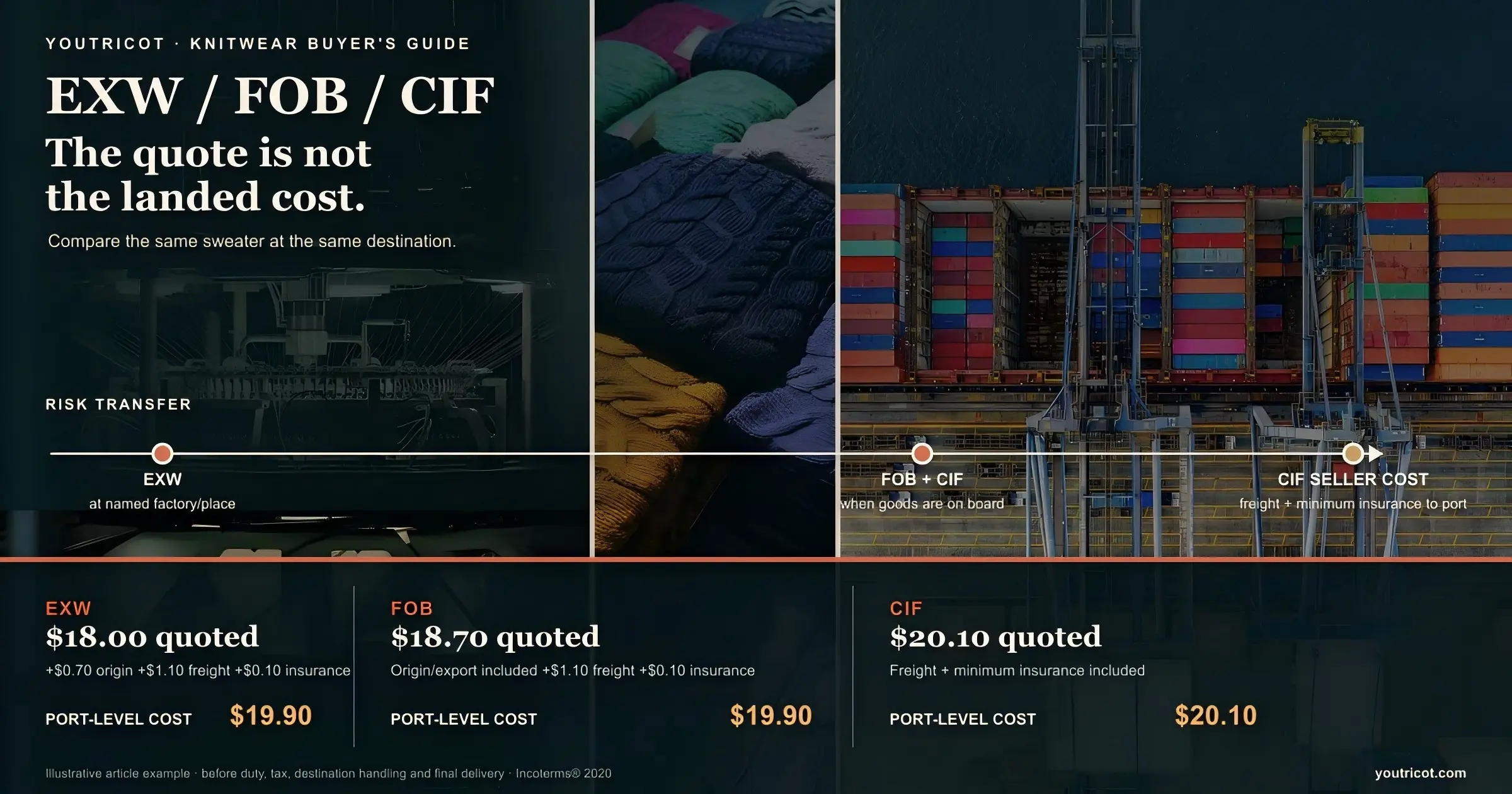
Quick Answer: Do not compare an EXW, FOB or CIF knitwear quote by unit price alone. First convert every offer to the same named delivery point, product specification, currency, shipment date and cost scope. EXW leaves most origin and transport work to the buyer; FOB includes export-side delivery on board at the named origin port; CIF adds ocean freight and minimum insurance to the named destination port, while risk still transfers at origin. The meaningful comparison is landed cost per sellable sweater.
Key Takeaways
1. Normalise every quotation before comparing it. A knitwear FOB price cannot be directly compared with EXW or CIF until each quote uses the same delivery point and commercial scope. The lowest unit price may produce the highest landed cost after origin handling, freight, insurance, customs clearance, duties, destination charges and final delivery are added.
2. FOB is often practical for experienced international buyers. The seller manages export-side execution while the buyer controls main freight. A usable quote should state the named port and rules version, such as “FOB Shenzhen, Incoterms® 2020.” FOB is for sea or inland-waterway transport; FCA may better reflect containerised knitwear handed to a carrier or terminal before vessel loading.
3. CIF payment and risk transfer happen at different points. The seller pays ocean freight and arranges minimum insurance to the named destination port, but risk transfers when the goods are loaded on board at origin. Buyers must still check destination charges, import clearance, duties, taxes, final delivery, insured value, exclusions, deductible and claims procedure.
4. Separate manufacturing cost from logistics assumptions. Lock the tech pack, fibre composition, gauge, garment weight, colour quantities, trims, packaging, testing and approved sample. Then request the same carton, freight, insurance, currency and destination inputs from every supplier. The buying decision should be based on landed cost per sellable sweater.
Table of Contents
2. What Does EXW Mean?
3. What Does FOB Mean?
4. What Does CIF Mean?
5. Quick Decision Tree
6. Landed Cost Calculator
7. Worked Knitwear Price Comparison
8. 12-Field Quotation Checklist
9. Cost Exclusions and Red Flags
10. Buyer Recommendation
11. EXW, FOB and CIF FAQ
12. Authoritative Sources
13. About the Author
14. Request a Comparable Quotation
Knitwear FOB Price Comparison: EXW vs FOB vs CIF
What is the main difference between EXW, FOB and CIF knitwear quotations? The product may be identical, but the seller’s cost, delivery and transport responsibilities end at different points. A quotation that states only “FOB China” or “CIF Europe” is incomplete; it should include the exact named place or port and the applicable Incoterms® version.
The table below provides a practical sourcing comparison, but the purchase contract must also define product specifications, payment terms, documents, inspection requirements and any charges not allocated by the trade rule.
| Cost or responsibility | EXW — named factory/place | FOB — named origin port | CIF — named destination port |
|---|---|---|---|
| Finished sweaters and agreed packing | Seller | Seller | Seller |
| Loading at the factory | Buyer under the rule unless separately agreed | Seller | Seller |
| Origin collection and inland transport | Buyer | Seller | Seller |
| Export customs formalities | Buyer | Seller | Seller |
| Origin terminal and vessel loading | Buyer | Seller | Seller |
| Main ocean freight | Buyer | Buyer | Seller |
| Cargo insurance | Buyer | Buyer | Seller arranges minimum cover |
| Destination terminal charges | Buyer | Buyer | Buyer unless expressly included |
| Import clearance, duty and non-recoverable taxes | Buyer | Buyer | Buyer |
| Final delivery to buyer’s warehouse | Buyer | Buyer | Buyer |
| Typical risk-transfer point | When goods are placed at the buyer’s disposal at the named place | When goods are loaded on board at the named origin port | When goods are loaded on board at the origin port |
| Best suited to | Buyers with strong origin logistics support | Buyers who want export support and freight control | Buyers who want supplier-arranged port freight |
What Does EXW Mean for Knitwear Buyers?
EXW, or Ex Works, means the seller makes the finished knitwear available at the named factory, warehouse or other agreed place. Under the rule, the seller is not required to load the collecting vehicle or clear the goods for export. The buyer therefore manages collection, origin handling, export formalities, international freight, insurance, import clearance and final delivery. EXW can suit experienced buyers with a reliable China-side forwarder or consolidation programme.
For an overseas buyer without origin support, it may create avoidable coordination and export-clearance difficulties despite showing the lowest factory unit price.
What Does FOB Mean for Knitwear Buyers?
FOB, or Free On Board, means the seller clears the knitwear for export and delivers it on board the buyer-nominated vessel at the named origin port. Risk transfers when the goods are on board, while the buyer arranges main freight, cargo insurance, destination charges, import clearance, duties and final delivery. A FOB knitwear price is often easier to compare across Chinese suppliers because the seller controls product manufacturing and export-side execution.
Quotation requirement: Identify the exact port and rules version—for example, “FOB Shenzhen, Incoterms® 2020”—rather than using the incomplete expression “FOB China.”
What Does CIF Mean for Knitwear Buyers?
CIF, or Cost, Insurance and Freight, means the seller pays ocean freight and arranges minimum insurance to the named destination port. Risk nevertheless transfers when the goods are loaded on board at the origin port, not when they arrive. CIF is a maritime rule and does not automatically include destination terminal charges, import customs clearance, duties, taxes or delivery to the buyer’s warehouse.
Insurance limitation: Under Incoterms® 2020, the default CIF insurance obligation generally reflects Institute Cargo Clauses (C) or similar minimum cover. Buyers should check the policy, insured value, exclusions, deductible and claims contact.
Quick Decision Tree: Which Trade Term Should a Knitwear Buyer Choose?
Which trade term is most appropriate depends on who can reliably manage each logistics stage. EXW provides origin control but requires local operational support. FOB gives the seller responsibility for export-side execution while allowing the buyer to select the main carrier and insurance. CIF is convenient when the buyer wants the seller to arrange ocean freight to the destination port, but destination costs and insurance limitations still require review.
Use the decision tree below as a starting point, then confirm the operational handover with the supplier and freight forwarder.
1
Do you have reliable origin support?
Yes: EXW may work, especially when consolidating cargo from several suppliers. No: Continue to the next question.
2
Do you want to control freight and insurance?
Yes: Request FOB at a named port or FCA at a named terminal. No: Continue to the next question.
3
Can you handle import clearance and delivery?
Yes: CIF may be considered if the seller’s freight and insurance terms are competitive. No: Discuss a suitable destination-delivery term with a qualified forwarder.
4
Is containerised cargo handed over before vessel loading?
Yes: Ask whether FCA better reflects the actual handover point. No: FOB may remain operationally appropriate for qualifying sea shipments.
Scope warning: If your team cannot handle import customs clearance and destination delivery, EXW, FOB and CIF may all be insufficient. Confirm a suitable destination-delivery term with a qualified freight forwarder.
Knitwear Landed Cost Calculator
How is the landed cost per sweater calculated? Convert every supplier quotation to the same destination and divide the total by the number of sellable units received. Use the same currency, exchange-rate date, shipment mode, origin, destination, cargo-ready date, carton dimensions, chargeable weight, insurance scope and duty treatment. Include only non-recoverable taxes as a permanent landed-cost component.
If import VAT or GST can be recovered, record it separately as a cash-flow requirement rather than adding it permanently to product cost.
Landed cost per sellable sweater = total non-recoverable order cost ÷ sellable units received
| Calculator field | EXW quote | FOB quote | CIF quote |
|---|---|---|---|
| Factory goods value | Enter EXW total | Enter FOB total | Included in CIF total |
| Factory loading, if excluded | Enter cost | Included | Included |
| Origin collection and trucking | Enter cost | Included | Included |
| Export clearance and origin charges | Enter cost | Included | Included |
| Main international freight | Enter cost | Enter cost | Included |
| Cargo insurance | Enter cost | Enter cost | Minimum cover included; add upgrade if required |
| Destination terminal and handling | Enter cost | Enter cost | Enter excluded destination charges |
| Customs broker and import clearance | Enter cost | Enter cost | Enter cost |
| Import duty | Enter verified amount | Enter verified amount | Enter verified amount |
| Non-recoverable import VAT, GST or other tax | Enter only non-recoverable amount | Enter only non-recoverable amount | Enter only non-recoverable amount |
| Recoverable VAT or GST cash-flow requirement | Record separately; do not permanently add to landed cost | Record separately; do not permanently add to landed cost | Record separately; do not permanently add to landed cost |
| Final delivery and destination handling | Enter cost | Enter cost | Enter cost |
| Inspection, testing or other excluded charges | Enter cost | Enter cost | Enter cost |
| Total landed order cost | Add all non-recoverable EXW-column costs | Add all non-recoverable FOB-column costs | Add all non-recoverable CIF-column costs |
| Sellable units received | Enter quantity | Enter quantity | Enter quantity |
| Landed cost per sellable sweater | Total ÷ units | Total ÷ units | Total ÷ units |
Worked Example: Why the Lowest Quote May Not Be the Lowest Cost
How can EXW and FOB quotations produce the same port-level cost? Consider the same approved merino crew-neck sweater, quantity and packing specification. Supplier A quotes USD 18.00 EXW, Supplier B quotes USD 18.70 FOB, and Supplier C quotes USD 20.10 CIF. Assume verified origin and export costs of USD 0.70 per unit, ocean freight of USD 1.10 and cargo insurance of USD 0.10.
Illustrative figures only: These figures are a comparison model, not current freight quotations or universal factory prices.
| Cost per sweater | Supplier A: EXW | Supplier B: FOB | Supplier C: CIF |
|---|---|---|---|
| Quoted unit price | USD 18.00 | USD 18.70 | USD 20.10 |
| Origin and export costs | + USD 0.70 | Included | Included |
| Ocean freight | + USD 1.10 | + USD 1.10 | Included |
| Cargo insurance | + USD 0.10 | + USD 0.10 | Minimum cover included |
| Normalised port-level cost before destination charges | USD 19.90 | USD 19.90 | USD 20.10 |
The EXW and FOB offers normalise to the same amount in this model. The CIF price is slightly higher, but it may use a different sailing, freight basis, free-time allowance or insurance scope. Import duty, non-recoverable taxes, customs clearance, destination terminal charges and final delivery must still be added consistently before declaring any supplier the lowest-cost option. Recoverable VAT or GST should be assessed separately as a cash-flow item.
Copyable 12-Field Knitwear Factory Quotation Checklist
What information must every knitwear quotation contain? The buyer should send each factory the same product specification and require the same commercial fields in return. This keeps manufacturing variables separate from logistics variables and exposes missing assumptions before the purchase order is placed. Copy the checklist below into an RFQ, spreadsheet or supplier email. A quotation that cannot answer these fields should be marked incomplete rather than treated as directly comparable.
- Product specification: Tech pack version, approved sample status, fibre composition, yarn count, gauge, stitch structure and finished garment weight.
- Order breakdown: Total quantity, quantity per colour, size ratio, colour minimums and any yarn-dyeing surcharge.
- Unit-price scope: Knitting, linking, washing, finishing, quality control, labels, trims, packaging and stated exclusions.
- Trade term: Exact Incoterms® rule, applicable version and named factory, terminal, origin port or destination port.
- Currency and validity: Quotation currency, exchange-rate assumption where relevant and the price-validity expiry date.
- Payment terms: Deposit, balance-payment trigger, accepted payment method and any document conditions attached to payment.
- Packaging data: Units per carton, carton dimensions, gross weight, net weight, estimated carton count and total CBM.
- Production and cargo timing: Sample approval assumptions, production lead time, cargo-ready window and shipment-mode basis.
- Export documents: Commercial invoice, packing list, origin documents and any buyer-required export documentation included in the quote.
- Testing and inspection: Included factory QC, third-party inspection, laboratory testing, acceptance standard and responsible paying party.
- Freight details: Forwarder or carrier source, quotation date, route, departure basis, transit time, surcharges and free-time assumptions.
- Insurance and destination exclusions: Insurance certificate, coverage, deductible, claims contact, destination charges, duties, taxes and final delivery exclusions.
Sampling fee note: Any symbolic sampling fee should be shown separately and is fully deductible from later bulk production orders. Development charges should not be hidden inside a logistics comparison.
Cost Exclusions That Require Further Investigation
What should a buyer investigate when a knitwear factory quotation appears unusually low? First determine whether the supplier has changed the product specification or excluded normal production, compliance or logistics costs. A low price is not automatically misleading, but it may describe a lighter garment, different yarn, simpler finishing, reduced packaging or another shipment scope. Ask the supplier to mark every inclusion and exclusion in writing before comparing the quotation with another factory.
- Yarn-price validity, dye-lot matching, fibre documentation and colour minimums
- Pattern development, programming, needle drafting and sample revisions
- Special washing, hand-feel finishing, brushing or shrink-control treatment
- Pilling, shrinkage, colour-fastness, fibre-content or harmful-substance testing
- Third-party inspection, metal detection or retailer-specific compliance work
- Woven labels, care labels, hangtags, barcodes, branded trims and spare yarn
- Polybags, tissue, recycled packaging, carton marks and retail-ready packing
- Origin collection, VGM, terminal handling, export declarations and document amendments
- Freight, peak-season, fuel, security, congestion or carrier surcharges
- Destination handling, storage, demurrage, detention and delivery appointments
- Customs duty, non-recoverable taxes, broker charges and last-mile delivery
Buyer Recommendation: Compare Origin Price First, Then Model the Destination
What is the most reliable way to compare knitwear factories in China? For buyers comparing FOB knitwear quotations from China, the most reliable method is to lock the product specification and request an origin-price comparison first—commonly FOB at a named port, or FCA at a named terminal for containerised cargo. Then apply one independently sourced freight, insurance and destination-cost model to every supplier.
When evaluating CIF knitwear shipping, compare the seller’s freight, sailing, insurance and destination conditions with a current forwarder quotation. EXW remains useful when the buyer has reliable origin logistics and consolidation support.
Read the full guide here : Knitwear Tech Pack RFQ Checklist
Read the full guide here : Knitwear Manufacturing Cost Breakdown
FAQ: Knitwear EXW, FOB and CIF Quotations
Is a lower EXW knitwear quote always cheaper than a higher FOB quote?
No. An EXW quotation excludes responsibilities and costs that are already included in an FOB price. The buyer must add loading where applicable, factory collection, origin trucking, export clearance, terminal handling and documentation before comparing EXW with FOB. Both quotations must also use the same product specification, quantity, packing, currency, port and cargo-ready date.
In the worked example above, USD 18.00 EXW and USD 18.70 FOB both become USD 19.90 after the same origin, freight and insurance assumptions are applied.
What should a knitwear FOB price include?
A knitwear FOB price should include the approved product and packing scope, export formalities and delivery on board the nominated vessel at the named port. It should state the Incoterms® version, exact port, currency, shipment window, order quantity, documents and price validity. Buyer-specific testing, third-party inspection, premium packaging or special documentation should be identified as included or excluded.
Main international freight, cargo insurance, destination charges, customs duties, import taxes and final warehouse delivery normally remain the buyer’s responsibility.
Does CIF mean the seller carries all risk until the sweaters arrive?
No. Under CIF, transport risk transfers when the goods are loaded on board at the origin port. The seller pays ocean freight and arranges minimum insurance to the named destination port, but this payment obligation does not move the risk-transfer point to the destination. The buyer should review the insurance certificate, insured value, exclusions, deductible and claims process.
Destination terminal charges, import clearance, duties, taxes and final delivery also remain buyer-side unless the commercial agreement expressly states otherwise.
Why can FCA be more appropriate than FOB for containerised knitwear?
FCA can better reflect containerised cargo that is handed to a carrier or terminal before it is loaded on the vessel. FOB requires delivery on board, while the seller may lose physical control of a container at the terminal before that point. The International Chamber of Commerce therefore identifies FCA as a more suitable option for many containerised movements.
If commercial practice still uses FOB, the supplier, buyer and forwarder should clearly document the handover point, origin charges, export documents and bill-of-lading requirements.
Which term is best for a first-time knitwear importer?
FOB at a named port is often a practical starting point when the buyer has a destination customs broker and an international freight forwarder. It allows the supplier to manage origin transport and export clearance while the buyer controls the main freight and insurance. CIF may appear easier because the supplier books ocean transport, but the buyer must still manage destination charges and import formalities.
EXW is usually more demanding because the buyer needs reliable operational support at the factory location and must organise export-side execution.
How can buyers reduce surprises in landed sweater cost?
Freeze the product specification, request itemised inclusions and use current logistics data for every comparison. Confirm fibre composition, garment weight, gauge, colour split, packaging, testing, shipment mode, carton dimensions, named port, currency and quotation date. Obtain duty and tax guidance from a customs broker or competent authority rather than copying a rate from another shipment.
Finally, divide total non-recoverable landed cost by the sellable units expected, while recording recoverable VAT or GST separately as a cash-flow requirement.
Authoritative Sources
Which sources define EXW, FOB and CIF responsibilities? Incoterms® are published by the International Chamber of Commerce. Buyers should use the official rules and obtain professional freight, insurance, customs and legal advice where needed. Trade terms allocate specified delivery, cost and risk responsibilities, but they do not replace the product specification, payment agreement, title-transfer clause, remedies for delay or buyer-specific compliance requirements.
- International Chamber of Commerce: Incoterms® 2020
- ICC Academy: FAS or FOB and the Containerised-Cargo Distinction
- UK Government: Freight Forwarding and Risk Management
Request a Comparable Knitwear Quotation
Send your tech pack, fibre composition, gauge, garment weight, quantity by colour, packing requirements, destination and preferred trade term. YouTricot can separate product cost from logistics assumptions and prepare an export-ready quotation for a defined commercial scope.