

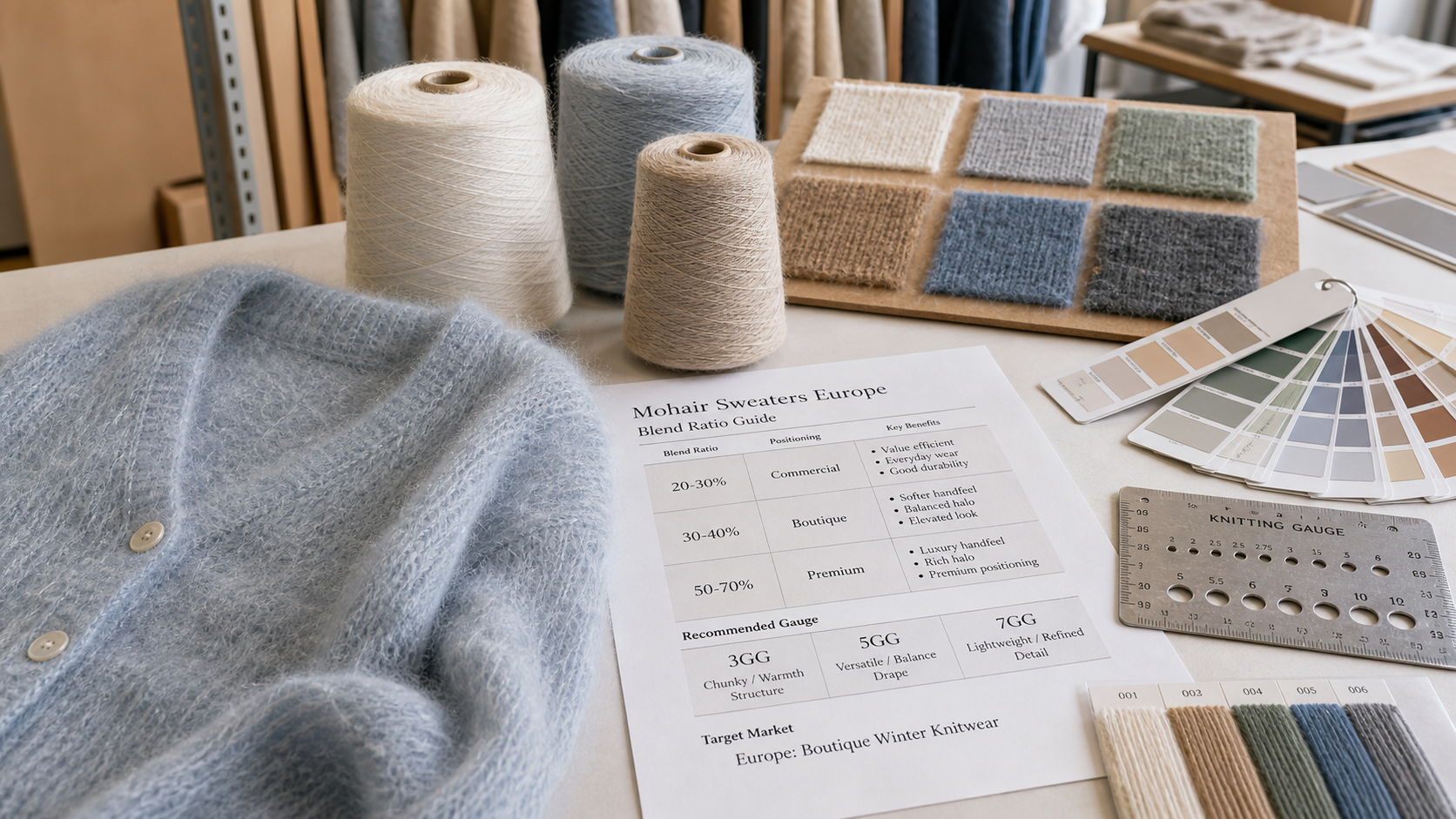
Mohair sweaters have become a strong category in the European autumn and winter knitwear market. From French-style cardigans and Nordic striped sweaters to oversized knit sweaters and boutique mohair cardigans, mohair appears frequently in premium womenswear, DTC collections and boutique knitwear wholesale programs.
The appeal is easy to understand. Mohair is light, warm, fluffy, softly lustrous and highly photogenic. Compared with basic wool, it has stronger visual texture. Compared with pure cashmere, it can create a premium look without always reaching the same cost level.
For brands looking for a custom knitwear manufacturer, sweater factory OEM, mohair knitwear supplier or private label knitwear partner, mohair is not just about choosing a fiber percentage. The final result depends on the blend ratio, yarn structure, sweater gauge, silhouette, custom dyeing, brushing finish and target market.
Why European Customers Like Mohair Knitwear
European consumers are familiar with natural animal fibers. Wool, cashmere, alpaca and mohair are not unusual in autumn and winter wardrobes. Many customers already understand the value of a mohair sweater: it is light, warm, fluffy and visually soft.
European styling also works well with mohair. France, the UK, Italy, Germany and the Nordic markets all have strong demand for cardigans, pullovers, turtleneck knitwear, layering pieces and outerwear-friendly knitwear. Mohair’s soft halo fits French, vintage, Nordic and boutique styling very naturally.
Mohair also performs well online. Its fuzzy surface, soft colors and blurred texture are easy to capture in product photography. For DTC brands, social media and lookbooks, a mohair cardigan often creates more visual interest than a plain basic sweater.
In Europe, mohair is often positioned as a boutique and premium winter yarn rather than a basic commodity yarn. That is why many DTC knitwear brand suppliers and small designer knitwear manufacturers use mohair as a key yarn for autumn and winter development.
Why Mohair Is Usually Blended
Commercial sweaters rarely use 100% mohair. This does not mean pure mohair is not valuable. It simply means that high mohair content can be more expensive and more demanding in terms of stability, shedding control and consumer comfort.
By blending mohair with wool, nylon, acrylic, polyester, alpaca or recycled yarn, a sweater can become more stable, durable and suitable for bulk sweater production or low MOQ knitwear projects.
For a deeper comparison of premium yarn behavior, brands can also review YouTricot’s knitwear yarn OEM guide and material knowledge page.
| Blend | Main Benefit | Best Use |
|---|---|---|
| Mohair + Wool | Warm, natural, premium | Winter sweaters, cardigans, turtlenecks |
| Mohair + Nylon | Better strength and stability | Commercial production |
| Mohair + Acrylic | More cost-friendly, visible fuzz | Mid-market and low MOQ programs |
| Mohair + Alpaca | Softer and fluffier | Premium womenswear |
| Mohair + Recycled yarn | Better sustainability story | Sustainable knitwear projects |
Blending is not a downgrade. It is often what makes mohair knitwear commercially wearable.
10%-15% Mohair: Light Fuzz and Easy Market Acceptance
A 10%-15% mohair blend gives a light fuzzy effect without making the sweater too bold or expensive. It is a good entry option for brands testing mohair for the first time.
This ratio works well for basic crew neck sweaters, lightweight cardigans, womenswear knit tops, everyday pullovers and DTC basics.
Recommended gauges:
- 7GG for medium-weight crew neck sweaters and basic cardigans
- 9GG for lightweight womenswear tops
- 12GG for fine, lighter layering pieces
The main advantage is accessibility. The cost is easier to control, the comfort level is higher, and it works well for low MOQ knitwear factory projects.
The limitation is that the fuzzy effect is subtle. It may not be strong enough for brands looking for a high-impact boutique look.
20%-30% Mohair: The Best Commercial Ratio
For most brands, 20%-30% mohair is the most balanced and commercially useful range. It gives a visible mohair halo, photographs well and still keeps the product wearable and manageable in cost.
If a brand asks a custom sweater manufacturer where to start for a first mohair collection, this is often the safest answer.
Best styles include mohair cardigans, crew neck mohair sweaters, relaxed pullovers, striped sweaters, soft turtleneck knitwear, cropped cardigans and boutique sweater collections.
Recommended gauges:
- 5GG for visible texture and autumn/winter weight
- 7GG for the best balance of cost, hand feel and stability
- 9GG for lighter womenswear tops
This ratio works especially well for DTC womenswear brands, European boutiques, mid-to-high-end wholesalers and private label knitwear collections.
The small limitation is that some sensitive customers may feel slight itchiness when worn directly on skin. This can be managed through a relaxed fit, layering suggestions or a softer blend structure.
30%-40% Mohair: Premium Boutique and Designer Knitwear
A 30%-40% mohair blend gives a stronger fluffy surface and a lighter, airier feel. It looks closer to premium mohair knitwear and is ideal for brands that want a more distinctive product.
This ratio is suitable for European boutiques, designer labels, premium DTC womenswear and small designer knitwear manufacturer projects.
Best styles include oversized mohair sweaters, cropped cardigans, vintage striped pullovers, designer knit tops, soft cardigans and autumn/winter capsule collections.
Recommended gauges:
- 3GG for chunky, high-impact styles
- 5GG for premium cardigans and key winter styles
- 7GG for lighter womenswear with a refined look
The advantage is a clear premium appearance. The texture, color depth and lightness all fit well with European boutique styling.
The only caution is that sampling, washing and finishing need more attention. The higher the mohair content, the more important it is to check size stability, brushing effect and post-wash performance.
50%-70% Mohair: Premium Statement Pieces
A 50%-70% mohair blend is for brands that want a strong fuzzy look and a high-end visual statement. It is better suited to premium collections, boutique display pieces and hero styles rather than low-price bulk production.
Best styles include high-pile oversized sweaters, luxury cardigans, premium mohair cardigans, runway-inspired knitwear and capsule collection hero pieces.
Recommended gauges:
- 3GG for chunky statement sweaters
- 5GG for more commercial high-mohair styles
- 7GG for refined premium styles, if the yarn and factory capability support it
The biggest advantage is visual identity. Customers immediately understand the product as soft, warm and special. In the European market, this type of sweater is often more suitable for a higher retail price.
The limitation is higher cost and more careful maintenance. It is better to start with small-batch testing before moving into larger production.
YouTricot’s material library also includes a 50% mohair / 16% wool / 34% nylon structure designed for premium loft, tensile strength and reduced shedding, which is especially suitable for 3GG-7GG brushed mohair developments.
70%+ Mohair: Niche Luxury Development
Mohair content above 70% is a niche premium direction. It can work for designer labels, showpieces, image styles and special capsule collections.
It has a very strong fuzzy surface, but cost, care requirements, comfort and production stability need to be carefully reviewed. For a first mohair collection, most brands should not begin here.
Mohair Blend Ratio, Style and Gauge Guide
| Mohair Ratio | Main Benefit | Best Styles | Suggested Gauges | Best For |
|---|---|---|---|---|
| 10%-15% | Cost-friendly, easy to wear | Crew necks, light cardigans, daily sweaters | 7GG, 9GG, 12GG | Startups, low MOQ |
| 20%-30% | Balanced and commercial | Cardigans, stripes, turtlenecks, relaxed sweaters | 5GG, 7GG, 9GG | DTC, boutiques, wholesalers |
| 30%-40% | Fluffy and premium | Oversized sweaters, cropped cardigans, boutique styles | 3GG, 5GG, 7GG | Designer brands, boutiques |
| 50%-70% | Strong visual value | Premium cardigans, hero styles, capsules | 3GG, 5GG, 7GG | Premium brands, buyers |
| 70%+ | Niche luxury | Showpieces and special collections | 3GG, 5GG | High-end designer labels |
Custom Dyeing: A Key Step for Premium Mohair Sweaters
Mohair is excellent for custom dyeing. Because the fiber has a soft lustre and fuzzy halo, colors often look softer and more layered than they do on basic wool.
Stock colors are suitable for low MOQ programs, fast sampling and first market tests. Custom dyeing is better for premium brands, designer collections and boutique sweater collections.
Popular premium colors include misty blue, wine red, sage green, cream, caramel brown, dusty lilac, rose pink and sea-salt blue.
Custom dyeing gives a sweater stronger brand identity. It also helps with lookbooks, e-commerce hero images and boutique merchandising. For high-end mohair sweaters, color is not just decoration; it is part of the product value.
Brands should remember that custom dyeing usually means higher MOQ, longer lead time and lab dip approval. Dark and light colors may also look different after brushing, so bulk production should only begin after the final color and surface effect are confirmed.
For visual reference, YouTricot’s fashion gallery includes a 9GG ultra-fine kid mohair cardigan that shows how light gauge, soft color and fuzzy texture can work together for European-style layering.
Brushing Finish: The Detail That Creates a Premium Look
Mohair has a natural halo, but the final fluffy surface depends heavily on finishing. Brushing is one of the most important processes in premium mohair sweater development.
A controlled brushing finish can make a mohair cardigan, chunky knit sweater, oversized mohair sweater or cropped cardigan look softer, fluffier and more atmospheric.
The benefits include:
- Stronger fluffy surface
- Softer color appearance
- Better product photography
- More boutique-style texture
- Higher perceived value
Brushing works especially well on 3GG, 5GG and 7GG styles. A light brushing effect can be used on 9GG, but heavy brushing is usually not recommended for finer gauges.
Good brushing is not simply “pulling the hair out.” The factory must control pressure, direction, brushing times and consistency. Too little brushing gives a weak effect. Too much brushing may affect size stability, shedding and garment structure.
For premium mohair projects, a pre-production sample is important. Brands should check size change before and after brushing, surface evenness, shedding level, color change and post-wash stability.
The same principle applies to cashmere and other brushed luxury fibers. Brands can read more about surface finishing in our brushed cashmere process guide.
How to Choose a Mohair Knitwear Supplier for European Brands
A good mohair knitwear supplier should do more than quote a price. Mohair development requires yarn judgment, gauge testing, finishing control and clear quality standards.
Before starting bulk production, brands should ask:
- Can you suggest mohair blend ratios based on target price and market?
- Do you support 3GG, 5GG, 7GG, 9GG and 12GG mohair development?
- Can you provide fast sampling knitwear for mohair cardigans or oversized sweaters?
- Do you support low MOQ knitwear for first-season testing?
- Can you manage custom dyeing and lab dip approval?
- Do you have brushing finish experience for premium mohair sweaters?
- How do you control shedding, pilling and size stability?
- Can you provide knitwear quality control and pre-shipment inspection?
- Do you support private label knitwear, care labels and custom packaging?
For European brands, the right supplier should also understand boutique styling, soft color palettes, premium hand feel and realistic production lead times. A reliable mohair knitwear supplier can reduce sampling risk and improve bulk production consistency.
For small European brands, supplier choice is also about risk control. Our guide on high-end knitwear OEM from China explains how sampling, yarn review, gauge selection and quality checks reduce sourcing risk before bulk production.
For broader sourcing planning, see our China knitwear OEM guide.
Cost and Pricing Logic for Mohair Knitwear
Mohair usually costs more than basic wool, acrylic and many synthetic fibers, but it can be more accessible than many pure cashmere sweater custom projects. This makes it commercially valuable: it can create a premium look without always reaching the price level of pure cashmere.
Cost depends on mohair content, whether kid mohair or super kid mohair is used, blend material, yarn count, gauge, garment weight, custom dyeing, brushing finish, MOQ, certification and packaging requirements.
A practical strategy:
- Use 20%-30% mohair for commercial bulk styles
- Use 30%-40% mohair for boutique and designer styles
- Use 50%-70% mohair for premium hero pieces
- Use stock colors and low MOQ knitwear testing for first development
- Add custom dyeing and brushing for premium collections
For brands focused on sustainability, recycled yarn knitwear, GRS certified knitwear or OEKO-TEX knitwear factory documentation can support the story. But the final hand feel and garment stability should still come first.
For responsible sourcing references, brands can review the Responsible Mohair Standard by Textile Exchange, which focuses on animal welfare, land management and chain of custody. For chemical safety, OEKO-TEX STANDARD 100 is widely used for textiles tested for harmful substances. If recycled yarn is part of the collection, the Global Recycled Standard can support recycled material claims and traceability.
Customer Awareness and Acceptance
European customers are relatively familiar with mohair, especially in France, the UK, Italy, the Nordic region and Germany. Many customers already associate mohair sweaters with lightness, warmth, softness and a fluffy surface.
They usually respond well to these benefits: softer visual texture than basic wool, lighter feel than heavy winter sweaters, stronger design value than plain knitwear, and good compatibility with French, Nordic, vintage and boutique styling.
Customers may ask whether mohair is itchy or whether it sheds. These questions should not be avoided. Mohair has natural fibers on the surface, so slight shedding can happen. Skin feel depends on blend ratio, yarn quality, yarn structure and how the sweater is worn. For sensitive skin, brands can recommend layering or choose a lower mohair content.
A good product description could say:
“Mohair blend yarn gives this sweater a light, warm and fluffy texture, while the blended structure helps improve durability and everyday wearability.”
Care Instructions for Mohair Sweaters
Good care helps mohair sweaters keep their shape and fluffy texture.
High-mohair styles are best dry cleaned. Lower mohair blends can often be hand washed in cold water, but hot water should be avoided to prevent shrinking and distortion.
Use mild wool detergent. Do not use bleach, strong alkaline detergent or harsh stain removers. Do not rub the sweater heavily. Press gently during washing.
Avoid machine washing, spinning and tumble drying. After washing, press out water with a towel and lay the sweater flat to dry. Do not hang it while wet, as this may stretch the shoulders and body length.
For storage, fold the sweater instead of hanging it for long periods. Slight pilling can be removed carefully with a professional fabric shaver, but avoid over-trimming the mohair surface.
Recommended care copy:
“Hand wash cold or dry clean. Use mild wool detergent. Do not bleach, tumble dry or wring. Lay flat to dry and store folded.”
FAQ
Is a higher mohair percentage always better?
No. Higher mohair content gives a stronger fuzzy effect, but it also increases cost, care requirements and production risk. For commercial styles, 20%-30% mohair is often the most balanced choice.
Do European customers like mohair sweaters?
Yes. European customers are familiar with mohair cardigans, mohair sweaters and fuzzy knitwear, especially in French, Nordic, vintage and boutique styling.
What gauge is best for mohair sweaters?
5GG and 7GG are best for most commercial mohair sweaters. 3GG and 5GG work well for chunky statement pieces. 9GG and 12GG are better for lighter styles.
Is mohair suitable for custom dyeing?
Yes. Mohair has a soft lustre and fuzzy halo, so custom-dyed colors often look layered and premium. Lab dip approval is important before bulk production.
Does brushing make mohair sweaters look more premium?
Yes. A controlled brushing finish can improve fluffiness, softness and visual value. The brushing level should always be approved through sampling.
What styles are best for mohair knitwear?
Mohair works well for cardigans, oversized sweaters, cropped cardigans, striped sweaters, turtleneck knitwear and boutique womenswear collections.
Is mohair good for low MOQ knitwear projects?
Yes, especially when using stock yarn colors and 20%-30% mohair blends. Custom dyeing may require higher MOQ, so first-season testing should start with limited colors.
How can brands reduce shedding in mohair sweaters?
Choose the right blend ratio, avoid excessive brushing, confirm the yarn structure and test the pre-production sample. Slight shedding is normal for fuzzy mohair knitwear.
What should brands ask a mohair knitwear supplier?
Ask about mohair ratios, available gauges, sampling time, custom dyeing, brushing finish, MOQ, quality control, size stability and post-wash performance.
Is mohair more affordable than cashmere?
Usually, mohair is more expensive than basic wool or acrylic, but it can be more accessible than many pure cashmere sweater projects. It offers a premium look with flexible price positioning.
Conclusion
Mohair is popular in Europe because it fits what autumn and winter knitwear customers want: lightness, warmth, softness, texture and a premium visual effect. It works especially well for mohair cardigans, oversized knit sweaters, boutique womenswear, turtleneck knitwear and high-value winter collections.
For stable commercial styles, 20%-30% mohair is the most recommended range. For boutique and designer collections, 30%-40% gives a more premium look. For hero styles and high-end capsules, 50%-70% can be tested. For first development or low MOQ programs, 10%-30% is usually safer.
A good mohair sweater is not defined only by fiber content. The blend ratio, gauge, silhouette, color, brushing finish, MOQ and target market must work together. For brands developing mohair cardigans, oversized sweaters or private label knitwear for the European market, working with an experienced mohair knitwear supplier can reduce sampling risk and improve bulk production consistency. To discuss yarn ratio, gauge, custom dyeing or brushing finish for your next collection, contact YouTricot for a technical review.