

Key Takeaways
- A 20%–30% mohair blend is the most balanced starting point for many commercial European sweater collections. This range creates a visible halo while keeping cost, comfort, production stability and care requirements more manageable than higher-mohair constructions. It works particularly well for cardigans, relaxed pullovers, striped sweaters, turtlenecks and boutique womenswear. A 5GG or 7GG construction normally provides the strongest balance of texture and stability, while 9GG supports lighter styles. The final decision should still be tested against the actual yarn count, companion fibres, garment weight, silhouette and finishing method.
- Mohair percentage and machine gauge must be selected together rather than treated as separate specifications. A 3GG or 5GG construction can produce chunky, high-impact sweaters, while 7GG supports versatile commercial cardigans and pullovers. Finer 9GG and 12GG structures are more suitable for lightweight layering pieces when the yarn count and stitch structure support them. Higher mohair content does not automatically create a better garment: it increases halo and visual value but may also increase cost, shedding, sensitivity and finishing risk. Buyers should approve a knitted sample after washing and brushing before bulk production.
- A reliable mohair knitwear supplier should control yarn specification, dyeing, brushing, measurements and shedding—not merely quote a fibre percentage. Buyers should confirm the complete blend, yarn count, colour method, gauge, garment weight, brushing level, care requirements, MOQ and inspection standard in writing. Stock-supported colours can simplify first-season testing, while custom dyeing usually requires lab-dip approval and may affect minimums and timing. For responsible-material claims, request order-specific evidence and verify the scope of standards such as the Responsible Mohair Standard, OEKO-TEX Standard 100 or Global Recycled Standard rather than relying on unsupported certification logos.
Mohair Ratio, Style and Gauge Quick Reference
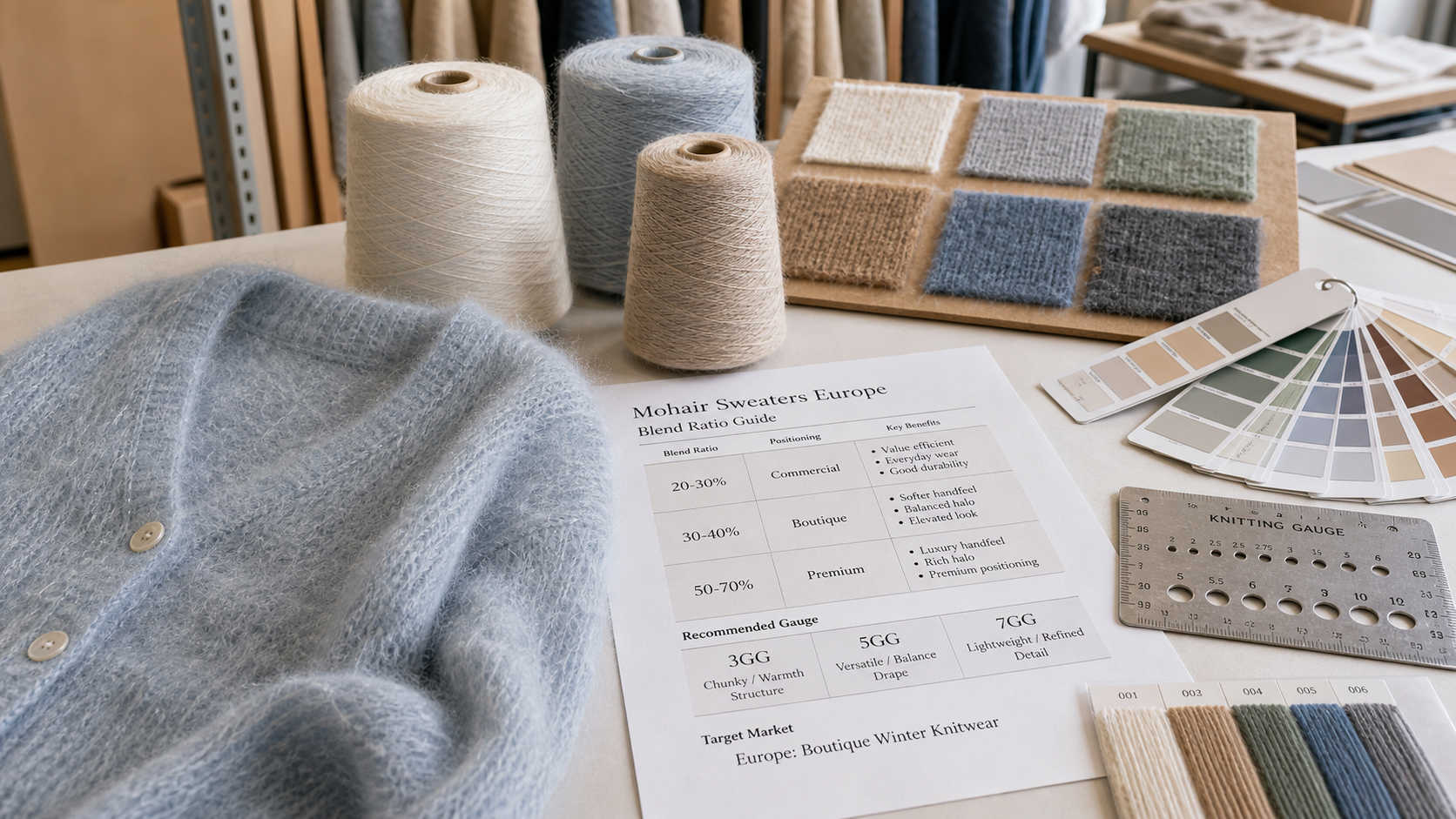
The table below provides practical starting points for matching mohair percentage, product type and knitting gauge. It should not be treated as a universal machine specification because yarn count, ply, companion fibres, stitch density, silhouette and brushing can change the result. A 7GG garment made with a fine, airy yarn can behave differently from another 7GG garment using a heavier or more compact construction. Buyers should use the table to define a sample direction, then approve garment weight, measurements, hand feel, surface character and post-wash stability before authorising bulk production.
| Mohair Ratio | Surface and Positioning | Best Product Types | Suggested Gauges | Commercial Use | Main Risk to Check |
|---|---|---|---|---|---|
| 10%–15% | Light halo; accessible positioning | Crew necks, light cardigans, everyday pullovers and layering pieces | 7GG, 9GG, 12GG | First mohair launch, basic programs and low-MOQ testing | Halo may be too subtle for a statement product |
| 20%–30% | Visible halo; balanced commercial positioning | Cardigans, striped sweaters, turtlenecks and relaxed pullovers | 5GG, 7GG, 9GG | DTC brands, boutiques, private label knitwear and wholesalers | Skin feel and brushing level require approval |
| 30%–40% | Fluffier, lighter and more premium | Oversized sweaters, cropped cardigans and designer knit tops | 3GG, 5GG, 7GG | Designer labels, boutiques and premium capsules | Size stability, shedding and wash performance |
| 50%–70% | Strong halo and statement positioning | Premium cardigans, high-pile sweaters and hero styles | 3GG, 5GG, 7GG | Premium collections and boutique display pieces | Higher cost, care requirements and production sensitivity |
| Above 70% | Niche luxury with a pronounced surface | Showpieces, image styles and special designer capsules | 3GG, 5GG | High-end designer development | Comfort, stability, shedding, maintenance and cost |
Why Do Mohair Sweaters Appeal to European Buyers?
Mohair sweaters suit European autumn and winter markets because they combine low visual weight with warmth, texture and strong photographic appeal. The soft halo works naturally with French-inspired cardigans, Nordic stripes, vintage pullovers, oversized silhouettes and boutique womenswear. Compared with a plain wool surface, mohair can create greater colour depth and a more distinctive appearance. Compared with many pure cashmere products, a blended mohair sweater can offer more flexible price positioning, although the result depends on the exact fibre ratio and construction. Mohair is therefore useful for DTC collections, boutiques, wholesalers and seasonal capsule launches.
Why Is Mohair Usually Blended with Other Fibres?
Mohair is commonly blended because companion fibres can improve strength, stability, comfort, price positioning and production suitability. Wool adds natural warmth and body; nylon can support tensile strength and structural stability; acrylic can reduce cost and maintain visible fuzz; alpaca can increase softness and loft; and recycled fibres can support a responsible-material strategy when properly documented. Blending should not automatically be viewed as a reduction in quality. The correct blend is the one that achieves the approved surface, hand feel, durability, garment weight and commercial target. Buyers should confirm every fibre percentage rather than describing a product only as “mohair.”
A suitable mohair yarn should therefore be evaluated by fibre ratio, yarn count, companion fibres, intended gauge and finishing method before sampling begins.
| Blend Structure | Primary Benefit | Typical Application | Control Point |
|---|---|---|---|
| Mohair + wool | Natural warmth, body and premium character | Winter sweaters, cardigans and turtlenecks | Skin feel, shrinkage and pilling |
| Mohair + nylon | Strength and production stability | Commercial bulk programs and airy yarn structures | Exact composition and hand feel |
| Mohair + acrylic | More accessible cost and visible fuzz | Mid-market and introductory programs | Surface recovery and perceived quality |
| Mohair + alpaca | Additional loft and softness | Premium womenswear and statement knits | Shedding, weight and dimensional stability |
| Mohair + recycled fibre | Recycled-content sourcing option | Documented sustainable knitwear programs | Certification scope and transaction evidence |
For a broader comparison of cashmere, merino wool, cotton, silk blends and recycled yarns, read the Knitwear Yarn OEM Guide.
How Should Brands Select a Mohair Blend Ratio?
The correct mohair ratio depends on the intended surface, price position, consumer comfort, gauge and production risk. Lower ratios support accessible products with a restrained halo, while higher ratios create stronger visual texture and premium positioning. However, fibre percentage does not describe yarn quality, yarn count, companion fibres or construction. Two garments with the same mohair percentage may perform differently after washing and brushing. Brands should therefore select a ratio as part of the complete product specification, then test the actual yarn through a swatch, sample and pre-production approval rather than buying on composition alone.
10%–15% Mohair: Light Halo and Accessible Positioning
A 10%–15% mohair blend is suitable for brands that want a light fuzzy effect without making mohair the dominant product feature. It works well for basic crew-neck sweaters, lightweight cardigans, everyday pullovers, womenswear knit tops and layering pieces. Suggested starting gauges are 7GG for medium-weight cardigans and crew necks, 9GG for lighter womenswear, and 12GG for fine layering products. This range is commercially accessible and can be easier to use in a first-season launch. Its limitation is visual impact: the halo may be too subtle for premium statement positioning.
20%–30% Mohair: Balanced Commercial Development
A 20%–30% mohair blend is the strongest commercial starting point for many European cardigans and sweaters. It normally provides a visible halo, photographic texture and manageable price positioning without the stronger production sensitivity of high-mohair yarns. Suitable styles include crew necks, relaxed pullovers, striped sweaters, cropped cardigans and soft turtlenecks. Suggested gauges are 5GG for autumn and winter texture, 7GG for balanced commercial construction, and 9GG for lighter womenswear. Sensitive customers may still notice surface fibres, so brands should approve skin feel and consider relaxed silhouettes or layering instructions.
30%–40% Mohair: Premium Boutique Knitwear
A 30%–40% mohair blend creates a clearer premium surface and is suitable for boutique, designer and high-value DTC collections. The garment can feel lighter and airier while displaying a stronger halo than lower-ratio blends. Oversized sweaters, cropped cardigans, vintage stripes and capsule-collection knit tops are common applications. Suggested gauges are 3GG for chunky visual impact, 5GG for premium cardigans and winter styles, and 7GG for a lighter refined appearance. Sampling should verify brushing consistency, measurements, colour appearance, shedding and stability before and after washing.
50%–70% Mohair: Premium Statement Pieces
A 50%–70% mohair blend is best reserved for hero styles that depend on a pronounced fuzzy surface and strong visual identity. Appropriate products include high-pile oversized sweaters, luxury cardigans, runway-inspired knitwear and premium capsule pieces. Suggested gauges are 3GG for chunky statements, 5GG for more commercial high-mohair construction, and 7GG when yarn count and technical capability support a refined result. One retained production reference uses 50% mohair, 16% wool and 34% nylon for loft, strength and reduced shedding across 3GG–7GG development. The exact result must still be sampled.
Above 70% Mohair: Niche Luxury Development
Mohair content above 70% is a niche direction for designer showpieces, image products and specialised capsule collections. It produces a highly pronounced surface but also increases the importance of yarn quality, comfort, care, finishing and dimensional control. Suggested starting gauges are 3GG and 5GG, depending on yarn count and desired weight. Most brands should not begin their first mohair collection at this level because commercial acceptance and production consistency require more testing. A high ratio should only be selected when the visual effect justifies the increased cost and the approved sample demonstrates acceptable wear performance.
Mohair vs Cashmere vs Wool: Which Fibre Fits the Product?
Mohair, cashmere and wool serve different product positions and should be compared by surface, warmth, durability, care and commercial objective rather than softness alone. Mohair is chosen for halo, lightness and visual texture; cashmere is valued for fine softness and luxury hand feel; wool offers broad versatility, resilience and accessible sourcing options. Actual cost and performance depend on fibre grade, origin, yarn count, blend, garment weight and finishing. The table below provides a sourcing comparison for European collections without assuming that one fibre is universally better than the others.
| Factor | Mohair | Cashmere | Wool |
|---|---|---|---|
| Primary hand and surface | Airy, lustrous and visibly fuzzy | Fine, soft and refined | Warm, resilient and variable by grade |
| Visual positioning | Boutique, textural and photographic | Luxury, understated and tactile | Classic, versatile and commercially broad |
| Relative cost level | Medium to high, depending on ratio and grade | Usually high, especially for premium pure cashmere | Low to high, depending on breed, fineness and quality |
| Warmth-to-weight impression | Light and warm with an airy halo | Warm with a light, fine hand | Ranges from lightweight merino to heavy winter wool |
| Common wear concern | Shedding, sensitivity and halo compression | Pilling, abrasion and delicate care | Pilling, felting or itchiness depending on quality |
| Typical products | Cardigans, oversized sweaters and statement knits | Fine sweaters, luxury basics and premium cardigans | Crew necks, outer layers, cardigans and everyday knitwear |
| Care requirements | Gentle cleaning, flat drying and surface protection | Gentle cleaning, flat drying and abrasion control | Depends on yarn and finish; often wool-cycle or hand-care instructions |
| Best commercial role | Visible texture and seasonal differentiation | Luxury hand feel and premium fibre positioning | Versatile core collections and broad price architecture |
How Does Custom Dyeing Affect Mohair Sweaters?
Custom dyeing gives mohair sweaters stronger brand identity but introduces colour approval, MOQ and timing considerations. Mohair’s lustre and surface halo can make colours appear softer and more layered than on compact wool yarns. Misty blue, wine red, sage green, cream, caramel brown, dusty lilac, rose pink and sea-salt blue are useful premium directions retained from the original guide. Stock-supported colours are normally easier for sampling and limited tests. Custom colours require lab-dip approval, and the buyer should compare colour before and after brushing because surface finishing can alter the visual depth of dark and light shades.
How Does Brushing Create a Premium Mohair Surface?
Controlled brushing increases the visible halo of mohair, but excessive brushing can damage structure, measurements and shedding performance. The process must control pressure, direction, repetition and consistency across garment panels and production lots. It is particularly effective on 3GG, 5GG and 7GG garments. A light effect can be developed on 9GG, while heavy brushing is generally unsuitable for finer structures unless testing proves otherwise. Buyers should approve surface evenness, colour appearance, garment dimensions, shedding and post-wash stability on a pre-production sample. More finishing principles are explained in the brushed cashmere process and care guide.
- ☐ Compare measurements before and after brushing.
- ☐ Check surface uniformity across body, sleeves, ribs and seams.
- ☐ Evaluate loose-fibre shedding under the intended wear conditions.
- ☐ Confirm that brushing has not weakened linking or garment structure.
- ☐ Compare colour appearance under consistent lighting.
- ☐ Retain an approved sample as the bulk-production reference.
How Should European Brands Select a Mohair Knitwear Supplier?
A mohair knitwear supplier should be evaluated on material judgment, gauge development, brushing control and bulk repeatability—not unit price alone. A qualified supplier should explain how the proposed blend supports the target product, provide realistic gauge options and identify risks involving skin feel, shedding, shrinkage and finishing. European brands should also verify sampling, colour approval, measurement control, inspection, labels, packaging and communication procedures. A custom sweater manufacturer that regularly handles ordinary wool may not automatically have the finishing experience required for high-halo mohair. Relevant samples and production records are more useful than general claims.
- ☐ Can the supplier explain why a specific mohair ratio suits the product?
- ☐ Can it develop 3GG, 5GG, 7GG, 9GG and 12GG where technically appropriate?
- ☐ Can it confirm the full fibre composition, yarn count and yarn source?
- ☐ Does it support swatches, prototypes and pre-production samples?
- ☐ Can it control custom dyeing and lab-dip approval?
- ☐ Does it have documented brushing and finishing procedures?
- ☐ How are shedding, pilling, shrinkage and measurements checked?
- ☐ Is MOQ stated by yarn, style, colour and total order?
- ☐ Can it support private label knitwear details and packaging?
- ☐ Does it provide in-line and final quality-control evidence?
For a broader supplier audit covering yarn control, knitting, linking, finishing, quality systems and traceability, use this Knitwear Factory Evaluation Checklist.
What Determines Mohair Sweater Cost and MOQ?
Mohair sweater cost is determined by the complete garment specification rather than fibre percentage alone. Important variables include whether kid mohair or another grade is used, the full blend, yarn count, gauge, stitch structure, garment weight, colour method, brushing, finishing, order quantity, colour split, testing, labels and packaging. A 20%–30% mohair blend yarn sweater may provide suitable commercial positioning, while 30%–40% supports premium boutique styles and 50%–70% is better reserved for hero products. For low MOQ knitwear, stock-supported yarn and consolidated colours generally reduce material fragmentation and sourcing risk.
| Cost Driver | Lower-Complexity Direction | Higher-Complexity Direction |
|---|---|---|
| Mohair ratio | 10%–30% commercial blend | 50%–70% or above for statement styles |
| Colour | Available stock-supported colours | Custom dyeing with lab-dip approval |
| Gauge and structure | Proven commercial construction | Complex textures or technically sensitive fine gauge |
| Finishing | Controlled light halo | Pronounced brushing with additional testing |
| Order planning | Concentrated styles and colourways | Fragmented quantities across many colours |
| Documentation | Standard order records | Certified material, testing and traceability requirements |
What Responsible-Sourcing Evidence Applies to Mohair?
Responsible-material claims should be supported by standards and documents that apply to the actual fibre, supplier and order. The Responsible Mohair Standard addresses animal welfare, land management, social requirements and chain of custody for certified mohair. OEKO-TEX Standard 100 concerns harmful-substance testing for certified textile products. If recycled fibres are used, the Global Recycled Standard supports recycled-material verification and supply-chain tracking. Buyers should check certificate scope, validity, supplier identity and transaction evidence before making product claims.
How Should Mohair Sweaters Be Washed and Stored?
Mohair sweaters require gentle cleaning, flat drying and protection from heat, friction and long-term hanging. High-mohair garments may specify dry cleaning, while some lower-ratio blends may support cold hand washing when garment testing confirms it. Use mild wool detergent and avoid bleach, strong alkaline cleaners, aggressive rubbing, machine spinning and tumble drying. Press water out gently with a towel, reshape the sweater and dry it flat. Store the garment folded to prevent shoulder and body-length distortion. Any care label should reflect testing of the finished garment rather than a generic fibre assumption.
- Check the approved care label. Follow the tested instruction for the complete blend and finished garment.
- Use cold water if hand washing is permitted. Hot water and agitation can cause shrinkage or distortion.
- Select a mild wool detergent. Avoid bleach, alkaline detergent and aggressive stain removers.
- Do not rub, wring or machine-spin. Compress the garment gently and use a towel to remove water.
- Reshape and dry flat. Do not tumble dry or hang the garment while wet.
- Store folded. Protect the surface from friction, hooks and prolonged compression.
- Remove pilling cautiously. Use a suitable professional tool without repeatedly trimming the intended mohair halo.
Recommended care copy: “Hand wash cold or dry clean. Use mild wool detergent. Do not bleach, tumble dry or wring. Lay flat to dry and store folded.” The final wording should be confirmed through garment testing.
Frequently Asked Questions
Is a Higher Mohair Percentage Always Better?
No. A higher mohair percentage creates a stronger halo but does not automatically improve comfort, durability or commercial suitability. It can increase material cost, shedding, finishing sensitivity and care requirements. For many cardigans and sweaters, 20%–30% provides a practical balance between visible texture and production stability. Ratios of 30%–40% suit premium boutique products, while 50%–70% is more appropriate for statement styles. Buyers should compare actual yarn quality, companion fibres, yarn count, gauge and garment weight rather than ranking products by mohair percentage alone.
What Gauge Is Best for a Mohair Sweater?
5GG and 7GG are the most versatile starting gauges for commercial mohair sweaters, but there is no universal best gauge. A 3GG construction supports chunky, high-impact products; 5GG works well for winter cardigans and textured pullovers; 7GG offers balanced commercial versatility; and 9GG or 12GG can support lighter layering styles. The final choice depends on yarn count, ply, stitch structure, garment weight and desired halo. A supplier should test the selected yarn rather than promising a result based on gauge number alone.
How Can Brands Reduce Shedding in Mohair Knitwear?
Shedding can be managed through yarn selection, blend structure, controlled brushing, washing and pre-production testing, although a small amount may remain normal for fuzzy knitwear. Buyers should avoid specifying the strongest possible halo without considering fibre anchoring and garment stability. Review loose fibres after sample handling, fitting and approved cleaning. Compare the garment before and after brushing, inspect panel and seam areas, and confirm that bulk finishing follows the approved method. Excessive brushing should not be used to compensate for unsuitable yarn or weak construction.
Is Mohair Suitable for Low-MOQ Knitwear Development?
Mohair can be suitable for low-MOQ knitwear when yarn availability, colour planning and construction are controlled. Stock-supported yarns and a limited number of colours are usually easier to accommodate than custom-dyed yarn divided across many small colourways. A 20%–30% commercial blend can provide a useful starting point for first-season testing, but feasibility still depends on supplier yarn minimums, gauge, garment weight, finishing and order allocation. Buyers should request the MOQ per style, colour and yarn rather than relying on one headline quantity.
Is Mohair More Affordable Than Cashmere?
Mohair blends can offer more flexible price positioning than many premium pure-cashmere garments, but the comparison depends on material grade and product specification. High-mohair yarn, kid mohair, custom dyeing, pronounced brushing and low-volume colour splits can create a high-cost product. Cashmere prices also vary by fibre quality, yarn count, garment weight and finishing. Buyers should compare complete garments with equivalent weight, construction, quantity and commercial terms. Mohair should be selected for its halo and design value rather than treated only as a cheaper substitute for cashmere.
What Should Buyers Ask a Mohair Knitwear Supplier?
Buyers should ask a mohair knitwear supplier to explain the proposed ratio, full fibre composition, yarn count, gauge, garment weight and finishing method. The supplier should also confirm colour availability, custom-dyeing conditions, lab dips, MOQ, sampling, measurement control, brushing, shedding checks, washing, labels, packaging and final inspection. Request relevant examples and order-specific evidence rather than general marketing claims. Before bulk production, approve the pre-production sample, measurements, colour, surface effect and care instructions in writing so that the factory has a measurable production benchmark.
Request a Mohair Sweater Development Review
The safest starting point for a European mohair collection is a technical review of ratio, yarn structure, gauge, silhouette and finishing. Send the current tech pack, reference images, target mohair percentage, preferred companion fibres, colour plan, size range, quantity and intended retail positioning. YouTricot can review whether the proposed construction supports the desired halo, garment weight, comfort, MOQ and post-wash stability before sampling begins. The review can also identify which specifications are fixed and which variables should remain open until a swatch or prototype has been evaluated.