
Key Takeaways
- Twenty years in Prato established the quality standards behind this manufacturing model. Working with European brands, yarn suppliers, wholesalers and knitwear technicians developed a practical understanding of yarn hand feel, garment fit, washing performance, durability and finishing. Premium knitwear is not judged by fiber composition alone; buyers also examine how a garment fits, recovers after wear and performs after washing. That experience now guides material selection, knitting tension, measurement control, linking, washing and final inspection at the current manufacturing base in Dalang.
- A Dongguan knitwear manufacturer can combine integrated production with European-informed product judgment. Dalang connects yarn sourcing, computerized flat knitting, linking, washing, finishing, inspection, packaging and export coordination within an established manufacturing ecosystem. This concentration reduces handover delays and makes flexible order planning more practical. For fashion brands, the resulting model combines Prato-informed quality expectations with faster sampling, controllable production costs and an industrial structure suited to repeat orders, capsule collections and the development needs of independent designers.
- The current model supports premium custom knitwear without requiring brands to begin with large inventories. Selected stock-yarn programs can start at 30 pieces, while custom-dyed yarn or fully customized development generally begins at around 100 pieces. Sampling typically takes 7–10 working days after the yarn, gauge, measurements and technical requirements are confirmed. Bulk production usually requires 30–45 days. This structure is suitable for boutiques, DTC labels, independent designers, wholesalers and established European or US fashion brands.
Table of Contents
- Prato and Dongguan: Complementary Textile Strengths
- The Prato-to-Dongguan Manufacturing Story
- Manufacturing Capacity and Compliance
- Products and Materials
- Five Core Manufacturing Advantages
- From Design Brief to Bulk Production
- Low MOQ, Sampling and Lead Times
- Seven-Node Quality Control
- OEM vs ODM Knitwear
- Frequently Asked Questions
- About the Author
- Start a Knitwear Project
How Does a Dongguan Knitwear Manufacturer Combine Prato and Dalang Strengths?
Prato and Dongguan contribute different but complementary strengths to premium knitwear manufacturing. Prato provides textile heritage, material knowledge and the quality expectations associated with European fashion production. Dalang, Dongguan contributes an integrated industrial network, computerized knitting capacity, flexible order planning and coordinated export production. This comparison is not intended to declare one region superior. It explains how experience gained in the Italian textile district can guide a high-end custom knitwear manufacturer operating through Dongguan’s responsive production ecosystem.
| Comparison Factor | Prato, Italy | Dalang, Dongguan | Value for Fashion Brands |
|---|---|---|---|
| Primary contribution | Textile heritage and premium quality judgment | Integrated knitwear production ecosystem | European product standards with responsive execution |
| Material knowledge | Exposure to European yarn suppliers and fabric evaluation | Access to yarn sourcing and production partners | More informed yarn and blend selection |
| Product development | Focus on hand feel, fit, finishing and durability | Computerized programming and coordinated sampling | Faster development without ignoring performance |
| Production structure | Specialist textile knowledge across established suppliers | Knitting, linking, washing, inspection and packing within one cluster | Fewer delays between production stages |
| Order flexibility | Quality-led development for premium fashion markets | Suitable for small initial orders and repeat production | Lower inventory risk for emerging brands |
| Commercial role | Defines the product and quality mindset | Supports speed, flexibility and cost control | A balanced European-Asian sourcing model |
Authoritative reference : Prato Industrial Tourism and the Prato textile district.
What Is the Prato-to-Dongguan Manufacturing Story?
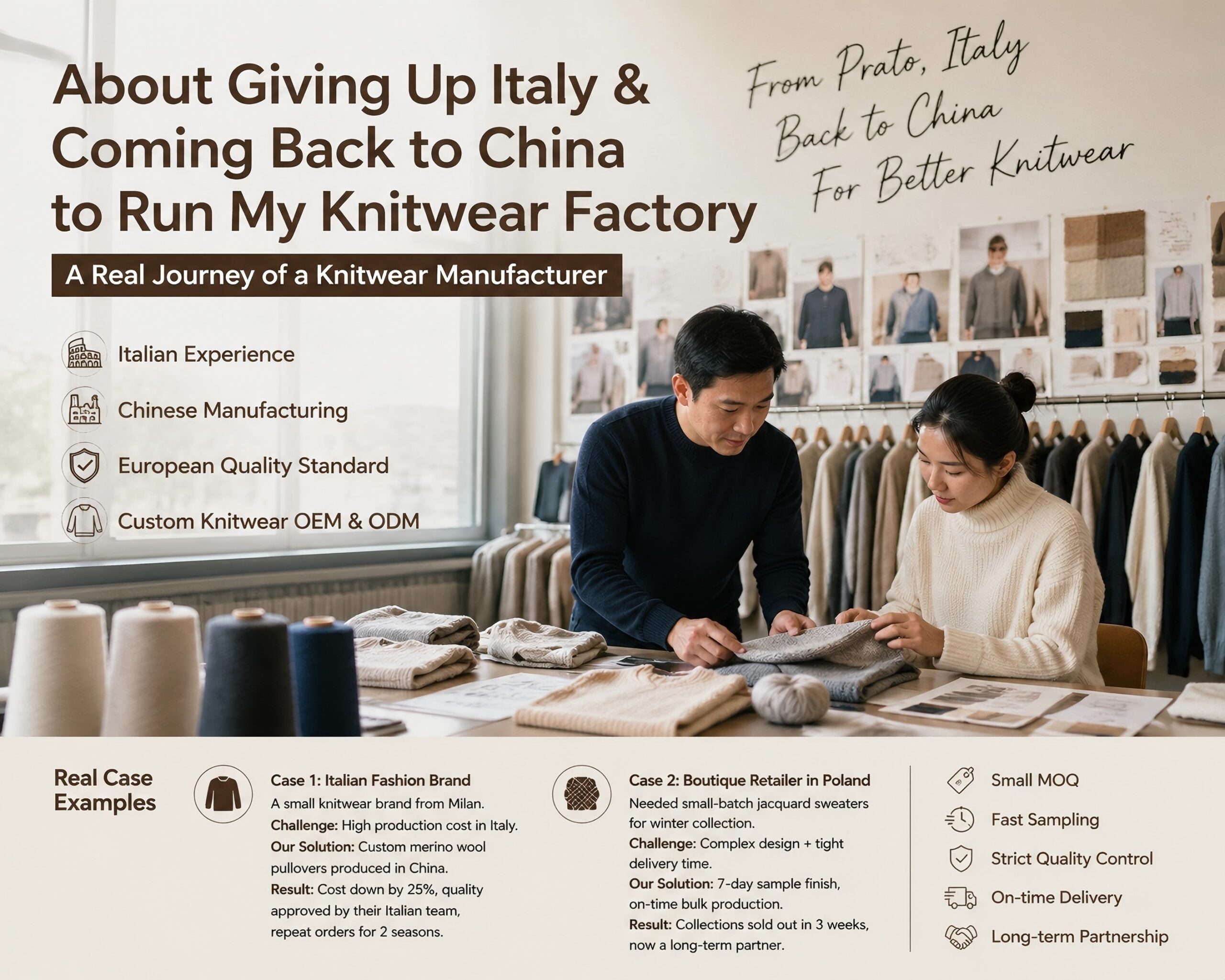
The manufacturing story connects 20 years of European textile experience with an integrated knitwear supply chain in Dalang. Prato provided exposure to premium yarns, European buyer expectations and the technical details that determine how a garment feels and performs. The 2024 move to Dongguan added faster coordination between yarn sourcing, knitting, linking, washing, finishing, inspection and export preparation. The result is a manufacturing model designed to preserve disciplined product judgment while responding to the commercial realities of modern fashion brands.
What Are the Three Milestones in the Story?
Three milestones explain how the current manufacturing model developed. Each stage contributed a different part of the company’s technical and commercial approach.
- Twenty years in Prato: Working with European brands, yarn suppliers, wholesalers and technicians developed practical knowledge of hand feel, fit, washing, durability and finishing.
- The 2024 transition: Frank moved from Prato to Dalang to combine that product judgment with an integrated supply chain capable of faster sampling and flexible quantities.
- The current operating model: International brands can begin with a sample or small order, evaluate communication and workmanship, and then progress to repeat production through the same coordinated workflow.
What Did 20 Years in Prato Teach About Premium Knitwear?
Twenty years in Prato taught Frank that premium knitwear quality is created through a sequence of technical decisions rather than a single expensive material. Cashmere requires controlled knitting tension to protect softness without creating an unstable garment. Merino wool requires shrinkage management and testing because washing performance directly affects fit. Wool-cashmere, cotton and silk blends must balance hand feel, durability, garment weight and target price. European buyers also evaluate linking, neckline construction, measurement consistency, finishing and recovery after wear. These lessons now inform yarn selection, sample evaluation, washing adjustments and final inspection.
Why Was the Move to Dongguan in 2024 a Strategic Transition?
The 2024 move was a strategic transition rather than a simple relocation of production. European brands increasingly needed a combination that was difficult to achieve through a single traditional sourcing model: premium product judgment, faster sampling, flexible opening quantities and more controllable costs. Dalang offered an established ecosystem for yarn sourcing, computerized flat knitting, linking, washing, finishing, inspection, packaging and export coordination. Bringing Prato-informed quality standards into this environment created a supply-chain model designed to respond faster while retaining disciplined material, construction and finishing decisions.
Related company background : Read the complete manufacturing story.
Related internal guide : China Knitwear OEM Manufacturing Guide.
Which Manufacturing Capabilities and Compliance Standards Support Current Production?
Current production is supported by 120 Shima Seiki and 80 Stoll computerized flat knitting machines covering gauges from 3G to 18G. In May 2026, the operation added 80 upgraded Stoll machines, including 50 machines in 12 gauge and 30 machines in 7 gauge. Shima Seiki equipment supports fine-gauge and seamless development, while strategic Cixing equipment support adds further production flexibility. The machine mix allows the factory to develop chunky structures, commercial mid-gauge garments and refined fine-gauge knitwear within one coordinated production system.
Compliance pathways also matter when serving EU and US fashion brands. Relevant programs can be developed around OEKO-TEX STANDARD 100 requirements for textiles tested for harmful substances, the Responsible Wool Standard for wool supply-chain responsibility and the Good Cashmere Standard for animal welfare, environmental and producer considerations. Certification scope should always be confirmed for the selected yarn, supplier and purchase order rather than assumed from a general material description.
- Official reference : OEKO-TEX STANDARD 100
- Official reference : Responsible Wool Standard
- Official reference : The Good Cashmere Standard
What Products and Materials Can Be Developed?
The factory develops premium knitted garments from completed technical specifications or early product concepts. Programs can begin with a tech pack, sketch, reference sample, mood board or target price. Material and construction decisions consider hand feel, garment weight, durability, shrinkage risk and commercial positioning rather than fiber name alone.
- Custom sweaters, cardigans, pullovers and knitted hoodies
- Private label knitwear collections
- 100% premium Inner Mongolia raw cashmere garments
- Superfine merino wool knitwear
- High-end silk and silk-blend knitwear
- Wool-cashmere, cotton and other blended-yarn garments
- Jacquard, cable-knit, pointelle and Milano-rib structures
- Fine-gauge and chunky knitwear
- Custom labels, care labels and packaging
- Production from completed technical specifications
- Development support for yarn, stitch and garment construction
Authoritative material reference : The Woolmark Company.
What Are the Five Core Manufacturing Advantages?
The principal advantages are textile experience, integrated production, flexible quantities, defined timelines and process-based quality control. Together, these factors support brands that need premium custom knitwear but want to limit the inventory risk associated with conventional high-volume sourcing.
- Prato-informed quality judgment: Twenty years of European textile experience guide yarn, fit, washing and finishing decisions.
- Integrated Dalang production: Major manufacturing stages can be coordinated within one knitwear ecosystem.
- Flexible opening quantities: Selected stock-yarn programs may begin at 30 pieces.
- Responsive development: Sampling typically takes 7–10 working days after specifications are confirmed.
- Seven-node quality control: Materials, knitting, linking, washing, measurements, finishing and shipment preparation are checked through defined stages.
How Does a Knitwear Project Move from Design Brief to Bulk Production?
A successful project moves through clearly defined technical and commercial decisions before bulk production begins. This reduces misunderstandings about yarn, measurements, garment construction, cost and delivery expectations.
- Design review: The buyer submits a tech pack, sketch, mood board or reference sample.
- Feasibility assessment: Yarn, gauge, stitch structure, target price and intended quantity are reviewed.
- Technical development: Pattern making, needle drafting, gauge selection and stitch construction are prepared before the first sample is knitted.
- Material confirmation: Available stock yarn, custom-dyed options and relevant compliance requirements are compared.
- Sample development: Programming, knitting, linking, washing and finishing create the first physical garment.
- Buyer evaluation: Fit, measurements, hand feel, color and construction are reviewed before revisions.
- Bulk production: Approved specifications become the reference for production, inspection, packing and shipment.
How Do Low MOQ Knitwear, Sampling and Production Lead Times Work?
Low MOQ knitwear programs are determined by yarn availability, color requirements, construction complexity and finishing processes. Selected stock-yarn programs can start at 30 pieces, making them suitable for capsule collections, product testing and small batch knitwear production. Custom-dyed yarn or fully customized development normally begins at around 100 pieces. Sampling generally takes 7–10 working days after the tech pack, yarn, gauge, measurements and construction requirements are confirmed. Bulk production usually requires 30–45 days, depending on order volume, yarn availability, stitch complexity and finishing requirements.
How Does the Seven-Node Quality-Control Process Work?
Quality control is distributed throughout production rather than being limited to a final inspection. This approach helps identify material, construction or measurement problems before they affect an entire order.
- Raw-material verification: Confirm yarn composition, color and suitability.
- Programming and knitting: Control gauge, tension, stitch structure and panel dimensions.
- Linking and structural testing: Check seams, attachment points and garment construction.
- Washing and fulling: Monitor shrinkage, hand feel and dimensional stability.
- Multi-stage inspection: Review measurements, workmanship and visible defects.
- Packing preparation: Verify labels, folding, packaging and order quantities.
- Shipment compliance: Confirm specifications and export documentation before dispatch.
Related internal standard : Knitwear Quality-Control SOP.
What Is the Difference Between OEM and ODM Knitwear?
An OEM/ODM knitwear solution can begin with either completed specifications or an early-stage product concept. OEM is most suitable when a brand already has measurements, materials, stitch details, colors and packaging instructions. ODM provides additional support when the buyer begins with a sketch, reference garment, mood board or target price. The manufacturer can then help translate the concept into a workable yarn, gauge, stitch structure and garment specification before sampling. The appropriate model depends on how much technical development the brand has already completed.
| Factor | OEM Knitwear | ODM Knitwear |
|---|---|---|
| Starting information | Completed design and technical pack | Sketch, reference, mood board or product concept |
| Brand responsibility | Defines measurements, materials and construction | Defines creative direction and commercial goals |
| Manufacturer support | Sampling and production execution | Yarn, stitch, construction and development support |
| Best suited to | Brands with an established technical team | Designers and brands needing development assistance |
| Final outcome | Production under the buyer’s branding | A developed product for the buyer’s collection |
Frequently Asked Questions
These questions address the practical issues most often considered by fashion brands evaluating a premium custom knitwear manufacturer. Actual quotations and schedules depend on yarn selection, garment structure, size range, colors, order volume and finishing processes. A detailed tech pack or clear product reference allows the manufacturer to assess feasibility, cost and delivery timing before sampling begins.
Why did the founder move from Prato to Dongguan?
The move was intended to combine European textile experience with a faster and more flexible manufacturing ecosystem. After working in Prato for 20 years, Frank moved to Dalang in 2024. The Italian experience provided knowledge of yarn evaluation, fit, washing, finishing and European buyer expectations. The new location added integrated access to computerized knitting, linking, washing, inspection, packaging and export services. This operating model is designed for brands that want premium product development together with flexible quantities, responsive sampling and more controllable production costs.
Can a Dongguan knitwear manufacturer meet European quality expectations?
European quality expectations can be supported when they are translated into measurable material, construction and inspection requirements. Location alone does not determine garment quality. Buyers should evaluate yarn specifications, knitting tension, measurements, shrinkage testing, linking quality, finishing consistency and inspection procedures. In this model, standards developed through 20 years of European textile experience guide a seven-node production-control process in Dalang. Brands should still approve the selected yarn, measurements, colors and pre-production sample before bulk manufacturing begins.
What is the minimum order quantity for custom knitwear?
The minimum order can start at 30 pieces for selected stock-yarn programs. This option is intended for capsule collections, initial product tests and smaller launches where available yarns and colors match the design. Orders requiring custom-dyed yarn or fully customized development normally begin at around 100 pieces. Final quantities may vary with yarn supplier requirements, garment complexity, color count, size distribution and finishing processes. Buyers should submit the intended design and material direction before treating either quantity as a confirmed production minimum.
How long does custom knitwear sampling take?
A custom knitwear sample typically takes 7–10 working days after the essential specifications are confirmed. Required information normally includes the tech pack or design reference, yarn, color, gauge, measurements, stitch structure and construction details. The schedule may change if a special yarn must be sourced, a custom color must be dyed or the garment requires complex jacquard, cable, pointelle or finishing work. Prompt feedback on measurements, hand feel and construction helps prevent unnecessary delays between the first sample and any revised version.
How long does bulk knitwear production take?
Bulk production usually takes 30–45 days after the sample, order details and materials are approved. The actual schedule depends on order quantity, yarn availability, color preparation, knitting complexity, washing requirements, labeling, packaging and shipment arrangements. Fine-gauge garments made with available yarn may follow a simpler schedule than multi-color jacquard or highly structured pieces. Brands should allow separate time for sample approval and material confirmation before counting the bulk-production period.
Should a fashion brand choose OEM or ODM development?
Choose OEM when the brand already has complete technical specifications, and choose ODM when additional product-development support is required. OEM is appropriate for buyers with finished designs, measurements, yarn requirements and construction details. ODM is better suited to brands beginning with a sketch, reference sample, mood board or target price. Under the development model, the manufacturer can help select yarn, gauge, stitch structure and construction before producing the first sample. The difference is primarily the amount of technical assistance needed before production.
About the Author
Frank is the founder of YouTricot, a premium knitwear OEM/ODM manufacturer with 20 years of experience across Prato, Italy and Dalang, Dongguan, China. YouTricot operates 120 Shima Seiki and 80 Stoll computerized flat knitting machines, covering gauges from 3G to 18G, and specializes in cashmere, merino wool and silk-blend knitwear for EU and US fashion brands.
Start a Knitwear Project
Planning a custom sweater, cardigan, knitted hoodie or private-label collection? Share your tech pack, reference sample, sketch or mood board to evaluate suitable yarns, gauge, order quantity, sampling requirements and production timing. Information about target price, size range, colors, quantities and delivery expectations will help the manufacturing team provide a more accurate feasibility assessment. Selected stock-yarn programs may support smaller opening quantities, while fully customized projects can be planned around the brand’s material and construction requirements.