

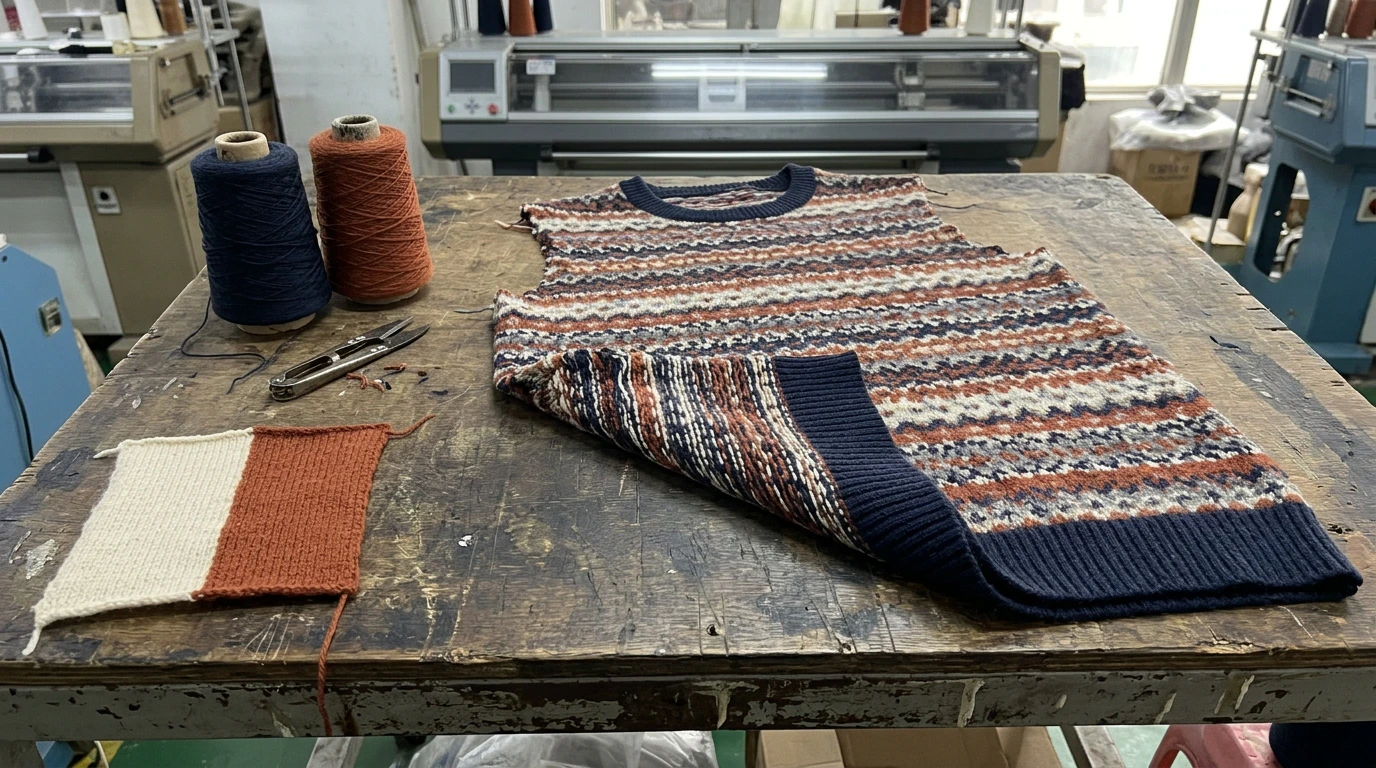
Send the same 2D sweater graphic to three factories without naming the reverse loop structure, and you will get three completely different quotes back. One mill prices a single-bed float jacquard that leaves loose, snag-prone threads across the inside of the chest. Another prices a double-bed birds-eye jacquard that adds 120 grams of backing yarn to the sweater. A third quotes hand-finished intarsia or sends the panel out to a print house. Before you can choose between intarsia, jacquard, and surface print—or make sense of a what is jacquard knit vs intarsia cost comparison—you have to flip the garment over. How colours sit along each horizontal row, what happens to the unknitted yarn on the back, how much the finished panel weighs, and how much yarn you have to buy per colour will make that decision for you.
Go with intarsia knitting when your artwork breaks down into clean, separate colour blocks (ideally two to six active yarn carriers on any single horizontal row) and you need a light, single-layer fabric with normal jersey stretch and no loose floats inside. Go with jacquard knitting when a pattern repeats across the body or switches colours every few needles—using single-bed float jacquard only when colour jumps are short, and switching to double-bed jacquard (birds-eye, ladder-back, or tubular) when wider spans need the back needle bed to trap the travelling yarn and the style can handle the extra weight. Save surface printing (screen print or digital DTG printing on knitwear) for airbrushed gradients, photo graphics, or lines thinner than a single stitch loop, and only put it on a smooth, low-hairiness fine-gauge jersey.
Key Takeaways
- Choose the process from the back of the panel, not the front sketch: Use intarsia for distinct colour blocks with a clean single-layer back, single- or double-bed jacquard for repeating motifs that carry yarn across the row, and surface print only for gradients or micro-lines on tight, smooth-gauge jersey.
- Check low factory quotes for hidden structure swaps: A cheap quote on a large graphic usually means the mill priced single-bed jacquard with long exposed floats instead of intarsia, or swapped cheaper synthetic yarn onto the back bed of a double-bed jacquard.
- Keep colour MOQs down with stock accent yarns: Limit how many colours appear on the same horizontal row, pull low-usage motif colours from mill stock-yarn shade cards instead of custom-dyeing full vats, and always approve washed front-and-back swatches before bulk knitting.
How to turn a 2D sweater graphic into a clear factory RFQ, compare unit quotes, and check production swatches.
1. Lock Five Artwork Details Before You Ask for Quotes
An Illustrator flat shows where the colours sit on the chest, but it says nothing about how the yarn gets from needle to needle. When a brand sends an unlabelled graphic to three factories, each merchandising team fills in the blanks on its own. A cautious mill quotes slow multi-carrier intarsia or heavy double-bed jacquard so they do not lose money on knitting minutes. An aggressive bidder prices fast single-bed float jacquard, collects your sampling fee, and lets you find out two weeks later that the inside of the sweater is full of long loose threads. You can avoid that trap by checking five physical details on your artwork before the RFQ goes out.
1.1 How Many Colours Sit on the Same Horizontal Row?
Sweater panels knitted on equipment using computerized flat knitting technology are built horizontally, one course (row) at a time. A sweater with six colours stacked as horizontal stripes is easy to knit because only one yarn carrier runs on any given row. Turn those same six colours into a central crest where all six shades appear across the same horizontal line, and the machine has to manage six yarn paths on every single pass across the chest.
In jacquard, every extra colour on a horizontal row means another non-knitting yarn that has to either float loose across the back or get knitted into a backing layer, which slows down the carriage and thickens the fabric. In intarsia, each separate block of colour along that row needs its own yarn carrier (feeder). Lay a straight ruler horizontally across the busiest part of your artwork: if that line cuts across eight separate islands of colour—even if they only alternate between black and white—the machine has to assign eight independent yarn carriers or carry floats behind the gaps.
1.2 Line Thickness vs Machine Gauge
Think of each knitted stitch as a physical pixel. Because a jersey loop is slightly wider than it is tall, diagonal lines, tight curves, and small letters naturally step like an old low-resolution screen. Across our 7-gauge mid-heavy machines and 12-gauge to 16-gauge fine-knit lines, that stitch size sets a hard limit on what you can knit cleanly. On a chunky 5G or 7G sweater, a 15 mm letter or a thin diagonal border looks stair-stepped and rough. Moving to a 12G, 14G, or 16G machine shrinks the loop enough to give you clean curves and readable text. If your artwork relies on soft airbrush shading, halftones, or 1 mm hairline outlines, no knitting needle can reproduce it directly—you will need surface printing or post-knit embroidery. If your team needs a quick refresher on how needle gauge relates to base stitch structures, check our Knitwear Stitch Types and Manufacturing Terminology guide before fixing the graphic scale.
1.3 Base Stitch, Target Weight (GSM), and What Touches the Skin
Decide early how heavy the sweater can be and what the inside of the panel needs to feel like. A lightweight spring cotton crewneck or a fine merino layering piece cannot take on the extra backing yarn of a full double-bed jacquard without feeling stiff and blowing past its target gram weight. By the same token, children’s sweaters, unlined fitted tops, and styles worn over watches or jewelry cannot have loose reverse floats that catch fingers during dressing. Once you write down the max colours per row, smallest line width, target gauge, weight limit, and reverse-side requirement, you can compare how your artwork actually behaves across the five production options.
2. Same-Artwork Comparison: Intarsia vs Jacquard Sub-Structures vs Surface Print
Designers often ask for a quick rule on what is jacquard knit vs intarsia, as if “jacquard” were just one stitch. On a flat-knitting machine, jacquard is a whole family of constructions. Depending on what the programmer tells the back needle bed to do with the unused yarn, a jacquard panel can come off the machine as a light single-layer fabric with loose strands on the back, or as a thick, two-layer cloth. Printing is different again—it puts ink or dye onto a finished knit surface rather than building the image out of yarn loops.
To keep the comparison fair, let’s put one specific design through all five routes. Take an illustrative 12-gauge production benchmark: a Size M crewneck pullover in 2/26 Nm compact worsted merino wool (where a plain solid-colour sweater weighs 280 grams) with a 22 cm × 22 cm four-colour chest graphic made up of large colour blocks, inner lettering, and a contrasting outline. Table 1 shows what happens to the front face, the inside back, the gram weight, the unit quote, and your colour MOQs under each method.
| Production Route | Front Look & Edge Clarity | What the Inside Back Looks Like | Weight, Drape & Stretch | What Drives the Factory Quote | MOQ Impact & Best Use Case |
|---|---|---|---|---|---|
| 1. Intarsia Knitting (Separate yarn carrier per block) |
Clean, solid colour blocks with zero dark yarn showing through from behind. Tiny scattered dots or thin inner lines are hard to do without adding extra carriers. | Single-layer reverse showing the exact same solid colour blocks as the front; neat linked joins at colour borders; yarn ends tucked by hand. | Keeps the base 280 g feel (~285 g finished), full horizontal stretch, and soft single-jersey drape. | Detailed needle drafting, slower intarsia carriage speed, and hand labour to tie and hide yarn tails on the reverse. | Uses very little accent yarn, but setup labour is high on tiny runs. Best for large placement graphics, bold colour blocking, and luxury single-layer sweaters. |
| 2. Single-Bed Float Jacquard (Stranded single-jersey jacquard) |
Crisp stitch detail on small repeating motifs. If a colour block is wide, the float behind it pulls the front fabric together and causes puckering. | Unused colours travel across the back as horizontal loose threads (floats) until that colour knits again. | Slight weight increase (~300–315 g); the horizontal floats limit how far the chest panel can stretch sideways. | Knits fast with minimal hand finishing, but creates major snagging claims if used on wide motifs without tie-downs. | Do not use for wide isolated blocks unless floats are anchored. Best for classic Fair Isle bands and small all-over repeats (2–3 colours per row, floats ≤12 mm). |
| 3. Double-Bed Birds-Eye Jacquard (Full two-bed backed jacquard) |
Handles detailed multi-colour art across the full row. Dark backing yarn can peek through light front stitches (grin-through) if knitted too loosely. | Zero loose floats; unused yarns knit onto the back needle bed in a neat speckled (“birds-eye”) or striped backing layer. | Heavy weight jump (~385–430 g if full-panel); feels thick, warm, and structured like a double-knit jacket. | High raw yarn consumption (every colour in the row runs across front or back bed) plus slower two-bed machine time. | Eats more yarn per accent shade, hitting dyehouse minimums faster. Best for all-over multi-colour patterns, heavy winter sweaters, and structured knitwear. |
| 4. Ladder-Back / Tubular Jacquard (Anchored or pocket double-bed) |
Clean front face with far less dark-yarn grin-through when rear anchor tucks are hidden behind matching front wales. | Long floats are caught periodically on the back bed in vertical “ladder” lines, or knitted as two thin separate tubular skins. | Mid-weight (~330–355 g); much softer and lighter than full birds-eye backing while still preventing long snagging floats. | Needs a skilled in-house programmer to balance front and rear stitch tension so anchor points do not dimple the front. | Requires a technically strong OEM mill. Best for medium-to-large multi-colour graphics that need a tidy inside back without double-knit bulk. |
| 5. Surface Printing (Screen print or DTG on knit panel) |
Captures gradients, photos, and tiny text regardless of stitch size. Sits on top of the loops; unprinted loop sides can flash white when stretched. | Plain single-jersey back (~280 g base); no floats, yarn ends, or extra backing yarn. | Thick screen-print paste stiffens the chest and cracks under stretch; dye-based reactive/acid DTG keeps a softer hand on smooth yarns. | Sweater knits fast in one solid yarn; extra cost comes from screen/pretreatment setup, print charge, post-print washing, and 3%–5% panel spoilage. | No dyed-yarn MOQs for accent colours, but fails on fuzzy or chunky yarns. Best for 12G–16G smooth combed cotton or compact worsted wool. |
Look at the weight and reverse columns in Table 1 and you can see why blind price comparisons fail. If one supplier quotes you $17 on a large four-colour graphic while two other mills quote $23, the $17 quote almost always assumes Route 2 (single-bed float jacquard) or trims back carrier changes—leaving you to deal with snagging threads or stiff double-layer panels once the sample lands on your desk.
3. Knitted-In Artwork: Intarsia vs Jacquard on the Factory Floor
Most production headaches happen when a graphic sits right on the line between intarsia and jacquard. When a prototype comes into our sample room, it takes less than half a minute to tell whether the structure was engineered properly: turn the sweater inside out, lay the chest panel over a light table, and pull the colour borders sideways by twenty percent.
3.1 Intarsia Reality: Carrier Rails, Join Pinholes, and Hand-Tucking Yarn Tails
In true intarsia knitting, each colour block has its own yarn carrier. That feeder travels only between the left and right edges of its assigned shape, stops at the border, and turns back on the next row. Where Colour A meets Colour B, the two carriers twist or tuck over a shared needle to lock the fabric together. Because no yarn travels behind a neighbouring colour block, you get a true single-layer sweater with clean colour blocks on both sides and the natural stretch of plain jersey.
What drives up intarsia cost in production is carrier space on the machine and handwork after knitting. Commercial flat-knitting machines—like the 7-gauge and 12-gauge Stoll machines on our floor—have a fixed number of yarn-carrier tracks. When a graphic has three to six clean, solid colour blocks across a horizontal row, intarsia runs cleanly. When a designer scatters twelve tiny disconnected stars or colour flecks across the same horizontal line, the machine runs out of carrier rails. Even on multi-carrier intarsia setups, every colour island leaves two loose yarn ends on the back where it starts and stops. Before the panels go into the washing drums, workers have to thread, tie, and hand-tuck every one of those tails into the seam boundary. Put forty tiny disconnected colour spots on a sweater and hand-finishing becomes the slowest step in the building—and if an operator snips a tail too short instead of tucking it, that join pops through to the front during the customer’s first wash. The programmer also has to dial in the exact take-down tension along every colour join: too loose leaves tiny pinholes along the border when stretched; too tight gathers the seam like a pulled thread.
3.2 Single-Bed vs Double-Bed Jacquard: Float Spans, Grin-Through, and Backing Weight
In jacquard knitwear production, every yarn active in a horizontal course runs all the way across the patterned zone. The needles pick which colour comes to the front face and push the rest to the back. What the programmer does with those back yarns controls the sweater’s weight, safety, and price.
In single-bed float jacquard, the unused colours simply skip behind the working needles as loose horizontal strands. Because only the front needle bed is knitting loops, the fabric stays light. That makes single-bed float jacquard ideal for classic Fair Isle yokes or small geometric repeats where a yarn never floats across more than five or six needles at a time (we generally keep adult floats under 10 mm to 15 mm, and much tighter on children’s styles so small fingers cannot catch inside). If a factory tries to knit a wide 10 cm chest block in single-bed float jacquard to save machine time, those long loose strands catch on watches, rings, and coat hangers immediately and pull the front graphic out of shape.
To get rid of long floats on wider or more detailed graphics, we engage both front and rear needle beds for double-bed birds-eye jacquard. While one yarn knits the front image, the inactive colours alternate with the ground yarn on the back bed, forming a tidy speckled backing called birds-eye jacquard. The inside of the sweater is completely smooth and snag-free, but you are now knitting two layers of fabric on every patterned course. Yarn consumption jumps by 100 grams or more on an all-over sweater, sideways stretch tightens up, and the panel takes on a firmer, jacket-like hand feel. You also have to watch high-contrast colour pairs: if dark charcoal yarn is running on the back bed behind a pale cream front motif, a slightly loose stitch setting lets the dark backing peek through the front loops—a flaw buyers call grin-through.
When a style needs wide colour spans without the heavy, blanket-like weight of full birds-eye backing, our technicians programme ladder-back jacquard or tubular (pocket) jacquard instead. In ladder-back jacquard, selected rear needles catch and tack the travelling float every few wales along neat vertical columns, keeping float spans short while cutting backing-yarn weight roughly in half. In tubular jacquard, the front and back beds knit two thin separate jersey layers that trade places where colours invert. Both options drape much closer to a single-layer sweater than standard birds-eye jacquard, provided the programmer balances front and rear cam tensions so the tie-down tucks do not leave tiny dimples on the front after steam pressing.
3.3 Combining Intarsia with Jacquard or Embroidery—and Spotting Factory Shortcuts
Plenty of real-world sweater graphics have two or three big colour blocks plus thin outlines, eyes, or small lettering. Knitting the whole thing as intarsia creates a mess of yarn tails; knitting the whole front panel as double-bed jacquard ruins the light drape of a fine merino or cashmere pullover. In practice, we build these as a hybrid structure: we knit the large background shapes in single-layer intarsia so the sweater stays light and stretchy, use localized jacquard only on the narrow rows where multiple colours cross rapidly, and put the 2 mm outlines or small script text on by post-knit embroidery or duplicate stitch after the panels have been washed and relaxed.
When a quote comes in well below the market average, check the inside of the prototype for three common shortcuts:
- Quoting intarsia, knitting float jacquard, and clipping the floats with scissors: Some workshops knit a multi-colour graphic as single-bed float jacquard and trim the long back floats close to the stitch loops by hand. It looks tidy on a hanger, then unravels into holes during the first domestic wash.
- Swapping cheaper yarn onto the back needle bed: On a cashmere or superfine merino double-bed jacquard, a supplier may feed cheaper synthetic or coarser wool yarn onto the rear bed to save raw-material cost. Because the two fibres shrink differently in wet finishing, the washed chest panel bubbles and curls.
- Drafting the graphic without post-wash shrinkage correction: Knitted loops change height-to-width ratio after wet relaxation. If the programmer copies a square pixel grid straight onto the machine without compensating for washed course density, a round logo comes out of the dryer looking like a flattened oval.
4. When Surface Printing Works—and Which Sweater Yarns Ruin It
If your graphic has photographic faces, soft airbrush gradients, watercolour washes, or ten-colour shading, trying to turn it into knitted stitches usually disappoints the design team. Even on an 18-gauge fine-knit bed, yarn changes happen one discrete loop at a time. That is where surface printing on knitwear—either flatbed screen printing or digital direct-to-garment (DTG printing knitwear)—earns its place, provided you only put it on yarn and gauge combinations that can hold ink cleanly.
4.1 Which Yarns Take Print Cleanly—and Why Fuzzy or Chunky Knits Fail
Printing on a sweater is nothing like printing on a flat woven poplin or a tight 28-gauge T-shirt jersey. Sweater loops have deep three-dimensional grooves and active surface fibres, so the base yarn makes or breaks the print:
- Yarns that print well (12G–16G+ smooth, low-hairiness yarns): Surface printing works best on tight 12-gauge, 14-gauge, or 16-gauge single-jersey or interlock panels knitted from combed or gassed cotton, cotton-viscose blends, smooth silk blends, or high-twist compact-spun worsted merino wool. On these smooth surfaces, the loop crowns sit tight together, allowing reactive digital dyes (for cotton/viscose) or acid digital dyes (for wool/silk) to soak into the yarn core without gluing the stitches together.
- Yarns to keep away from print tables (woollen cashmere, mohair, brushed alpaca, and chunky 3G–7G ribs or cables): Do not put heavy pigment or plastisol screen print onto lofty woollen-spun cashmere, brushed alpaca, or long-halo mohair. Those luxury yarns get their soft hand feel from thousands of fine surface fibres blooming above the yarn core. Printing paste sits on top of that loose fuzz and glues the cashmere or mohair halo into a stiff, scratchy patch. Worse, as the sweater rubs during normal wear and starts to fuzz or pill, those printed surface fibres break off or roll into pills—leaving the graphic patchy and faded after a handful of wears. Chunky 5G/7G knits and 2×2 ribs create a different problem: ink only hits the high ridges of the wales, so the moment the wearer bends an elbow or stretches the chest, the unprinted valleys open up and flash raw base yarn through the print (stretch grin-through).
- Why most premium sweater brands choose Hybrid Intarsia + Embroidery over heavy screen print: Because opaque screen-print underbases make a knit panel feel boardy and crack under repeated stretch, mid-to-luxury knitwear brands rarely use heavy paste prints for logos or crests. Unless they need a tonal photo print on fine-gauge cotton or worsted wool, they convert the artwork into knitted intarsia or jacquard paired with post-knit embroidery so the graphic keeps a real textile hand feel and survives years of washing.
4.2 Keeping Control When Sweater Panels Go Out to a Print House
When a style genuinely calls for digital DTG or screen printing on a fine-gauge knit, keep one supply-chain fact in mind: flat-knitting factories and industrial textile printers use completely different equipment. Printing a sweater almost always involves moving knitted panels or linked garments to a specialist print partner. To make sure you never get caught in a blame game between the knitter and the printer, write three rules into your order before sampling starts.
First, require full wet washing and loop relaxation before printing. The raw knit panels have to be washed, dried, and relaxed to their stable finished measurements before any ink goes down; if someone prints on raw off-machine panels and washes the sweater afterward, the wool or cotton loops shrink under the cured ink and warp the graphic. Second, agree upfront whether the job is flat-panel printing before linking (which needs extra panel wastage allowance and strict seam-matching marks if the art crosses a shoulder or side seam) or finished-garment printing on a platen. Third, keep single-point quality responsibility with your primary knitwear OEM factory so they own final rubbing fastness, wash fastness, and print registration under one invoice.
5. Comparing Quotes, Sample Costs, and Per-Color MOQs
Once you know which construction fits the artwork, the conversation turns to unit price and yarn minimums. Buyers looking up custom intarsia sweater manufacturer price or custom jacquard sweater manufacturer price regularly see 30% to 60% gaps between factory quotes on the exact same tech pack—because each mill calculates backing-yarn weight, machine minutes, hand yarn-tail finishing, and leftover dyed-yarn minimums differently.
5.1 Where the Money Goes in Intarsia vs Jacquard vs Print Quotes
Every honest sweater quote builds the ex-factory price from six concrete buckets:
Unit Price = [(Finished Garment Yarn Weight + Knitting/Linking Waste) × Yarn Price/kg] + Pattern Programming Setup + (Knitting Machine Minutes × Minute Rate) + Linking & Hand Yarn-End Tucking + Washing / Subcontracted Printing + QC, Testing & PackingTo show what affects the production cost of intarsia sweater versus what affects the production cost of jacquard sweater on a real costing sheet, Table 2 breaks down how weight and labour shift across our illustrative 12-gauge 2/26 Nm worsted merino crewneck (where a plain solid sweater weighs 280 grams). These numbers are illustrative engineering benchmarks to help you audit factory quotes, not a fixed price list.
| Cost Driver | Single-Layer Intarsia (4-color placement block) |
Double-Bed Birds-Eye Jacquard (Full-width backed rows) |
Ladder-Back / Tubular Jacquard (Anchored float double-bed) |
Surface Print (DTG / Screen) (On 280 g plain knit panel) |
|---|---|---|---|---|
| 1. Finished Garment Yarn Weight | ~285 g (+5 g only for yarn-tail tuck ends; zero backing layer). | ~385 g to 430 g (+105 g to 150 g of extra yarn knitted into the rear birds-eye backing). | ~330 g to 355 g (+50 g to 75 g; cuts backing yarn consumption roughly in half vs full birds-eye). | ~280 g (Base single-jersey weight unchanged; add ~3%–5% extra panel spoilage allowance for printing). |
| 2. Needle Drafting & Setup | High: Detailed carrier kick-back, stop positions, and join tension tuning at every colour border. | Moderate: Standard two-bed jacquard expansion with front/back stitch density balancing. | High: Custom rear-bed anchor placement so tie-downs never dimple or show through the front face. | Low (Knitting) / Moderate (Print): Plain jersey knit file + colour separation, screen or digital RIP setup. |
| 3. Flat-Knitting Machine Minutes | Slower carriage speed: Carriage slows down to position and brake multiple intarsia feeders accurately. | More carriage passes: Multi-system passes needed to knit every active colour across front and back beds. | Moderate-to-High: Multi-feeder two-bed knitting with controlled take-down tension. | Fastest on knitting floor: Continuous high-speed plain jersey knitting with one yarn carrier. |
| 4. Post-Knit Handwork & Finishing | Highest hand labour: Every colour block start/stop leaves yarn tails that must be tied, tucked, and checked over light tables. | Minimal hand labour: Yarns travel continuously inside the backing loops with very few loose ends. | Low-to-Moderate labour: Continuous yarn paths; needs careful steam pressing so anchor columns lie flat. | High secondary steps: Pre-wash relaxation + panel transport + printing + post-print steamer fixation wash. |
| 5. What to Check on the Quote | Saves expensive raw yarn on cashmere or fine merino; you are paying for machine minutes and skilled hand yarn-end tucking. | On luxury yarns, the extra 105–150 g of backing fibre often costs more than intarsia hand labour. Always check quoted gram weight. | Often the sweet spot for multi-colour graphics on expensive yarns where full birds-eye backing gets too heavy and pricey. | Only makes sense when print setup and transport are spread across enough units on smooth cotton or worsted merino. |
When you knit with expensive cashmere or superfine merino wool, double-bed birds-eye jacquard often ends up costing more per piece than intarsia—because burying an extra 110 grams of luxury yarn on the back needle bed costs more than paying a worker to hand-tuck intarsia yarn tails. Before you compare two factory quotes, make every supplier write down four numbers: quoted finished weight in grams, exact reverse structure, whether accent-colour yarn minimums are included, and the shipping Incoterm.
5.2 What Drives Custom Intarsia and Jacquard Sample Costs?
When buyers ask about custom intarsia sweater sample cost or custom jacquard sweater sample cost, it helps to remember that programming one sample takes the exact same needle-drafting work as setting up a 1,000-piece bulk run. Our technician still has to convert the flat graphic into a stitch-by-stitch machine file, dial in carrier stop positions and join tensions across every colour border, knit test panels, and wash and press them to see how much the patterned zone shrinks compared with the plain jersey around it.
At YouTricot, we charge a symbolic sampling fee, fully deductible from a later bulk production order of at least 500 pieces of the same approved style. If your artwork is technically tricky—like a multi-carrier intarsia graphic, a high-contrast ladder-back jacquard, or a hybrid intarsia-plus-embroidery crest—we always suggest running a washed 25 cm × 25 cm artwork swatch first. Approving the front edge clarity, reverse floats, and washed hand feel on a flat swatch before we knit and link the full sweater saves you money and prevents second-round sample delays.
5.3 Why MOQ Changes by Color—and How Dalang Stock Yarns Unlock 50-Piece Orders
Nothing stalls a small-batch collection faster than custom intarsia sweater MOQ per color or custom jacquard sweater MOQ per color. Why does adding four small accent shades to a chest motif suddenly trigger huge yarn surcharges at most factories?
Because garment knitting minimums and dyehouse vat minimums are two separate numbers. On our knitting floor, YouTricot works from a low baseline MOQ of 50 pieces per style per color (depending on yarn availability, colour count, construction complexity, trims, testing, finishing, and technical feasibility). Order 50 pieces of a navy sweater across four sizes, and the main navy body yarn uses around 14 kg to 18 kg of yarn—plenty to run cleanly.
Now look at the five small accent colours inside the chest graphic on that navy sweater. If crimson, ochre, forest green, ivory, and sky blue only use 15 grams of yarn per sweater, a 50-piece order needs just 0.75 kg (750 grams) of each accent shade. If you ask a factory to custom lab-dip and vat-dye all five accent colours to specific Pantone numbers, the dyehouse will enforce its minimum dye-vat weight (usually 10 kg to 30 kg per colour) or bill a steep small-vat fee—forcing your 50 sweaters to pay for 45+ kg of leftover accent yarn that sits in a warehouse.
How We Fix the Accent-Yarn MOQ Problem (Stock Yarn vs Custom-Dyed Yarn): Because our factory sits right inside the Dalang, Dongguan knitwear cluster, our sourcing team can pull directly from hundreds of in-stock shade cards across 100% Inner Mongolia cashmere, superfine merino wool, and combed cotton blends by the single cone (1 kg to 2 kg). Keep your main body yarn on your core seasonal colour, and match your 10-gram to 40-gram motif accent colours to approved mill stock-yarn shade cards. You skip dyehouse vat minimums completely, pay zero deadstock yarn surcharges, and cut two to three weeks off your sampling and bulk lead time. You can see how style-colour minimums work across a full collection in our Low MOQ Knitwear Rules guide.
6. Factory Audit Checklist, Tech Pack Specs, and Swatch Approval Gates
Picking the right stitch structure only protects your bulk delivery if the mill has the in-house programmers, calibrated machines, and inspection habits to hold that standard from Size XS to Size XL. Before you hand over an artwork-heavy development package, check your shortlisted suppliers against four shop-floor realities and tie sample sign-off to washed swatches.
6.1 Custom Intarsia and Jacquard Sweater Factory Audit Checklist
When you are looking for the best manufacturer for low MOQ intarsia sweater or jacquard sweater production, look past showroom samples and check how the factory actually operates:
Start by asking whether pattern making and needle drafting happen in-house. Many trading companies and small linking workshops send their computer programming out to external drafting studios. When programming is outsourced, every small tension tweak or motif proportion fix after the first sample takes five to seven extra days and gets lost in translation between the outside programmer and the machine operator. At YouTricot, our programming technicians work steps away from the sampling machines, so we adjust carrier stop blocks, stitch length, and ladder-back anchor tension right at the needle bed while the swatch is running.
Next, check whether the panels are knitted on in-house computerized flat knitting machines or farmed out to subcontractors. Multi-carrier intarsia and balanced double-bed jacquard need consistent needle-bed calibration across every machine running your order. After our May 2026 floor expansion—adding 80 upgraded Stoll computerized flat knitting machines (50 in 12-gauge and 30 in 7-gauge) alongside our fine-gauge Shima Seiki machines—we keep small-batch and mid-size artwork runs under one tension and programme control system instead of splitting orders across outside workshops. For a full 64-point factory vetting tool, see our Knitwear Factory Evaluation Criteria Checklist.
Finally, look at how the mill handles high-contrast yarn lots and light-table inspection. High-contrast intarsia and jacquard sweaters (like black/ivory or navy/ecru) will bleed during wet finishing unless the factory tests dark yarn lots for wash fastness before knitting. And because intarsia join pinholes are much easier to mend before fulling, the workshop should inspect panels twice over a light table: once in the raw greige state straight off the machine, and again after washing and steam pressing to check motif measurements and tucked yarn ends. You can see how those checks fit into our seven-node inspection routine in our Knitwear Quality Control SOP.
6.2 Factory Submission Checklist: What an Artwork Sweater Tech Pack Must Include
To answer what should an intarsia sweater tech pack include (or a jacquard/print tech pack), put these seven details into your RFQ file so every factory quotes the exact same build (for full garment BOM and measurement templates, use our Knitwear Tech Pack and RFQ Checklist):
- Dimensioned artwork file and placement measurements: Attach a vector file (AI/PDF/EPS) or stitch grid showing exact finished graphic width and height in centimetres (e.g., 22.0 cm W × 22.0 cm H on base size M) and the exact drop in cm from High Point Shoulder (HPS) or center-front line.
- Required construction route: Name the structure clearly: Single-Layer Intarsia, Single-Bed Float Jacquard (state max float span in mm), Double-Bed Birds-Eye / Ladder-Back Jacquard, Hybrid Intarsia + Embroidery, or Surface Print. If you want the mill to compare two options, write:
Quote and swatch Option A (Intarsia) vs Option B (Ladder-Back Jacquard) with finished gram weights. - Target gauge, yarn spec, and finished weight cap: List the machine gauge (7G, 12G, 14G), fibre blend, yarn count/ply, and maximum finished garment weight in grams so the programmer knows how much backing-yarn weight the design can tolerate.
- Colour breakdown with stock-yarn permission: Give Pantone TCX/TPG codes for the main body shade and each motif colour, and mark which low-usage accent shades can be matched to the factory’s approved stock-yarn shade cards to avoid custom dye-vat minimums.
- Inside reverse-face standard: State the maximum allowed free float length (e.g.,
no float over 12 mm), preferred backing structure (birds-eye vs ladder-back), and yarn-tail rule (all ends tied and tucked with zero tails poking through after three washes). - Size-grading rule for the graphic (Fixed Motif vs Graded Motif across XS–XL): State whether a chest motif stays the exact same centimetre size across all garment sizes (grading only the plain jersey stitches around it) or scales up and down proportionally with chest width from XS to XL (which requires drafting separate knitting programmes for different size groups).
- Care label washing method: State whether the sweater will be sold as hand wash, machine wool wash, or dry clean so sample washing and colourfastness checks match real consumer care.
6.3 Washed-Swatch Checks and Lab Test Standards Before Bulk Release
Never sign off on sweater artwork from a digital screen render or an unwashed off-machine (greige) panel. Double-bed jacquard zones, single-layer intarsia blocks, and plain jersey backgrounds relax and shrink at different rates during washing, fulling, and steam pressing. A circle that looks round coming off the needle bed can easily turn into a squat oval or ripple along its edges once washed.
Use Table 3 to check your washed development swatches and set up lab testing. Keep in mind that ISO standards tell the lab how to run the test, while your brand’s quality manual or purchase order sets the commercial pass/fail limit for your market.
| Artwork Route | What Usually Goes Wrong in Bulk | Hands-On Check on the Washed Sample | Reference Lab Test Method (Set Buyer Pass Limit in Contract) |
|---|---|---|---|
| Intarsia Knitting | Pinholes or gaps opening along colour joins under stretch; tucked yarn tails popping out to the front in washing; uneven shrinkage between colour blocks. | Pull the washed panel 20%–30% sideways across every colour border over a light table to check for pinholes; check the reverse after 3 washes for loose tails. | Domestic washing and drying per ISO 6330:2021 with dimensional change measured per ISO 5077:2007 across both graphic and body zones. |
| Single-Bed Float Jacquard | Long reverse floats catching on fingers or jewelry; tight floats pulling the front motif narrower and leaving vertical pucker lines. | Measure the longest single float span in mm on the inside of the washed sample with a steel ruler; check front chest width recovery and flatness. | Snagging resistance test (Mace spiked-ball method per ISO 25086-1:2026 or buyer snag standard) plus child finger-entrapment checks on kids’ styles. |
| Double-Bed Jacquard (Birds-eye / Ladder-back) |
Dark backing yarn peeking through pale front loops (grin-through); overweight finished sweaters; dark yarn bleeding into white motifs; wavy borders where two-bed meets single-jersey. | Weigh the conditioned sweater on a digital scale against target grams; stretch high-contrast areas slightly under D65 light to check grin-through. | Colourfastness to washing per ISO 105-C06:2010 (checking cross-staining between dark and pale yarns) and post-wash garment spirality per ISO 16322-3:2021. |
| Surface Printing (Screen / DTG on knit) |
Ink cracking or white loop side walls showing when stretched; stiff plastisol hand feel; ink rubbing off or breaking apart as surface fibres pill. | Stretch the printed zone 30% sideways and release to check for ink cracks or white grin-through; compare washed hand feel against an unprinted panel. | Dry and wet rubbing fastness per ISO 105-X12:2016, wash fastness per ISO 105-C06:2010, and Martindale pilling check per ISO 12945-2:2020. |
7. Common Questions on Sourcing Intarsia, Jacquard, and Printed Sweaters
7.1 What should a buyer do when bulk intarsia or jacquard sweaters differ from the approved sample?
When bulk artwork sweaters come out heavier, stiffer, or distorted compared with your approved pre-production sample (PPS), one of four things usually changed on the floor: (1) the mill swapped a different yarn lot, yarn count, or cheaper synthetic backing yarn onto the back needle bed; (2) operators ran the carriages faster or changed stitch-cam tension to boost daily output; (3) the laundry shortened the washing or tumble-relaxation cycle, changing the loop height-to-width ratio; or (4) the Size M programme was copied onto XS or XL panels without re-balancing the motif stitch count. Before bulk starts, seal a washed physical PPS tagged with the exact machine programme file ID, yarn lot numbers, finished gram weight, and washed stitch density (courses and wales per 10 cm). If the first bulk pieces look off, stop linking immediately and check the off-machine panel weight and reverse loop structure against that sealed PPS.
7.2 Does grading across XS to XL require a separate knitting program for every size?
It depends on whether the artwork is a centered chest graphic or an all-over / seam-to-seam pattern. For a central chest motif (say, a 20 cm × 20 cm intarsia crest), brands often keep the motif stitch count identical across adjacent sizes—or use just two graphic scales, one for XS–S and one for M–XL—while adding or removing plain background stitches around the outside edges. That saves programming time and keeps sampling costs down. For all-over jacquard sweaters, yoke-spanning ski patterns, or diagonal stripes that have to meet cleanly at the shoulder and side seams, the programmer has to re-grade the pattern grid for every size.
7.3 In what order should a factory combine intarsia, jacquard, and embroidery or printing on one sweater?
Always finish the flat knitting and wet washing before putting any embroidery or print onto the sweater. On a hybrid design, the computerized flat knitting machine knits the large intarsia colour blocks and any local jacquard rows into the panel first. Next, the panels (or linked sweater) go through scouring, fulling/washing, drying, and light steam pressing so the loops settle into their final relaxed dimensions. Only after the knit fabric is stable should post-knit embroidery, duplicate stitch, or surface printing go on; if you embroider or print on raw unwashed panels first, the washing shrinkage will pucker the embroidery backing or warp the print.
Send Your Sweater Artwork for a Construction, Cost & MOQ Feasibility Review
Send us your artwork file (or early sketch with target measurements), yarn direction, machine gauge, garment flat, colour count, expected pieces per colorway, and how you want the inside reverse to look. Our programming and sourcing team in Dalang will check whether single-layer intarsia, single- or double-bed jacquard, hybrid embroidery, or surface print makes the most sense for your design, match low-usage accent colours to stock-yarn shade cards, and flag the details to lock in before sampling.
Frank has 20 years of knitwear industry and operational experience across Prato, Italy and Dalang, Dongguan, China. He writes for fashion-brand founders, designers, product developers and sourcing teams that need to translate creative direction into commercially workable yarn, gauge, construction and production decisions. Explore additional technical notes on the YouTricot Blog.