


The current apparel inventory crisis is forcing the global fashion industry into a deep destocking cycle. In the next 3-5 years, the core competition will violently shift to a game of inventory efficiency. For premium labels searching for strategies to manage risk, the reality is stark: traditional business models relying on quarterly stockpiling and fixed markups have completely failed.
However, in the high-end knitwear sector, this crisis is magnified. The financial risk of stockpiling 100% pure cashmere is drastically different from stockpiling basic cotton t-shirts. This guide analyzes the 2026 market disruption and provides actionable, compliant, and agile manufacturing solutions for high-end European boutiques.
I. The Core Impact: The Data Behind the 2026 Inventory Crisis
Traditional apparel merchants have historically relied on offline experience and local words-of-mouth. Yet, their heavy-inventory model—ordering half a year in advance and stocking up in massive quantities—has exposed fatal financial flaws under current digital disruption.
When evaluating the impact of cross-border e-commerce on local European boutiques, the disparity in supply chain agility is the primary killer. Platforms utilizing ultra-fast manufacturing maintain inventory turnover cycles of just 30 days, while traditional merchants suffer from agonizing turnover cycles exceeding 150 days. Furthermore, fully managed, lowest-price mechanisms from platforms like TEMU input cheap apparel in bulk, completely penetrating the local price system.
2026 Authoritative Market Realities:
- The Fast-Fashion Waste Trap: By early 2026, the European fast-fashion inventory loss rate (dead stock and aggressive markdowns) has reached a critical 28%, destroying baseline profitability.
- The Livestreaming Illusion: While livestreaming drives massive volume, the return rate for impulse apparel purchases in the EU has surged past 45%, leaving merchants with unsellable, depreciated returns.
- The Knitwear Premium Opportunity: Conversely, high-end, sustainable knitwear categories maintain a robust 60-80% premium margin. Consumers are actively migrating away from disposable synthetics toward investment pieces.
II. Voice of the Market: Real Feedback on the High-End Knitwear Bottleneck
The inventory crisis stems not only from external shocks but from refusing lightweight, digital transformation and blindly believing that hoarding stock stabilizes sales. Here is the real-time feedback from the frontlines of the European B2B apparel market regarding high-value categories:
- German Distributor (Munich) on “Cashmere Inventory Risks”:“Cashmere and Merino wool are high-cost raw materials. A dead-stock scenario for these fibers is financially devastating. To survive, we absolutely need agile factory partners capable of small-batch flexible manufacturing. We cannot tie up capital in 500-piece MOQs anymore.”
- French Boutique Owner (Paris) on “Flaws of Cross-Border Cheap Knitwear”:“Cross-border low-price knitwear relies heavily on acrylic blends, loose machine tension, and non-compliant chemical dyes. Our Parisian clients demand precise craftsmanship. But without a supplier that supports small-order trial runs for true high-end quality, competing is impossible.”
- Polish Wholesaler (Warsaw) on “Sustainable Compliance 2026”:“With the new EU sustainable textile regulations, we face heavy penalties if our supply chain isn’t compliant. We need manufacturers who offer both flexibility and guaranteed ethical sourcing, which online giants simply ignore.”
III. Practical Breakthrough Solutions: Agile Knitwear Manufacturing & 2026 Compliance
Local merchants must not follow the trend of low-price involution. True competitive barriers are built on high-end natural fibers, advanced knitting technology, and actionable ethical sourcing.
1. Inventory Reconstruction: Small-Batch Trial for High-Value Yarns Wholesalers must completely abandon the quarterly bulk ordering model. By adopting a lightweight model of “small-batch trial, sales review, bestseller replenishment, and fast clearance,” brands can compress inventory turnover to within 80 days. For expensive materials like Merino and cashmere, rapid restocking is not just an operational upgrade; it is critical capital protection.
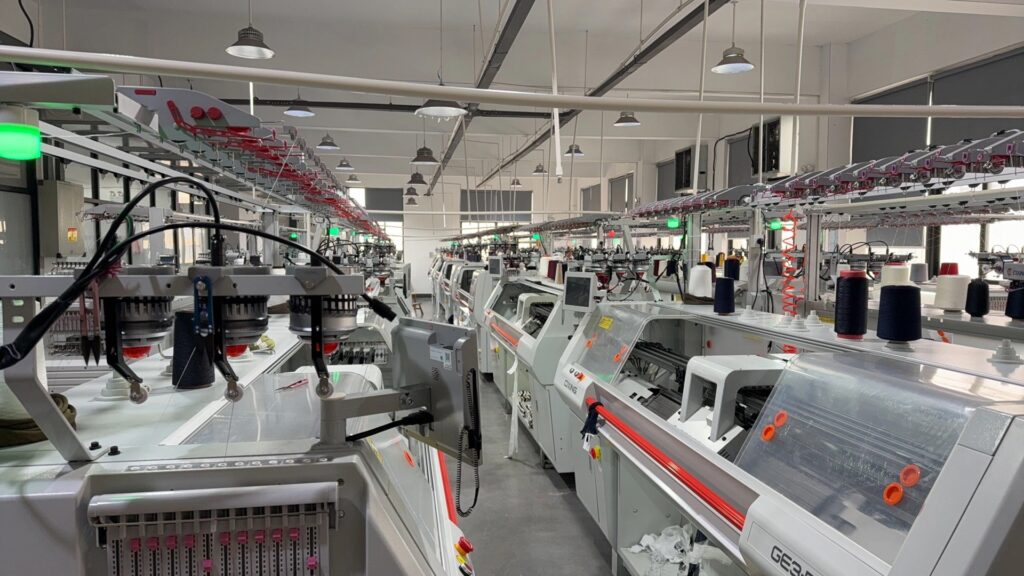
To execute this, we utilize over 80 state-of-the-art computerized flat knitting machines from global industry leaders to ensure precision, such as : Shima Seiki Official . This guarantees tight gauge precision that completely eliminates the sagging and deformation common in fast-fashion knits. Furthermore, premium materials like 100% pure cashmere provide a luxurious hand-feel that cannot be replicated. Review our precise 7-node manufacturing methodology designed for these premium fibers : Quality Control SOP .
2. Defending Margins with Actionable 2026 EU Compliance
With the European Union’s 2026 Eco-design for Sustainable Products Regulation (ESPR) taking full effect, non-compliant fast fashion faces severe import barriers. Compliance requires actionable execution. We provide full supply chain traceability and align our premium yarn procurement with globally recognized ethical protocols, such as : The Good Cashmere Standard .
This ensures your brand passes stringent audits seamlessly. To understand the full scope of these incoming regulatory mandates, you can review the official directives directly via the : European Commission Official Portal . Avoid platform homogenization by focusing on this precise product selection and ethical sourcing based on the specific climates and dressing habits of local populations.
IV. FAQ: Strategic Answers for EU Knitwear Wholesalers
Q1: How can European physical apparel stores survive against ultra-low-price e-commerce imports?
A: There is ample survival space. Cross-border platforms generally suffer from poor texture, inaccurate sizing, and zero sustainability compliance. Local merchants who focus on localized adaptation, high-quality natural yarns, and ethical compliance can lock in the lucrative mid-to-high-end customer base.
Q2: Should premium knitwear distributors prioritize clearing old inventory or changing their ordering models?
A: In the short term, rapidly revitalize existing inventory to recover cash flow. In the long term, you must abandon the bulk hoarding model and implement small-batch rapid response to eliminate new backlogs from the source. Discover how transitioning to this flexible model reduced a premium internet brand’s lead times from 14 to just 5 days : Client Case Study .
Q3: How do we maintain our brand premium without participating in price wars?
A: Emphasize the tactile superiority and tight gauge precision of your garments. Add value-added services such as outfit customization and after-sales guarantees. By replacing price competition with service premiums, you increase product sell-through rates and reduce slow-moving risks.
Q4: Do traditional apparel wholesalers need to engage in TikTok low-price livestreams?
A: It is not recommended to blindly follow low-price livestreams or compete on price. Instead, execute lightweight quality livestreams focusing on fabric popularization (e.g., explaining the traceability of pure cashmere) to balance brand tone and inventory digestion.
Q5: What is the absolute core competitive barrier for European high-end knitwear boutiques in 2026?
A: The core barrier is no longer style and low price, but efficient inventory turnover, localized differentiated products, strict EU sustainability compliance, and stable private domain repurchase capabilities.
Conclusion
The impact of e-commerce and livestreaming only eliminates the traditional backward hoarding business model, not the offline physical apparel retail format. In the future, the apparel industry in Europe, America, and Australia will completely bid farewell to price involution and enter a new stage of efficient inventory turnover and differentiated competition. Traditional local merchants can completely break the inventory dead loop only by abandoning inherent thinking and completing lightweight, agile transformations.
Ready to avoid 2026 EU compliance fines, prevent devastating inventory losses on high-end yarns, and lock in long-term high premiums for your boutique? Transform your supply chain with our dual-hub manufacturing expertise in Prato and Dongguan : Youtricot OEM/ODM Services .
About Youtricot OEM
Custom Knit OEM & ODM Manufacturer
Start creating beautiful, fully-customizable websites with the new WordPress Site Editor and the Ollie block theme.