

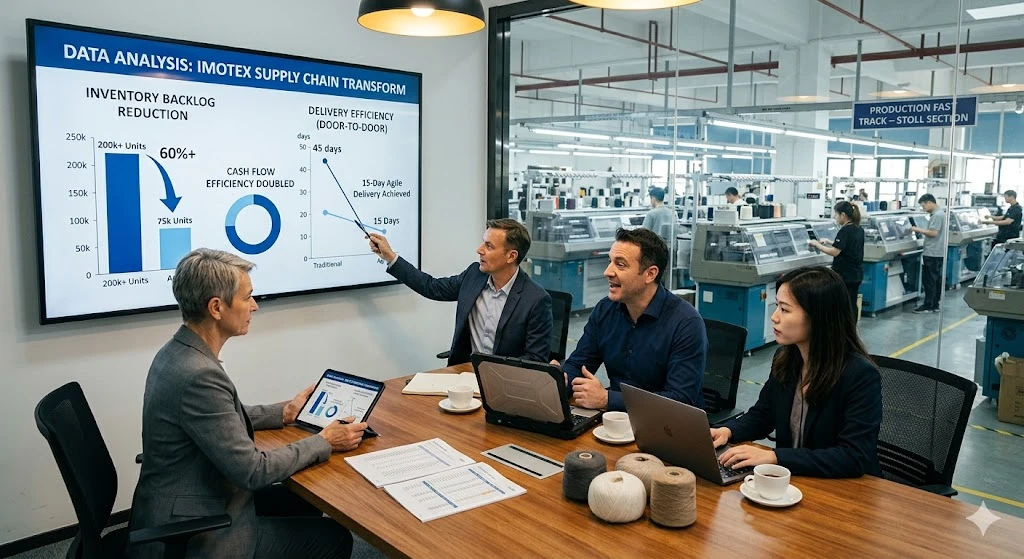
Quick Answer: A mid-sized German fashion wholesaler serving buyers around IMOTEX in Neuss used a direct knitwear OEM factory model to receive a physical sample in 10 days and, after sample approval and official order confirmation, bulk goods at its warehouse in 15 days. Compared with the buyer’s previous seasonal sourcing model, inventory backlog fell by more than 60% and time-to-market shortened by around 70% for selected styles. The result depended on confirmed yarn, available capacity, rapid approvals and coordinated express logistics; it is not an automatic timeline for every design.
Published: May 26, 2026 | Updated: September 4, 2026 | Article type: Buyer case study
Key Takeaways
1. The German wholesaler reduced inventory backlog by more than 60% and shortened time-to-market by around 70% for selected seasonal knitwear styles. YouTricot supported a demand-led sourcing model built around a 10-day physical sample, a focused small-batch order and 15-day door-to-door bulk delivery to the client’s warehouse in Neuss. The buyer tested demand before repeating successful styles, reduced speculative stock exposure and gained a more flexible private label knitwear model for future collections.
2. The 15-day delivery window ran from official order confirmation and production-slot allocation to arrival at the warehouse in Neuss. The timeline combined one day of preparation, approximately four to five days for knitting and linking, around two days for washing and finishing, one to two days for final quality control and packing, and approximately five to six days for international delivery. Confirmed yarn, an approved sample, available capacity and coordinated export logistics were essential conditions.
3. A physical knitwear sample reached Germany in 10 days after development began from one reference photo and basic product notes. The technical review covered yarn direction, gauge, stitch structure, panel construction, pattern making, European sizing, needle drafting, machine programming, shrinkage and measurement tolerance. Accuracy improves when buyers also provide target measurements, fit expectations, hand-feel references and commercial positioning.
4. The inventory improvement came from changing the buying model, not simply choosing faster transport. Smaller first orders, earlier physical sampling, controlled knitwear quality checks and quicker replenishment decisions allowed retail feedback to inform repeat orders before capital was committed to weaker styles. This approach best fits European wholesalers, boutique networks and private label buyers that value lower inventory exposure and seasonal responsiveness more than the lowest possible unit price.
Table of Contents
This case concerns a mid-sized fashion wholesaler serving boutiques and regional buyers around the IMOTEX fashion and order center in Neuss, Germany. The buyer needed premium knitwear, faster market testing and replenishment without repeating a high-inventory seasonal purchasing model.
What Business Results Did the German Wholesaler Achieve?
The project produced four measurable sourcing outcomes: lower inventory backlog, faster market entry, quicker sample validation and a 15-day bulk-delivery cycle. The comparison baseline for the inventory and time-to-market improvements was the client’s previous seasonal buying model. Cash-flow improvement was also reported because less capital had to be committed before market demand was tested.
| Result | Measured Outcome | Buyer Impact |
|---|---|---|
| Inventory backlog | Reduced by more than 60% | Lower exposure to weak seasonal stock |
| Time-to-market | Shortened by around 70% for selected styles | Faster response to retail demand |
| Physical sample | Delivered to Germany in 10 days | Earlier fit, hand-feel and style decisions |
| Bulk delivery | 15 days door to door | Replenishment aligned more closely with retail timing |
What Sourcing Problems Did the Buyer Need to Solve?
The wholesaler needed to replace a slow, intermediary-heavy seasonal sourcing model with a faster and more flexible replenishment system. Its assortment included custom knit sweaters, fine-gauge cardigans, wool-blend pullovers and seasonal fashion products for German and nearby European retailers. Five problems were restricting growth:
- Physical sampling often required several weeks.
- Multiple communication layers delayed technical decisions.
- The buyer needed a practical MOQ of 50 pieces per style per color to test styles in controlled runs.
- Replenishment arrived too late for fast-moving products.
- Capital was committed before sell-through data became available.
The buyer therefore needed faster development without sacrificing measurements, hand feel, finishing or repeat-order consistency.
Why Did the Buyer Choose a Direct Knitwear OEM Factory?
The buyer chose a direct knitwear OEM factory to shorten technical communication and connect European product expectations with production execution. The sourcing model combined a Prato-informed understanding of yarn, fit and commercial styling with computerized flat knitting, pattern making, needle drafting, linking, washing, finishing and inspection in Dalang, Dongguan. This reduced the number of handoffs between product interpretation and manufacturing. It also allowed decisions about gauge, stitch density, shrinkage and measurement tolerance to be resolved before bulk production.
Read the full guide here : OEM and ODM Knitwear Workflow
How Was a Physical Sample Delivered in 10 Days?
The first physical sample was developed from one reference photo and delivered to Germany in 10 days. Basic notes on fit, yarn hand feel and market position were converted into a technical development brief. The sequence below preserves the actual sampling checkpoints.
| Day | Development Activity |
|---|---|
| Day 1 | Reference review, style-risk assessment and yarn direction |
| Day 2 | Yarn matching, gauge selection and pattern making |
| Day 3 | Needle drafting and computerized knitting setup |
| Days 4–5 | Panel knitting and structural correction |
| Day 6 | Linking, washing and finishing |
| Day 7 | Measurements, shrinkage review and internal quality checks |
| Day 8 | Photo and video confirmation |
| Days 9–10 | Express delivery to Germany |
Read the full guide here : Knitwear Tech Pack and RFQ Checklist
How Did Small-Batch Production Reduce Inventory Exposure?
Small-batch production allowed the wholesaler to test retailer demand before committing to a larger seasonal volume. After approving the sample, the buyer placed a focused trial order rather than repeating its previous speculative purchasing pattern. The bulk workflow still included yarn-lot confirmation, size grading, measurement-tolerance approval, computerized flat knitting, linking, seam control, washing, finishing, shape stabilization, inline inspection, final QC, packing and export documentation.
The commercial benefit came from combining controlled first quantities with faster feedback and replenishment decisions. For this service route, the MOQ is 50 pieces per style per color, subject to a style-level review of yarn availability, construction, finishing and packing requirements.
Read the full guide here : French Small-Batch Knitwear Case Study
How Did the 15-Day Door-to-Door Timeline Work?
The 15-day period was counted from official order confirmation and production-slot allocation to arrival at the client’s warehouse in Neuss. The steps below show how production and logistics were coordinated within that window.
01 · DAY 1
Production Preparation
Yarn lot confirmation, size-set review and machine scheduling.
02 · DAYS 2–6
Knitting and Linking
Approximately four to five days for knitting, panel checks, stitch-density control and linking-tension review.
03 · DAYS 7–8
Washing and Finishing
Approximately two days for shrinkage control, hand-feel development and garment-shape stabilization.
04 · DAY 9
Final QC and Packing
Measurements, appearance, color and packing were checked before dispatch.
05 · DAYS 10–15
International Delivery
Export documentation and coordinated express logistics supported delivery to the Neuss warehouse.
Timeline condition: The original stage ranges were one to two days for QC and five to six days for delivery. Coordinated scheduling kept the complete door-to-door cycle within 15 days in this case. Different yarns, stitch structures, quantities, revisions, finishing treatments, destinations or capacity conditions can require a different schedule.
How Was Knitwear Quality Controlled During Fast Production?
The compressed schedule retained the same technical checkpoints expected in a controlled knitwear order. Speed was supported by prior sample approval and confirmed materials, not by removing inspection stages. Controls covered:
- Yarn lot, stitch density and panel dimensions.
- Linking quality, seam tension and garment construction.
- Washing shrinkage, finished measurements and shape.
- Surface appearance, pilling risk and color consistency.
- Final packing and shipment documentation.
Where applicable, buyers can request material or supplier documentation related to OEKO-TEX STANDARD 100 and the Responsible Wool Standard.
Compliance note: Documentation is not automatic for every yarn or finished garment. Buyers should identify required certificates, test reports, labeling rules and market-specific restrictions before quotation and material approval. The factory must confirm which documents are available and which testing must be arranged for the order.
Which Buyers Can Use This Sourcing Model?
The model is best suited to European wholesalers and fashion businesses that need premium knitwear in controlled quantities with faster replenishment. Suitable buyers include:
- Wholesalers supplying boutiques and regional retailers.
- Private label buyers testing sweaters or cardigans.
- Independent designers using the MOQ of 50 pieces per style per color.
- Retailers replenishing successful seasonal styles.
- Brands that need faster physical sampling before committing capital.
It is less suitable for buyers who compare only the lowest unit price or who cannot confirm materials, measurements and approvals quickly. A fast timeline works when the buyer and factory can make technical decisions without repeated redesign.
What Should Buyers Confirm Before Requesting a Fast Timeline?
Buyers should confirm the product and approval route before treating a 10-day sample or 15-day delivery as feasible. Provide the factory with:
- A tech pack, reference image or physical garment.
- Target measurements, size range and fit direction.
- Yarn composition, hand feel, colors and gauge expectations.
- Order quantity by style, color and size.
- Labels, packaging and compliance requirements.
- A named decision-maker for sample approvals.
- The warehouse destination and required arrival date.
The factory must then confirm yarn availability, capacity, technical risk and the logistics route before issuing a reliable schedule.
Feasibility boundary: An approved sample, confirmed yarn, an allocated production slot, rapid buyer decisions and coordinated express logistics made this case possible. A style-level technical and logistics review is required before any sampling or bulk-delivery date is confirmed.
Frequently Asked Questions
These answers clarify what made this German wholesaler project possible and where buyers should avoid generalizing from one case.
How can a knitwear OEM factory deliver from China to Germany in 15 days?
A 15-day door-to-door delivery requires an approved sample, confirmed yarn, an allocated production slot, rapid buyer decisions and coordinated international logistics. In this case, the timeline started when the order was officially confirmed and capacity was allocated; it ended when the bulk order reached the client’s warehouse in Neuss. The style had already passed sample review, so production could move through preparation, knitting, linking, washing, finishing, final inspection, packing and dispatch without repeated redesign. Complex new styles, unavailable yarn or delayed approvals would require a different schedule.
Can one reference photo become an accurate knitwear sample?
One reference photo can start knitwear development, but it does not contain every technical specification required for accurate bulk production. In this case, the photo was supplemented with notes about fit, yarn hand feel and market positioning. The technical team then evaluated likely yarn composition, gauge, stitch structure, panel construction, pattern making, European size proportions, needle drafting, shrinkage and measurement tolerance. Accuracy improves when the buyer also provides a size chart, target garment measurements, close-up construction images, a physical reference garment or clearly marked fit corrections.
What information does a buyer need to start knitwear sampling?
A complete tech pack is the strongest starting point, but an initial review can begin with a reference image, target yarn composition, preferred hand feel, size range, color direction and intended retail position. Before bulk production, the buyer should confirm garment measurements, grading, stitch or pattern details, labels, packaging, compliance requirements, quantity by style and color, and the required delivery location. The factory should also confirm yarn availability, proposed gauge, sample timing and technical risks. Missing information can lengthen development because assumptions must be tested and approved.
What MOQ applies to YouTricot projects like this?
The MOQ is 50 pieces per style per color. Buyers should still submit the intended size breakdown, yarn, gauge, stitch structure, finishing and packaging requirements so the factory can evaluate material allocation, setup, schedule and quotation. Custom-dyed or exclusive yarn can create separate material-purchase requirements, but the finished-garment MOQ remains 50 pieces per style per color.
Does fast knitwear production reduce quality-control requirements?
No. Faster production should come from confirmed specifications, available capacity and coordinated workflow rather than skipped inspections. The German order retained checks for yarn lot, stitch density, panel dimensions, linking tension, washing shrinkage, finished measurements, shape, appearance, color consistency and packing. Prior sample approval reduced the risk of redesign during bulk production, but it did not remove the need for inline and final QC. Buyers should agree on measurement tolerances, inspection standards and approval responsibilities before production begins.
Are knitwear sampling fees free?
No. YouTricot charges a symbolic sampling fee, which is fully deductible from later bulk production orders. The exact fee depends on yarn, garment complexity, stitch structure, gauge, trims and finishing requirements. Buyers should confirm what the fee includes, how many revisions are covered, whether courier charges are separate and how the deduction will appear on the subsequent bulk-order invoice. Sampling should never be represented as universally free.
Can European buyers request compliance documentation?
Yes. European buyers can request available compliance and material documentation according to the yarn supplier, product specification and order requirements. Relevant frameworks may include OEKO-TEX Standard 100, the Responsible Wool Standard and the Good Cashmere Standard, as well as customer-requested third-party testing where applicable. Documentation is not automatic for every yarn or finished garment, so buyers should identify required certificates, test reports, labeling rules and market-specific restrictions before quotation and material approval.
Request a Knitwear OEM Feasibility Review
A fast sampling or delivery plan should begin with a style-level technical and logistics review. Share your tech pack or reference images, measurements, yarn direction, quantity by style and color, packaging requirements, warehouse destination and target arrival date. The production team can then assess gauge, pattern making, needle drafting, yarn availability, sample revisions, capacity and the most suitable shipping route.