

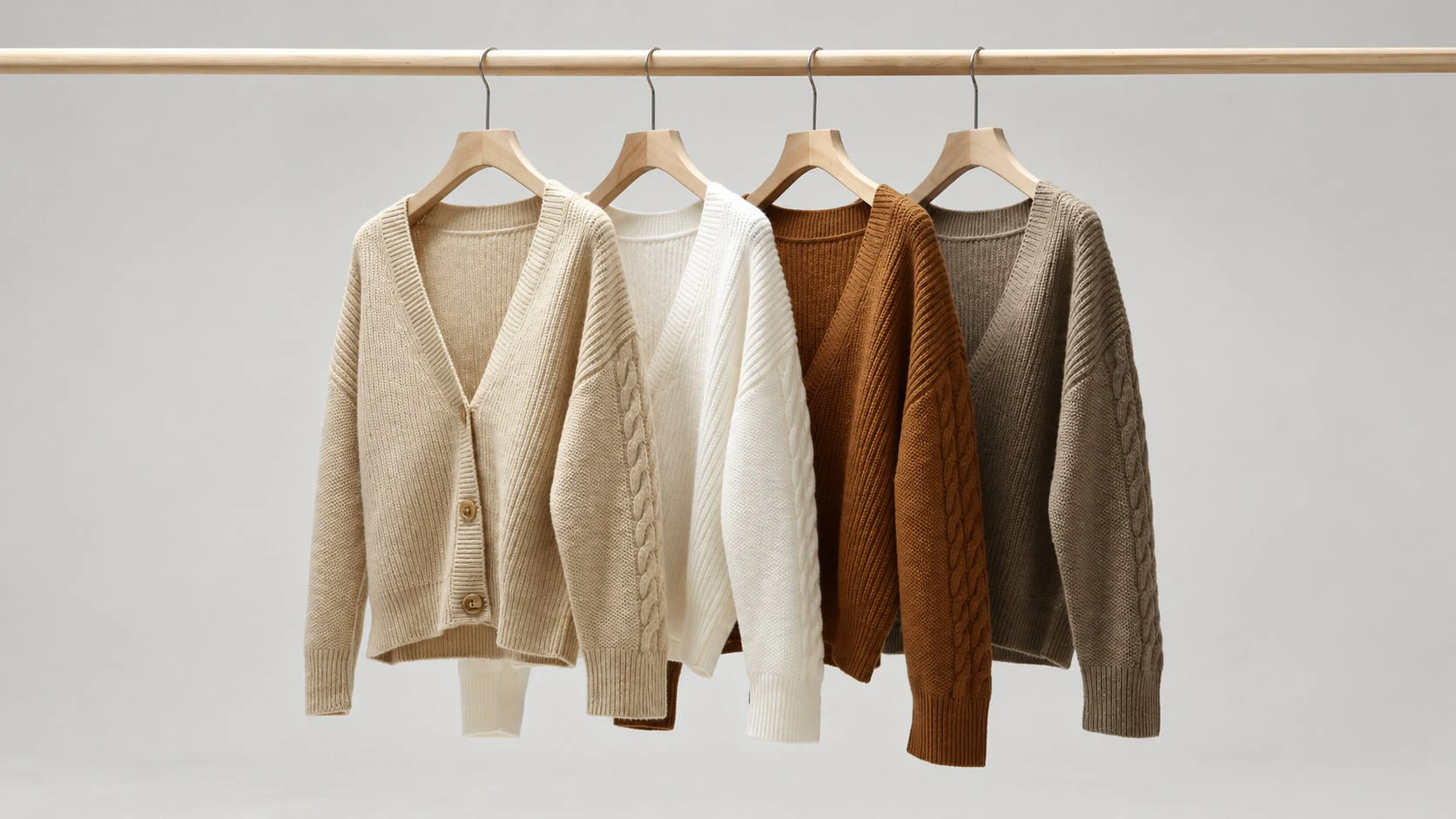
Quick answer: For 2027, build around lightweight texture and fluid summer layers, then tactile classics and controlled winter volume. Use these published yarn directions to develop customer-specific garments, rather than treating them as proven demand. Validate yarn, structure and finish together, protect material choices with comparable quotations, and plan backward from sales-ready stock.
Evidence reviewed: 16 October 2026. This outlook covers S/S 2027 and A/W 2027–28 proposals available by that date. Spring, summer, autumn and winter refer to Northern Hemisphere temperate-market wearing conditions. Southern Hemisphere brands should remap the calendar; tropical and travel collections should prioritize actual climate, air conditioning and customer use. No globally uniform launch date is assumed.
Key Takeaways
- Choose the product job first. A breathable summer layer and a winter statement sweater need different fabric behavior, even when they share a visual theme.
- Approve the finished knit, not a fibre name. Machine gauge, yarn construction, stitch density and finishing jointly determine the result.
- Protect the range through alternatives. Keep a clear role for pure cashmere while comparing purposeful blends and conditional cost scenarios.
- Make the deadline sale-ready. Freight arrival is followed by receiving, acceptance and channel preparation; those tasks need their own time.
Table of Contents
- Spring/Summer 2027: Yarn, Texture and Lightweight Design
- Autumn/Winter 2027–28: Tactile Classics and Sculptural Knitwear
- How 2026 Cashmere Cost Pressure Could Shape 2027 Collections
- Choosing Wool and Cashmere Blends for the Right Product
- Extending Classic Styles and Planning Initial Inventory
- Washing and Finishing: From Intended Effect to Repeatable Results
- Plan One Season Ahead: From Sampling to Sales-Ready Delivery
Knitwear Trends 2027: Spring/Summer Yarn and Design Directions
Develop S/S 2027 around contrasts in surface and movement: refined cotton beside tactile yarn effects, and airy structures beside fluid layers. These are material-led development directions, not evidence that any particular garment will sell.
In its January 2026 presentation, Pecci Filati’s S/S 2027 collection proposed textured and refined cotton, linen combinations, fine viscose and silk pairings. That supports testing different handles and surfaces. The garment suggestions below are editorial translations of those yarn proposals; they are not reported runway trends or sales forecasts.
Spring — Transitional Layers and Refined Texture
For cool mornings and warmer interiors, consider a light cardigan, knitted polo or V-neck that layers without bulky seams. A clean body with a restrained textured panel gives a familiar style a seasonal identity without changing every fit detail.
Cotton is a candidate for a matte, defined surface; cotton–wool can be trialled where the brief calls for a transitional handle, and cotton–silk where a smoother surface is desired. Compare finished swatches at the intended weight. A blend does not automatically make a garment lighter, more resilient or easier to wash.
An initial 12–14 GG trial suits the proposed refined-layer route when the yarn specification permits it. Try jersey with rib trims, narrow ribs or limited tuck texture. Seek a relaxed, clean finish rather than a heavily raised surface. Check cardigan placket balance, neckline recovery, layering ease and dimensions after the intended care cycle.
Summer — Airy Structures and Fluid Silhouettes
For warm-weather use, develop an open cardigan, short-sleeve polo or fluid sleeveless top according to the customer’s coverage needs. Fine cotton, linen blends, viscose blends and cotton–silk offer routes to compare for dry touch, movement or a smoother appearance. Confirm the actual yarn rather than assigning those effects to every blend.
Trial 12–16 GG for fine jerseys or pointelle, subject to count and yarn bulk. Openness comes from the structure and stitch setting as well as the machine: a high GG number does not itself create ventilation. A restrained wash and controlled drying should preserve the approved surface and drape. Test transparency over the intended underlayer, snagging, seam stability and growth during wear; a beautiful hanging swatch can become an impractical garment.
For S/S color development, compare a tonal route with a controlled contrasting accent on the actual yarns. This is an editorial palette exercise, not a verified list of winning 2027 colors. Physical shade references and finished knit-downs should govern approval, since the same shade can read differently on matte cotton and lustrous yarn.
How to read the gauge recommendations: GG describes machine needle density, commonly needles per inch on flat knitting machines. Finished stitch density means courses and wales per measured length after finishing and conditioning; stitch structure describes how the loops are arranged. The ranges here are editorial trial windows, not fibre-to-gauge specifications or YouTricot machine claims. STOLL’s yarn table treats yarn allocation as guidance and calls for yarn quality and specific weight to be considered. Confirm count system, ply, bulk, machine setup, needle selection, stitch length and finished cover through sampling.
Autumn/Winter 2027–28: Tactile Classics and Sculptural Knitwear
For A/W 2027–28, pair tactile expression with recognizable products: a textured layer can carry novelty while a fine sweater provides a quieter alternative. Separate surface experimentation from assumptions about customer demand.
Woolmark’s 24 June 2026 AW27 presentation highlighted cables, bouclé jacquard, fine gauges, sculptural volume and wool blends. Pitti Filati’s Discipline research, dated 21 May 2026 proposed refined equestrian classics, craft references, stripes and color blocking. These are published sourcing and design proposals, not proof of consumer adoption.
Autumn — Texture and Layering
Consider a ribbed crewneck, cable cardigan or knitted polo that works beneath outerwear. Merino, a wool–cashmere blend or a wool–cotton route can be compared for the required balance of surface, body and seasonal weight. The aim is a wearable layer, not maximum bulk.
Start texture trials around 7–12 GG where yarn and machine compatibility allow. Narrow cables, ribs or modest jacquard can update an established block. Approve the wash against both texture definition and hand: excessive bloom can obscure a cable or soften a crisp graphic. Check underarm bulk, garment weight, jacquard floats and snagging, and the ability to layer comfortably.
Pitti’s contrasting color themes suggest separate development routes: restrained classic shades for one group, or a selective stripe/block accent for another. Choose between them using the brand’s color sales and channel needs. Neither proposal establishes which palette will sell best.
Winter — Warmth, Volume and Fine Layers
Build two possible winter roles: an expressive cable or textured cardigan, and a fine crewneck or rollneck for indoor layering. Pure cashmere may suit the premium fine-layer role when its hand, weight and price position justify it. Wool or purposeful blends can be tested for a fuller body; neither warmth nor lightness follows from composition alone.
For a bulky visual route, trial compatible yarns around 3–7 GG; for fine layers, consider 12–16 GG. Use cable or rib for visible relief and jersey for a cleaner surface. Brushing is an optional halo treatment; controlled milling is a different route to greater consolidation. Compare finished weight, comfort, measurements and surface durability before selecting either. A dense winter knit may be unsuitable for a heated-office customer.
| Season | Product direction | Candidate yarn | Indicative gauge / structure | Intended finish | Main validation need |
|---|---|---|---|---|---|
| Spring | Light cardigan or polo | Cotton; cotton–wool; cotton–silk | 12–14 GG; jersey, rib, restrained tuck | Clean, relaxed surface | Placket balance, recovery, care dimensions |
| Summer | Open layer or fluid top | Fine cotton; linen or viscose blends; cotton–silk | 12–16 GG; pointelle or fine jersey | Preserved openness and drape | Transparency, snagging, growth |
| Autumn | Textured sweater or cardigan | Merino; wool–cashmere; wool–cotton | 7–12 GG; rib, cable, selected jacquard | Defined texture with controlled bloom | Layering bulk, floats, weight |
| Winter | Volume piece plus fine layer | Wool; pure cashmere; product-specific blends | 3–7 GG for volume; 12–16 GG for fine layers | Approved halo, clean hand or controlled consolidation | Surface durability, comfort and dimensions |
Comparison basis: temperate-market wearing roles. Source inputs: the Pecci, Woolmark and Pitti proposals cited above; STOLL provides technical guidance on yarn allocation. Product routes, GG trial windows and validation priorities are editorial recommendations, not source-issued specifications. None is a universal gauge for a fibre, a warmth rating or a verified factory capability.
How 2026 Cashmere Cost Pressure Could Shape 2027 Collections
Treat 2026 cashmere cost pressure as a reason to compare specifications and protect options. The evidence reviewed does not establish a measured, market-wide increase in like-for-like 100% cashmere yarn prices, and it does not establish an inevitable increase in 2027.
Evidence status: the magnitude remains Pending. XINCUI’s supplier commentary dated 14 September 2026 reports rising cashmere costs, including yarn. It does not provide the matched supplier quotations or purchasing records needed here to verify the same yarn across a defined period. Its percentages are therefore not adopted as market measurements.
For a usable comparison, request dated quotations from two points in 2026 for the same composition, fibre grade, yarn count and count system, ply, color, order quantity, currency and commercial terms. Record validity periods and whether freight, tax or other charges are included. Raw collected cashmere, dehaired fibre, spun yarn and a finished sweater are different cost stages. A change at one stage cannot simply be applied at the same percentage to the next.
If your own comparable cashmere yarn price has increased, preserve pure cashmere where its distinctive handle and light warmth are central to a premium core or hero product. Build adjacent price tiers around separately approved materials. Review color breadth, silhouette and yarn consumption together: a large cable garment can require a different commitment from a fine crewneck, even in the same yarn. Reducing garment weight must still meet cover, fit and performance requirements.
- If costs stay elevated: concentrate pure-cashmere commitments on the styles and colors with the clearest customer rationale; compare blend alternatives before confirming the range.
- If costs stabilize: prioritize repeatable quality and margin visibility; stability does not remove shade, availability or approval risks.
- If costs ease: re-quote before the next uncommitted material purchase. Existing reservations and orders may retain their contracted prices; do not assume retroactive savings.
Agree quotation validity, the event that fixes the material price, and responsibility for changes before committing. Reserving material can reduce exposure to later availability changes, but creates payment, cancellation and unused-stock obligations. These are scenarios for collection planning, not price predictions.
Choosing Wool and Cashmere Blends for the Right Product
Choose a blend to deliver a defined garment outcome. Pure cashmere remains a distinct proposition; a cashmere wool blend should earn its place through the finished sample, rather than being presented as an equivalent material at a lower price.
For wool blend knitwear, specify what the second fibre is intended to change: handle, body, drape, weight or price position. Filati Biagioli’s fibre information identifies silk as a cashmere blending partner and fine Merino as a partner for other fine fibres. That supports considering those routes, not a universal optimal percentage or guaranteed garment performance.
| Product goal | Candidate composition route | Expected benefit to trial | Trade-off | Evidence or testing needed |
|---|---|---|---|---|
| Premium soft fine layer | 100% cashmere reference | Distinctive hand and light warmth | Material commitment and care demands | Verified yarn identity; approved hand, cover, pilling and care results |
| Tactile everyday sweater | Wool–cashmere | Cashmere-influenced hand with a wool-based body and different price position | Not identical to pure cashmere; savings are quote-dependent | Comparable quotations; finished weight, recovery, pilling and care checks |
| Fluid refined layer | Wool–silk or cashmere–silk | Smoother surface, luster and drape | Possible growth or snagging; silk is not automatically cheaper | Wear/drape trial, snagging, seams, color and care validation |
| Transitional matte layer | Wool–cotton | A different balance of wool handle and cotton surface | Changed bulk, recovery and drying behavior | Finished swatches at the intended weight; shape and care assessment |
Comparison basis: product goals at an agreed fit and wearing condition, not equal price or equal thermal performance. Candidate benefits and trade-offs are editorial technical hypotheses informed by the cited fibre and seasonal sources. No composition percentages, performance rankings or optimal recipes are prescribed; validate the actual yarn and construction.
Fibre percentages alone cannot prove pilling resistance, strength, recovery, machine washability or environmental benefit. A softer sample may still pill; a smoother blend may still grow. Woolmark’s pilling guidance describes interacting fibre, twist, fabric and abrasion factors. Agree care requirements and performance checks before choosing the final composition.
Read the full guide here : Cashmere vs Wool-Cashmere-Silk Blend Knitwear. For broader yarn specifications, use the Knitwear Yarn OEM Guide.
Extending Classic Styles and Planning Initial Inventory
Extend a classic by changing selected design variables while retaining a clear reference product. A familiar crewneck or cardigan reduces neither material risk nor inventory exposure automatically; its track record must belong to your brand, customer and channel.
- Proven core: retain a selling crewneck, V-neck, cardigan or polo where sales, returns and fit feedback support continuity. Confirm that its yarn and finish are still reproducible.
- Seasonal update: trial a new yarn, narrow cable, altered proportion, neckline, placket, color or finish on a familiar block. Identify the changed variable; a new yarn can invalidate the old fit and care approval.
- Experimental product: use more expressive volume, openness or contrast as a separate test. Seek wholesale feedback or controlled demand evidence before expanding colors and sizes.
For example, a selling cardigan could be sampled in a clean spring yarn and, separately, with an autumn textured front. This is a development example, not a YouTricot customer case. Compare both with the original for fit, weight, cost and care. Do not change the yarn, body length, finish and size curve simultaneously and then attribute the result to a single trend.
Set opening quantities using actual sales history, size curves, color demand, returns and channel requirements where available. A new brand without that history should label its forecast as uncertain. Avoid fixed core-to-trend percentages or claims that classics are risk-free.
Keep four commitments separate: stock yarn is material currently offered for sale; reserved material is allocated under agreed terms; reserved production capacity is a booked manufacturing slot; finished-garment inventory is already made into specific styles, colors and sizes. One does not establish the availability of the others. If considering an OEM knitwear stock yarn program, confirm lot continuity, reservation expiry and remaining quantity. For custom knitwear for in-season replenishment, also confirm repeatability, trims, capacity, approvals and the remaining selling window. Replenishment is an option to assess, not a delivery guarantee.
Washing and Finishing: From Intended Effect to Repeatable Results
Develop finishing alongside the trend sample because it can change whether a seasonal idea works. Record the intended hand, bloom, surface, drape and dimensions, then establish a repeatable production reference. A soft factory-washed garment does not prove consumer machine washability.
- Routine garment washing: a controlled factory process to achieve the approved clean, relaxed or developed handle; it is not the consumer’s laundering instruction.
- Controlled milling or felting: deliberate consolidation in a suitable animal-fibre construction. It may support body or a sculptural look, but changes dimensions and can reduce stitch definition.
- Brushing and other surface treatments: develop a halo or another surface effect. Assess fibre release, pilling, color appearance and the visibility of details alongside softness.
- Shrink-resist or easy-care processing: a specific treatment route requiring suitable materials and garment validation; it is not achieved merely by making the sample feel soft.
- Consumer laundering: the care process the complete garment must tolerate under the intended label, including seams, trims and contrasting colors.
An established processing example is WoolUp, described by Woolmark, a dry ozone treatment for wool and wool blends. It is not ordinary wet washing, and the cited information does not establish applicability to cashmere. No dated evidence reviewed here establishes it as a new 2026 or 2027 breakthrough, or as a YouTricot process. Its relevance is the distinction between a designed treatment and a validated care claim.
For the selected trend sample, create a sweater garment washing specification linking the fibre and yarn lot, structure, machine setup, treatment version, loading, drying and conditioning to an approved reference. Retain untreated and treated comparisons where useful. Record before-and-after observations and measurements; do not invent a universal wash recipe or acceptance limit.
Knitwear garment washing quality control should check consistency between the development reference, pre-production sample and bulk batches. Agree methods and acceptance criteria for dimensions, appearance, pilling or shedding, color and care according to the product risk. ISO 6330:2021 specifies domestic washing and drying procedures for textile testing; it does not supply a universal commercial pass limit. Factory finishing and consumer-care testing remain separate records.
For deeper process decisions, see the brushed cashmere guide and the Merino machine-wash validation guide.
Plan One Season Ahead: From Sampling to Sales-Ready Delivery
Plan one season ahead by working backward from received, accepted and sales-ready goods. This is a planning principle, not a guarantee that one season provides enough time. Custom yarns, revisions, testing, holidays and delivery routes can require an earlier start.
Define the selling window and the earlier sales-ready date with the commercial team. Then work backward through receiving and acceptance, transport and customs, shipment release, production, material readiness, pre-production approval and development. Begin knitwear sampling against this schedule, with named approvers and revision time. Factory working time excludes buyer approvals, material preparation and transit unless the agreed schedule explicitly includes them.
Use dependencies rather than adding every task in sequence. Lab dips, yarn trials and preliminary trim sourcing can proceed together after the brief is stable. Bulk production starts only after both the required approvals and materials are ready, plus an available production slot. Testing begins at the appropriate sample or bulk stage; shipment release waits for required results and inspection closure. Photography planning, pricing, barcode setup and channel onboarding can run alongside production, but final product claims and imagery must match the approved product.
| Milestone | Dependency | Approval / output | Owner | Illustrative timing assumption | Buffer |
|---|---|---|---|---|---|
| Sales-ready stock | Accepted goods and completed channel setup | Sellable stock, final listings, price and barcodes | Brand / channel team | Ready by 16 August; selling starts 1 September | 16 calendar days before selling window |
| Receive and accept | Delivery and receiving appointment | Count, condition, assortment and acceptance closed | Warehouse / buyer QA | Receive by 9 August; ready by 16 August | 7 calendar days for intake and closure |
| Shipping and customs | Release, documents and booked route | Delivered goods and clearance | Forwarder / importer | 21 June–9 August allowed in this example | 49 calendar days total route allowance; replace with confirmed transit, customs and contingency |
| Release for shipment | Required tests, inspection and corrections closed | Release authorization and reconciled documents | Buyer QA / factory | By 21 June | Reserve correction and report time within the production plan |
| Bulk materials and production | Approved pre-production basis, ready materials and booked slot | Finished, packed goods meeting agreed requirements | Factory / material suppliers | 10 May–21 June assumed production-and-release window | 42 calendar days are an assumption, not factory working time |
| Pre-production gate | Fit, color, finish, trims and test plan resolved | Approved reference, specification and material readiness | Buyer approvers / factory | By 10 May | Do not release bulk against unresolved approvals |
| Fit, color and revisions | Finished swatches and prototypes | Fit and color decisions; size and finish confirmation | Developer / designer / QA | Prototype reviews from 1 March; resolve direction by 12 April | 12 April–10 May reserved for remaining validation and readiness |
| Brief and yarn selection | Market, product role, price and care needs defined | Yarn shortlist; structure, shade and swatch plan | Brand / developer / supplier | Brief from 18 January; swatches before prototype review | Confirm yarn preparation, sample rounds and approver availability |
Comparison basis: a hypothetical Northern Hemisphere autumn launch, created as an editorial planning example. Every date and allowance is illustrative, not a YouTricot lead time, carrier quote or confirmed order calendar. The table runs backward; overlapping material preparation, approvals, testing and commercial preparation must be scheduled as dependencies. Replace assumptions with named owners’ confirmed durations, working calendars and explicit contingency; do not count the same buffer twice.
Spring/Summer 2027 requires its own earlier sales-ready target. As of October 2026, a brand planning an early-spring launch should check remaining development and logistics time immediately. If the remaining window cannot accommodate necessary validation, reduce scope, select a feasible later drop or defer the style; do not solve the problem by deleting approval gates.
For the existing sourcing-focused treatment, read the A/W 2027 sourcing guide. Its procurement context is separate from the illustrative sales-ready plan above.
Knitwear Trends 2027: Collection Planning Checklist
- Confirm the target market, wearing conditions, selling window and earlier sales-ready deadline.
- Assign each style a core, seasonal-update or experimental role, supported by the best available demand evidence.
- Approve finished yarn/structure trials, fit, color, finish and the required care/performance plan.
- Confirm material availability, price validity, production capacity and the separate approval deadlines.
- Book testing, inspection, transport, customs and receiving with explicit dependencies and recovery time.
- Complete photography, product information, pricing, barcodes and channel onboarding before launch.
- Set a replenishment decision point using actual sales and remaining material/capacity; define when it is too late to reorder.
Turn the Outlook into a Development Brief
Prepare your target market and sales-ready date; selected styles and customer use; material and finish preferences; target price position; quantities by style, color and size; required care and performance; and approval owners and delivery assumptions.
Use those inputs to request a feasibility and schedule review with YouTricot. Ask which material, construction and timing assumptions can be supported for the specific brief before making commitments.
Frank, Founder of YouTricot
YouTricot Blog