

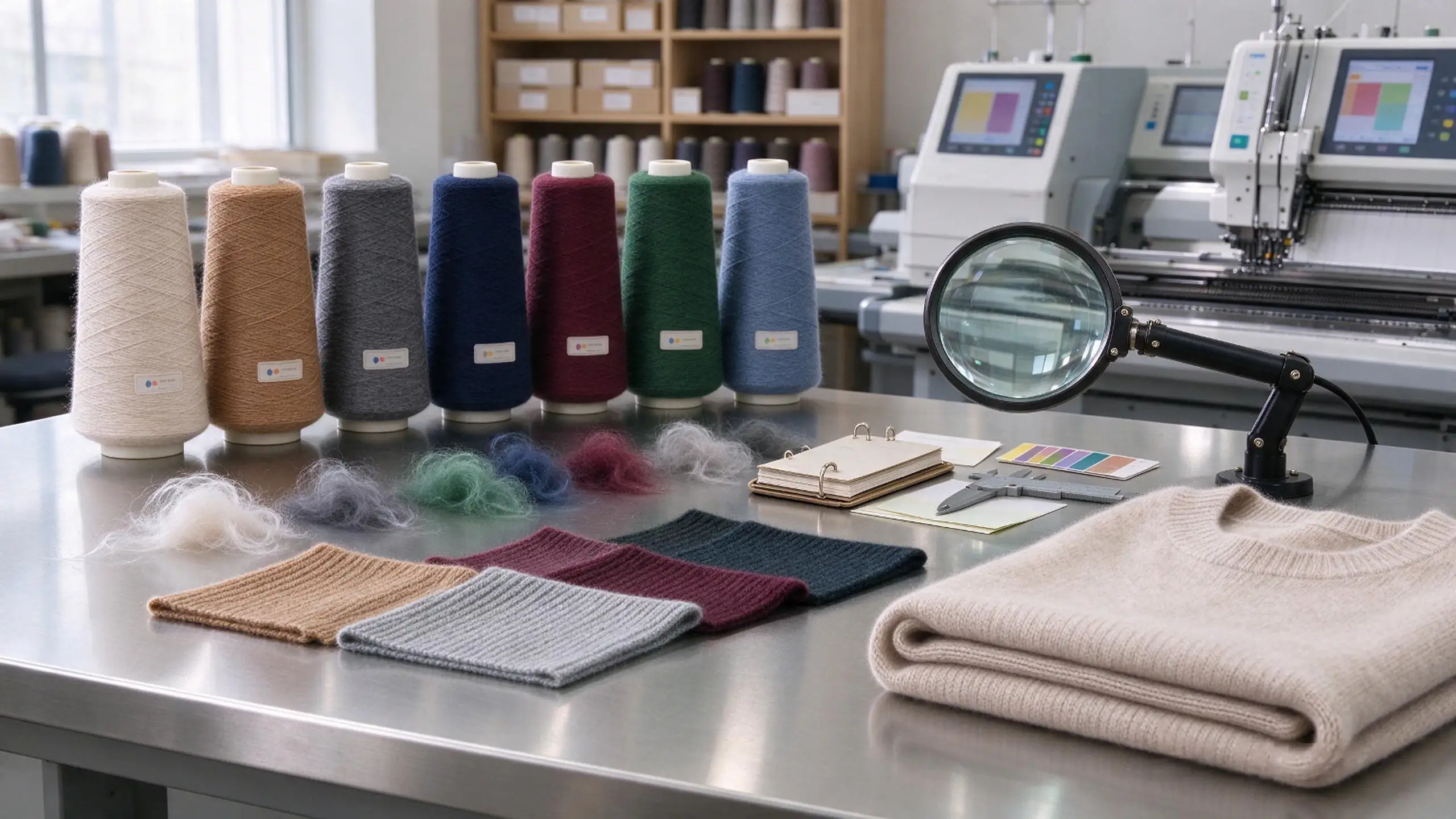
Quick Answer: The right cashmere sweater manufacturer for a DTC brand is the supplier that can connect fiber identity, yarn specification, machine compatibility, finishing approval, performance testing and bulk controls in one documented process. Complete nine evidence checks before paying for sampling, and reject any material, quality or production claim that cannot be tied to the proposed order.
Key Takeaways
1. Verify the fiber claim before evaluating softness. Specify the exact composition and intended label, then request supplier, lot, transaction and test evidence that relates to the proposed yarn.
2. Approve yarn and gauge as one technical system. Yarn count, ply, machine gauge, stitch density, finished weight, silhouette and finishing must work together.
3. Use a physical hand-feel reference. Approve softness, loft, surface, garment weight and dimensions on one coded sample instead of relying on subjective language or photographs.
4. Set tests and acceptance criteria before testing. A report is useful only when its method, sample, date and result correspond to the product being approved.
5. Freeze the bulk control package. The approved pre-production sample, specification, yarn lot, color standard, tolerances, test plan and change procedure must become the production reference.
Table of Contents
How Should a Cashmere Sweater Manufacturer Be Checked Before Sampling?
A supplier should pass nine connected checks before a DTC brand commissions a cashmere sample: fiber identity, traceability, yarn specification, gauge compatibility, color and lot control, finishing, hand feel, performance testing and sample-to-bulk consistency. Each check needs a buyer requirement, evidence request and approval decision. A soft showroom sample or persuasive presentation cannot replace this evidence chain. Use the matrix below to compare suppliers against the same product brief. It is a screening framework rather than a factory audit, certification or laboratory conclusion.
01
Fiber Identity
02
Traceability
03
Yarn Count
04
Gauge Compatibility
05
Color and Lot
06
Finishing Route
07
Hand-Feel Reference
08
Performance Testing
09
Bulk Consistency
| Check | Buyer Must Specify | Evidence to Request | Approval Decision |
|---|---|---|---|
| 1. Fiber identity | Exact composition and intended label claim. | Yarn specification and independent composition test when required. | Confirm that the proposed claim is supportable. |
| 2. Traceability | Origin, sourcing program and documentation scope. | Supplier, transaction, purchase and yarn-lot records. | Accept, qualify or remove the sourcing claim. |
| 3. Yarn count | Count system, count, ply, composition and target weight. | Technical sheet, cone label and sample-lot reference. | Approve the yarn or request a trial alternative. |
| 4. Gauge compatibility | Gauge, stitch, density, opacity, stretch and silhouette. | Unwashed and finished swatches with technical notes. | Freeze or revise the yarn-gauge-density route. |
| 5. Color and lot | Stock or custom shade and approved color standard. | Lab dip, color reference, lot and reservation status. | Approve one standard and a replacement-lot rule. |
| 6. Finishing route | Surface, loft, brushing, dimensions and care direction. | Written route and before-and-after measurements. | Approve only after appearance and dimensions align. |
| 7. Hand feel | Softness, loft, compactness, drape and weight. | Coded physical sample tied to yarn and finish. | Approve physically or request one controlled revision. |
| 8. Performance testing | Method, care cycle, test stage and acceptance criteria. | Product-linked pilling and dimensional reports. | Approve, revise or reject against written criteria. |
| 9. Bulk consistency | PP sample, tolerances, inspections and change authority. | Signed specification, lot records and production checks. | Release bulk only when all controls are complete. |
Real limitation: A supplier may be suitable for one cashmere program but unsuitable for another. Fine-gauge jersey, dense cables, brushed surfaces, custom colors and complex constructions create different material, machinery, finishing and testing requirements.
How Should Buyers Verify Cashmere Fiber Traceability?
A cashmere sweater manufacturer should connect every material claim to a defined yarn, supplier, transaction and production lot. The buyer must specify the intended composition, origin statement, sourcing-program claim, destination market and label wording. Request the yarn specification, cone or lot reference, purchase records, applicable chain-of-custody documents and an independent composition test when commercial or regulatory risk justifies it. Confirm that names, dates, certificate holders, product scope and transaction references match the order. If the evidence does not support the proposed claim, revise the claim or reject the material route.
What Traceable Cashmere Evidence Should Include
- Exact fiber composition and the wording intended for garment labels and product pages.
- Named yarn supplier, yarn reference, purchase record and identifiable production lot.
- Applicable chain-of-custody or transaction documentation for any sourcing-program claim.
- A written rule requiring approval before yarn, spinner, composition, shade or lot substitution.
- Independent fiber-content testing when required by the buyer’s risk assessment.
For US sales, the Federal Trade Commission’s cashmere guidance defines the conditions under which fiber may be identified as cashmere and advises businesses not to rely solely on invoice statements. For EU sales, Regulation (EU) No 1007/2011 governs textile-fiber names and related composition labeling.
Where GCS-related sourcing is requested, review the relevant holder, scope and transaction route against The Good Cashmere Standard Chain of Custody Guidelines. A certificate image or general supplier relationship is not automatically product-level proof.
How Do Yarn Count and Gauge Determine Technical Fit?
Cashmere yarn count and machine gauge must be assessed with ply, stitch structure, density, finished weight, opacity, stretch and finishing. The buyer should specify the intended silhouette and performance rather than sending only a composition and reference image. Request a technical yarn sheet, cone label, current color reference, gauge recommendation and both unwashed and finished swatches. The decision is whether the proposed combination can deliver the intended fabric without unacceptable looseness, stiffness, instability, excess weight or loss of stitch definition. Approve one documented yarn-gauge-density route before programming the full garment sample.
Define Four Connected Variables
- Yarn: composition, count system, count, ply, color, supplier and lot.
- Fabric: gauge, stitch, density, opacity, recovery and stretch direction.
- Garment: finished weight, measurements, silhouette, drape and wearing season.
- Finish: washing or brushing that may alter surface, dimensions and loft.
A cashmere yarn supplier can provide count and application guidance, but the garment factory must validate that yarn on the intended machine and structure. Cashmere yarn knitwear may change noticeably after washing and finishing, so an unfinished swatch cannot serve as the final approval reference.
YouTricot uses computerized flat knitting technology, including 80 Stoll machines added in May 2026—50 in 12 gauge and 30 in 7 gauge—alongside Shima Seiki seamless and fine-gauge equipment. This supports technical evaluation but does not make every yarn, stitch or design automatically feasible.
How Should Finishing and Hand Feel Be Approved?
Finishing and hand feel should be approved through one physical, version-controlled sample rather than descriptive words alone. Define the desired softness, loft, compactness, drape, surface bloom, brushing level, weight and care direction. Request the finishing route, yarn and lot used, measurements before and after finishing, garment weight and a coded reference sample. Review appearance, touch and dimensions together because a softer finish may also affect shape, recovery or pilling behavior. Approve the reference with a version number, date and consolidated comments so bulk garments have a practical comparison standard.
Replace Subjective Comments With Controlled Comparisons
Instead of requesting a “more luxurious” result, give comparative instructions tied to the submitted sample. For example: retain the current garment weight, reduce visible surface bloom, maintain neckline recovery and move the hand feel slightly softer without increasing brushing. If two alternatives are submitted, code them clearly and approve only one.
Approval limitation: Hand feel is partly subjective and can change with conditioning, humidity, handling and finishing variation. A sealed physical reference reduces disagreement but should be supported by garment weight, dimensions and surface criteria.
Which Pilling and Dimensional Tests Should Be Agreed?
Pilling and dimensional testing must be defined before the sample is sent to a laboratory. Specify the test method, specimen or garment state, conditioning, care procedure, exposure level, measurement points and acceptance criteria. Request a report that identifies the tested article, method, date and result. Do not accept an unsupported statement such as “anti-pilling cashmere,” and do not apply a result from a different yarn, finish or construction. If the tested configuration fails the buyer’s written standard, revise the yarn, density, finishing, care instruction or product expectation before bulk approval.
The ISO 12945 series includes methods for evaluating fabric propensity to pilling, fuzzing and matting. Dimensional-change assessment may use ISO 5077 with an appropriate preparation and care procedure, including applicable procedures in ISO 6330. The buyer or qualified laboratory must confirm the applicable method and threshold. There is no universal passing grade for every cashmere sweater.
How Can Buyers Control Sample-to-Bulk Consistency?
Sample-to-bulk consistency requires the approved sample to become part of a controlled production package. Freeze its version, measurements, tolerances, yarn and shade references, gauge, stitch density, finishing route, trims, labels, test requirements and packaging. Request a pre-production sample, signed specification, material-lot record, approved change log, inline measurement checks and final inspection evidence. Bulk production should not begin while an approval-critical field remains open. If a yarn lot, color, finish or construction changes, the supplier must disclose the change and obtain approval before continuing to use the original sample as the reference.
- Physical reference: sealed pre-production sample with version and date.
- Technical reference: measurements, tolerances, construction and workmanship.
- Material reference: yarn, lot, shade, composition and substitution rule.
- Performance reference: methods, criteria and test stage.
- Production record: changes, inline findings, corrections and final release.
Related quality-control guide
Read the full guide here : knitwear quality control SOP
Which Variables Drive Cashmere Sweater Cost?
Cashmere sweater cost cannot be compared accurately unless suppliers quote the same material, garment and service scope. Composition, yarn specification, finished weight, gauge, stitch complexity, color route, finishing, testing and quantity may all change the result. A lower quotation may reflect a lighter garment, different cashmere yarn, simpler construction, stock color, reduced testing or narrower service scope. Ask every supplier to state its assumptions and exclusions rather than comparing one total price. This section identifies quotation variables only; it does not set universal market prices or guarantee that a higher price represents better quality.
| Cost Driver | Question to Ask | Comparison Risk |
|---|---|---|
| Composition and yarn | Which composition, count, ply, supplier and lot assumption is priced? | Different fiber or yarn specifications presented as equivalent. |
| Finished garment weight | What sample size and target finished weight does the quotation assume? | A lighter garment appears cheaper despite using less yarn. |
| Gauge and structure | Which gauge, density and stitch program are included? | Complex or slower structures are omitted from the initial assumption. |
| Color route | Is the price based on an available shade or custom dyeing? | Custom-color minimums or development work appear later. |
| Finishing | Which washing, brushing, shaping and finishing steps are included? | Suppliers quote different hand-feel and surface outcomes. |
| Testing and inspection | Which laboratory tests and inspection stages are included? | One quotation excludes required external services. |
| Quantity and packaging | Which style-color quantity, size ratio, trims and packaging are priced? | Setup work or custom components are spread across different quantities. |
Which Knitwear Factory Is Best for Cashmere Sweaters?
The best factory is the one that provides the strongest technical and evidence fit for the intended sweater, not the supplier with the broadest capability list. Score each candidate against the same brief, deadline and evidence request. Traceability and yarn-gauge compatibility should be mandatory gates because finishing cannot correct an unsupported composition claim or unsuitable knitted structure. The scorecard below helps organize a shortlist, but it is not an audit or certification. A supplier with a high total should still be rejected if it fails a legal, traceability, testing or disclosure requirement.
| Area | 0 Points | 1 Point | 2 Points | 3 Points |
|---|---|---|---|---|
| Traceability | Unsupported claim | General document | Named supplier and lot | Order-matched chain and test plan |
| Yarn-gauge fit | No review | Verbal recommendation | Technical sheet and swatch | Finished trial with records |
| Finish and hand feel | Subjective promise | Uncoded sample | Coded reference | Reference plus finish record |
| Testing readiness | No criteria accepted | Generic report | Methods agreed | Product-linked corrective route |
| Bulk controls | No package | Sample only | PP sample and specification | Lot, inline and change controls |
| Commercial clarity | Material mismatch | Major open conditions | Feasible with conditions | Clear scope and exclusions |
Decision rule: Treat a zero in any mandatory area as a stop condition. For the remaining suppliers, investigate the lowest-scoring area before comparing price. A high total cannot compensate for unsupported composition, undisclosed substitution or missing acceptance criteria.
What Should Be Verified Before Paying for Sampling?
Before paying for sampling, confirm what the sample must prove and what the quotation includes. Identify the style, yarn route, sample type, size, color, finishing, testing, revision allowance, courier treatment, exclusions and next approval gate. At YouTricot, sampling uses a symbolic sampling fee that is fully deductible from later bulk production orders. Sampling is not represented as universally free. Premium cashmere, custom colors, special trims, external testing or additional revision rounds may require project-specific review.
Pre-Payment Verification Checklist
- Name the sample objective: swatch, proto, fit, revised or pre-production approval.
- Use a current tech pack with a style number, version and revision date.
- Record the fiber claim, yarn, count, ply, color, gauge and stitch direction.
- List the evidence and testing required before bulk approval.
- Define physical approval for color, surface and hand feel.
- Confirm included revisions, external costs, courier terms and exclusions.
- Record the bulk MOQ, material conditions and capacity confirmation required.
- Do not treat the bulk price or schedule as final while critical specifications remain open.
YouTricot’s standard opening MOQ is 50 pieces per style per color. Final feasibility depends on yarn availability, gauge, construction, color, finishing, testing, labels, packaging and scheduling. Custom-dyed or scarce cashmere yarn may introduce a separate mill requirement even when the garment MOQ is acceptable.
Phased Sourcing Workflow
01
Screen
Issue one RFQ and reject unsupported mandatory claims.
02
Validate
Close material and technical gaps through records and swatches.
03
Sample
Develop one controlled version and consolidate buyer comments.
04
Approve
Review the physical sample and required test results.
05
Freeze
Seal the PP sample and issue the final control package.
06
Control Bulk
Check lots, production, finishing, measurements and release status.
Preceding procurement guide
Read the full guide here : reliable low MOQ sweater factory
Commercial MOQ conditions
Read the full guide here : low MOQ knitwear rules
Next sourcing step
Read the full guide here : fast sampling knitwear
What Should a Decision-Ready Cashmere RFQ Contain?
A decision-ready RFQ gives each supplier enough information to evaluate the same product, evidence standard and commercial scope. Include the style number, technical drawings, measurements, target composition, cashmere claim, yarn or hand-feel direction, gauge, stitch, garment weight, colors, size range, quantity per style and color, tests, destination market, label requirements, sample objective and factory-release window. Mark unresolved fields as “supplier to recommend with evidence.” Ask each cashmere sweater manufacturer to separate confirmed facts, assumptions, alternatives, exclusions and items requiring buyer approval.
Request a Cashmere Technical-Feasibility Review
Send your tech pack, target fiber claim, yarn or hand-feel direction, gauge and stitch requirements, colors, size range, quantity, testing needs and launch window. YouTricot will review the proposed yarn, construction, finishing and production conditions before confirming the sampling scope or quotation.
Cashmere Sweater Manufacturer FAQs
These answers address common commercial-investigation questions from DTC founders and sourcing teams. Apply them to a defined product rather than treating them as universal rankings, prices or test specifications. The appropriate evidence, test method and production route depend on the destination market, fiber claim, yarn, gauge, construction, finish, care method and buyer quality manual.
Which knitwear factory is best for cashmere sweaters?
The best factory is the one that proves compatibility with your yarn, gauge, stitch, finish, test requirements, quantity and schedule. Compare traceability, technical trials and bulk controls against one brief rather than selecting from a ranking, headline MOQ or unsupported quality promise.
Why are cashmere sweaters so expensive?
Cost may reflect fiber and yarn specification, garment weight, knitting time, stitch complexity, color development, finishing, testing, quality control and order size. Compare prices only when suppliers have quoted the same product and service scope.
How to choose a knitwear manufacturer in China?
Send shortlisted factories the same brief. Compare product specialization, traceability, yarn-gauge reasoning, sample quality, testing readiness, production controls, exclusions and live capacity. Verify material and operational claims before paying for sampling or releasing production.
What evidence should a cashmere yarn supplier provide?
Request the composition specification, count, ply, color, supplier and lot reference, applicable chain-of-custody documents and any product-specific test report required by the buyer. Check that each document relates to the yarn proposed for sampling and bulk production.
Does cashmere pill easily?
Cashmere can develop surface fuzzing or pills, but the result depends on fiber and yarn characteristics, twist, density, finish, use and care. Agree a relevant test method and buyer-defined criterion instead of relying on a universal “anti-pilling” promise.
Can one sample guarantee bulk cashmere quality?
No. A sample becomes a useful control only when it is tied to an approved specification, material reference, finishing route, test plan and production record. Material substitutions and process changes still require disclosure and approval.
What is YouTricot’s MOQ for a cashmere sweater OEM project?
The standard opening MOQ is 50 pieces per style per color. Final feasibility depends on yarn availability, color, gauge, construction, finishing, testing, labels, packaging and scheduling. Specialty or custom-dyed yarn may carry separate material conditions.
Authority and update note: Regulatory and testing references were reviewed on 26 September 2026. Buyers remain responsible for confirming current destination-market requirements, selected standard editions, laboratory protocols and product-specific obligations.
Frank, Founder of YouTricot
Frank has 20 years of knitwear-industry and operational experience across Prato, Italy and Dalang, Dongguan, China. He writes for fashion founders, product developers and sourcing teams that need practical guidance on premium yarns, supplier verification, sampling and controlled knitwear production.