

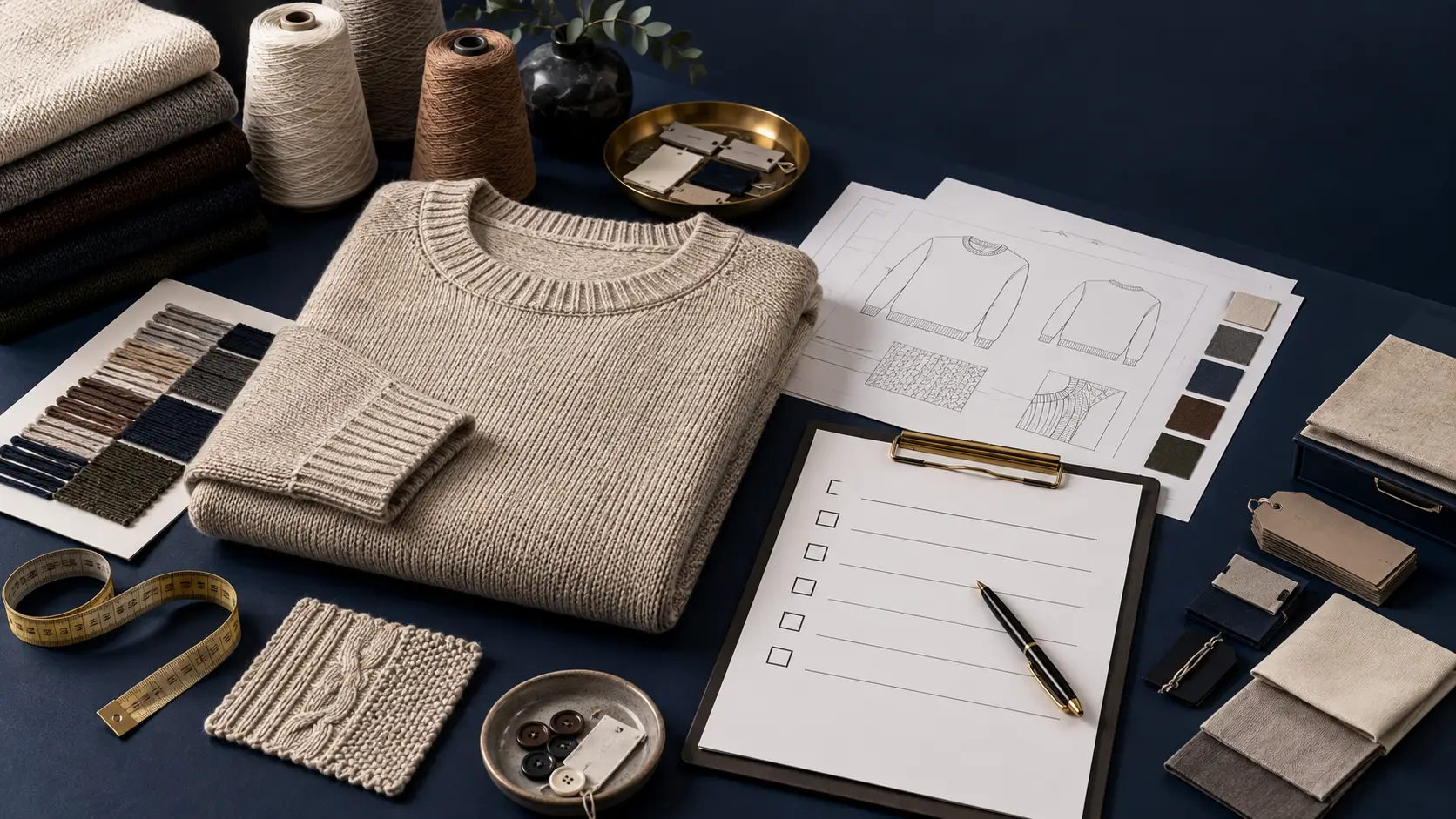
Quick answer: If you are researching how to find a reliable sweater factory with low MOQ, use an evidence-based sequence: define one technically realistic brief, build a focused shortlist, verify the legal entity and production site, approve a development sample, and test a controlled order before committing to repeat production. For this sourcing route, the standard opening MOQ is 50 pieces per style per color. It cannot be split across styles or colors, and final feasibility still depends on yarn, gauge, construction, finishing, packaging, compliance scope, and capacity.
Key Takeaways
1. Low MOQ must be defined before suppliers are compared. A useful MOQ states the quantity basis, not just a headline number. Confirm whether the minimum applies per style, per color, per yarn, or per order. Here, the opening rule is 50 pieces per style per color, with sizes planned inside an approved style-color combination. Custom-dyed yarn, uncommon fibers, complex intarsia or jacquard, special finishing, and unusual packaging can create separate minimums or extend the schedule. A supplier that explains these boundaries is more credible than one that promises any design at any quantity.
2. Verification needs documents, live evidence, and a product test. A business license alone does not prove that a company can make your sweater. Match the Chinese legal name, Unified Social Credit Code, registered address, payment beneficiary, and business scope. Then request a live video walkthrough that shows signage, knitting machines, gauge range, sample development, linking, washing, inspection, and packing. Validate certificate numbers and site scope with the issuing program. Finally, compare a physical sample and trial order with the approved tech pack. These evidence layers reduce identity, capability, quality, and delivery risk.
3. A safe trial order tests the working relationship, not only the garment. Begin with one commercially important style in one color and 50–100 pieces. If you test two styles under this standard opening MOQ, plan at least 100 pieces in total because each style-color combination starts at 50 pieces. Inspect fit across the approved size set, handfeel, seams, labels, packaging, defect handling, communication, and dispatch performance. Record the approved sample, measurement chart, shade reference, packing instructions, and defect resolution in writing so the second batch can be compared against the first.
Table of Contents
The 5-Step Safe Sourcing Methodology
Use this sequence to move from a search result to an evidence-backed supplier decision. The time column is a suggested buyer review allowance, not a factory lead-time promise.
| Step | Action | Tools | Required output | Suggested buyer time |
|---|---|---|---|---|
| 1. Define | Fix product type, MOQ basis, budget, timeline, target market, and compliance needs. | Tech pack, bill of materials, target-cost sheet, compliance brief | One comparable RFQ with must-haves and negotiables | 1–3 working days |
| 2. Discover | Build a shortlist through multiple channels, then screen for low-MOQ operating fit. | Alibaba filters, trade-show directories, Google advanced search, industry forums | Shortlist of 5–10 plausible factories | 3–7 working days |
| 3. Verify | Verify legal identity, site capability, documents, certificates, samples, and references. | Government registry, live video call, audit records, label checks, buyer references | Completed 20-item pass/fail file | 5–10 working days |
| 4. Test | Approve a sample, place a 50–100-piece trial style-color, and inspect the result. | Approved sample, QC checklist, measurement report, photo record | Trial-order scorecard and corrective-action log | Style-specific written schedule |
| 5. Assess | Measure repeat-batch consistency, response to issues, and improvement discipline. | Batch scorecards, delivery records, CAPA log, review meetings | Approve, conditionally approve, or replace supplier | Review across 2–3 completed batches |
Step 1: Define the Low-MOQ Requirement Before You Search
Direct answer: Write a sourcing brief that lets every factory quote the same product and the same commercial boundary. State the garment category, fiber composition, yarn direction, gauge, stitch or artwork, construction, size range, colors, labels, packaging, target market, testing or documentation needs, target budget, desired dispatch date, and reorder expectation. Define MOQ as pieces per style per color. For this sourcing route, use 50 pieces per style per color as the opening baseline. Mark stock-supported yarn as acceptable only if it meets the approved composition, handfeel, color, and compliance requirements. A vague brief creates low quotes that cannot be compared and schedules that cannot be defended.
The Minimum Viable RFQ
01
Product definition
Tech pack or authorized reference, measurements, yarn direction, gauge, stitches, construction, and sample purpose.
02
Commercial boundary
50 pieces per style per color, target cost, Incoterm, payment proposal, packaging, and reorder plan.
03
Market and compliance
Destination market, care labeling, restricted-substance needs, requested certifications, and third-party testing.
04
Decision timeline
Latest sample dispatch, buyer fitting time, revision window, bulk approval date, and required delivery date.
Real limitation: Fifty pieces is an opening garment MOQ, not a universal promise for every specification. A custom Pantone dye lot, scarce or luxury yarn, engineered jacquard, complex intarsia, special brushing, printing, trims, testing, or packaging may introduce another supplier minimum or a longer development route. Confirm feasibility before treating the quantity as approved.
Read the full guide here : knitwear tech pack RFQ checklist
Read the full guide here : low MOQ knitwear rules
Step 2: How to Discover a Low MOQ Sweater Factory
Direct answer: Build a broad list, then narrow it with evidence. On Alibaba, use product, location, supplier-type, years-active, response, and verification filters as discovery signals, not proof. Search trade-show exhibitor directories for knitwear, flat knitting, yarn, and private-label capabilities. Use Google operators such as site:, quotation marks, and combinations of product, location, gauge, and MOQ terms. Read professional sourcing communities and industry forums for recurring service patterns, then verify every claim independently. Shortlist five to ten suppliers whose product range resembles your design, whose stated MOQ matches your quantity basis, and whose team can explain sampling, production, QC, and compliance without changing the subject.
Five Signs of a Reliable Low MOQ Sweater Factory
| Green flag | Why it matters | Evidence to request |
|---|---|---|
| 1. Stock yarn library | Available yarn programs can reduce exposure to yarn-mill lot minimums and shorten allocation time. | Current color cards, composition records, available quantities, lot policy, and reorder limitations |
| 2. Dedicated sample line | Sample development has assigned people and machines instead of waiting behind every bulk order. | Live sample-area video, development workflow, revision control, and current slot availability |
| 3. Flexible, right-sized team | A small-to-medium team may schedule short runs more easily, provided technical and QC roles remain clear. | Organization chart, named project owner, machine plan, and QC responsibility |
| 4. Planned shared-capacity scheduling | The factory can sequence several brands’ small programs across planned machine time without mixing customer materials or traceability records. | Scheduling method, lot segregation, style identification, and changeover controls |
| 5. DTC and e-commerce experience | The team understands launch quantities, size ratios, labels, barcodes, individual packing, and fast feedback. | Anonymized order workflow, packaging examples, and references from comparable buyers |
No single green flag proves ownership or reliability. Treat each one as a reason to request the next layer of evidence.
Step 3: Verify the Legal Entity, Factory, Quality System, and Claims
Direct answer: The safest answer to how to verify a knitwear factory before ordering is to connect four things: the company you contract with, the site making the garments, the capability required by your design, and the evidence supporting each compliance claim. Check a Chinese supplier’s legal name and Unified Social Credit Code in the official registry. Match the address and payment beneficiary to the quotation and contract. Conduct a live factory walkthrough and record machine count, gauge range, workforce, sample capability, and capacity for comparable products. Validate certificate holders, sites, dates, and scope. Finally, approve a physical sample and request authorized references or equivalent documented evidence.
For China business-license checks, use the National Enterprise Credit Information Publicity System. For material and social-compliance claims, use the OEKO-TEX Label Check, the Responsible Wool Standard information from Textile Exchange, and the amfori BSCI program information. Treat BSCI as an audit and improvement-system claim, not a product certificate. Source links reviewed September 10, 2026.
Eight Red Flags When Evaluating Low-MOQ Factories
| Red flag | Why it matters | Buyer response |
|---|---|---|
| 1. Unexplained ultra-low MOQ | An offer below 30 pieces may be legitimate for samples, ready stock, or a special slot, but it can also indicate resale or a production model that is difficult to repeat. The number alone does not prove trader status. | Ask how yarn minimums, programming, setup, QC, and repeat production are funded and scheduled. |
| 2. No factory address or current photos | You cannot connect the quotation to a production site. | Pause the shortlist until the address and live site evidence are supplied. |
| 3. No business license | The contracting identity and legal status cannot be checked. | Do not pay a bulk deposit until the entity is verified. |
| 4. Materially underpriced quotation | A gap of 50% or more versus specification-matched quotations is a screening trigger, not proof of misconduct. It may hide a different fiber, garment weight, construction, finishing, QC scope, Incoterm, or omitted cost. | Normalize the specification and request a line-by-line clarification. |
| 5. No sample-production capability | Pattern making, needle drafting, knitting, washing, and measurement risks remain untested. | Reject the supplier for custom OEM/ODM work unless a disclosed, verified development partner is contractually included. |
| 6. Refuses a live video call or visit | Staged images cannot confirm current site control or equipment access. | Request a live route through the named address or use an independent auditor. |
| 7. No QC documentation | There is no controlled reference for measurements, defects, shade, handfeel, or release. | Ask for anonymized inspection forms, checkpoints, tolerances, and corrective-action records. |
| 8. Demands 100% upfront for a bulk trial | The buyer carries all performance risk without a milestone or inspection hold point. | Negotiate written milestones or protected terms. A small sample invoice may follow different terms from a bulk order. |
20-Item Factory Verification Checklist
Complete every row and retain the supporting file, screenshot, video, report, or contact note. Review the four evidence groups separately; a blank item is not a pass, and a strong result in one group does not cancel a material failure in another.
| # | Verification item | Acceptable evidence | Result |
|---|---|---|---|
| A. Legal and Commercial Identity | |||
| 1 | Chinese legal company name | License name matches registry and contract | ☐ Pass ☐ Fail |
| 2 | Unified Social Credit Code | Code matches license and official registry | ☐ Pass ☐ Fail |
| 3 | Registration status | Active status with no material unexplained abnormality | ☐ Pass ☐ Fail |
| 4 | Registered address | Registry, quotation, signage, and live location are reconcilable | ☐ Pass ☐ Fail |
| 5 | Business scope | Scope is consistent with garment or knitwear manufacturing and trade activities | ☐ Pass ☐ Fail |
| 6 | Payment beneficiary | Matches the contracting entity or a disclosed export arrangement documented in writing | ☐ Pass ☐ Fail |
| B. Factory and Production Capability | |||
| 7 | Current factory identity | Live video shows exterior, signage, date context, and interior route | ☐ Pass ☐ Fail |
| 8 | Knitting-machine count | Live count or current machine list with brand, model, and operating status | ☐ Pass ☐ Fail |
| 9 | Gauge range | Machines and samples demonstrate the gauges required by the project | ☐ Pass ☐ Fail |
| 10 | Sample line | Named sample team, workflow, machine access, and revision records | ☐ Pass ☐ Fail |
| 11 | Production processes | Knitting, linking, washing, finishing, inspection, and packing roles are disclosed | ☐ Pass ☐ Fail |
| 12 | Workforce size and roles | Current headcount by technical, production, QC, and project-management function | ☐ Pass ☐ Fail |
| 13 | Monthly capacity | Capacity for comparable gauge and complexity, supported by current utilization and schedule evidence | ☐ Pass ☐ Fail |
| C. Quality, Materials, and Compliance | |||
| 14 | Stock-yarn controls | Composition, supplier, color card, lot identity, availability, and reorder policy | ☐ Pass ☐ Fail |
| 15 | Quality-control documents | Measurement, inline inspection, final inspection, defect, and corrective-action forms | ☐ Pass ☐ Fail |
| 16 | OEKO-TEX claim | Certificate or label number, holder, validity, product class, article scope, and site match | ☐ Pass ☐ Fail |
| 17 | amfori BSCI claim | Current audit/report access, audited site, date, scope, findings, and improvement status | ☐ Pass ☐ Fail |
| 18 | Other material certification claims | RWS, GCS, or other documents match the material, certificate holder, transaction scope, and supply chain | ☐ Pass ☐ Fail |
| D. Product and Reference Evidence | |||
| 19 | Sample evaluation | Physical sample matches approved measurements, construction, handfeel, color, labeling, and finish | ☐ Pass ☐ Fail |
| 20 | Comparable buyer-reference evidence | Buyer contacts shared with permission, or equivalent evidence such as redacted orders, an authorized case study, or a buyer-arranged reference call | ☐ Pass ☐ Fail |
Certificate boundary: Verify the holder, production site, validity date, covered product or material, and transaction scope. A logo in a presentation does not prove that your exact yarn, garment, order, or factory site is covered. Ask the supplier to explain the chain of evidence that will accompany your order.
Step 4: Approve the Sample and Run a Controlled Trial Order
Direct answer: Test the smallest order that still reflects normal production. Begin with one commercially important style in one color at 50–100 pieces. Under the 50-pieces-per-style-per-color rule, testing two one-color styles requires at least 100 pieces in total. Approve a physical development sample, measurement chart, material reference, and written construction standard before bulk knitting. Inspect fit across approved sizes, handfeel consistency, seams, labels, packaging, and order-level variation. Record defects by severity and track response times. The trial succeeds only when the garments and the supplier’s communication, documentation, corrective action, and dispatch performance meet the agreed acceptance criteria.
What to Order and What to Evaluate
01
Order scope
One priority style and one color at 50–100 pieces. Add a second style only when the team can evaluate two separate style-color references.
02
Fit and measurements
Check critical points across the approved size set, tolerance application, grading logic, garment balance, and recovery after finishing.
03
Material and construction
Compare handfeel, shade, stitch density, seams, linking, trims, washing, surface appearance, and finishing with the approved sample.
04
Identity and packing
Verify main labels, care labels, size labels, hangtags, barcodes, folding, polybags, carton marks, quantities, and assortment accuracy.
Define Trial-Order QC Criteria Before Bulk Knitting
A defect rate is meaningful only when the buyer and factory use the same defect definitions, measurement method, inspection sample, and disposition rules. Put these criteria in the approved specification or purchase order before production; otherwise, a percentage reported after delivery cannot show whether the lot met the agreed standard.
| QC element | What must be agreed | Required record |
|---|---|---|
| Defect classes | Define critical defects that create safety, legal, or identity risk; major defects that impair function, appearance, or saleability; and minor workmanship defects with limited effect. | Approved defect library with photographs where practical |
| Measurement tolerances | Set point-by-point tolerances, garment preparation, measuring position, and the condition in which finished pieces will be checked. | Controlled measurement chart and measurement method |
| Inspection sample | Define the lot, inspection stage, sample size, random-selection method, and acceptance rule. Use a buyer-approved sampling plan when one is required. | Signed inspection plan and completed report |
| Lot disposition | State when a lot is accepted, reworked, reinspected, replaced, credited, or rejected, including responsibility and completion timing. | Written release decision and remedy record |
| Corrective action | Record containment, root cause, action owner, due date, verification method, and evidence that the next production run changed. | Corrective and preventive action record |
Questions to Ask After Delivery
- What was the final defect rate by defect type, and how does it compare with the agreed acceptance criteria?
- Which defects were found during production, and what corrective action prevented recurrence?
- What replacement, repair, or credit route applies, and what is the written completion timeline?
- Were the sample, bulk approval, and dispatch milestones met? If not, when was the risk communicated?
- Did both teams receive clear, timely answers, updated documents, and one controlled version of the specification?
How Fast Sampling Fits the Trial Strategy
At YouTricot, an eligible fast-track sample can move from a confirmed technical start to sample completion and dispatch preparation in 7–10 working days. Eligibility requires a current tech pack, available yarn and color, familiar construction, a controlled approval scope, and confirmed machine capacity. International courier time, customs, buyer fitting, comments, custom dyeing, complex jacquard or intarsia, special finishing, and additional revision rounds are separate. Sampling uses a symbolic sampling fee that is fully deductible from later bulk production orders; the quotation should state the exact scope and deduction terms.
Read the full guide here : fast sampling knitwear
Step 5: Measure Long-Term Reliability Across Repeat Batches
Direct answer: Do not convert a successful sample into permanent supplier approval. A reliable low MOQ knitwear manufacturer should reproduce the approved standard across at least two to three completed batches. Track measurements, handfeel, yarn-lot and shade control, defect types, packing accuracy, milestone performance, document accuracy, response time, and corrective-action closure. A dependable partner reports risk early, contains affected goods, identifies the cause, proposes a dated solution, and proves the next batch changed. Reapprove materials when yarn lots or programs change. Retain a backup supplier until repeat performance shows that the factory can protect both product quality and launch timing.
| Dimension | What to compare | Approval signal |
|---|---|---|
| Batch consistency | Measurements, handfeel, shade, seams, finish, labels, and packing across orders | Variation stays within written standards and approved changes |
| Issue response | Time to acknowledge, contain, investigate, replace, repair, or credit | Clear owner, dated action, and written closure |
| Communication | Response quality, version control, milestone warnings, and decision records | Problems are raised before they affect shipment |
| Improvement | Corrective action from one batch compared with the next batch | Evidence shows the root cause was addressed, not merely discussed |
| Commercial reliability | Quoted scope, approved changes, invoices, material reservations, and delivery milestones | Changes are documented before cost or timing moves |
How a Flexible OEM/ODM Partner Supports Low-MOQ Buyers
YouTricot’s low-MOQ OEM/ODM route is designed for independent designers, startup labels, and DTC brands that need controlled inventory exposure. The standard opening MOQ is 50 pieces per style per color. Stock-supported yarn programs can reduce material-minimum pressure when the approved fiber, color, handfeel, and compliance scope are available. A dedicated sample line supports development without removing technical review, while bilingual project management keeps decisions, revisions, and milestones clear for international teams. Pricing is confirmed against the actual yarn, gauge, stitch program, construction, finishing, labels, packaging, testing, and delivery scope. Sampling is charged as a symbolic sampling fee, fully deductible from later bulk production orders.
Decision rule: Choose the supplier that provides the strongest match between evidence and your exact product, not the lowest headline MOQ or fastest unqualified promise. Approve long-term status only after repeat orders show consistent quality, transparent communication, on-time control, and measurable improvement.
Frequently Asked Questions
How do I find a reliable sweater factory with low MOQ?
Define a comparable technical and commercial brief, discover suppliers through more than one channel, verify the legal entity and live production site, approve a physical sample, and test a controlled bulk order. Continue measuring performance across repeat batches before granting long-term supplier status.
What MOQ should a startup brand plan for?
For this sourcing route, plan 50 pieces per style per color. Sizes can be discussed inside an approved style-color combination, but styles and colors cannot be combined to reach the minimum. Final feasibility depends on the yarn, construction, finishing, packaging, and schedule.
Does an MOQ below 30 pieces prove that the supplier is a trading company?
No. It is a warning sign, not proof. The quote may cover a sample, ready stock, resale, or a special production slot. Ask how yarn minimums, programming, setup, quality control, and repeat orders work, then verify the legal entity and production site.
How can I verify a knitwear factory in China before ordering?
Check the Chinese legal name, Unified Social Credit Code, registration status, address, and business scope in the national registry. Match the contracting and payment entities, conduct a live factory walkthrough, validate capability and certificates, inspect a sample, and request buyer contacts shared with permission or equivalent evidence such as redacted orders and an authorized case study.
What certifications should a sweater factory provide?
The answer depends on the target market, product, material, and buyer policy. Relevant claims may include OEKO-TEX Standard 100, RWS, GCS, or an amfori BSCI audit. Verify the certificate holder, site, validity, product or material scope, and order-level chain of evidence instead of accepting a logo alone.
Do sweater factories offer fast sampling services?
Qualified OEM/ODM factories normally offer sample development. A 7–10 working-day route is feasible only for eligible, technically ready styles with available yarn and confirmed capacity. Courier transit, customs, buyer review, custom dyeing, complex structures, and additional revisions are separate.
Should I pay 100% upfront for a trial order?
Treat a demand for 100% upfront bulk payment as a risk requiring negotiation and stronger protection. Use written milestones, inspection hold points, and clearly defined remedies where possible. A small sample invoice may use different terms, so separate sample-payment logic from bulk-order payment terms.
What should a trial-order QC agreement include?
Define critical, major, and minor defects; point-by-point measurement tolerances; the lot and sample-selection method; the acceptance rule; and the remedies for failed goods. Also require a corrective-action record with containment, root cause, owner, due date, and verification in the next production run.
Request a Style-Specific Low-MOQ Review
Send your tech pack or authorized reference, style and color count, yarn direction, size range, target market, testing needs, target quantity, budget, and required dispatch date. We will review the product against the 50-pieces-per-style-per-color rule and confirm the appropriate sampling and quotation route.
Frank, Founder of YouTricot
Twenty years of knitwear industry and operational experience across Prato, Italy, and Dalang, Dongguan, China.