

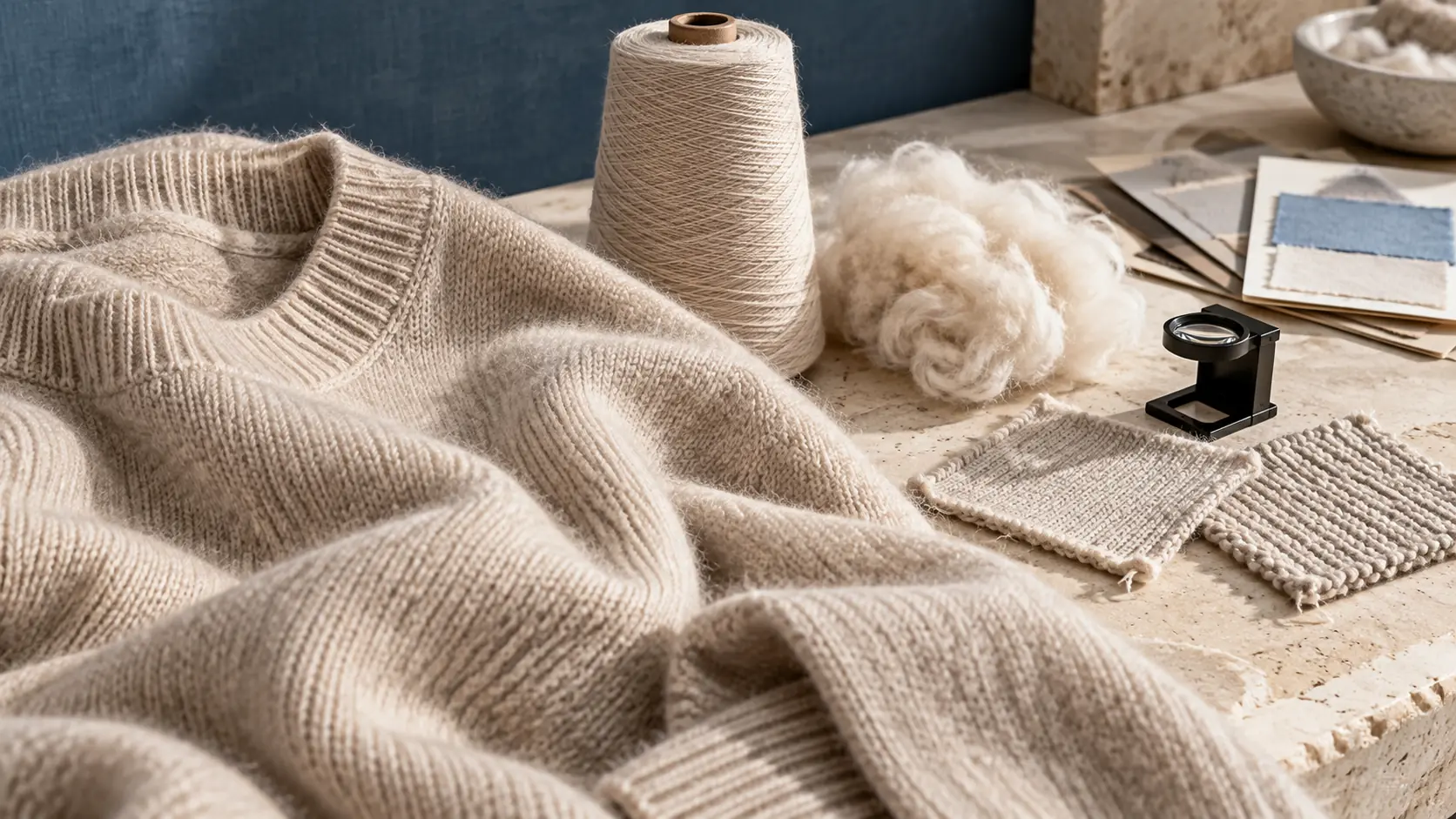
Quick answer: For a sweater brand comparing quotes from a cashmere sweater manufacturer, cashmere is expensive because usable fine undercoat is limited, coarse hair and contamination must be removed, and premium yarn requires controlled spinning, knitting, washing and testing. It is worth the price only when verified fibre, construction and finished-garment performance support the intended market position.
For luxury knitwear founders, product developers and sourcing managers, the real question is whether the quoted sweater contains the specified fibre, uses a construction suited to its end use and meets agreed performance criteria. This guide separates product facts, supplier evidence and buyer decisions so the cashmere premium can be evaluated rather than assumed.
Key Takeaways for Cashmere Buyers
Cashmere value is established through a chain of connected decisions: fibre identity and quality, yarn specification, knitted construction, finishing, and finished-garment verification. A composition label answers only one part of that chain. Buyers should define the intended wearer, climate, silhouette, care method and retail promise first, then request evidence that matches those conditions. No yarn name, region, micron figure, certification label or laboratory result can independently predict the complete sweater. The following takeaways therefore use conditional rules rather than universal quality claims.
1. “100% cashmere” identifies composition, not a complete quality grade. Fineness, length, dehairing, cleanliness, spinning, construction and finishing still require separate evidence.
2. Yarn price cannot be evaluated without garment consumption. Count, ply, gauge, stitch density, size, garment weight and waste allowance jointly affect material use and knitting time.
3. Softness at sample handover is not enough. Pilling, dimensional change, shade control and appearance after the specified care method must be assessed under agreed conditions.
4. Cashmere is worth the price only when evidence supports the brand proposition. Pure cashmere, blends and alternative premium fibres can each be the better choice for a different end use.
Table of Contents
Why Are Cashmere Sweaters So Expensive at Fibre Level?
Cashmere commands a premium when a mill starts with the correct fine undercoat, removes coarse guard hair and contamination, controls the usable dehaired fibre, and documents the lot through conversion. Fineness influences handle and spinning options; length contributes to yarn cohesion; cleanliness and dehairing affect how much usable fibre remains; traceability supports origin or programme claims. When comparing an Inner Mongolia cashmere supplier, the buyer should approve a defined lot against measurable requirements rather than a regional name or broad adjective. Evidence should include composition, lot-linked technical data and traceability records. No individual fibre metric guarantees the appearance, durability or fit of a finished sweater.
Definition first: cashmere content is not a premium grade
For products sold in the United States, the Federal Trade Commission explains that cashmere is the fine, dehaired undercoat produced by a cashmere goat and sets diameter-related conditions for the fibre name. Those conditions define whether a fibre may be called cashmere; they do not create a universal hierarchy for expressions such as grade A cashmere yarn. If a supplier uses “Grade A,” ask for its written grading basis, test method, sampling plan and lot-specific results. Without that definition, the phrase is marketing language rather than comparable procurement data. Read the FTC cashmere guidance.
| Cost driver | Product fact to define | Supplier evidence to request | Buyer decision | Applicable limitation |
|---|---|---|---|---|
| Identity and composition | Cashmere percentage and any blended fibres | Lot identification, composition declaration and, when required, fibre-analysis report | Approve only the declared composition that matches the product claim | Composition does not prove fineness, length, origin or garment quality |
| Fineness | Average diameter, distribution and stated test basis | Lot-linked test report or certificate of analysis with method and sample reference | Select a range appropriate to handle, count and end use | A lower average alone does not guarantee durability, uniformity or comfort |
| Fibre length | Staple-length result and distribution under a named method | Current report tied to the lot; confirm the standard edition with the laboratory | Match length to yarn count, spinning route and performance target | Length cannot be judged from softness and does not independently determine pilling |
| Dehairing yield and cleanliness | Usable dehaired fibre after guard hair, dirt and other matter are removed | Mill specification, incoming-material record and relevant cleanliness or contamination data | Compare usable output and consistency, not greasy-fibre input alone | Finished-yarn buyers may not receive raw-fibre yield data unless it is contractually requested |
| Origin and traceability | Claimed region, chain-of-custody route and applicable programme | Transaction, lot and chain-of-custody documents covering each named claim | Approve only traceable wording that the evidence supports | “Inner Mongolia” alone does not prove fibre grade, animal-welfare status or garment performance |
| Natural colour and lot continuity | Base-fibre colour, dyed shade, lot size and replenishment plan | Approved shade standard, lot references and continuity statement | Reserve or approve lots for the required colour quantity | Visual continuity remains conditional on dye lot, lighting, finish and production timing |
Real limitation: ISO 5162:2023 covers quality labelling of pure virgin dehaired cashmere, but ISO explicitly states that it does not apply to yarn, fabric or garments. Raw-fibre evidence is useful, yet a sweater still needs yarn-, construction- and garment-level approval. See the ISO 5162 scope.
How Yarn Count, Ply, Gauge and Stitch Structure Change Cost
Yarn cost becomes garment cost only after the technical package defines how much yarn the sweater consumes and how long it takes to knit, link, finish and inspect. Yarn count describes linear density within a named count system; ply states how many yarn ends are combined; machine gauge relates to needle density; garment weight records the approved finished sample; and stitch structure changes both yarn demand and knitting complexity. Buyers should compare quotations against the same size, measurements, count system, ply, gauge, stitch map and washed weight. The limitation is that none of these fields works as a standalone proxy for quality or price.
01
Fix the yarn identity
State fibre percentage, supplier or approved equivalent, article, count system, count, ply, colour and lot-control requirement.
02
Fix the knitted geometry
Record gauge, stitch type, stitch density or approved swatch, panel dimensions, rib structures and any fully fashioned details.
03
Measure finished consumption
Use the approved size, post-finish garment weight, size range and an agreed production allowance rather than a generic weight estimate.
04
Compare like with like
Ask each factory to quote the same specification and disclose approved substitutions, sampling assumptions and change-control points.
What changes material use and production time?
A heavier approved garment normally contains more material than a lighter version of the same size, but weight alone does not reveal density, fibre content or construction. Cables, links-links, intarsia, jacquard, plating and engineered shaping can alter consumption, machine time or manual operations differently. A fine-gauge jersey and a coarser, lofty structure may use the same fibre label yet deliver different weight, opacity and recovery. Therefore, the buyer decision is to approve a physical swatch and sample against an exact specification; the evidence is the yarn data sheet, swatch record, machine programme details, consumption calculation and post-finish garment weight; the limit is that values can change with size, colour, finish and approved corrections.
YouTricot uses computerized flat knitting technology. In May 2026, it added 80 Stoll computerized flat-knitting machines—50 in 12G and 30 in 7G—to support development across relevant constructions. That capability helps execute defined programmes, but machine brand or gauge never substitutes for a buyer-approved swatch, size specification and finished sample.
Yarn specification context
Read the full guide here : Knitwear Yarn OEM Guide
Construction reference
Read the full guide here : Knitwear Stitch Types Glossary
How Finishing and Performance Affect Total Cashmere Value
The value of a cashmere sweater is determined after knitting as well as before it. Washing and finishing develop the intended handle and surface; pilling control addresses appearance under specified abrasion; dimensional-stability checks show how measurements respond to an agreed care procedure; and shade controls manage visual consistency between approved standard and production. The buyer should approve a defined finish and measurable tolerances on a representative garment, then verify production against the same conditions. Evidence includes finish records, pre- and post-care measurements, retained shade standards and named test reports. The limitation is that results apply only to the tested sample, method, colour, care cycle and production conditions.
Washing and finishing: approve a result, not “extra soft”
Product fact: the finishing route can change bloom, hand, surface appearance and measurements. Supplier evidence: an approved pre-production sample, recorded wash or finishing route, post-finish garment weight and measurement report. Buyer decision: approve an objective visual and measurement standard alongside the handfeel reference. Limitation: a subjective touch comparison depends on conditioning, handling and evaluator; excessive softness at handover does not prove later performance.
Pilling control: name the method and acceptance point
Product fact: fibre, yarn twist, stitch density, surface finish and use all influence pilling behaviour. Supplier evidence: a report identifying the specimen, colour, conditioning, test method, cycles or endpoint and assessed grade. Buyer decision: set a product-specific acceptance level after wear-risk review. Limitation: ISO 12945-2:2020 describes a modified Martindale method for pilling, fuzzing and matting, but a method is not a universal pass grade. See ISO 12945-2.
Dimensional stability: connect the test to the care label
Product fact: length, width and component measurements can change after washing and drying. Supplier evidence: marked measurements before and after the specified care sequence, with the method and drying procedure stated. Buyer decision: set tolerances for the actual care claim and critical points of measure. Limitation: ISO 5077:2007 provides a method for determining dimensional change, but the observed result remains conditional on the selected washing and drying procedure. See ISO 5077.
Shade consistency: control the standard, lot and viewing conditions
Product fact: shade appearance can vary with dye lot, fibre base colour, knitted texture, finish and light source. Supplier evidence: approved lab dip or colour standard, yarn-lot references, production shade bands and agreed viewing conditions. Buyer decision: define whether mixing lots is prohibited and how replenishment will be approved. Limitation: laundering colourfastness and lot-to-standard shade matching answer different questions. ISO 105-C06:2010 addresses colour fastness to domestic and commercial laundering, not every cause of shade variation. See ISO 105-C06.
Production verification context
Read the full guide here : Knitwear Quality Control SOP
Is Cashmere Worth the Price? A Value Decision Matrix
Cashmere is worth its premium when its verified sensory, design and brand value matches the intended product and the commercial model can absorb the evidence, sampling and care requirements. Pure cashmere can suit a halo piece or a next-to-skin luxury programme; a cashmere blend may provide a more appropriate balance of hand, structure and target cost; an alternative premium fibre may better fit frequent wear or a distinct aesthetic. The buyer should select by end use and positioning before selecting fibre. Evidence must cover exact composition, construction and finished performance. The limitation is that fibre category alone cannot determine comfort, durability, retail acceptance or margin.
| Material route | Best considered for | Buyer decision rule | Evidence required | Key limitation |
|---|---|---|---|---|
| 100% cashmere | Luxury halo pieces, refined layering and products where cashmere identity is central to the proposition | Choose it when the brand can substantiate the claim and the approved sample justifies the premium | Composition, lot data, traceability where claimed, swatch, sample weight, finish and garment tests | “Pure” does not automatically mean finer, longer, more durable or better made |
| Cashmere and wool or merino blend | Core luxury knitwear requiring cashmere character with a different structure, wear profile or target cost | Choose the percentage and wool specification by desired hand and performance, not by a token cashmere claim | Exact fibre percentages, component specifications, blend-uniformity evidence and garment testing | Blend performance depends on both components and their processing; it is not inherently inferior or superior |
| Cashmere and silk blend | Lightweight, fluid or trans-seasonal pieces where drape and surface character matter | Choose it when the approved knitted form meets opacity, recovery, snag and care expectations | Composition, count and ply, stitch-density record, swatch, care trial and relevant performance tests | Fibre names do not predict drape or resilience without the yarn and construction |
| Superfine merino wool | Premium everyday layers, structured knitwear and products whose story need not depend on cashmere | Select after comparing approved hand, recovery, care and wear performance with the cashmere option | Wool specification, any claimed chain-of-custody evidence, knitted sample and finished tests | Comfort and performance remain conditional on fibre, yarn, finish and wearer sensitivity |
| Other premium natural-fibre route | Distinctive capsules where a verified silk, yak, alpaca or other material story fits the product | Choose only after defining the performance and claim that the alternative must deliver | Exact identity and percentage, source evidence for claims, sample comparison and relevant testing | Different fibres are not direct substitutes; test methods and care expectations may differ |
Decision boundary: do not approve a pure-cashmere premium solely because a line sheet uses “luxury,” “Grade A” or a recognised region. Approve it when the evidence and finished sample support the exact retail claim, target customer, care proposition and expected use.
How Do Consinee AURORA and M.ORO JADE Compare?
Consinee AURORA and M.ORO JADE are both credible 100% cashmere development references, but they are not interchangeable approvals. AURORA’s official page discloses 2/26 Nm, 12G, 150 colours and an average fibre diameter of 15.2–15.8 µm. An affiliated M.ORO catalogue lists JADE at 2/26 Nm and 100% cashmere, while M.ORO’s own current page positions JADE as a pure-cashmere line. Buyers should compare current lot documents, shade availability, swatches and finished-garment tests, not the yarn name alone. AURORA offers stronger public specification detail; JADE remains commercially relevant but requires more information from the current technical pack. Either can justify a premium only when the chosen lot, garment construction and test plan match the intended end use.
Consinee AURORA
100% “Royal Cashmere” · 2/26 Nm · 12G
- Supplier-published average fibre diameter: 15.2–15.8 µm
- 150 colours listed for the FW26–27 programme
- Best public-data advantage: clearer starting specifications for swatch and quotation control
M.ORO JADE
100% Cashmere · 2/26 Nm
- Positioned by M.ORO as a leading pure-cashmere line in its 27/28FW collection
- The public M.ORO page does not state a comparable micron range, gauge or colour count
- Best buyer approach: request the current article sheet and approve the exact lot through swatch and garment testing
| Evaluation factor | Consinee AURORA | M.ORO JADE | Buyer decision | Evidence limit |
|---|---|---|---|---|
| Published identity | 100% “Royal Cashmere,” 2/26 Nm | 100% cashmere, 2/26 Nm | Use the exact article code in the RFQ and prohibit substitution without written approval | A product name and published composition do not authenticate the production lot |
| Fibre and knitting data | Average 15.2–15.8 µm and a 12G reference are published | The reviewed public pages do not state a comparable micron range or gauge for current JADE lots | Do not rank the yarns until current technical data and washed swatches are compared under the same construction | A published average is not a lot result, and missing public data is not evidence of lower quality |
| Colour and development value | The current page lists 150 colours, which can support faster initial shade screening when the required colour is available | M.ORO presents a current 27/28FW JADE colour-card story, but the reviewed page does not publish a total shade count | Choose only after confirming current shade status, dyelot route, minimum yarn commitment and replenishment conditions | Online colour cards cannot replace a physical shade standard or bulk dyelot approval |
| Market recognition signal | Consinee calls AURORA its signature Royal cashmere yarn. Consinee also states that AURORA was used for red sweaters worn by Chinese athletes at Beijing 2022. Official Consinee reference | Nameson Holdings’ FY2025 presentation describes M.ORO as its cashmere-yarn subsidiary, calls the brand widely accepted by the market and reports HK$575.6 million in external cashmere-yarn sales. These are M.ORO business figures, not JADE-only sales. FY2025 corporate presentation | Treat both as established market-facing references, then decide on product evidence rather than recognition alone | These are supplier or parent-company disclosures, not independent market-share or quality rankings |
| Commercial value judgement | A strong shortlist option when a 12G luxury programme benefits from transparent starting data and broad published colour coverage | A credible shortlist option for a named 2/26 Nm pure-cashmere programme, provided the current technical pack closes the public data gaps | Sample both in the intended stitch, garment weight, colour and finish when the final choice has material commercial impact | No universal winner exists; results can change with lot, shade, gauge, structure, finishing, care and test conditions |
| Approval evidence | Current article sheet, shade card, lot certificate, traceability support, approved swatch and finished-garment results | The same evidence set, with explicit confirmation of count, ply, composition, fibre data, gauge suitability and colour availability | Release bulk only after the evidence pack and physical approval standard refer to the same production route | A certificate or test for a different lot, colour, specimen or facility may not support the final claim |
Practical comparison rule: if shade choice and transparent public starting data are the priority, AURORA may be easier to screen. If JADE’s current colour direction or commercial terms fit the range better, request the missing technical details before treating it as equivalent. In both cases, approve the yarn through the intended garment, not through reputation alone.
What Evidence Should a Buyer Request Before Approving Cashmere?
Before approving a cashmere claim, request a connected evidence pack that identifies the fibre, yarn, colour lot, knitted sample and finished garment. The pack should contain commercial documents, current technical data, physical approval samples and test reports that state the specimen and method. The buyer then decides which claims may appear on the product and which performance criteria must become purchase-order requirements. A certificate name alone is insufficient: its issuing body, holder, scope, product or facility, validity, transaction coverage and label rules must be checked. Evidence limits should be recorded because one document rarely proves composition, origin, chemicals and performance at once.
| Check | Supplier evidence request | Buyer decision | Evidence limit |
|---|---|---|---|
| 1. Fibre identity and percentage | Signed composition declaration and lot-specific analysis when the risk or claim requires it; ISO 17751-1:2023 covers quantitative analysis of cashmere, wool and other specialty animal fibres using light microscopy | Approve the fibre-content statement and tolerance under the applicable market rules | A report covers the identified specimen, not automatically every lot or finished style |
| 2. Fibre quality basis | Fineness and length data, method, date, sample identity and grading definition; ISO 18596 is a staple-length method for dehaired cashmere | Accept, reject or resample the lot against the written specification | Confirm the current edition with the laboratory; ISO lists the 2015 edition as under revision |
| 3. Yarn specification | Supplier, article, composition, count system, count, ply, twist information where relevant, colour and lot | Freeze the approved yarn or define a written equivalent-approval route | A data sheet does not prove the yarn was used in the submitted garment |
| 4. Origin or responsible-sourcing claim | Chain-of-custody and transaction records for the precise claim; the Good Cashmere Standard chain-of-custody guidance explains document, separation and labelling controls within that programme | Use only wording covered by valid scope and transaction evidence | Programme documents are claim-specific and do not prove every quality or performance attribute |
| 5. Chemical-safety evidence | Applicable test report or valid label/certificate details for the product and scope; review OEKO-TEX Standard 100 and verify labels through the official OEKO-TEX Label Check | Confirm that scope, validity and product class fit the destination and product | A harmful-substance assessment does not prove cashmere identity, grade or geographic origin |
| 6. Physical approvals | Approved yarn or colour standard, knitted swatch, fit sample, pre-production sample and sealed production reference as appropriate | Sign and date each approval, recording permitted deviations | Small samples may not reveal lot variation or full size-range behaviour |
| 7. Finished-garment tests | Reports for agreed pilling, dimensional stability, colourfastness and any end-use-specific tests, with methods and acceptance criteria | Release only when the tested condition and result match the purchase requirement | Passing one test or colour does not guarantee every colour, size, lot or care condition |
| 8. Change control and production linkage | Purchase-order references, bill of materials, yarn-lot allocation, approved substitutions and signed change log | Require reapproval when a controlled variable changes | Documents are only reliable when identifiers follow the actual production lot |
Certification scope rule: OEKO-TEX Standard 100; RWS; and GCS refer to different claim systems and scopes. Do not describe a factory, yarn or garment as certified merely because a supplier mentions one of these names. Verify the certificate holder, current validity, product or facility scope, chain-of-custody requirements and transaction-level coverage before publishing a claim.
What Should a Cashmere Sweater RFQ Specify?
A useful RFQ converts the desired cashmere story into verifiable production variables. State the market, wearer, style, size range, target measurements and care method; identify the yarn by composition, article or approved equivalent, count, ply, colour and evidence needs; specify gauge, stitch, finished weight and workmanship; then name sample stages, test methods, acceptance criteria, delivery assumptions and change-control rules. A cashmere sweater manufacturer can quote more consistently when every bidder receives the same basis. The limitation is that an early estimate may change after the approved swatch, consumption, size set, colour route and testing plan are fixed.
01
Product and market brief
Define customer, climate, use, fit, measurements, size range, care proposition, destination market and intended fibre claim.
02
Yarn and evidence
List exact composition, supplier or equivalent route, article, count, ply, colour, lot controls, traceability claims and required reports.
03
Construction and finish
Provide gauge, stitch map, artwork, panels, trims, linking details, target post-finish weight, handle reference and measurement tolerances.
04
Approval and release
Name sample stages, test methods, acceptance points, quantity, delivery basis, packaging, inspection and written substitution controls.
For cashmere yarn OEM production requirements, add the document owner and due date beside every evidence request. This prevents a technical data sheet, lab report or traceability record from arriving after the material has already been approved. At YouTricot, cashmere, superfine merino and silk-blend developments are evaluated against the submitted specification and physical sample route; final feasibility remains subject to yarn availability, construction, colour, finish, testing and order conditions.
RFQ preparation
Read the full guide here : Knitwear Tech Pack RFQ Checklist
Cashmere Price and Sourcing FAQs
These concise answers address the questions buyers most often raise before a cashmere programme reaches sampling. Each answer distinguishes the material claim from the evidence needed to support it. They are decision prompts, not universal pass/fail rules: the right conclusion can change with the exact fibre, yarn, gauge, stitch construction, garment weight, colour, finishing route, test method, care instruction, sales market and production conditions. Use them to identify the missing line in a specification or evidence pack before comparing supplier quotations.
Why are cashmere sweaters so expensive?
Cashmere sweaters are expensive when fine undercoat must be sorted, cleaned and dehaired before spinning, then converted into a garment through controlled knitting, washing and finishing. The label alone does not prove those inputs. Compare lot-specific fibre data, yarn specifications, actual garment weight, construction, finishing records and agreed test results.
Is cashmere worth the price for a sweater brand?
Cashmere is worth the price when verified material and finished-garment value support the brand’s positioning, end use and care promise. Pure cashmere is not automatically the best option. Compare it with appropriate blends or premium alternatives using the same silhouette, performance criteria, evidence standard and commercial assumptions before approving the premium.
Why does cashmere cost so much when two sweaters both say 100% cashmere?
“100% cashmere” states fibre content, not fibre grade, yarn engineering or garment construction. Two sweaters can differ in fineness, length, cleanliness, traceability, yarn count, ply, weight, stitch density, finishing and quality controls. Ask for comparable lot evidence and measure the approved garments under the same care and test conditions.
Does grade A cashmere yarn guarantee a high-quality sweater?
No universal “Grade A” claim should be accepted without its grading definition and test basis. Even verified fine, long cashmere can perform differently after spinning, knitting and finishing. Request lot-linked fibre data, the complete yarn specification, an approved washed sample and finished-garment tests that match the intended use and care method.
How should I evaluate an Inner Mongolia cashmere supplier?
Treat regional origin as one claim, not a quality conclusion. Ask the Inner Mongolia cashmere supplier to connect origin documents, chain-of-custody records, fibre and yarn lot identifiers, composition and technical reports to the material offered. Then validate the knitted sample and garment tests. Origin evidence alone does not prove fineness, responsible-sourcing status or performance.
What should a cashmere sweater manufacturer include in an RFQ response?
The response should identify quotation assumptions, yarn article or approved equivalent, composition, count, ply, gauge, stitch, target finished weight, colour route, sample stages, evidence availability, testing, quantity basis and delivery terms. It should also disclose exclusions and substitutions. Final figures remain conditional until consumption, finish, size range and approval standards are fixed.
Turn the Cashmere Premium into a Verifiable RFQ
Send your tech pack with the intended fibre claim, yarn reference or approved-equivalent rule, composition, count, ply, gauge, stitch map, target finished weight, colour, care method, evidence requests and test criteria. YouTricot can review these inputs for sampling feasibility under the stated production conditions. Sampling is handled with a symbolic sampling fee, fully deductible from a later bulk production order.
Standards, programme guidance and supplier pages cited above were reviewed on 14 September 2026. Buyers should confirm the current edition, validity, scope and applicability for their destination market and purchase order.
About the Author
Frank, Founder of YouTricot
High-end Knitwear OEM/ODM · Product Development · Sourcing Decisions
Frank brings 20 years of knitwear industry and operational experience across Prato, Italy, and Dalang, Dongguan, China. He works with international founders, product developers and sourcing teams on high-end knitwear OEM/ODM development.
His writing turns broad material and marketing language into usable specifications, sampling controls, evidence requests and conditional approval criteria. Fibre, compliance and performance claims should always be checked against the current material lot, document scope, test method, care method and destination-market requirements.