

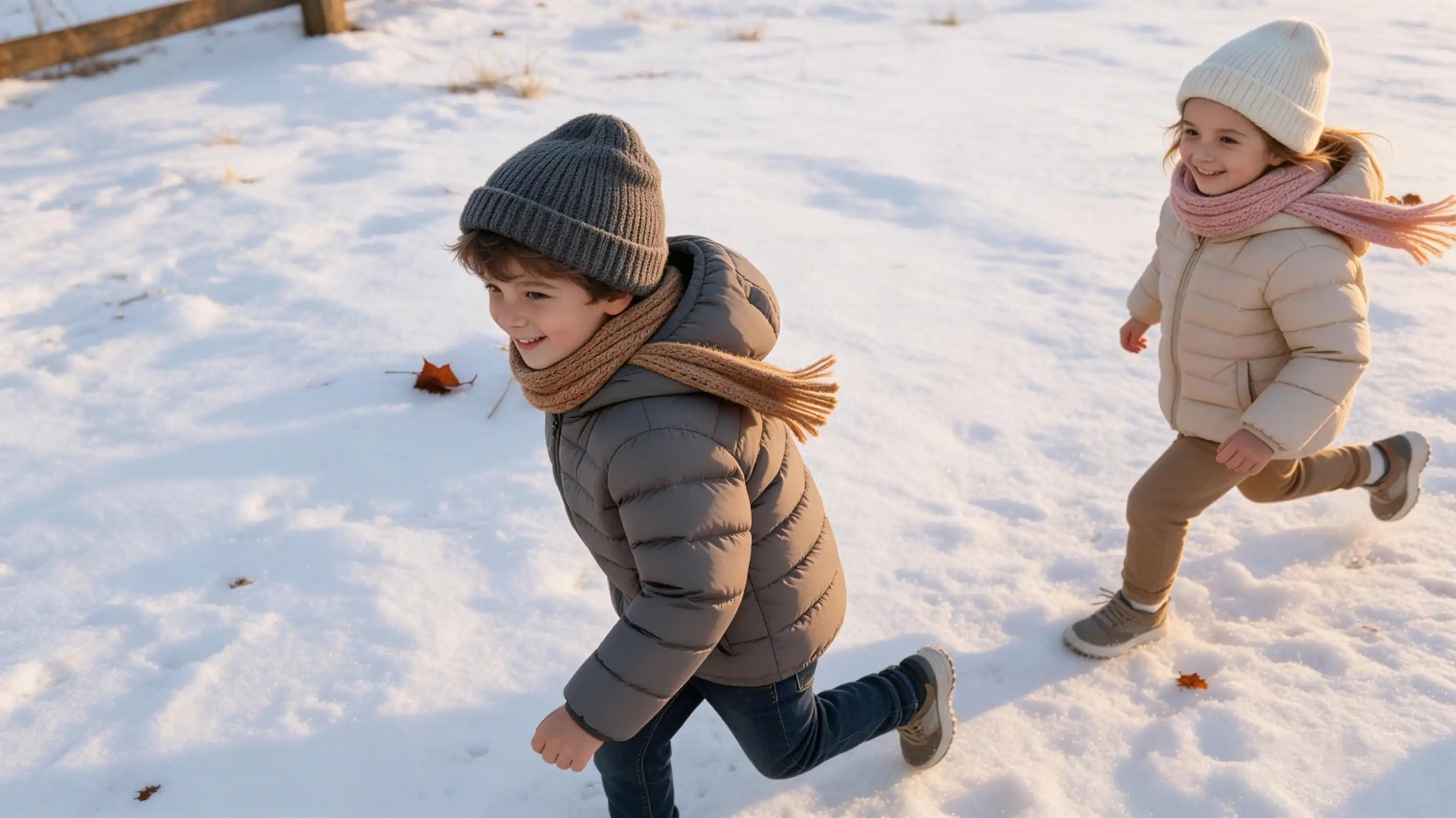
Quick answer: This is a children’s knitwear development guide, not just a safety note. It covers category, yarn composition, gauge, pattern structure, sizing and construction, then the safety, durability and labeling gates. Every kids knitwear manufacturer build should be specified, evidenced and approved control by control — never ordered on a recycled adult sweater spec.
Key Takeaways
1. Children’s knitwear is its own product, not a small adult one. Category, yarn and gauge decisions drive cost, comfort and safety far more than in adultwear, so brief them explicitly rather than scaling a grown-up pattern down.
2. Yarn and gauge set everything downstream. Fiber choice controls hand, washability and pilling; gauge (7G to 12G, plus fine seamless) controls weight, drape, machine time and which kids’ styles it suits.
3. Pattern and construction are safety decisions, not just aesthetics. Intarsia is kinder than large jacquard on small bodies; floats, openwork and cords must clear finger-trap and entanglement rules.
4. Size to the EU/US children’s chart, then add growth allowance to length and sleeve only. Hold neck, cuff and hem fit-critical zones; knit sizing must account for stretch and recovery.
5. Close it out on evidence and a complete RFQ. Fiber certificates, cord-free construction, a wash-tested sample and market labeling are what turn a specification into a low-risk, wholesale-ready product.
Table of Contents
Children’s Knitwear Categories to Develop
Yarn Composition: Choosing and Applying Fiber
Gauge Selection: 7G, 12G and Fine Seamless
Patterns & Construction: Intarsia, Jacquard, Cable, Seams
The Product Specification Matrix
Fiber and Chemical Safety
Trim Security and Drawcord Risk
Western Children’s Sizing and Growth Allowance
Pilling, Seam and Wash Durability
Labeling and Destination-Market Responsibility
Design-to-Sample Workflow
Product-Specific QC Checklist
Quotation / RFQ Checklist
Buyer FAQs
Next Step
Why a Kids Knitwear Manufacturer Can’t Reuse an Adult Spec
A serious kids knitwear manufacturer knows an adult sweater spec controls fit, gauge and yarn. It does not control the three things that make or break a children’s garment: the hazard a child can physically interact with (a drawcord, a button, a loose pattern float), the size a child will still fit into at the end of the season, and the chemical and labeling obligations that transfer to the brand the moment goods clear customs. Left unspecified, the factory builds to the cheapest reading and the risk — and the returns — land on you.
This matters most for the buyers who use this guide: small and mid-size wholesalers carrying several labels, independent designers building a first children’s line, and creator-led private-label brands without an in-house tech team. The fix is one product-specific development brief — covering category, yarn, gauge, pattern and construction, then safety and labeling — that reads each area as three questions: what you specify, what evidence you request, what decision follows. That brief, not a reused tech pack, is the real starting point with any serious custom or OEM knitwear manufacturer. If you are starting a first label, work through the private label knitwear and OEM/ODM launch guide alongside this one.
Children’s Knitwear Categories to Develop
Answer. “Children’s knitwear” is not one product. A beanie, a scarf, a blanket and a cardigan share almost nothing in gauge, weight, trimming or risk profile, so a kids knitwear manufacturer should pick the category first and let it drive the yarn, gauge and structure decisions that follow. For a wholesale or capsule plan, building across a small category range — one mid-weight pullover, one cardigan, one hat, one neckwear or blanket — lets a factory reuse yarn and dye lots across styles, which protects pricing and lead time at low order quantities.
| Category | Typical gauge / build | Key development points | Safety / compliance watch |
|---|---|---|---|
| Pullover / crewneck | 7G chunky to 12G fine; ribbed neck, cuffs, hem | Raglan or set-in shoulder; neck opening sized for a child’s head plus growth | No hood/tail drawcords; check neck/hem openings for finger-trap |
| Cardigan | 9G–12G lighter or 7G textured | Front placket, button/snaps, self or contrast facings — see the cardigan cost & MOQ spec guide | Secure fasteners to a pull force; no small detachable buttons for toddlers |
| Hat / beanie | 7G–9G warm, or 12G fine liner | Turnback brim, pompom attachment, head-size grading | No long ties or cords; secure or omit pompoms/pom-balls |
| Scarf / neck warmer | 7G–12G rib or cable | Short snoods and neck warmers avoid long loose ends | Long scarves and tassels are a strangulation risk for young children |
| Knit blanket / throw | 5G–7G chunky, open or tight | Size, weight, drape, edging; openwork affects warmth | Infant sleep use has separate safe-sleep rules — confirm before marketing for cribs |
Yarn Composition: Choosing and Applying Fiber
Answer. Fiber choice is the single highest-leverage decision in a children’s program, because it sets hand-feel, washability, pilling tendency, cost and even how a garment behaves in the safety file. There is no universal “best” fiber — the right one depends on age, season, price point and how often it will be machine-washed. For wholesalers and creator brands, the usual tension is between a natural-fiber story (merino, cotton, cashmere) and an engineered, easy-care synthetic at a sharper price.
| Fiber | Hand & comfort | Washability | Pilling tendency | Best fit / cost driver |
|---|---|---|---|---|
| Merino wool (superwash) | Soft, fine, temperature-regulating, low odor | Machine-washable if superwash treated | Low–moderate | Next-to-skin base layers, cooler climates; mid–high cost; screen for wool sensitivity |
| Cotton (incl. organic) | Breathable, non-allergenic, cool hand | Easy; pre-shrink to control shrinkage | Low | Everyday and frequent-wash pieces, warm climates, sensitive skin; low–mid cost; request GOTS where organic is claimed |
| Certified synthetic (acrylic / recycled poly / nylon) | Lightweight, soft (engineered), bold color | Very easy, quick dry, strong | Quality-dependent (can pill) | Price-sensitive wholesale and fast-turn; low cost; less breathable |
| Cashmere (RWS / GCS certified) | Luxury soft, warm to weight | Delicate; gentle wash, higher care cost | Higher | Occasional/gift and older careful kids, not rough daily wear; high cost |
A practical note for developers: a small percentage of nylon or polyamide added to wool or cotton sharply improves durability and shape recovery in elbows and cuffs, at the cost of a natural-fiber claim — a trade worth making on play-heavy kids pieces. Blends let you hit a hand and a price at once. YouTricot sources premium Inner Mongolia cashmere, superfine merino and silk blends, and works to certified material streams for eligible programs; for the underlying mill and lot data, see the yarn and raw-materials guide for EU/US OEM.
Gauge Selection: 7G, 12G and Fine Seamless
Answer. Gauge — the number of needles per inch on the knitting machine — sets the weight, hand, drape and machine time of a children’s piece, and it is the decision buyers get wrong most often. A lower gauge (5G, 7G) knits thick, structured, quick-to-produce fabric ideal for chunky pullovers, beanies and blankets; a higher gauge (12G) knits fine, light, next-to-skin fabric at the cost of more machine time. There is no “best” gauge, only the right gauge for the category, the age and the price.
| Gauge | Weight / hand | Suits which children’s styles | Production & cost note |
|---|---|---|---|
| 5G–7G (chunky) | Thick, structured, warm | Chunky pullovers, cable cardigans, beanies, blankets | Fewer machine hours = faster and cheaper; can feel bulky on small bodies |
| 9G–10G (mid) | Balanced weight and drape | Everyday mid-weight pullovers and cardigans | Versatile default for core kids ranges |
| 12G (fine) | Light, dense, soft next-to-skin | Fine sweaters, lightweight layers, finer colorwork detail | More machine time = higher cost; best hand for sensitive skin |
| Fine-gauge seamless | Whole-garment, minimal seaming | Next-to-skin comfort pieces, fewer stress seams on small bodies | Programming + machine time; validate on the specific build |
For development, this is where factory capability becomes concrete: YouTricot runs computerized flat knitting including 50 machines at 12 gauge and 30 at 7 gauge (added May 2026) plus Shima Seiki fine-gauge and seamless equipment — so the fine, chunky and seamless options above can all be knitted in-house. Feasibility still depends on yarn, style, color and quantity, so treat this as a range to sample against, not a blanket promise.
Patterns & Construction: Intarsia, Jacquard, Cable and Seams
Answer. Colorwork and structure are as much a comfort-and-safety decision as a design one on a child’s garment. Intarsia knits separate color areas with no long floats behind, so the inside stays smooth — the better choice for next-to-skin and for under-3s. Large jacquard leaves floats on the wrong side that can scratch and snag a finger. Cables and openwork read great but add weight or create holes that need finger-trap checks. Match motif scale to the small size the garment actually is.
- Intarsia — clean color blocks, smooth interior; use for logos, patches and colorblocking on small sizes; one yarn carrier per color area, so cost rises with color count.
- Jacquard — multi-color, machine-knits fine detail but leaves back-side floats; keep floats short and avoid dense jacquard directly next to a young child’s skin.
- Cable — textured, warm, structured; best on 7G–9G for pullovers, beanies and blanket panels; watch added weight on the smallest sizes.
- Pointelle / openwork — breathable summer knits; check hole size so fingers cannot be trapped in the openings.
- Construction & seams — a raglan shoulder (no sleeve seam at the shoulder) sits smoother under an arm for active kids; set-in gives a classic block; linked neckbands and cuffs outlast stitched-on ones; fine-gauge seamless removes interior seams at stress points entirely. See the knitwear stitch types glossary for structure terms.
Development rule. For children’s sizes, default to intarsia over large jacquard on anything worn next to the skin, cap float length on jacquard panels, and design openings (neck, cuffs, pointelle) so a small finger cannot pass through and become trapped.
The Product Specification Matrix
With category, yarn, gauge and structure chosen, this is the compliance control grid for the build; the safety sections below add the why, the named standards and the test methods rather than restating these rows.
| Control area | What the buyer must specify | Evidence to request | Approval gate |
|---|---|---|---|
| Fiber & chemical safety | Fiber %, yarn lot, restricted-substance class | Fiber-content report + lot-matched certificate | Release or re-source the lot |
| Trim security | Mechanical fixing, no small detachable parts | Trim pull/torque record on size set | Approve the fixing method |
| Drawcord / pattern risk | Cord-free head/neck/hem; capped floats; no finger traps | Construction note vs the market cord/opening rule | Approve cord-free build |
| Age-based sizing | Size curve + height, growth allowance, fit-critical holds | Graded sheet + flat-measured fit sample | Freeze grade before programming |
| Pilling, seam & wash | Pilling target + method, seam per stress point, wash regime | Pre/post-wash report with grade and shrinkage | Approve on a wash-tested sample |
| Labeling & market duty | Composition text, care marks, traceability | Artwork proof vs tested composition + certificate set | Sign off labels against the report |
Fiber and Chemical Safety
Answer. Because children put garments in their mouths and carry more skin surface per kilogram of body weight, chemical safety is a specification input, not a compliance afterthought. The gate is lot-level evidence: the certificate must cover the delivered, dyed and finished yarn, not a generic factory claim. Specify the whole-garment fiber content including trims, then approve the yarn lot before any bulk colorway — the decision is “can this exact material enter a child-facing product,” a higher bar than a soft hand-feel.
The specifics behind the grid. Name the restricted-substance class you will test to and ask whether it covers the dyed lot or only greige. A “bio-based fiber knitwear” claim is a documentable fiber-origin statement, so require the composition evidence behind it. YouTricot works to OEKO-TEX Standard 100, Responsible Wool Standard and Good Cashmere Standard certified material streams for eligible programs — a credible starting point for your file, not a substitute for the market-specific evidence you still collect.
Decision gate. Release the yarn lot for bulk only when the certificate identity matches the delivered lot; otherwise re-source before sampling.
Trim Security and Drawcord Risk
Answer. The physical-injury risk in children’s knitwear concentrates in two features: cords and small detachable parts. A hood, neck or hem drawcord can snag on playground equipment, doors or vehicle parts, so for young sizes the correct control is to design the cord out, not to warn against it. Buttons, snaps and pompoms are a second failure mode: anything small enough to become a choking hazard after repeated washing must be fixed by a method that survives the pull force a child can actually exert.
The specifics behind the grid. Specify zero functional cord at head/neck/hem for the age band (the EU/UK reference rule for cords and drawstrings on children’s clothing is EN 14682; the US uses ASTM drawstring guidance for children’s upperwear), trims sewn or mechanically fixed with a stated minimum retention and no glue-only fixing, and hardware without sharp edges. Confirm how each trim is anchored, because a glued appliqué passes a visual review but fails the pull test and the wash.
Decision gate. Reject a corded design for young sizes outright — do not trade a hazard for a warning label; approve trims only when the fixing survives both the pull check and laundering.
Western Children’s Sizing and Growth Allowance
Answer. Size children’s knitwear to the EU/US chart the destination market actually uses, then add growth allowance where it helps and never where it hurts. EU sizing is height-based (80–158 cm); US sizing is age-based (2T–16). Extra body length and sleeve length keep the garment wearable as the child grows; a loosened neck, dropped shoulder or slackened cuff is a fit failure, and at the neck it is a safety concern. Because knit is elastic, the chart is only a starting point — grade against your yarn’s elongation and recovery, and confirm every figure to a flat-measured fit sample.
| Age | Height (cm) | EU size | US size | Body chest (cm, approx) |
|---|---|---|---|---|
| 2 years | ~92 | 92 | 2T | ~51 |
| 3–4 years | 98–104 | 98–104 | 3T–4T | ~53–55 |
| 5–6 years | 110–116 | 110–116 | 4–5 / 6 | ~57–61 |
| 7–8 years | 122–128 | 122–128 | 6–7 | ~63–67 |
| 9–10 years | 134–140 | 134–140 | 8–10 | ~69–74 |
| 11–12 years | 146 | 146 | 12 | ~76–81 |
| 13–14 years | 152–158 | 152–158 | 14–16 | ~83–88 |
Decision gate. Add growth allowance to body length and sleeve only, hold neck, cuff and hem tension and shoulder fixed, freeze the grade rules before knit programming, and approve a measured fit sample for the whole size run — not one size in isolation.
Pilling, Seam and Wash Durability
Answer. Children’s knitwear is machine-washed far more than adultwear, so durability is specified on a named test method and proven on a wash-tested sample, not judged by showroom hand-feel. The three failure modes are surface pilling, seam strength at stress points, and dimensional change plus hand loss after laundering. If you cannot see the method, the grade and the cycle count written down, you have not specified durability — you have hoped for it, and hope is not a specification.
The specifics behind the grid. Specify a pilling-resistance target on the method you will test to (for example ISO 12945 or a pilling-box grade on a 1–5 scale); choose seam construction per stress point (shoulder, side, set-in sleeve); set an acceptance threshold for dimensional change and hand-feel after an agreed wash regime (a method such as ISO 6330 or AATCC); and include color-fastness to washing and to perspiration (for example ISO 105). Fine-gauge and seamless construction reduces seaming at stress points, one reason YouTricot’s Shima Seiki fine-gauge and seamless capability matters for children’s pieces — but validate the specific build, since durability is a yarn-plus-construction-plus-finishing outcome, never a machine badge.
Decision gate. Approve bulk only against a wash-tested pre-production sample that meets the stated pilling grade and dimensional tolerance.
Labeling and Destination-Market Responsibility
Answer. Labeling is where product knowledge becomes legal liability, and the obligation sits with the importer or brand, not automatically the factory. Each destination market sets its own fiber-content wording, care-marking and traceability rules, and children’s products usually add third-party testing or certificate duties. Name the market, request declarations and artwork proofs that match the tested composition, and confirm who the responsible economic operator is, because that party files the paperwork — in the US those duties are set out in the CPSC children’s product rules. The table names rule families to confirm with a compliance partner; it is a starting list, not thresholds.
| Market | Rule families to confirm by name | Document the brand typically holds |
|---|---|---|
| EU | REACH restricted substances; Textile Fiber Naming, Reg (EU) 1007/2011; EN 14682 cords & drawstrings on children’s clothing; GPSR general product safety & traceability | Technical compliance file + composition label |
| UK | UK REACH; retained EN 14682; UK textile labeling; UKCA where applicable | UK responsible-operator details + label artwork |
| US | CPSIA (lead, tracking label, Children’s Product Certificate via third-party testing; phthalates where coatings/parts apply); 16 CFR 1610 flammability; ASTM drawstring guidance | Children’s Product Certificate + CPSC-recognized-lab reports |
The specifics behind the grid. Watch the wording traps: buyers often search an “EN 71 safety standard for children’s knitwear,” but EN 71 governs toys, not garments — the child-facing cord rule is EN 14682, so confirm which standard actually applies before you build the file. Specify country and responsible-operator identification, care symbols per the correct standard, and lot/recall marking.
Decision gate. Release labels only when the wording matches the tested composition and every document obligation is assigned to a named party.
Design-to-Sample Workflow
Answer. Any kids knitwear manufacturer advances a children’s program through gates, not through a single “approve the sample” moment, and each gate produces the artifact that unlocks the next. You never reach bulk approval without, behind you, a signed brief, chosen category, yarn, gauge and pattern, lot-matched material evidence, a cord-free construction note, a flat-measured fit sample for the size run and a wash-tested pre-production report. A repeat style can compress early steps, but for a first children’s build no gate should be skipped, because each artifact is the evidence a later dispute turns on.
01
Brief & category set
Category, target market and Product Specification Matrix signed per size.
02
Yarn & gauge chosen
Fiber, blend and gauge (7G/12G/seamless) locked to a swatch.
03
Material sourcing
Fiber-content + restricted-substance evidence matched to lot.
04
Pattern & safety review
Intarsia vs jacquard set, floats capped, cord-free, trims mechanical.
05
First proto sample
Flat-measured fit sample + graded measurement sheet.
06
Pre-production (wash-tested)
Pilling, seam, shrinkage and hand report on the real build.
07
Label & compliance proof
Artwork proof tied to tested composition + certificate set per market.
08
Approval to bulk & QC
Written sign-off, then inline/final QC against the approved sample.
Product-Specific QC Checklist
Answer. For a kids sweater factory, QC needs its own checklist because the pass/fail line is the approved wash-tested sample, not the order form — an inspector comparing a garment to a spec sheet, rather than to the physical reference and the test reports, will pass pieces a child cannot safely wear. Treat every “must be absent” row (cord, detachable small part, long float, trap-sized opening) as a stop-ship item, not a defect to note and ship; never release a carton on a visual pass alone.
| Check | Method | Acceptance basis | Evidence source |
|---|---|---|---|
| Cord at head/neck/hem? | Visual + spec review | Must be absent for the age band | Approved construction |
| Loose floats / finger traps | Wrong-side + opening inspection | No snag float; no trap-sized opening | Approved pattern card |
| Trim retention | Pull/torque on size set | No detachment within age-appropriate force | Inline pull test |
| Fiber content vs label | Report cross-check | Label text = tested composition | Lab report vs artwork proof |
| Pilling grade | Named method, 1–5 scale | Meets specified grade | Pre-prod wash report |
| Dimensional change | Measure pre/post at defined cycles | Within agreed tolerance | Wash-test report |
| Measured size in grade | Flat measure size set | Within stated tolerance per size | Measurement sheet |
| Color-fastness | Named method (wash/sweat) | Meets specified grade | Test report |
Quotation / RFQ Checklist
Answer. A complete RFQ exists to stop the factory from pricing a generic sweater you never asked for, because most “wrong quote” disputes are a missing specification the buyer assumed was obvious. Send the same inputs you would want returned on a pre-production sample — category, fiber and gauge, pattern and construction, the size-and-grade sheet, and a test regime named per risk area; it is also the file a kids sweater manufacturer needs to price accurately. For eligible programs MOQ is 50 pieces per style per color, but quantities, cost and lead time are conditioned on yarn availability, gauge, construction, color count, finishing, testing and scheduling; sampling is a symbolic sampling fee, fully deductible from later bulk production orders.
| Line to supply | What to include | Why it changes the quote |
|---|---|---|
| Category & age band | Pullover/cardigan/hat/scarf/blanket; sizes; market | Sets safety grade and size run |
| Yarn & gauge | Fiber, blend, cert class, gauge (7G/12G/seamless) | Certified/traceable yarn and fine gauge price higher |
| Pattern & construction | Intarsia/jacquard/cable, color count, seam type | Colors and structure drive machine time |
| Trims & safety | Trim spec, fixing method, cord rule | Mechanical fixing and cord-free add checks |
| Test regime | Method + grade per risk area | Testing and labeling drive cost and calendar |
| Quantity & colorway split | Pieces per style per color | MOQ and dye-lot economics |
| Target delivery & market | Destination + deadline | Compliance and scheduling gates |
Buyer FAQs
What yarn is best for sweaters aimed at children?
Softness and washability first: fine-gauge merino, cotton, or a certified easy-care synthetic for sensitive skin and frequent laundering. Choose the fiber by the outcome you must control — itch, shrinkage, pilling, price — and demand the composition and safety evidence for the actual lot, not a yarn name.
For a private label knitwear line, how do I pick the best yarn for sweaters kids will actually wear?
Match fiber and gauge to age and use. A finer gauge reads softer with fewer bulky seams on small bodies; cotton and certified synthetics win on easy care and price, wool and cashmere on warmth and hand. Because the fiber sets the finishing, validate hand-feel after the wash test rather than in the showroom.
Which knitting gauge should I use for children’s styles?
7G for chunky pullovers, beanies, cable cardigans and blankets (faster, cheaper, warmer but bulkier); 12G for fine next-to-skin sweaters and lighter cardigans; fine-gauge seamless where fewer interior seams matter. The right gauge follows the category, age and price, not a default.
Intarsia vs jacquard vs cable — which pattern suits small children?
For next-to-skin and under-3s, prefer intarsia because it leaves no long floats on the inside. Save larger jacquard for outer panels and cap float length; use cable where warmth and texture are wanted but mind the added weight. Always scale motifs down to the small garment size.
What certifications should a sweater factory have for children’s knitwear?
Start with OEKO-TEX Standard 100 on the delivered yarn plus the destination market’s own documents — REACH in the EU, CPSIA third-party testing in the US — and responsible-sourcing claims such as RWS or GCS where wool or cashmere is involved. Always ask whether a certificate covers the dyed, finished lot or only the base material.
What is a children’s sweater safety standard?
There is no single global standard. It is a stack of rules set by the market you sell into: cord-and-drawstring rules on children’s clothing such as EN 14682 in the EU, chemical rules (REACH, CPSIA), small-part and flammability rules, and fiber-labeling duties. Toy standards like EN 71 are a separate category.
What are the drawstring safety rules for children’s sweaters?
Treat the head, neck and hem as cord-free zones for young sizes rather than relying on a warning, because a drawcord that snags is a real hazard and a compliant design removes it instead of labeling it.
How do EU and US children’s sizing differ for knitwear?
EU sizes are height-based (80–158 cm); US sizes are age-based (2T–16). Grade your tech pack to the market you are selling into, add growth allowance to length and sleeve only, and hold neck, cuff and hem fixed — then confirm against a measured, washed fit sample.
How do I control pilling and seam durability in kids’ knitwear?
Specify a pilling grade on a named method, choose seam construction per stress point (or fine-gauge seamless), and approve only a pre-production sample that has been wash-tested — never a showroom piece.
Is cashmere a good choice for children’s knitwear?
Best for occasional or gift pieces and older, careful wearers, not rough daily play. Cashmere is delicate and pills more under hard use and frequent washing, so weigh the hand against durability and care cost — and require RWS/GCS-certified sourcing evidence where you use it.
What should a children’s knitwear RFQ include to get a real quote?
The full Product Specification Matrix plus your development choices — category, fiber and gauge, pattern and construction, trim and cord rules, the size-and-grade sheet, a test regime with methods and grades, quantity and color split, and the destination market. That is the difference between a quote and a guess.
Ready to develop a children’s knitwear line?
Whether you are a wholesaler, an independent designer or a creator-led label, send the category, yarn and gauge plan, the pattern and construction choices, the size-and-grade sheet and the test regime per risk area — the same inputs you would want returned on a pre-production sample. As a kids knitwear manufacturer, YouTricot quotes against those facts, not a generic sweater spec.
Frank, Founder of YouTricot
20 years across Prato, Italy and Dalang, Dongguan, China, building high-end knitwear OEM/ODM capability for independent designers and private-label brands.
Further Reading
YouTricot Guide
Can Merino Wool Sweaters Be Machine Washed? Testing and Care-Label Decisions for Brands
Children’s knitwear is machine-washed far more than adultwear, so before you promise “easy care” on a kids line, see how to test merino for machine washing and set a defensible care label.
Read the full guide here : can merino wool sweaters be machine washed