

Key Takeaways
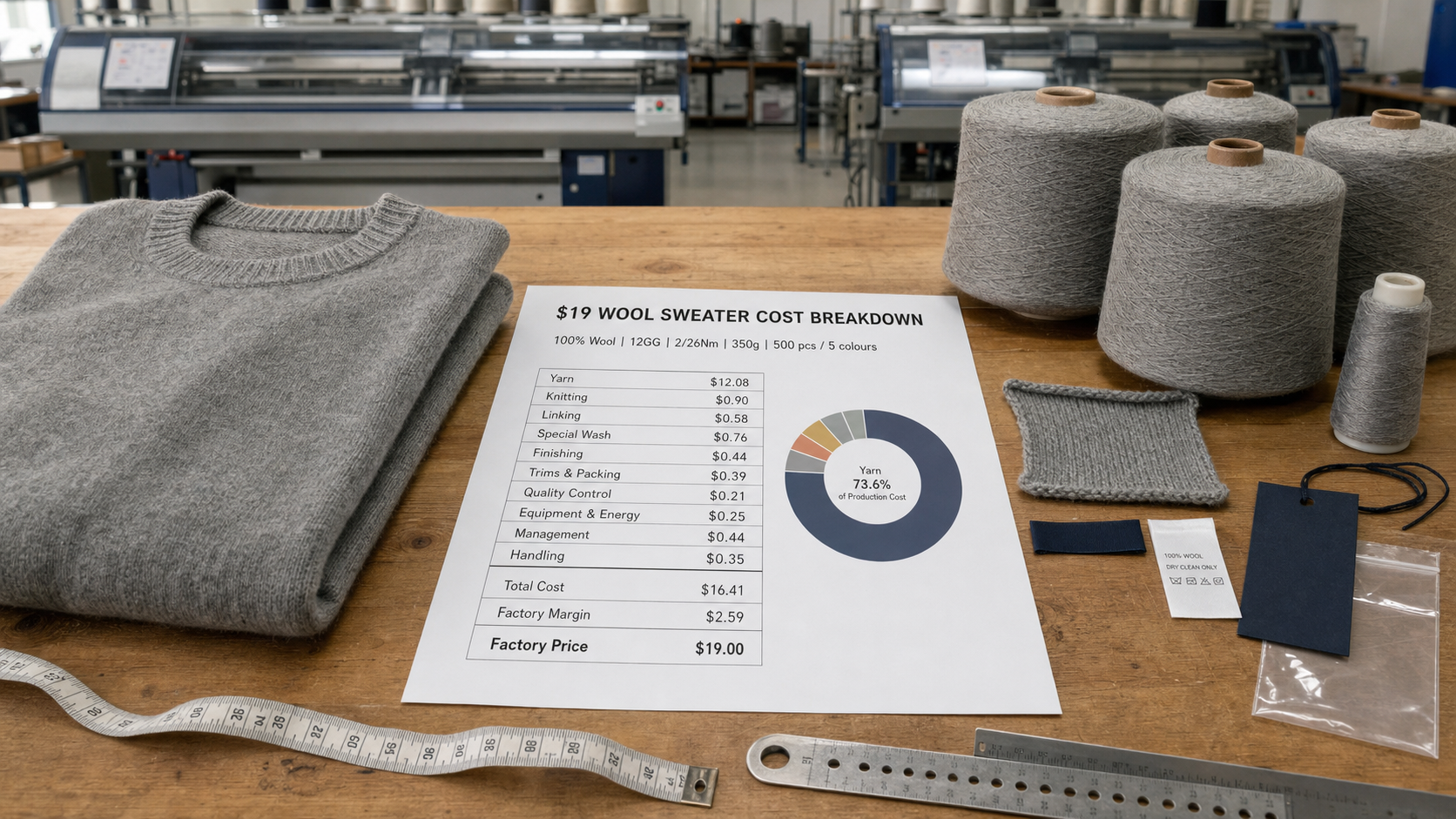
- This knitwear manufacturing cost breakdown shows why a USD 19 factory quote is credible only when the product specification and quotation scope are equally specific. The model uses a 350g, 100% wool, 12GG sweater knitted with 2/26Nm yarn, ordered in five colours with 100 pieces per colour. Estimated production cost is USD 16.41 per piece, leaving USD 2.59 in gross profit, or approximately 13.6%. Buyers should compare fibre content, garment weight, yarn allowance, colour split, finishing, packaging, quality control and trade terms before deciding whether two sweater quotations are comparable.
- Yarn is the dominant cost in this USD 19 wool sweater model, rather than labour or factory margin. The finished garment weighs 350g, but the costing model uses 378g of yarn after an 8% production allowance for setup, yarn ends, repairs, colour changes, washing variation and other commercial production risks. At RMB 230 per kilogram and an exchange-rate assumption of USD 1 = RMB 7.20, yarn costs RMB 86.94, or USD 12.08, per garment. Raw material therefore represents 73.6% of the total estimated production cost.
- A USD 15 quote cannot support the same specification in this model without changing the product, scope or commercial assumption. USD 15 equals RMB 108 at the stated exchange rate, while estimated production cost is RMB 118.14. A lower quote may use lighter weight, cheaper yarn, less than 100% wool, simplified washing, reduced finishing, excluded trims, a larger quantity assumption or an intentionally low first-order margin. A low price is not automatically dishonest, but it should always be matched to the actual product specification and included services.
- The most practical ways to reduce custom knitwear cost without concealing a quality change are to simplify the order structure. Reducing colour count, using an available yarn shade, simplifying packaging, increasing quantity or adjusting garment weight can lower cost while keeping the quotation transparent. Removing essential quality control, omitting normal yarn allowance or presenting a fibre-content change as the same product creates a misleading comparison. The buyer’s goal should be a clearly defined cost boundary, not merely the lowest factory number.
What Does the USD 19 Costing Model Assume?
This is a factory costing model for one defined wool sweater program, not a universal market price for every custom sweater. The model assumes a basic crew-neck silhouette without intarsia, jacquard, embroidery, zippers or other labour-intensive details. It uses a 350g finished garment weight, 100% wool, 2/26Nm yarn, 12GG knitting, five colours and 500 pieces in total. Final commercial prices can change with yarn availability, size ratio, stitch density, wastage, colour minimums, testing requirements, delivery terms and the exchange rate agreed when the order is confirmed.
| Item | Production specification |
|---|---|
| Fibre composition | 100% wool |
| Yarn count | 2/26Nm |
| Yarn purchase price | RMB 230/kg |
| Knitting gauge | 12GG |
| Finished garment weight | 350g |
| Order quantity | 500 pieces |
| Colour quantity | 5 colours |
| Quantity per colour | 100 pieces |
| Washing process | Softening wash, shrink-control treatment and hand-feel finishing |
| Factory price | USD 19 per piece |
| Exchange-rate assumption | USD 1 = RMB 7.20 |
How Do Yarn, Weight and Quantity Affect Sweater Cost?
Material choice, garment weight and order structure must be compared before a buyer treats two sweater quotes as equivalent. The USD 19 calculation applies only to the defined 100% wool scenario below. Cashmere and cotton-blend rows are directional sourcing comparisons, not price quotations, because the original model does not specify their yarn price, count, blend ratio, weight, construction or colour minimum. A supplier should quote every material option against the same tech pack, colour split, finishing requirement and delivery term.
| Material or order scenario | Weight / quantity reference | Cost comparison | Buyer interpretation |
|---|---|---|---|
| 100% wool | 350g; 500 pieces; 5 colours; 100 pieces per colour | USD 19 factory price; USD 16.41 estimated production cost; yarn is USD 12.08. | This is the only fully costed scenario in this article. Yarn represents 73.6% of production cost. |
| Cashmere | Weight, yarn count, blend ratio and order structure must be defined separately. | Requires a separate supplier quotation; no cashmere unit-cost figure is used in this model. | Cashmere yarn direction, certification, availability, hand feel and colour requirements can materially alter price and MOQ. |
| Cotton blend | Blend ratio, yarn construction, finished weight and gauge must be defined separately. | Requires a separate supplier quotation; no cotton-blend unit-cost figure is used in this model. | Do not assume a blend is cheaper until yarn price, consumption, knitting efficiency, finishing and minimums are confirmed. |
| Lower garment weight | Example comparison: 220g fine-gauge top versus 350g sweater | Lower material consumption can reduce cost, but the final effect also depends on yarn, density, structure and finishing. | Weight should be measured and agreed at the correct production stage, especially when washing affects dimensions or hand feel. |
| One colour versus five colours | 500 pieces in one colour versus five colour lots of 100 pieces | A single-colour order is usually more efficient than five smaller colour batches. | Each colour introduces separate setup, material control, washing separation and colour-specific inspection. |
Complete Knitwear Manufacturing Cost Breakdown
This knitwear manufacturing cost breakdown estimates RMB 118.14, or USD 16.41, in production cost for each 350g, 100% wool, 12GG sweater. The table separates material, knitting, assembly, washing, finishing, packaging, quality control, equipment and order-service costs so buyers can see what the factory price covers. Each line is based on the defined 500-piece, five-colour production scenario. It should be used as a transparent costing framework, not as a substitute for a style-specific quotation, sample review or confirmed supplier production plan.
| Cost item | Amount | Share of production cost | What the cost covers |
|---|---|---|---|
| 1. Wool yarn | RMB 86.94 USD 12.08 |
73.6% | The model uses 378g of costed yarn per garment: 350g finished weight plus an 8% production allowance. The allowance covers machine setup, tension adjustment, waste panels, yarn ends, panel repair, colour changes, damaged pieces and washing-related weight variation across five colour lots. At RMB 230/kg, 0.378kg of yarn costs RMB 86.94. For 500 pieces, the commercial yarn requirement is 189kg. If certified wool is requested, the specific yarn and transaction should be verified rather than assuming certification automatically applies. |
| 2. 12GG knitting | RMB 6.50 USD 0.90 |
5.5% | This allocation covers computerized flat-knitting machine time, programming for a basic structure, operator labour, machine setup, five-colour yarn changes, electricity, panel inspection and minor panel repair. Fine-gauge 12GG knitwear needs appropriate yarn preparation, machine settings and density control to achieve a clean and refined surface. The figure applies to a basic design only. Intarsia, jacquard, pointelle, cable structures, engineered ribs and complex fully fashioned shaping require additional machine time and separate costing. |
| 3. Linking and sewing | RMB 4.20 USD 0.58 |
3.6% | Linking and sewing assemble the knitted panels into a finished crew-neck sweater. The allowance includes shoulder linking, sleeve attachment, side seams, neck-trim attachment, loose-yarn finishing and an initial measurement check. This work is only USD 0.58 in the model, but excessive cost cutting at this stage can create uneven shoulders, distorted necklines, missed stitches, bulky seams and poor alignment. These defects may be difficult to identify in a quotation but become obvious in wear, fit review and final presentation. |
| 4. Special washing treatment | RMB 5.50 USD 0.76 |
4.7% | The washing allocation includes softening wash, shrink-control treatment and hand-feel adjustment. It covers chemicals, water, energy, washing equipment, labour, trial washing and separate batch handling for five colours. Washing affects more than softness: it can alter finished measurements, stitch appearance, surface character and colour. Buyers should therefore assess the approved sample after its final washing process. Shrink-control finishing alone does not justify a machine-washable claim; care instructions must reflect the specific yarn, treatment and finished-garment test results. |
| 5. Finishing and pressing | RMB 3.20 USD 0.44 |
2.7% | After washing, each sweater requires controlled drying, steaming, shaping, measurement correction, thread trimming, surface cleaning, final hand-feel review, pressing and folding. Finishing does not add a separate visible component, so it is often underestimated in a low quote. However, it strongly influences garment symmetry, finished dimensions, surface cleanliness, presentation and the first hand-feel experienced by the customer. A quote that omits finishing detail should be clarified before approval because the visual standard may differ even when the yarn and knitting gauge are identical. |
| 6. Trims and packaging | RMB 2.80 USD 0.39 |
2.4% | This allowance covers a basic private-label package: woven neck label, size label, fibre and care label, hangtag and string, spare yarn, tissue paper, individual polybag and carton allocation. It does not establish a universal packaging price. Custom woven labels, FSC-certified hangtags, recycled packaging, barcode stickers, premium boxes and retailer-ready packing can increase the amount. Buyers should define labels, fibre-content information, care instructions, barcode needs, folding method and carton requirements before requesting a final factory quotation. |
| 7. Knitwear quality control | RMB 1.50 USD 0.21 |
1.3% | The quality-control allocation covers routine in-process and final checks, including yarn-lot and colour review, knitted-panel measurements, linking quality, finished garment measurements, surface defects, colour consistency, garment weight, labels and packaging. It does not include independent laboratory testing or third-party final inspection. Where pilling, dimensional change, colour fastness or harmful-substance requirements apply, buyers should define the method and acceptance level. Useful references include ISO 12945-3 for tumble testing and OEKO-TEX STANDARD 100 for harmful-substance testing. |
| 8. Equipment, energy and maintenance | RMB 1.80 USD 0.25 |
1.5% | This line allocates part of the operating cost of computerized knitting machines, linking equipment, washing machines, dryers and pressing equipment. It includes equipment depreciation, electricity, preventive maintenance, spare parts and machine downtime. A supplier that excludes these costs can appear cheaper in a short-term comparison, but stable knitwear production relies on maintained machines, reliable settings and available technical support. Buyers should evaluate whether a low quote still allows for the equipment control required to repeat the approved sample in bulk production. |
| 9. Production management and order service | RMB 3.20 USD 0.44 |
2.7% | This allocation covers production planning, purchase-order administration, five-colour tracking, specification review, sample and approval records, warehouse handling, communication, defect risk and remake risk. Although the total order contains 500 pieces, it is divided into five colour batches of only 100 pieces. Each colour requires setup, material control, washing separation and colour-specific inspection. This explains why a low-MOQ knitwear factory cannot automatically apply the same unit cost as a large, single-colour production run. |
| 10. Local handling and commercial administration | RMB 2.50 USD 0.35 |
2.1% | This final cost line covers local handling, carton movement, basic commercial administration and document preparation. It is not presented as a statutory tax rate because tax treatment, export rebates, local transport and document costs depend on the legal seller, invoice structure, shipment method and agreed Incoterm. A factory price, EXW price and FOB price are not automatically the same. Buyers should confirm the named place or port and the applicable Incoterms 2020 rule whenever they compare international knitwear quotations. |
| Cost summary | RMB per piece | USD per piece |
|---|---|---|
| Total production cost | 118.14 | 16.41 |
| Factory gross profit | 18.66 | 2.59 |
| Factory price | 136.80 | 19.00 |
Frequently Asked Questions
These answers explain how to use the USD 19 model without treating it as a universal sweater price. A reliable knitwear quotation must define the material, yarn count, weight, gauge, construction, colour split, washing, packaging, quality requirements and trade terms. When one supplier includes these elements and another changes or omits them, their prices do not represent the same product. Use the questions below to test whether a quote is sufficiently detailed for commercial comparison.
Knitwear Manufacturing Cost Breakdown: How Much Does It Cost to Manufacture a Sweater?
In this defined case, a 350g, 100% wool, 12GG sweater costs approximately USD 16.41 to produce and is quoted at USD 19 per piece. The answer changes with yarn composition, yarn price, garment weight, stitch structure, colour quantity, MOQ, washing, trims, testing, quality requirements and trade terms. A buyer should avoid using this USD 19 figure as a benchmark for cashmere, cotton blends, a different weight, complex stitch structures or a different order size without receiving a comparable specification-based quotation.
How is the yarn cost of a wool sweater calculated?
Start with the finished garment weight, add a realistic production allowance and multiply the result by the yarn purchase price. In this model, the calculation is 0.350kg × 1.08 × RMB 230/kg = RMB 86.94 per garment. The costed yarn quantity is therefore 378g, rather than 350g. The 8% allowance reflects setup, irregular loss and material risk across five colour lots. It should be checked after sampling and size grading rather than assumed to be identical for every factory, yarn or construction.
Is 2/26Nm wool yarn suitable for a 12GG sweater?
It can be suitable, but yarn count alone does not confirm the final construction. Ply arrangement, knitting density, stitch structure, garment dimensions and intended hand feel must be tested on the selected machine. Two sweaters using the same nominal gauge can still differ in weight, opacity, recovery, surface appearance and cost. Buyers should approve a washed swatch or prototype before bulk production and should ask the factory to record any yarn, density or finishing assumptions that were made while preparing the quotation.
Why does a five-colour order cost more than a single-colour order?
Each colour requires separate material handling, batch identification, machine setup, washing separation and colour-specific inspection. Five lots of 100 pieces do not have the same production efficiency as one lot of 500 pieces, even when total quantity is unchanged. Colour minimums and yarn availability can also affect commercial feasibility. Buyers should ask whether the MOQ applies per style, per colour or across the whole order, and should request the cost effect of reducing colour count or using available stock-yarn shades.
Does shrink-control treatment make a wool sweater machine washable?
No. Shrink-control treatment does not automatically make every wool sweater machine washable. The final care claim must be supported by the actual yarn, treatment, garment construction and finished-product test results. ISO 5077 provides a method for determining dimensional change after washing and drying, but it does not guarantee a particular shrinkage outcome. Buyers should review the approved sample after final washing and follow the finished garment care label. Woolmark also generally advises flat drying unless the care claim specifically permits tumble drying.
Is the USD 2.59 factory profit guaranteed?
No. USD 2.59 is the gross profit generated by this one costing model, calculated from USD 19 revenue less USD 16.41 estimated production cost. Gross profit is not the same as final net profit. Exchange-rate movement, late material delivery, reworking, replacement garments, unplanned machine downtime, payment terms, quality claims and production delays can reduce the final result. A 13.6% gross margin is commercially workable for this 500-piece, five-colour custom knitwear order, but it is not an excessive margin.
Can sweater cost be reduced without lowering quality?
Sometimes. The most practical transparent options are reducing colour count, simplifying packaging, using an available yarn shade, increasing quantity or adjusting garment weight. These changes should be recorded in the revised specification and quotation. Removing essential quality control, omitting normal yarn allowance or changing fibre composition without disclosure is not a responsible cost-saving method. Buyers should ask the supplier to show the unit-cost impact of each proposed change so that a lower price can be evaluated alongside its effect on appearance, performance, MOQ and delivery.
How Much Profit Is Built Into the USD 19 Price?
At the model exchange rate, the factory earns approximately USD 2.59 in gross profit per sweater, equal to a 13.6% gross margin. The calculation is USD 19 × RMB 7.20 = RMB 136.80 in revenue; RMB 136.80 − RMB 118.14 = RMB 18.66 in gross profit; and RMB 18.66 ÷ RMB 136.80 = 13.6%. This gross profit must still absorb commercial risks such as exchange-rate movement, late materials, reworking, replacement garments, quality claims, payment terms, machine downtime and delays. It is not the same as guaranteed net profit.
Price–Quality Risk Matrix
For the same 350g, 100% wool, 12GG, five-colour specification, the price must be evaluated together with what the supplier has changed or excluded. This matrix does not claim that every USD 15 or USD 19 sweater is identical. It shows how the original model should be interpreted when a buyer receives a lower price. The safest comparison is a written quote that confirms material, weight, yarn allowance, construction, finishing, packaging, inspection and Incoterms on the same commercial basis.
| Price or cost benchmark | What it means | Price–quality risk | Buyer action |
|---|---|---|---|
| USD 15 factory quote | USD 15 equals RMB 108, which is RMB 10.14 below the RMB 118.14 calculated production cost. | High | Identify the changed condition: fibre content, weight, yarn, allowance, washing, finishing, trims, quantity assumption or excluded service. |
| USD 16.41 production-cost benchmark | This equals the model’s estimated production cost and leaves no gross-profit allowance for production risk. | High | Confirm whether the supplier has a different scope, a larger-volume assumption or a temporary commercial arrangement. |
| USD 19 factory quote | This supports the model’s RMB 118.14 production cost plus RMB 18.66 gross profit. | Moderate | Still verify yarn, weight, colour split, washing, packaging, quality control and the applicable trade term in writing. |
| Any price without a technical scope | A single number cannot show whether the garment, commercial terms and exclusions match another quotation. | High | Request a quote-ready tech pack, cost inclusions, exclusions, MOQ, sample plan and named Incoterm before comparing suppliers. |
What Can Change the Cost of Custom Knitwear?
Custom sweater cost changes when a technical or commercial variable changes, even if the garment appears similar in a product image. Yarn is the largest cost component in this 100% wool model, so material price and garment weight have immediate commercial impact. However, factory efficiency, stitch complexity, colour split, finishing, packaging, testing and delivery terms also affect the final quote. Buyers should ask suppliers to quantify the cost effect of each proposed change rather than negotiate a target price without adjusting the production scope.
- Fibre composition: Wool, merino wool, cashmere, cotton, acrylic and blended yarns have different prices, performance characteristics and sourcing requirements.
- Garment weight: A 350g sweater uses considerably more material than a 220g fine-gauge top, particularly when yarn is the main cost component.
- Gauge and stitch structure: Gauge alone does not determine cost; density, garment dimensions, machine time and structure must be considered together.
- Order quantity and colour split: MOQ for custom knitwear depends on yarn availability, colour minimums, gauge, design complexity, finishing and the quantity assigned to each colour.
- Washing and finishing: Softening, shrink control, brushing, enzyme washing and special hand-feel treatments require trials and process control.
- Trims and packaging: Labels, hangtags, barcodes, custom boxes and retailer-ready packing should be specified before the final quote.
- Quality and testing: Measurement tolerances, pilling, colour fastness, shrinkage, fibre composition and harmful-substance testing can affect both cost and lead time.
- Trade terms: EXW, FOB, CIF and other terms allocate transport, documents, cost and risk differently; the named place or port also matters.
Trade terms can change which logistics costs are included in a factory quotation. For a detailed comparison of responsibilities, risk-transfer points and landed cost, read the knitwear FOB price, EXW and CIF quotation guide.
What Should Buyers Ask Before Comparing Sweater Quotations?
A comparable knitwear factory quotation should make the product scope, included costs and commercial responsibilities visible before the purchase order is confirmed. Buyers should not compare only the final unit price, because one supplier may price a different yarn, lower garment weight, simplified washing, separate packaging or another Incoterm. The checklist below turns the USD 19 example into a practical supplier-comparison tool. It is particularly useful when a brand is comparing low-MOQ, multi-colour or technically detailed knitwear programs.
- Is the quoted composition exactly 100% wool?
- What yarn count and yarn price are assumed?
- Is the 350g garment weight measured before or after washing?
- Is yarn loss included in the quotation?
- Does the price cover five colours?
- Are colour minimums or dyeing surcharges included?
- Does the price include softening and shrink-control treatment?
- Are labels, trims and packaging included?
- What quality checks are included?
- Is the price EXW, FOB or based on another trade term?
- What happens if bulk measurements differ from the approved sample?
- Are testing and third-party inspection charged separately?
For quotation preparation and like-for-like supplier comparison, use a complete knitwear tech pack and RFQ checklist. For a broader sourcing framework, review the China knitwear OEM sourcing guide.
Request a Knitwear Cost Review
If your team is developing a custom wool sweater, submit the current tech pack, target fibre composition, garment weight, gauge, colour quantity, MOQ and delivery requirement for a practical review. A useful cost review identifies which variables are fixed, which decisions remain open and which proposed savings would alter the product or commercial scope. YouTricot can then prepare a style-specific quotation based on the actual yarn, construction, washing, packaging and quality requirements.