
Germany remains Europe’s largest knitwear import hub. If you are a global apparel importer, chain store buyer, or wholesaler looking for reliable knitwear OEM manufacturers in China, calculating real-world knitwear sampling costs dictates your supply chain safety. How much is the sample making cost? And is this manufacturing partner a qualified fit for your target market?
Driven by the 2026 market shift toward supply chain agility, European buyers are pivoting away from massive initial volume commitments. Today, flexible logistics, small-batch test runs, and absolute chemical compliance are non-negotiable. This practical guide breaks down real-world sampling costs, evaluation matrices for German market readiness, and actionable insights gathered directly from buyers at the IMOTEX fashion center in Düsseldorf.
For comprehensive structural insights into global knitwear production costs, Tech Pack preparation, and localized supply chain dynamics, you can review our technical manual here: https://youtricot.com/china-knitwear-oem-2026-complete-guide/
1. Sourcing Insights from IMOTEX Düsseldorf
IMOTEX (International Trade Fair for Apparel and Textiles) in Düsseldorf stands as a vital barometer for European volume apparel sourcing. Spanning 48,000 m² across seven sales floors and hosting over 140 permanent tenants with 400 rotating collections annually, it sets the procurement benchmark for Central European Pronto Moda (fast fashion) and mid-to-high-end wholesale channels.
Interviews and trade data collected from IMOTEX registered buyers summarize four fixed procurement rules for 2026:
- Small-batch trial orders: Initial test orders of 50 to 300 pieces per style are the standard volume to cut inventory risks.
- Compressed sampling windows: Wholesalers demand sample delivery within 10 day
sto hit strict seasonal retail launches. - Uncompromised certification standards: Verification of international social compliance audits and chemical safety protocols is required prior to issuing any Purchase Order (PO).
- Amortized sampling costs: Buyers are willing to pay upfront sample fees but expect them to be 100% deductible upon bulk order placement.
The Operational Solution: To successfully supply an IMOTEX-level wholesaler, a knitwear manufacturer cannot operate purely as a rigid bulk factory. The modern solution lies in a dual-center model—combining European local design sensitivity and compliance understanding with an agile manufacturing hub in China equipped with advanced machinery to execute rapid sampling.
To understand how evaluating knitwear sampling costs and agile supply frameworks directly address excess retail stock directly addresses excess retail stock, read our full strategic analysis here: https://youtricot.com/apparel-inventory-crisis/
2. Ultimate Guide to Breakdown of Knitwear Sampling Costs: Four Methods Compared
Analyzing knitwear sampling costs is the first true stress test of an OEM factory’s technical capability of an OEM factory’s technical capability. Sampling fees generally encompass yarn consumption, pattern making (needle drafting), computer knitting machine programming, sewing or linking assembly, specialized washing, iron-pressing, and measurement auditing. Special embellishments like printing, embroidery, or heavy enzyme washes typically incur an additional $5 to $15 per garment.
Knitwear Sampling Method Comparison Matrix
- Standard Sampling
- Unit Cost: $25 – $50
- Lead Time: 7 – 12 days
- Applicable Scenarios: Basic plain knit, rib, simple cardigan, regular jacquard.
- Refund Rule: Full 100% refund upon hitting agreed MOQ.
- Extra Notes: Uses existing in-stock yarns.
- Fast-Track Sampling
- Unit Cost: $15 – $30
- Lead Time: 3 – 5 days
- Applicable Scenarios: Urgent trade show samples, quick market test styles.
- Refund Rule: Fully deductible from bulk order value.
- Extra Notes: Reserved dedicated knitting machines, optimized fixed setup cost for repeat clients, hence lower unit sampling cost despite shorter lead time.
- High-Complexity Sampling
- Unit Cost: $50 – $100
- Lead Time: 15 – 20 days
- Applicable Scenarios: Intarsia, custom dyeing, hand crochet, spliced panels.
- Refund Rule: Partial refund (negotiable).
- Extra Notes: Extra $5–$15/pc for embroidery, printing, or heavy enzyme wash.
- A4 Yarn Swatch
- Unit Cost: $0
- Lead Time: 7 – 10 days
- Applicable Scenarios: Hand feel, gauge, and stitch density check.
- Refund Rule: N/A
- Extra Notes: Buyer covers international express delivery; not for fit confirmation.
For a detailed breakdown of how raw material selections affect these initial prototyping costs, you may consult our technical fiber guide here: https://youtricot.com/knitwear-yarn-oem-guide/
3. Evaluating Suppliers for the German Market
3.1 Core Compliance Certifications
Germany enforces product safety and environmental compliance protocols that extend beyond basic EU REACH frameworks. Before initiating design transfers, verify that your Chinese manufacturing partner possesses valid, up-to-date credentials from global authorities:
- OEKO-TEX® Standard 100: Official verification portal: https://www.oeko-tex.com.
- amfori BSCI: Official sustainable trade platform: https://www.amfori.org.
- ISO 9001: Standardized quality management systems governing factory floor operations.
- Sustainable Materials: Global Recycled Standard (GRS) or Global Organic Textile Standard (GOTS) if marketing eco-friendly capsule lines.
Chemical restrictions are heavily policed at German ports of entry. Importers must review the formal legal texts via the European Union’s official legal platform, EUR-Lex (https://eur-lex.europa.eu), ensuring all incoming knitwear complies with Commission Regulation C(2018)6521 regarding restricted CMR substances in textiles.
Always demand third-party verification reports from accredited testing bodies like SGS, TÜV, or Bureau Veritas.
To master the legal landscape of your supply chain and establish compliant low-risk procurement workflows, view our compliance blueprint here: https://youtricot.com/eu-compliant-knitwear-manufacturer-2026/
3.2 Mandatory EU Textile Regulations for German Import (2026)
- ESPR & CSDDD Compliance: The Ecodesign for Sustainable Products Regulation (ESPR) and Corporate Sustainability Due Diligence Directive (CSDDD) enforce absolute supply chain due diligence audits for raw material sourcing. German customs will block shipments that do not provide complete raw material traceability files.
- Digital Product Passport (DPP): Now mandatory for mid-to-high-end knitwear sold in Germany. Full fiber origin, environmental impact metrics, and production batch data must be digitally embedded into the garment label via QR or RFID codes.
- Mandatory German Technical Inspection Thresholds:
- Fabric Shrinkage Rate: ≤ 2%
- Color Fastness to Washing/Rubbing: ≥ Grade 4
- Structural Seam Strength: ≥ 15N
3.3 Low-MOQ and Small-Batch Production
Modern German wholesale inventory distribution relies on a “small batch test + rapid reorder” cycle. This requires a supply partner built specifically for flexibility. Manufacturers utilize an integrated network where design intelligence and premium sample development are handled under strict compliance oversight, while flexible mass production is carried out at our advanced Chinese manufacturing base without high minimum order surcharges.
- Flexible MOQs ranging from 20 to 50 pieces per style for specialty yarns (such as premium raw cashmere or fine Merino).
- Yarn Consolidation Strategies: The capacity to group multiple distinct aesthetics or styles using identical yarn compositions and colors into a single production batch, lowering structural waste and pricing.
For a comprehensive analysis of how flexible micro-batches operate on the factory floor, view our operational manifesto here: https://youtricot.com/small-batch-knitwear-oem-china/
3.4 Integrated Production & Lead Times
A vertically integrated factory possessing in-house computer knitting, linking, washing, and finishing operations can complete bulk production within 25 to 35 days post-sample approval. For a wholesaler based in Hamburg, Frankfurt, or Düsseldorf, this translates to a reliable 9 to 11-week door-to-door timeline when balancing maritime or rail freight routes.
To view an exact, step-by-step case study of how a German IMOTEX wholesaler achieved an agile turnaround using this synchronized infrastructure, review the complete case history here: https://youtricot.com/knitwear-oem-case-study-german-wholesaler/
4. On-Site Audit Checklist & Knitwear Sampling Costs Verification
Incorporate this operational checklist into your procurement workflow when auditing potential Chinese OEM knitwear suppliers:
Compliance Documents
- ☐ OEKO-TEX Standard 100 certificate with verifiable serial number (online checkable)
- ☐ Valid amfori BSCI audit report (Grade A/B, valid within 2 years)
- ☐ ISO 9001 quality management certification
- ☐ GRS/GOTS certificate (required for eco-label product lines)
Sampling Written Agreement
- ☐ Exact sampling fee listed explicitly in formal quotation
- ☐ Clear adjustment limit: maximum 2 rounds of free minor revisions defined in contract
- ☐ Written clause for full/partial sample fee deduction after bulk order placement
MOQ & Unit Price Terms
- ☐ Fixed minimum order quantity per style for stocked yarn variants
- ☐ Tiered unit price premiums confirmed for small orders under 300 pieces
Delivery Penalty Clauses
- ☐ Sample delivery deadline bound with liquidated damages for delays
- ☐ Ex-factory bulk shipment deadline bound by clear penalty terms
Payment & Incoterms
- ☐ Factory accepts standard 30% deposit + 70% balance against Bill of Lading (B/L) copy
- ☐ Factory accepts Sight Letter of Credit (L/C) for large bulk orders
- ☐ Confirmed Incoterm rules: FOB Shanghai/Ningbo, CIF Hamburg, or DDP via local forwarder
Third-Party Inspection Permission
- ☐ Factory allows SGS / TÜV / Bureau Veritas mid-production & pre-shipment inspections
- ☐ Financial liability clearly defined for re-inspection charges triggered by factory non-conformity
Germany Labeling Compliance
- ☐ Factory is capable of labeling complying with German Textilkennzeichnungsgesetz
- ☐ Full German fiber composition marking, EU standard sizes, care symbols, and origin labels pre-verified
To inspect a transparent, real-world 7-node quality control standard operational procedure from raw fiber to final packaged garment, you can review our factory internal protocol here: https://youtricot.com/quality-control-sop/
5. End-to-End Delivery Workflow
- Technical Handover: Wholesaler provides a comprehensive Tech Pack (detailed size specs, stitch artwork, gauge requirements, and yarn composition targets).
- Sampling Invoice: Factory Clarifies all knitwear sampling costs and generates a sample quote; buyer fulfills payment ($15–$100 depending on complexity).
- Prototyping & Transit: Factory programs machines, knits the sample (3–20 days), and dispatches via express courier (5–7 day
stransit to Germany). - Evaluation & Fitting: Wholesaler evaluates fit, drape, and hand-feel. Minor adjustments are executed if a second pre-production sample is required.
- Contract Finalization: Bulk unit prices, tiered MOQs, and delivery windows are locked into a formal Proforma Invoice (PI).
- Deposit & Production: Wholesaler transfers the 30% initial deposit, triggering yarn procurement and bulk production scheduling (25–40 days).
- Quality Control & Logistics: Pre-shipment inspection is executed. Upon passing, the remaining 70% balance is settled against the B/L copy or before factory release.
- Import Clearance: Goods clear German customs. Importers pay the standard 19% Einfuhrumsatzsteuer (EUSt, import VAT), which is fully recoverable as an input tax credit (Vorsteuer) for VAT-registered German enterprises.
6. FAQ: Understanding Your Knitwear Sampling Costs
Q1: What exactly is included in a Chinese custom knitwear factory’s sample making fee?
The sampling fee covers the following items:
- Technical CAD pattern development and knitting machine programming
- Yarn allocation, sewing and linking assembly
- Specialized washing, ironing and dimensional inspection Extra charges apply for embroidery, printing and customized finishing processes.
Q2: What social and environmental certifications are compulsory for German market distribution?
- Valid OEKO-TEX® Standard 100 certificates are required to pass chemical customs clearance at EU ports.
- Active amfori BSCI audit history (Grade A or B) is requested by German retail compliance departments.
- GRS or GOTS transactional certificates must be supplied if the end product is marketed as sustainable.
Q3: What are the pricing penalties associated with a “small batch, low MOQ” factory run in China?
- Small batches (20 to 100 pieces per style) incur a 30% to 60% unit price premium compared to standard 300-piece runs.
- This premium covers mechanical machine downtime, pattern programming amortization, and short-run splitting inefficiencies.
- The exact premium range fluctuates based on seasonal yarn raw material cost fluctuations.
Q4: What is the total operational timeline from sample authorization to arrival at a German warehouse?
- Prototyping development takes 7 to 12 days; bulk manufacturing takes 25to 40 days.
- Sea freight transport (Ningbo/Shanghai to Hamburg) takes 28 to 35 days.
- China-Europe Rail Freight (Xi’an to Duisburg Express) takes 15 to 22 days door-to-door. According to official release data from China State Railway Group, fixed-schedule trans-Eurasian rail lines complete the core transit segment in 12 days.
- Air freight delivery takes 5 to 7 days.
Q5: Which Incoterm provides the most secure risk profile for German wholesalers?
- FOB (Free on Board) Shanghai or Ningbo represents the wholesale standard, granting buyers total control over freight rates.
- CIF (Cost, Insurance, and Freight) Hamburg is optimal for small wholesalers who prefer the factory to handle core international maritime transit.
- DDP (Delivered Duty Paid) is recommended for smaller trial batches to consolidate import customs processing.
Q6: What operational remedies exist if the bulk delivery deviates from the approved Golden Sample?
- The contract must restrict allowable variances to strict ranges (e.g., dimensional variances within ± 3 %, color matching within Grade 4 on the international grayscale).
- Deploy certified inspectors (such as SGS China or Bureau Veritas China) to run pre-shipment quality evaluations on the factory floor.
- If defects exceed contractual limits, the factory is legally bound to execute re-works, offer financial credits, or initiate refunds before shipment release.
Q7: How can independent German fashion labels protect their intellectual property and design sketches?
- Request the manufacturing partner to sign a bilingual Non-Disclosure, Non-Use, and Non-Circumvention (NNN) Agreement before design handover.
- Restrict design files by transmitting flattened, encrypted PDFs containing explicit digital watermarks instead of native vector files.
- Establish clear liquidated damages clauses inside the manufacturing contract for any unauthorized design distribution.
Q8: What hidden logistics or processing fees frequently occur during German import clearance?
- Standard customs duties range from 4% to 12% for textile articles classified under HS Chapters 50–63. Exact rate confirmed by German Zoll based on precise HS code classification.
- Importers must budget for customs brokerage filing fees (€50–€150) and Less-than-Container Load (LCL) port de-consolidation fees.
- Port storage fees (demurrage) apply if documentation discrepancies delay customs release beyond the standard 3-to-5-day free port window. Official tariff classification rules can be cross-checked on the German Customs (Zoll) web portal: https://www.zoll.de
Q9: Can minor aesthetic modifications be executed during sampling without incurring secondary fees?
Up to 2 rounds of minor tweaks are free of charge:
- Sleeve length adjustment (+/-1.5cm)
- Rib width modification
- Color swap within same yarn batch Major revisions trigger new sampling charges: machine re-programming, custom yarn spinning, full knit structure redesign.
Q10: Where are the most efficient regions in China to source small-batch, high-end knitwear?
- The industrial manufacturing clusters of Dalang (Dongguan, Guangdong) and Puyuan (Zhejiang) host the highest infrastructure density.
- Dalang excels in complex yarn blending, rapid prototyping, and flexible production layouts designed for agile international brands.
- For a factual example of how a premium label overcame low-volume constraints within this eco-system, study the detailed case breakdown here: https://youtricot.com/luxury-knitwear-nakedcashmere-case-study/
7. Operational Summary
Navigating the economics of knitwear sampling costs in China requires a calculated understanding of machinery, material availability, and European trade boundaries. For German wholesalers, true supply chain security is achieved by partnering with an operator that bridges the geographic gap—combining European presence and high-end design oversight with advanced manufacturing facilities in China.
Whether you are scaling an established wholesale line at IMOTEX Düsseldorf or engineering an independent luxury label in Hamburg, data-backed procurement checklists will always outperform intuition.
To review our foundational company journey and understand our underlying commitment to premium European standards, explore our historical narrative here: https://youtricot.com/quit-20-years-prato-dongguan-knitwear/
8. Factory Profile & B2B Call to Action (CTA)
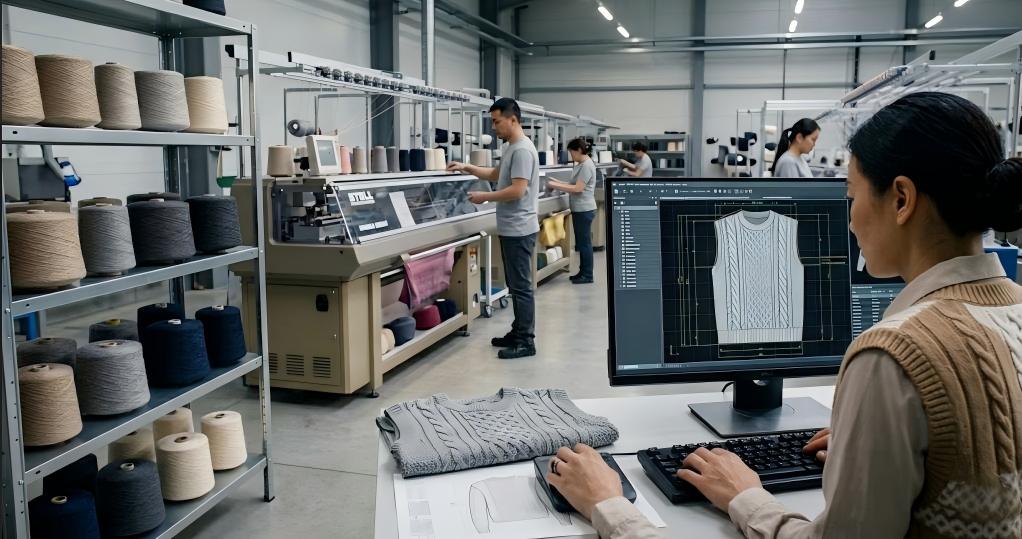
About Youtricot: Youtricot brings 20 years of technical knitwear expertise to a unique dual-center framework. Our design and compliance office in Prato, Italy guarantees complete alignment with European trends and strict German customs regulations. Our advanced manufacturing facility in Dongguan, China operates over 80 high-end knitting units—including legacy STOLL flat knitting machines (new machine production ceased Oct 2025; full global spare parts and after-sales support still available) and Shima Seiki equipment—engineered for rapid sampling and flexible, low-MOQ production.
Official machinery database for STOLL: https://www.stoll.com
Official tech portal for Shima Seiki: https://www.shimaseiki.com
Get Your Custom Quotation: We can send you the full editable Excel supplier audit checklist and a detailed sampling quotation tailored to your seasonal knitwear line completely free of charge. Share your full Tech Pack with us, and we will prepare a tailor-made quotation free of charge within 2 working days with no purchase obligation attached.

About Youtricot OEM
Your Trusted Knitwear OEMPartner in China
From design sampling to bulk production, wedeliver premium, fully-customizable knitwearsolutions for global fashion brands