
Quick Answer
Is Merino wool fire-resistant? Wool has inherent resistance to ignition, but a Merino yarn label does not establish the flame performance of a knitted fabric or garment. Wool can burn; it is not fireproof. Its non-melting fiber behavior is useful when evaluating materials, but does not establish protection against burns. Before making a protective claim, specify the exact composition, fabric weight, knit structure, treatments, seams, trims and care conditions, then obtain the applicable test and conformity evidence.
Key Takeaways
1. Fiber behavior is a starting point, not a product rating. Natural resistance to ignition does not make a sweater certified protective clothing. A report for one yarn, swatch or garment does not automatically cover another construction, finish or production lot. Keep the material description separate from any tested performance claim.
2. Comfort and protection need separate evaluation. Softness, breathability and moisture management can support prolonged wear, but comfortable hand feel does not demonstrate flame spread or heat-transfer performance. A blend selected for stretch or abrasion resistance must still be evaluated for the intended thermal exposure.
3. Compare the same measurements. Ignition temperature, melting temperature, Limiting Oxygen Index and heat of combustion describe different properties. Reference values are not safe exposure limits. Neither a high ignition temperature nor a low heat of combustion tells a buyer how long a garment will protect the wearer.
4. Match evidence to the finished specification. Define the hazard, destination market and intended claim before sampling. Confirm representative specimens, the applicable method and edition, pretreatment, acceptance criteria and any required conformity assessment. Manufacturing experience and supplier certificates cannot replace this evidence.
Table of Contents
- Merino Wool vs Cotton, Nylon, Polyester, and Rayon
- What Does Fire-Resistant Merino Wool Mean?
- Why Can Wool Resist Ignition?
- Five Fire-Performance Measurements and Their Limits
- Where Can Merino Wool Be Considered?
- When Is Product-Specific Flame Testing Required?
- What Should Designers Specify Before Sampling?
- How Can an OEM Partner Support Development?
- Frequently Asked Questions
- About the Author
- Develop Functional Merino Wool Knitwear
Merino Wool vs Cotton, Nylon, Polyester, and Rayon
The comparison below separates ignition from melting. It reproduces general fiber reference values from Woolmark’s fact sheet, which attributes the table to CSIRO. The source labels its wool row as wool, not a tested Merino grade or finished knitwear specification. Use these figures for initial material screening, not to rank garments by protection.
| Fiber | Ignition temperature (°C) | Melting temperature (°C) | LOI (%) | Heat of combustion (kcal/g) | Buyer interpretation |
|---|---|---|---|---|---|
| Wool | 570–600 | Does not melt | 25.2 | 4.9 | No Merino-specific or garment protection rating established. |
| Cotton | 255 | Does not melt | 18.4 | 3.9 | Non-melting does not establish flame protection. |
| Nylon | 485–575 | 160–260 | 20.1 | 7.9 | Assess melting in the actual blend and assembly. |
| Polyester | 485–560 | 252–292 | 20.6 | 5.7 | A melting value is not an ignition value. |
| Rayon | 420 | Does not melt | 19.7 | 3.9 | Untreated rayon is not equivalent to treated FR viscose. |
Source: Woolmark fire-resistance fact sheet, Table 1, ©2022; reviewed for this article revision.
Evidence boundary: The reference table does not identify a knit structure, fabric mass in g/m², conditioning procedure or specimen-level test method for each value. It is not a laboratory report for YouTricot fabric. The earlier comparison’s cotton “partial self-extinguishing” label is not substantiated and should not be used as a safety assurance.
What Does Fire-Resistant Merino Wool Mean?
In a material discussion, “fire-resistant” may describe resistance to ignition or flame spread. In a product claim, the phrase needs a defined basis: which material or garment was assessed, against which requirement, after what preparation, and with what result. “Fireproof” would imply a level of immunity that this article does not establish.
Keep three statements distinct: the fiber has particular thermal characteristics; the specified fabric achieved a result under a named test; and the finished garment meets an applicable protective-clothing requirement. Each needs its own evidence. A positive swatch result does not automatically establish the performance of seams, trims, a layered assembly or the complete garment.
For fashion knitwear, describe the selected material and intended comfort properties accurately. Avoid protective wording unless its scope is supported. A wool-rich blend, machine-washable finish or fine-gauge construction should not inherit a safety claim from the fiber name.
Why Can Wool Resist Ignition?
Wool’s protein structure, nitrogen content and moisture behavior help explain its resistance to ignition and tendency to char rather than melt. These material characteristics justify investigation; they do not establish a universal self-extinguishing result for every knitted construction. Sustained heat exposure can still cause burning and injury.
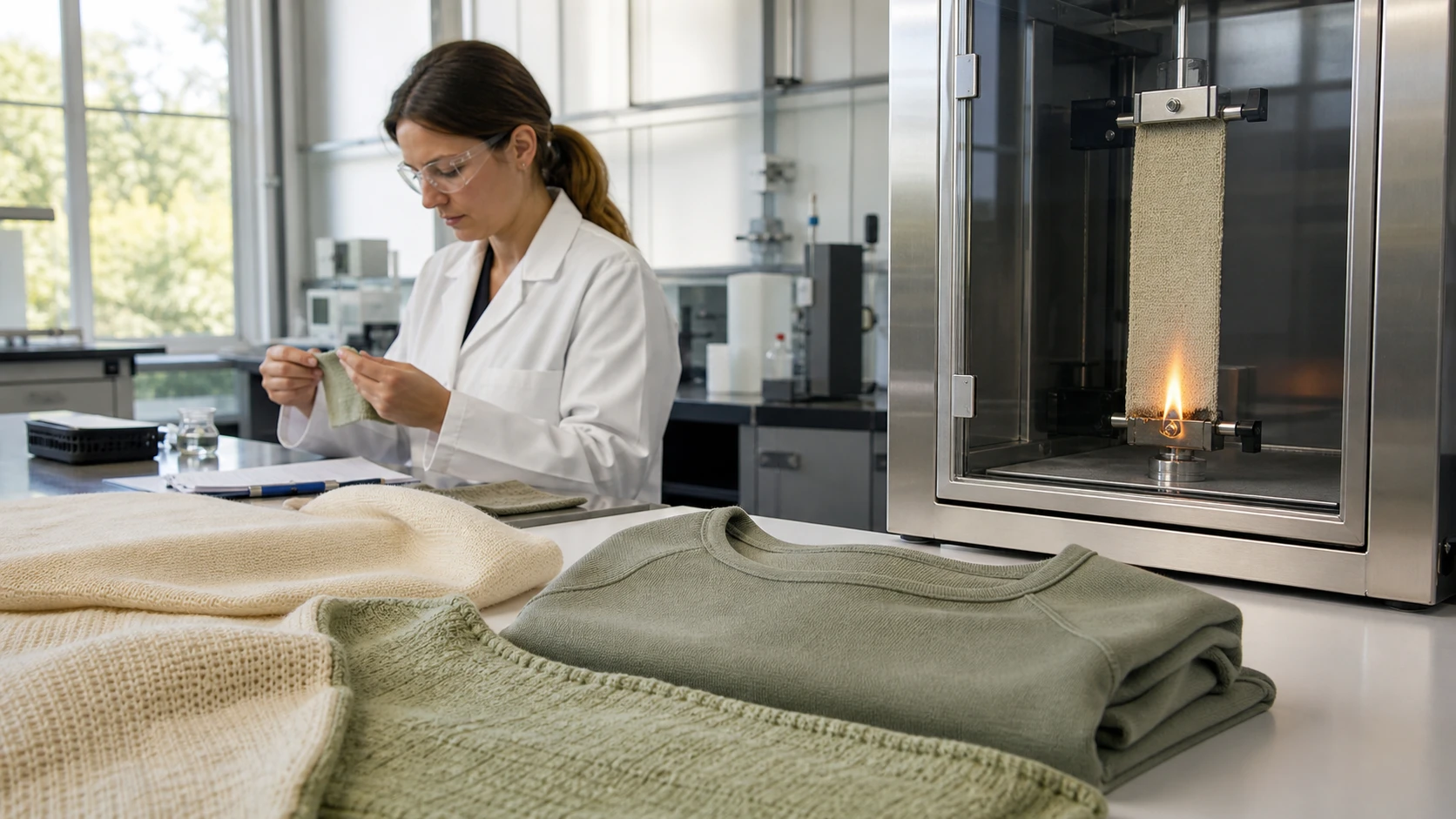
The existing Woolmark research on wool base layers for first responders summarizes AgResearch work published in 2020. It reports simulated naked-flame and accelerant exposure using a skin simulant. The comparison included Zirpro®-treated 100% Merino and Merino/FR-viscose double-knit and rib fabrics, alongside other materials. Fabric weights varied, so it was not a comparison at equal g/m².
What this study does not establish: It is not a standard-test pass report for an untreated Merino sweater. Treatment and construction are material differences, not details that can be omitted when explaining the result.
- Weight: the linked summary does not supply numerical g/m² values for all specimens.
- Structure: it identifies double-knit and rib examples; not every sample construction is fully specified.
- Treatment: treated wool and treated viscose were included; ordinary untreated yarn is not an equivalent specimen.
- Method: simulated exposures are described, but the summary is not a complete test protocol or a certificate to ISO 11612 or ISO 14116.
- Transfer limit: do not apply the reported outcome to another weight, blend, finish, garment or laundering condition without relevant evidence.
Five Fire-Performance Measurements and Their Limits
The figures in the comparison table answer different questions. When reviewing a technical sheet or laboratory report, check both the measurement and what it can legitimately support:
- Ignition temperature: a published material reference is not the temperature at which a garment remains safe to wear. Exposure duration, heat flux, specimen preparation and construction must be considered separately.
- Limiting Oxygen Index: LOI describes oxygen concentration under a defined test arrangement. Comparing a reference LOI with ambient oxygen does not prove that a garment cannot burn in air under external heating.
- Heat of combustion: kcal/g expresses energy per unit mass. It is not heat-release rate, heat transfer to skin or a predicted burn outcome. Cotton’s lower reference value does not by itself establish better protection.
- Melting behavior: separate fiber behavior from the complete blend, sewing thread, elastic, coating and trims. Non-melting wool does not establish non-melting behavior for every component.
- Limited flame spread: evaluate the actual specimen using the applicable procedure and preparation. Relevant observations may include afterflame, afterglow, damage, debris or hole formation; acceptance depends on the requirement, not a generic “fire-resistant” label.
Where Can Merino Wool Be Considered?
Merino wool is a candidate for outdoor knitwear, cold-weather garments, technical sweaters and base-layer development where comfort matters. Whether a particular construction belongs in protective clothing requires a separate hazard assessment and evidence review. The following are development contexts, not approval categories:
- Next-to-skin layers: assess hand feel, moisture behavior and compatibility with the complete clothing system.
- Outdoor performance garments: distinguish comfort or insulation requirements from any protective claim.
- Military, tactical and search-and-rescue systems: use the responsible buyer’s hazard specification and approval route.
- Motorsport base layers: confirm the governing requirements; a fiber description is not an approval.
- Cold-weather workwear: consider the actual thermal exposure alongside fit, care and construction.
- Technical sweaters and mid-layers: record weight, density, seams and layering rather than relying on gauge alone.
Not established by this article: suitability for structural firefighting, electrical arc, welding, molten-metal exposure or prolonged intense heat. An ordinary Merino sweater must not be offered as a substitute for hazard-specific protective clothing. Limited flame spread alone does not demonstrate heat insulation or safe skin temperatures.
When Is Product-Specific Flame Testing Required?
Before offering clothing for a defined thermal hazard or publishing a protective-performance claim, agree the applicable requirements with the buyer and a competent laboratory. Specify whether the assessment concerns fabric, a material assembly, components or the finished garment. Legal obligations depend on the product, claim and destination market; a test method is not itself a universal legal rule.
ISO 11612:2015 covers protective clothing requirements for heat and flame. ISO 14116:2015 concerns limited flame spread during occasional brief contact with small flames; it is not sufficient where heat-hazard protection is also needed. Both catalogue pages currently list published editions with revisions in development. Confirm the applicable edition before commissioning work.
ISO 15025:2016 is a limited-flame-spread test method, with surface- and bottom-edge-ignition procedures. The selected product requirement determines the relevant procedure and acceptance criteria. This small-flame method is not a substitute for assessment under large intense-heat exposure or restricted air supply, and is not appropriate for materials that show extensive melting or shrinkage. Do not infer an arc, firefighting or other hazard rating from a limited-flame-spread result.
A useful report identifies the specimen and lot, composition, conditioned fabric mass in g/m², structure, finish or treatment, test method and edition, procedure, specimen orientation, conditioning and laundering preparation. It also records results, deviations and the source of any pass/fail limits. Request the additional construction, heat-transfer or garment assessments required for the intended use.
Laboratory test results, product certification and legal conformity are separate records. A supplier certificate for restricted substances or responsible sourcing does not establish flame performance, certify YouTricot or cover every shipment. Match each document to its holder, scope, validity and product identity.
What Should Designers Specify Before Sampling?
The development brief should make the comfort target and the evidence requirement clear before yarn selection. Record the following so the sample, laboratory specimen and eventual production specification can be compared:
- Fiber percentages, yarn count, ply and supplier lot; identify pure wool, blends and reinforcement yarns.
- Machine gauge, stitch structure, stitch length or density and finished conditioned weight in g/m², with agreed tolerances.
- Color and all treatments: dyeing, softening, shrink-resist processing, coatings and any flame-retardant treatment.
- Target hand feel, fit and next-to-skin comfort; agree how these will be reviewed.
- Dimensional-stability requirements and how changes after care will be measured.
- Care route, wash or cleaning procedure, number of cycles, drying and conditioning before assessment.
- Intended wearer, garment layer, foreseeable exposure and expressly excluded uses.
- Target requirement, test method, edition, procedure and acceptance criteria.
- Seams, sewing thread, elastic, labels, trims and any relevant layered assembly.
- Required test and conformity records, specimen identity, approval owner and change-control rules.
For yarn selection context, read the full guide here : knitwear yarn OEM guide.
How Can an OEM Partner Support Functional Knitwear Development?
A Merino wool sweater manufacturer should translate the intended use into a controlled yarn, knit and garment specification. Ask your Merino wool sweater factory which development steps it can support, which tests require an external laboratory, and how sample changes will be recorded. Discuss the scope with YouTricot before committing to a protective application; this article does not claim certified protective-clothing capability or present a YouTricot flame-test result.
When assessing a Merino wool sweater supplier, use a knitwear quality control checklist that connects the approved sample to the production specification. Yarn substitutions, finish changes, density adjustments and different trims should trigger review of whether previous evidence remains applicable. Manufacturing feasibility, comfort approval and protective-performance approval are separate decisions.
Define the use
Confirm the wearer, hazard, destination market and intended claim. Identify exclusions and the person responsible for approving the test plan.
Specify the knit
Freeze composition, structure, conditioned weight, finishing, seams and trims. Keep a versioned technical pack and identifiable sample reference.
Develop and evaluate
Review hand feel, fit, shrinkage and construction after the intended care route. Record changes before selecting representative test specimens.
Test before claims
Obtain the required laboratory and conformity evidence. Confirm its scope and approve the exact claim wording before release.
For the broader manufacturing workflow, read the full guide here : China knitwear OEM 2026 complete guide.
Frequently Asked Questions
Use these answers for initial screening. Product decisions require evidence for the selected construction and use; no answer below assigns a protection class to an untested garment.
Is Merino wool fireproof?
No. Resistance to ignition does not mean immunity to flame or heat. Do not label an ordinary wool sweater as fireproof or offer it as protective equipment on the strength of fiber composition. Define the intended claim and obtain evidence that applies to the actual fabric or garment.
How does wool’s heat response differ from polyester’s?
Their melting behavior differs, as shown in the reference table. That distinction matters in material screening, but it is not a complete comparison of wearer safety. A wool/polyester blend, elastic component or treated construction needs its own evaluation. Check heat transfer and the whole clothing assembly rather than making a blanket “safer” claim.
What is the difference between Merino wool and cotton near flame?
The general wool and cotton reference values differ, but neither row certifies a finished garment. Untreated cotton should not be assumed to self-extinguish. Compare the actual fabric weight, construction, treatment and test conditions. Do not use the old table’s “partial” label as a protective-performance specification.
Can Merino wool be used in certified protective clothing?
It can be considered within a protective-clothing development program, but approval belongs to the specified product and assessment route. Define the hazard and relevant requirements first. A fabric test report is not automatically a finished-garment certificate, and a limited-flame-spread result does not establish protection against every heat exposure.
Does blending Merino wool with synthetic fibers affect flame resistance?
Changing the composition changes the specimen being assessed. Do not extend a pure-wool result to a blend, or a treated blend result to untreated yarn. Record percentages, yarn construction, reinforcement, finish and components. Ask the laboratory whether a material change requires further testing before keeping the previous claim.
What tests should buyers request for functional Merino knitwear?
Start with the intended use. Ordinary fashion development and protective clothing have different evidence needs. For a thermal-hazard claim, agree the product requirement, flame procedure, relevant heat-transfer assessment, garment or assembly scope and care preparation. Request specimen identity, results and acceptance criteria in the report, rather than a generic “fire test passed” statement.
Can a knitwear manufacturer develop functional Merino wool samples?
Ask which yarn, structure, pattern-making, needle-drafting and sampling tasks the manufacturer can undertake for your brief. Keep the approved specification and sample changes traceable. Manufacturing support does not replace a laboratory report or required conformity assessment, and a development sample should not carry an unsupported protective claim.
Develop Functional Merino Wool Knitwear
Share your intended use, yarn composition, knit structure, finished weight, treatments and care route for a development discussion. If protective performance is part of the brief, include the target requirement and available reports so the project scope and evidence gaps can be reviewed before sampling or quotation.
This article presents no YouTricot product-specific flame-test result or protective-clothing certification. Any proposed performance claim must remain unapproved until the required evidence matches the product and intended use.