

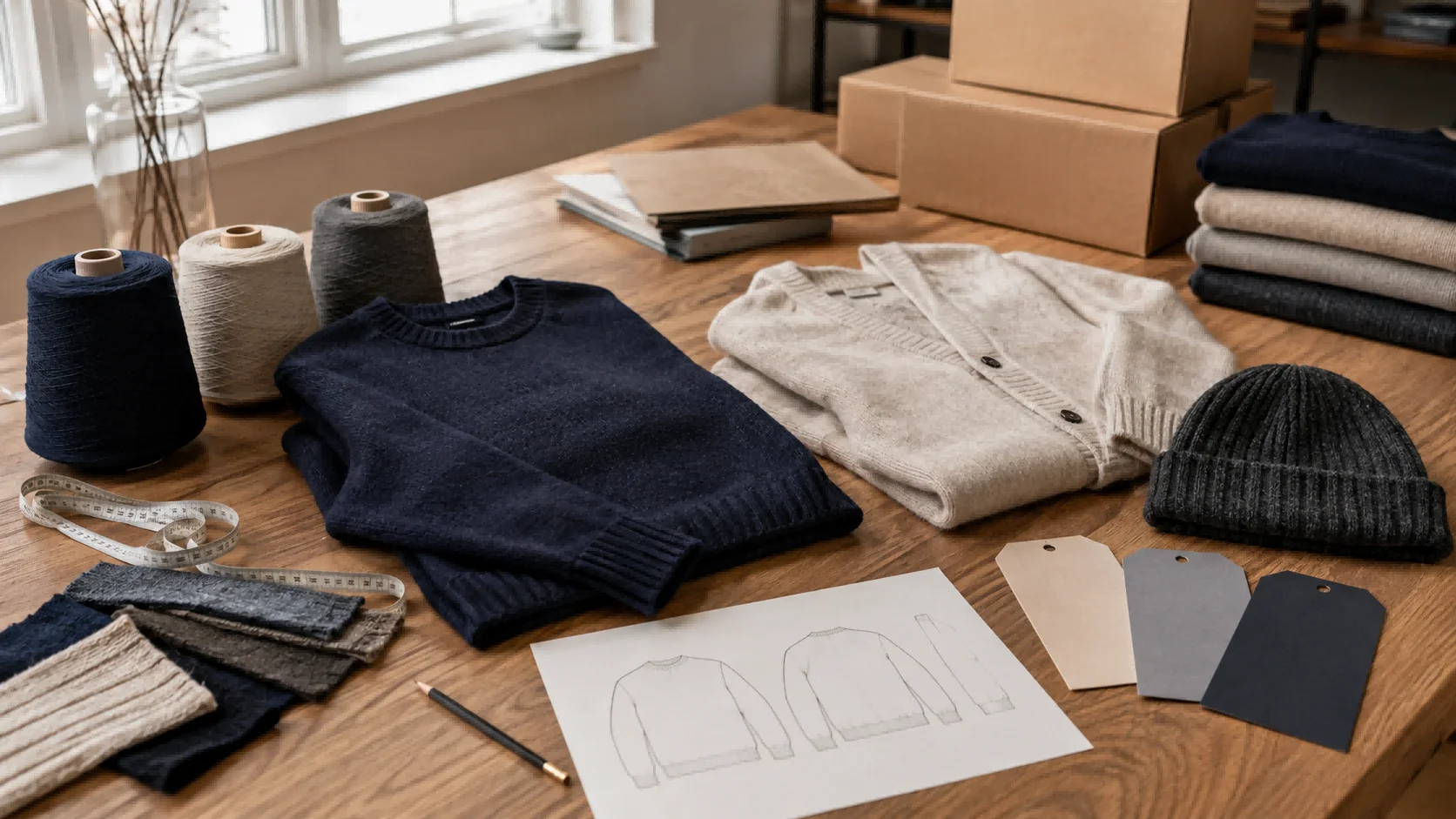
Quick Answer: To learn how to start a knitwear brand with no experience, begin with one defined customer, one retail price tier and two or three candidate core styles, then sample and commercially launch only one or two styles. A sequential path from positioning to an approved pre-production sample often needs about 10–17 weeks for planning purposes, followed by a factory-confirmed production schedule and an 8–12-week sales test. This guide uses an illustrative Phase 1 planning budget of $3,000–$8,000 for product development and the initial production commitment. Freight, duty, tax, market compliance testing, ecommerce setup, photography, paid acquisition, fulfilment, returns and working-capital reserves are separate unless explicitly budgeted.
Key Takeaways
1. Start with a narrow commercial position. Define the customer’s age, income, lifestyle and values before choosing yarn or sketching a collection. Select one realistic retail price tier and one primary style direction. A new brand rarely benefits from trying to serve entry-price, premium and luxury customers at the same time. Your customer promise, product quality, packaging, channel and target gross margin must support the same position. If these decisions conflict, factory quotations will not solve the underlying problem because suppliers will be pricing different interpretations of the brand.
2. Develop two or three candidates, but launch only one or two proven styles. A crewneck, cardigan and beanie can test different use cases without creating a large collection. Limit each style to two or three versatile colours and prioritise available stock-yarn options where they meet the required quality. Simple jersey, rib or restrained cable structures are easier for a first project to specify and revise than intarsia or multi-colour jacquard. The aim is to learn which fit, colour and price customers accept before committing cash to a broader range.
3. Evaluate factories through evidence and sampling, not promises alone. Prepare a tech pack, mood board, target price, quantity plan and launch date before contacting suppliers. Compare factories against the same brief and ask for documentary, practical, record-based and traceability evidence. Plan three controlled sample rounds, allowing additional revisions where needed: a proto sample for fit and construction, a revised sample for corrections, and a pre-production sample for final bulk approval. Consolidated comments, version control and a sample revision log are more valuable than frequent informal messages.
4. Treat the first order as a measured commercial test. A 50–200-piece launch can be sold through a direct-to-consumer website, Shopify store or selected pop-up markets. Measure fit feedback, perceived quality, price acceptance, returns, gross margin, customer acquisition cost and sell-through over a defined period. In this guide’s decision framework, sell-through above 60% supports proceeding, 30–60% calls for revision, and below 30% suggests a pivot. These thresholds are planning rules rather than universal industry guarantees and must be interpreted alongside discounting, traffic quality and launch duration.
Planning scope and real limitation
The budgets, timelines, sample charges and sell-through thresholds in this guide are editorial planning assumptions for an early-stage brand. They are not a fixed YouTricot quotation, a universal market benchmark or a delivery guarantee. Actual requirements depend on yarn availability, construction, colour count, size split, testing, destination, live capacity and buyer approval speed. This guide also does not replace professional advice on company registration, tax, trademarks, product liability, consumer law or destination-market compliance.
Table of Contents
The Seven-Stage Roadmap at a Glance
01
Position
Define the buyer, price tier and style direction.
02
Select
Choose two or three candidate core products.
03
Prepare
Build one quote-ready technical brief.
04
Evaluate
Compare factory evidence and quotations.
05
Sample
Control proto, revision and PP rounds.
06
Test
Launch 50–200 pieces and collect evidence.
07
Scale
Expand only after the KPIs support it.
| Stage | What to Do | Before Moving On |
|---|---|---|
| 1. Define Your Position | Identify your customer, price range, style direction and sales channel. | Write a one-page brand brief and check your initial margin assumptions. |
| 2. Choose Your First Products | Shortlist two or three styles, then select one or two for launch. | Confirm a manageable style and colour plan. |
| 3. Prepare Your Factory Brief | Document the design, measurements, yarn direction, quantities and target launch window. | Complete the information needed for comparable quotations; flag decisions requiring factory advice. |
| 4. Evaluate Factories | Compare suppliers against the same brief, supporting records and sample evidence. | Resolve critical evidence gaps and understand each quotation’s scope and exclusions. |
| 5. Develop and Approve Samples | Review prototypes, consolidate corrections and approve a pre-production sample. | Confirm the approved specification, materials, fit and outstanding production conditions. |
| 6. Test Your First Launch | Release a feasible small batch and collect sales, margin and customer feedback. | Decide whether to repeat, revise or stop before committing more inventory. |
| 7. Expand Proven Products | Reorder successful styles and add products gradually. | Confirm that demand, margins, cash flow and production readiness support expansion. |
Timing and budget: Treat this roadmap as a sequence of decisions, not a fixed launch calendar. This guide uses approximately 10–17 weeks from positioning to an approved pre-production sample as an illustrative planning allowance. Bulk production needs a factory-confirmed schedule, followed by the planned 8–12-week sales test. Actual timing depends on material availability, technical complexity, approval speed and any additional sampling rounds; international transit and customs are separate. Review the sampling assumptions in Stage 5 and the phased budget examples in Stage 7 when building your own cost plan. Those figures are planning examples, not YouTricot quotations or required investment levels.
Stage 1: How to Start a Knitwear Brand With Clear Positioning
The first step in deciding how to start a knitwear brand is to define who should buy the product, why they should choose it and what price they can reasonably accept. Record the target customer’s age, income, lifestyle and values, then select one retail price tier and one leading style direction. A customer who prioritises traceability and long-term wear may require a different yarn, margin structure and sales story from a trend-led buyer seeking frequent seasonal updates. Complete the positioning canvas before product development so design, material, packaging, channel and factory decisions follow one commercial logic.
Complete a Positioning Canvas
| Canvas Field | Question to Answer | Your Decision |
|---|---|---|
| Age | Which life stage and buying behaviour are you serving? | [Define a practical age range] |
| Income | What discretionary budget supports the intended retail price? | [Income or spending profile] |
| Lifestyle | Where, when and how will the knitwear be worn? | [Work, travel, leisure or outdoor use] |
| Values | Does the customer prioritise longevity, trend, performance, provenance or price? | [Choose one or two leading values] |
| Price Position | Which retail tier fits the customer and channel? | [Entry, mid-market, premium or luxury] |
| Style Direction | What visual and functional promise will remain recognisable? | [Classic, trend, sustainable or performance] |
| Customer Problem | What unmet need does the first product solve? | [One clear problem] |
| Proof | What evidence will support the promise? | [Material, fit, testing, traceability or construction] |
Choose One Retail Price Tier
| Position | Retail Price | Commercial Implication |
|---|---|---|
| Entry | $30–$60 | Requires strict cost control, simple construction and efficient fulfilment. |
| Mid-Market | $60–$150 | Supports greater material and fit differentiation if margin remains viable. |
| Premium | $150–$400 | Needs credible material, construction, fit and brand proof. |
| Luxury | $400+ | Requires exceptional product execution, service, provenance and brand authority. |
- Classic basics: familiar silhouettes, versatile colours and repeatability.
- Trend-driven fashion: stronger seasonal relevance but greater markdown risk.
- Sustainable or ethical: requires verifiable material and supply-chain evidence.
- Performance or outdoor: requires measurable functional specifications and appropriate testing.
Positioning limitation: A retail price target does not automatically establish a viable product cost. Build a margin model that includes production, packaging, payment fees, freight, duty, fulfilment, returns, discounts and channel commissions before approving the product brief.
Stage 2: Select a Beginner-Friendly Product Range
A beginner should develop two or three candidate core styles, such as a crewneck, cardigan and beanie, while planning to launch only the strongest one or two styles. Keep the first colour plan to two or three versatile shades and ask factories to show suitable stock-yarn options before considering custom dyeing. Simple solid-colour jersey, rib or restrained cable structures make fit, measurements and production variables easier to isolate. Intarsia and multi-colour jacquard can be added later when their visual value justifies additional artwork, programming, yarn management, sampling and quality-control requirements.
| Decision | Recommended Starting Point | Reason |
|---|---|---|
| Candidate Styles | 2–3 styles | Creates choice without building a full collection. |
| Commercial Launch | 1–2 approved styles | Concentrates cash and demand data. |
| Colours | 2–3 versatile colours maximum | Reduces fragmented inventory and material complexity. |
| Yarn | Suitable available stock yarn | Can reduce material minimums and procurement time. |
| Construction | Simple, repeatable structures | Makes development problems easier to diagnose. |
Stock-yarn limitation: Stock status can change, and an available shade may not deliver the composition, hand feel, performance or traceability required by the brand. Confirm the physical yarn, current lot availability, shade consistency and reservation terms before treating it as secured.
For material selection detail, use Material Knowledge.
Stage 3: Build a Quote-Ready Factory Brief
Contact factories only after preparing enough information for them to evaluate the same product and commercial scope. Your package should include a knitwear tech pack, mood board, target retail or factory-price framework, quantity by style and colour, MOQ expectations and launch timeline. Mark unresolved technical choices as “factory to recommend” instead of leaving blank fields. Keep this stage focused on a comparable brief; confirm the development route and order feasibility with each shortlisted factory. Better input produces more comparable quotations and more useful technical feedback.
What to Prepare Before Contacting a Factory
- Front and back technical flats for each style.
- Base-size measurements, points of measure and tolerances.
- Yarn composition, hand-feel direction, gauge and stitch requirements.
- Mood board and reference images identified as inspiration rather than specifications.
- Target price or target retail tier with expected sales channel.
- Quantity by style, colour and size.
- Required sample type, launch date, destination and delivery expectations.
- Testing, labelling, packaging and inspection requirements.
Communicate Like a Professional Buyer
Use one current file version
Add a style number, version number and revision date.
Consolidate questions
Send one organised response instead of fragmented messages.
Separate targets from approvals
A mood image is direction; a signed specification is authority.
Keep expectations realistic
Ask the supplier to confirm feasibility before promising a launch date.
Read the full guide here : [ knitwear tech pack and RFQ checklist ]
Stage 4: Source and Evaluate Knitwear Factories
Beginners can find knitwear factories through Alibaba, specialist trade shows, Google searches and trusted industry referrals. The channel identifies candidates; it does not prove capability. Send the same brief to a manageable shortlist, compare like-for-like quotations and evaluate evidence across yarn storage, knitting, linking, washing and finishing, quality control, planning, waste management and packing. A professional supplier should explain what it can produce, what remains uncertain and which records support its answer. Price should be reviewed only after the technical scope and exclusions are aligned.
| Channel | Best Use | Limitation to Check |
|---|---|---|
| Alibaba | Building a broad initial supplier list | Listings and badges do not replace product-specific evidence. |
| Trade Shows | Reviewing products and discussing capabilities in person | Show samples may not represent normal bulk-production control. |
| Finding specialised suppliers and technical content | Website quality does not prove production capability. | |
| Referrals | Reducing the initial search field | A supplier suitable for one brand may not fit another product or quantity. |
Apply the GAP-07 Evidence Method
For every evaluation point, record the evidence layer and assign one of three statuses: Clear, Follow-up or Not applicable. The purpose is to make uncertainty visible rather than forcing a simple pass or fail result.
| Evidence Layer | What to Verify |
|---|---|
| Document | Is there a current procedure, specification or approved standard? |
| Practice | Does the observed or demonstrated process match the document? |
| Record | Can the supplier show dated records from comparable work? |
| Traceability | Can one active order be traced from yarn cone to machine, garment, carton and shipment release? |
Eight practical evaluation areas:
- Yarn storage and lot control
- Knitting and machine suitability
- Linking, seaming and assembly
- Washing, finishing and dimensional control
- Quality control and testing
- Production planning and approval control
- Waste, yield and material accountability
- Packing and responsible operations
Responsible supplier evaluation should also extend beyond product quality. The OECD guidance for responsible garment and footwear supply chains provides a government-backed framework for identifying and addressing labour, human-rights, environmental and integrity risks. Source checked: 19 October 2026.
Read the full guide here : [ knitwear factory evaluation criteria ]
Stage 5: Complete Three Sampling Rounds
Use this three-round planning template so each physical sample answers a different approval question. Actual projects may need additional rounds. Round 1 is the proto sample for fit, proportion and construction. Round 2 tests the consolidated measurement and detail corrections. Round 3 is the pre-production sample that becomes the approved reference for bulk production. Keep one revision log across all rounds and identify the approver, comment date, measurement change and closure status. Do not approve a sample only from photographs when hand feel, stretch, weight, colour or construction requires physical review.
| Round | Sample Type | Purpose | Planning Time | Illustrative Development Budget per Sample | Exit Gate |
|---|---|---|---|---|---|
| Round 1 | Proto Sample | Test fit, proportion and construction | 2–3 weeks | $50–$100 | One consolidated correction list |
| Round 2 | Revised Sample | Confirm measurement and detail changes | About 2 weeks | $30–$50 | Technical corrections closed |
| Round 3 | PP Sample | Approve the final reference for bulk production | About 1 week | $20–$30 | Signed approval against a frozen specification |
Sampling-cost boundary
The dollar bands above are illustrative planning assumptions supplied for this guide, not a fixed YouTricot quotation or universal market price. Courier charges, special yarn, custom trims, testing and additional revision rounds may be separate. At YouTricot, sampling is handled through a symbolic sampling fee that is fully deductible from later bulk production orders. Sampling is not represented as completely free.
Sample Revision Log Template
| Style / Version | Sample Round | Review Area | Current Result | Required Change | Owner / Due Date | Status |
|---|---|---|---|---|---|---|
| [Style / V01] | [Proto / Revised / PP] | [Fit / Yarn / Stitch / Trim / Finish] | [Measured observation] | [Exact correction] | [Name / Date] | [Open / Closed] |
| [Style / V02] | [Round] | [Area] | [Observation] | [Correction] | [Name / Date] | [Open / Closed] |
Confirm project-specific sampling conditions through Fast Sampling Knitwear.
Stage 6: Run a Small-Batch Test Launch
A first launch should commit only enough inventory to test product-market fit without fragmenting demand across too many styles and colours. Treat 50–200 pieces as an illustrative test range, subject to confirmed order feasibility, and sell through a Shopify store, another direct-to-consumer website or selected pop-up markets. YouTricot may support 50 pieces per style per colour only when the yarn, colour, structure, trims, testing, finishing and technical route are feasible. Confirm the complete style-colour commitment before ordering. Define the sales-test period before launch, collect structured feedback and calculate sell-through and break-even using actual selling costs rather than the factory price alone.
Small-Batch Launch Decision Rules
| Sell-Through Rate | Decision | Next Review |
|---|---|---|
| Above 60% | Proceed | Confirm margin quality, returns and colour-size concentration before repeating. |
| 30–60% | Revise | Review fit, price, imagery, channel, colour and launch timing. |
| Below 30% | Pivot | Do not reorder until the product, position or channel hypothesis changes. |
Sell-through rate = units sold ÷ units available for sale × 100. Define whether returned units re-enter available inventory and keep the measurement window consistent between launches.
Break-Even Formula
Break-even units = fixed costs ÷ (selling price per unit − variable cost per unit)
The formula follows the U.S. Small Business Administration break-even method. Variable cost should reflect the costs that rise with each sale, which may include product cost, packaging, payment processing, pick-and-pack, channel commission and shipping subsidy. Fixed launch costs may include development, photography, ecommerce setup and other costs that do not change with each unit. Source checked: 19 October 2026.
Customer Feedback Log
| Date / Channel | Style / Size / Colour | Fit Feedback | Quality Feedback | Price Perception | Return or Keep | Action |
|---|---|---|---|---|---|---|
| [Date / Website] | [Style / M / Navy] | [Specific comment] | [Specific comment] | [Low / Fair / High] | [Keep / Return] | [Review / Revise / No change] |
For products sold in the United States, the Federal Trade Commission’s clothing and textile guidance explains requirements covering fibre content, country of origin, responsible company identification and care instructions. Other markets have different requirements, so confirm the rules for every destination before approving labels or launching sales. Source checked: 19 October 2026.
Test limitation: Sell-through can be distorted by discounts, limited traffic, unusually strong launch publicity, stockouts or an unbalanced size mix. Read the threshold together with gross margin, return reasons, customer acquisition cost and the defined selling period.
Check your opening order against Low MOQ Knitwear Rules.
Stage 7: Scale From Evidence
Scale only after the test launch shows which style, colour, size and price combinations generate profitable demand. Phase 1 should prove one or two styles within a controlled budget. Phase 2 can expand to four to six styles after repeat purchases, acquisition costs and realised margin are understood. Phase 3 can support a full collection when operational systems, cash flow and inventory controls can handle more than 5,000 pieces. At every phase, compare sell-through, customer acquisition cost and gross margin using the same definitions rather than relying on revenue growth alone.
| Phase | Volume | Planning Budget | Range | Priority KPIs | Decision |
|---|---|---|---|---|---|
| Phase 1: Validate | 0–500 pieces | $3,000–$8,000 | 1–2 styles | Sell-through, first-order CAC, realised gross margin | Repeat, revise or pivot |
| Phase 2: Expand | 500–5,000 pieces | $15,000–$50,000 | 4–6 styles | Style-level sell-through, CAC payback, gross margin after returns | Increase proven combinations and remove weak ones |
| Phase 3: Scale | 5,000+ pieces | $50,000+ | Full collection | Full-price sell-through, blended CAC, gross margin and inventory turnover | Build repeatable planning and replenishment systems |
Budget boundary: The Phase 1 range covers product development and the initial production commitment. Unless specifically included, it excludes freight, duty, tax, market compliance testing, ecommerce setup, photography, paid acquisition, fulfilment, returns reserves and working-capital buffers. The same exclusions should be reviewed again when entering Phases 2 and 3.
Read the full guide here : [ knitwear production lead time ]
Frequently Asked Questions
The answers below address the most common questions from founders researching how to start a knitwear brand with no experience. They distinguish preliminary planning assumptions from project-specific commitments. A factory should confirm feasibility, yarn availability, sampling scope, pricing, production timing and testing requirements against the final tech pack. Legal, tax, trademark, labelling and product-safety requirements must also be checked for the markets where the garments will be sold.
Can You Start a Knitwear Brand With No Experience?
Yes, but lack of experience must be compensated for with a narrow product scope, clear documentation and qualified technical support. A founder does not need to operate knitting machinery, but must be able to define the customer, approve fit, understand commercial assumptions and maintain version control. Do not expect a supplier to make every brand, product and pricing decision on your behalf.
How Much Does It Cost to Start a Small Knitwear Brand?
Use $3,000–$8,000 as a Phase 1 planning range for product development and the initial production commitment. Add separate allowances for freight, duty, tax, testing, ecommerce, photography, marketing, fulfilment, returns and working capital. The actual requirement depends on the number of styles, colours, sizes, yarn choices, sample rounds and sales channel.
What Is the MOQ for a First Knitwear Collection?
YouTricot may support 50 pieces per style per colour when the yarn, colour, structure, trims, testing, finishing and technical route are feasible. Confirm the applicable minimum before choosing your range; use the Stage 6 rules link for detailed conditions rather than treating 50 pieces as universal.
How Long Does Knitwear Development Take?
For preliminary planning, allow approximately 10–17 weeks from positioning work to an approved PP sample when stages run mostly in sequence. Bulk-production timing begins from an agreed readiness gate and depends on yarn, construction, quantity, approvals and live factory capacity. International transit and customs should be planned separately.
Do I Need a Knitwear Tech Pack?
Yes. A complete tech pack gives the factory a common basis for feasibility, sampling and quotations. Include technical flats, measurements, yarn direction, gauge, stitch structure, construction, colours, trims, labels, packaging and testing expectations. If a choice is unresolved, mark it clearly and ask the factory to recommend options.
How Do You Find a Reliable Sweater Factory With Low MOQ?
Use Alibaba, trade shows, Google and referrals to create a shortlist, then send every supplier the same technical and commercial brief. Evaluate documentary, practical, record-based and traceability evidence. Compare product capability, sample performance, communication, exclusions and production controls before comparing the final price.
Should a First Collection Use Intarsia or Jacquard?
Usually not. Solid-colour jersey, rib or restrained cable structures make early development easier to control. Use intarsia or jacquard in the first collection only when the technique is central to the brand identity and the budget, artwork, yarn plan, sample calendar and quality criteria can support the additional complexity.
Prepare Your First Knitwear Development Brief
Send your positioning summary, technical flats or tech pack, yarn direction, target quantity and launch window for an initial feasibility review. Any proposed price, sampling scope or production schedule remains subject to the final specification, material availability and capacity confirmation.
Frank, Founder of YouTricot
Frank has 20 years of knitwear-industry and operational experience across Prato, Italy and Dalang, Dongguan, China. He writes for fashion founders, designers and sourcing teams that need practical guidance on product development, factory evaluation, sampling and small-batch production.
Continue Reading: Plan Your First-Collection Sourcing Decision
Once your brand position and initial product range are defined, the next step is to compare factories against one consistent sourcing brief. This guide explains how independent designers can assess MOQ suitability, quotation scope, sample evidence, cost drivers and approval risks before paying a supplier or releasing bulk production.
Read the full guide here :
small designer knitwear sourcing