

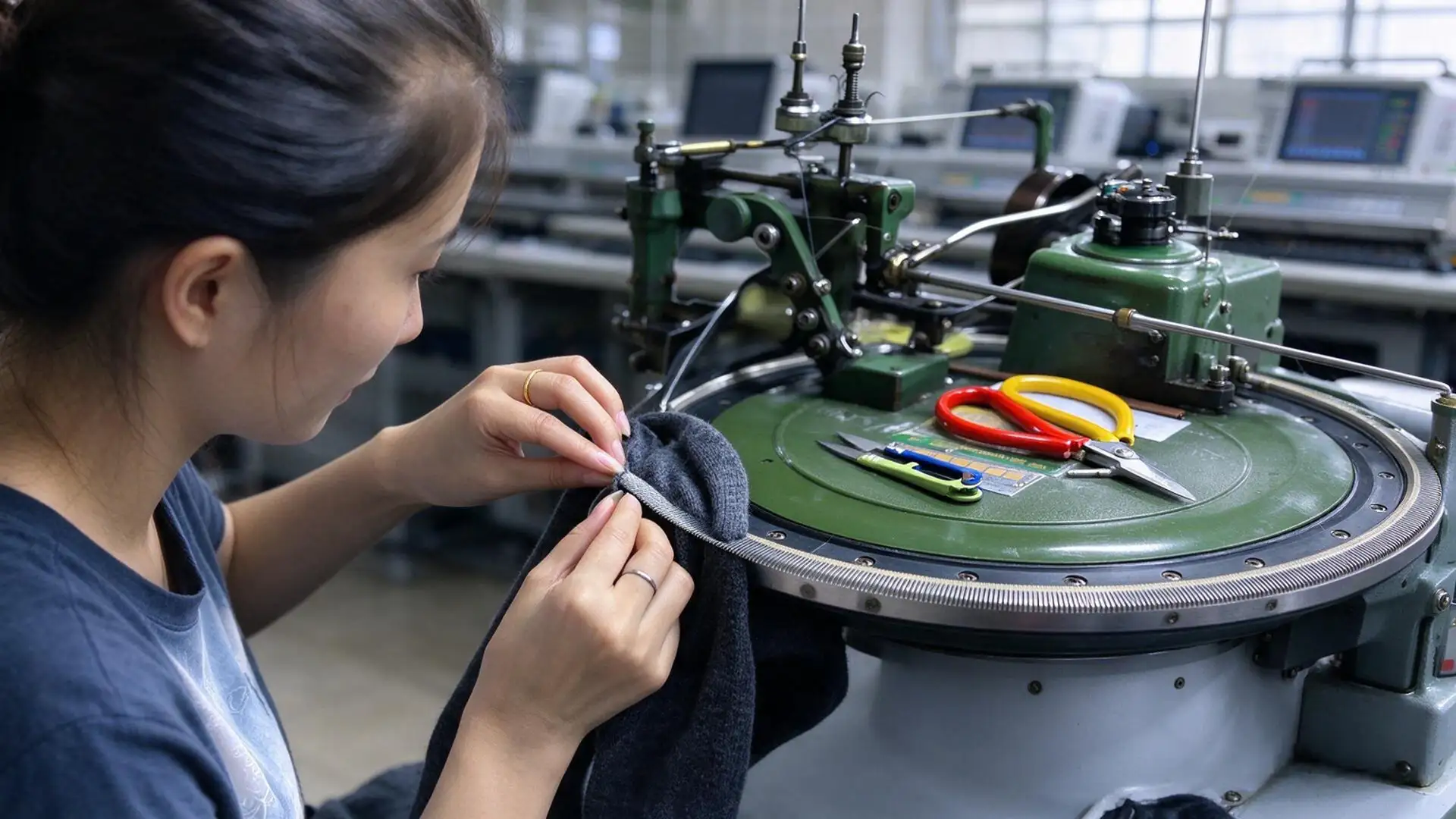
Quick Answer: What to ask a sweater factory before ordering: confirm that every quote uses the same style-color quantities, yarn, construction, sample scope, approval gates, production clock, inspection plan, payment triggers, Incoterm and compliance responsibilities. Release each payment only when the scope, evidence, assumptions and exclusions for that milestone are documented.
Key Takeaways
A safe first-order decision depends on four controls: comparable quotation scope, a SKU-level MOQ calculation, documented approval gates and an explicit responsibility map. These controls turn broad factory promises into evidence the buyer can approve. They also show where a lower price may transfer cost or risk into excess inventory, extra sampling, delayed approvals, failed inspections, freight or import work. Use the four takeaways below as the commercial test before reviewing the detailed questions and tables.
1. Compare scope before price. A unit price is meaningful only when every supplier has priced the same yarn, gauge, construction, size range, color plan, finishing, testing, packaging, delivery term and approval route.
2. Convert MOQ into style-color SKUs. At 50 pieces per style per color, one style in two colors is a 100-piece opening commitment before sizes are allocated within each color.
3. Tie every payment to a defined gate. Sample acceptance, material booking, bulk release and shipment release are different decisions. Each needs a named approver, a current revision and evidence that matches the decision.
4. Keep responsibilities explicit. The quotation and contract should identify who books freight, pays inspection and testing costs, prepares documents, clears imports, carries insurance and confirms destination-market compliance.
Table of Contents
What to Ask a Sweater Factory Before Ordering: 10 Decision Questions
Ask questions that end in an approval decision, not a reassuring conversation. For each issue, define the product and commercial requirement, request evidence tied to the quoted style and record whether the next step is approved, revised, held or rejected. The matrix separates buyer inputs from supplier evidence, making quotations comparable and exposing costs hidden by extra colors, undefined sample rounds, unpriced testing, buyer-caused waiting time or unsuitable shipping terms. Complete all ten rows before a deposit or material-booking payment.
| Question | Buyer must specify | Evidence to request | Approval decision | Limitation to record |
|---|---|---|---|---|
| 1. How is MOQ calculated? | Styles, colors, size ratios and reorder intent. | Style-color grid plus yarn, dye or trim minimums. | Approve or simplify the assortment. | Garment MOQ may not cover supplier minimums. |
| 2. What exactly does the price include? | Yarn, gauge, weight, construction, finish, trims, packing, testing and trade term. | Itemized scope, exclusions, validity, currency and named Incoterm place. | Normalize scope before ranking prices. | Consumption or construction changes can reprice the order. |
| 3. What does sampling cover? | Purpose, materials, colors, sizes, revisions, courier, tests and approval date. | Written sample scope, sample ID, billable extras and a symbolic sampling fee, fully deductible from later bulk production orders. | Authorize the defined sample stage only. | A development sample may not be bulk-ready. |
| 4. Which approvals release the next stage? | Approvers for material, color, fit, construction, finish, artwork and packaging. | Approval calendar, revision register and signed comments. | Approve, approve with recorded exceptions, or hold production. | Mixed versions create an ambiguous standard. |
| 5. When does production lead time start and end? | Cargo-ready date, destination date, response times and holidays. | Dated Day 0, factory days, buyer days, exclusions and handover. | Accept only achievable start conditions. | Sampling, transit and customs are separate. |
| 6. Is the design technically feasible? | Yarn, gauge, stitch map, dimensions, seams, wash and hand-feel target. | Feasibility comments, swatch, measurements and substitutions. | Freeze the route or revise the design. | Computerized flat knitting technology has product-specific limits. |
| 7. What quality evidence will support release? | Tolerances, defects, tests, sample plan and reinspection rule. | Lot records, sample ID, measurements, tests and final inspection. | Release, repair, sort, reinspect or reject. | Sampling inspection cannot prove every unit. |
| 8. What does each payment release? | Method, currency, beneficiary, milestone and dispute route. | Invoice, contract, verified bank details and gate evidence. | Release only the agreed milestone amount. | Payment terms cannot remove performance risk. |
| 9. Who controls shipping and knitwear import tasks? | Mode, destination, named place, cargo date, insurance and importer. | Incoterm, named place, version, documents, booking owner and costs. | Approve handover and landed-cost ownership. | Incoterms do not replace the sales contract. |
| 10. Which compliance claims and records apply? | Markets, fiber and care claims, labels, traceability and economic operator. | Certificate holder, scope, order link, tests and label artwork. | Approve claims for the order and market. | A certificate logo may not cover the transaction. |
How Should Buyers Compare MOQ and SKU Allocation?
Translate MOQ into sellable style-color combinations before comparing factories. YouTricot’s standard opening MOQ is 50 pieces per style per color, with sizes allocated inside that approved style-color quantity. The buyer should provide a SKU grid showing style, color, size ratio and reorder intent. The factory should return the quantity calculation plus any separate yarn, dye-lot, trim or processing minimum. Approve the assortment only after checking inventory exposure by SKU, not merely the total order. Final feasibility remains dependent on yarn, gauge, construction, color, finishing, testing, labels, packaging and production scheduling.
Planning rule: Opening garment quantity = distinct styles × colors per style × 50 pieces.
Example: one sweater in two colors requires 100 pieces before the size split is applied. A second style creates another MOQ calculation. This formula is an opening garment rule, not a promise that every custom yarn, custom dye or special trim is available at the same quantity.
01
Map Style-Colors
Give every design and color a distinct line before discussing sizes or price breaks.
02
Allocate Sizes
Set a realistic size ratio inside each color and flag any size-specific construction difference.
03
Check Hidden Minimums
Ask whether yarn mills, custom colors, trims, labels or finishing impose a separate minimum.
04
Approve Exposure
Review cash tied up in each SKU and the repeat-order path before approving the collection.
How Do Sampling, Approval Stages and Cost Scope Connect?
Sampling should convert open assumptions into approved production inputs. Specify the sample’s purpose, material status, required colors and sizes, revision allowance, courier, testing and approval owner. Request a numbered sample record that distinguishes a development sample from a pre-production reference. YouTricot describes its charge only as a symbolic sampling fee, fully deductible from later bulk production orders. Premium yarn, custom color development, special trims, external testing or extra revision rounds still require project-specific review. Approve bulk only when the sample, written specification, material reference, measurements, finishing route and exceptions all point to the same revision.
What to Ask a Sweater Factory Before Ordering About Manufacturing Cost
Build the comparison from cost blocks, then add freight, import charges and risk costs outside the factory price as applicable. Do not use fixed percentages unless the supplier has quoted them for the same specification. The correct calculation is the sum of quoted, evidenced components for the approved design and commercial scope.
Landed-cost formula:
Estimated landed cost per sellable unit = (factory goods cost + development + testing + inspection + freight + insurance + duty, tax and destination charges) ÷ expected sellable units.
| Cost block | Inputs to hold constant | Evidence to request | Common exclusion or limitation |
|---|---|---|---|
| Yarn and consumption | Composition, supplier or approved equivalent, count, ply, color route, garment weight and waste basis. | Yarn reference, color reference, consumption assumption and substitution rule. | Final consumption can change after pattern, density, size mix and wash are confirmed. |
| Programming, knitting and assembly | Gauge, stitch map, shaping, panel count, linking, seams, attachments and handwork. | Feasibility comments, knit-down, construction notes and approved workmanship sample. | Machine time, setup and handwork are construction-specific; gauge alone does not set cost. |
| Washing and finishing | Wash route, target hand feel, dimensions after finishing, surface treatment and pressing. | Approved finished sample, recipe control or declared process, and measurement results. | A visual reference cannot define a repeatable wash or hand-feel standard by itself. |
| Trims, labels and packing | BOM, artwork, label language, barcode, polybag or alternative, folding and carton specification. | Approved BOM, artwork proofs, packaging sample and unit costs. | Supplier MOQs and artwork changes can affect both cost and schedule. |
| Development, testing and inspection | Sample stages, included revisions, tests, laboratories, inspection party and reinspection rule. | Sample scope, laboratory quotation, inspection quotation and a symbolic sampling fee, fully deductible from later bulk production orders. | Failed tests, extra revisions and reinspection may fall outside the opening quote. |
| Logistics and import | Mode, chargeable weight or volume, Incoterm, named place, insurance, tariff classification and destination. | Forwarder quote, commercial documents and importer or broker estimate. | Freight, duty, tax, storage and customs outcomes can change after the factory quote. |
What Must a Knitwear Production Lead Time Include?
A usable knitwear production lead-time schedule defines the event that starts the clock, the handover event that stops it, factory working days, buyer approval time and excluded risks. Ask whether yarn is available, color is approved, the pre-production sample is released, capacity is reserved, commercial conditions are met and labels or packaging are ready. If a supplier advertises an 18-day production window for a China knitwear OEM order, it is not comparable until those start conditions and exclusions are written. Approve the schedule only when it fits the launch work-back plan and shows the effects of late comments, failed tests, rework, holidays and freight booking.
Ask for Five Dates, Not One Promise
- Information-complete date: all quote-critical fields are available.
- Sample approval date: the named approver releases the stated revision.
- Production Day 0: material, approvals, capacity and commercial start conditions are closed.
- Cargo-ready date: inspection, packing and documents reach the agreed status.
- Required destination date: forwarder, customs and receiving allowances are added outside factory production time.
Real limitation: A fast knitting window does not guarantee a fast order. Custom-dyed yarn, buyer approval delays, unstable finishing, external testing, reinspection, public holidays and missed freight cutoffs can move the critical path. The written schedule should show who owns each dependency.
Read the full guide here : Knitwear Production Lead Time
What Quality Evidence and Inspections Should You Request?
Request evidence that connects the approved specification to the actual yarn lot, sample revision and production lot. The buyer should define measurement tolerances, defect categories, appearance standards, performance tests, inspection stages, sample plan and release authority before bulk production. The factory should provide order-linked material records, sample IDs, in-line findings, measurement results, declared deviations and final inspection evidence. A third-party inspection can add independence when the order risk justifies it, but it still needs buyer-approved criteria. The release decision must state whether goods pass, require repair or sorting, need reinspection, or remain on hold.
Separate Process Control, Testing and Acceptance Sampling
- Process control follows yarn, knitting, linking, washing, finishing, measurements, labels and packing while correction is still possible.
- Product testing uses an agreed method and acceptance criterion to answer a defined performance or compliance question.
- Acceptance sampling makes a lot decision from a defined sample plan. ISO 2859-1:2026 defines AQL-indexed sampling schemes for lot-by-lot inspection, but a selected plan does not replace process control or product-specific testing.
How Should Payment, Shipping and Compliance Responsibilities Be Divided?
Divide responsibilities in the purchase contract and quotation. Link each payment to a defined release, state the Incoterm rule with named place and version, name freight and insurance owners, list export and import documents, and assign testing, inspection and reinspection costs. The buyer or importer must verify destination-market duties for its product and role. A factory can provide records within scope, but cannot assume every labeling, tax or product-safety duty. Approve payment only when the relevant line has an owner, deadline and evidence source.
1. Payment
Record the amount, verified beneficiary, invoice, trigger and the work or material commitment released. Evidence: signed terms and the completed preceding gate. Boundary: a deposit does not prove that specifications, materials or dates are complete.
2. Incoterm and Handover
Write the rule, named place or port and “Incoterms 2020” in the contract; use the ICC Guide to Incoterms 2020 as the authoritative reference. Boundary: Incoterms do not decide product conformity, payment method, title transfer or every remedy.
3. Freight and Import
Name the booking owner, mode, forwarder, insurance decision, document owner, customs broker and receiving buffer. Evidence: forwarder quote, booking confirmation, packing list and insurance document where required. Boundary: cargo-ready status is not warehouse delivery.
4. Testing and Inspection
Assign the methods, acceptance criteria, laboratory or inspector, report recipient, failure costs and release authority. Evidence: approved plan, quotation and report. Boundary: “QC included” does not define coverage, methods or acceptance.
5. Product and Label Compliance
The importer should verify applicable safety, technical-file, economic-operator and fiber-labeling duties. For EU-bound goods, review the EU GPSR business guidance and the European Commission’s textile-labeling overview. Boundary: duties vary by product, role and market.
6. Certification and Traceability Claims
Match the certificate holder, scope, material, product and transaction evidence to the exact claim. Review OEKO-TEX Standard 100 or RWS requirements where relevant. Boundary: a logo or supplier relationship does not prove order-level eligibility.
Comparison basis and limitation: Allocate these duties for the same order, destination and named Incoterm place, using the signed contract, quotation and order-linked records. The correct allocation varies by role, product and destination law; this section is a commercial control framework, not legal, tax or customs advice.
Which Approval Route Fits Your First-Order Scenario?
Use the lightest approval route that controls the order’s material risks. A stock-yarn style can prioritize assortment discipline and a clear approved sample; custom-dyed, technically complex or compliance-sensitive styles need more evidence. An urgent launch needs a verified critical path, not a faster-sounding promise. The table recommends the next decision and evidence for common first-order conditions, keeping the commercial scope constant while changing only the risk response. It does not score factories or replace project-specific review.
| Scenario | Recommended decision rule | Evidence before payment | Approval gate | Limitation |
|---|---|---|---|---|
| One style, two colors | Budget for 100 pieces and compare demand risk between colors before dividing sizes. | Separate color references, size ratios, color-specific cost changes and shade approval route. | Approve both color paths, not only the base style. | Different colors can behave differently in finishing or visual inspection. |
| Custom-dyed premium yarn | Separate garment MOQ from mill minimum and do not release bulk until shade and material evidence are approved. | Mill minimum, lab dip or physical shade standard, yarn identity, lot plan and surplus treatment. | Approve color and yarn booking before final bulk timing. | Custom dyeing can change quantity, cost and critical path. |
| Jacquard, intarsia or complex structure | Approve technical feasibility and the physical construction before relying on the bulk quote. | Artwork map, floats or back construction, weight, measurements, linking and finishing result. | Freeze the approved knit construction and declared exceptions. | A sketch or render cannot prove manufacturability or repeatability. |
| Urgent “18-day” production proposal | Accept only if Day 0, capacity, material status, buyer deadlines, inspection and cargo-ready handover are dated. | Critical-path schedule, named owners, excluded events and late-approval consequences. | Approve the full schedule, not the headline duration. | The phrase alone is not a delivery commitment and excludes transit unless stated. |
| EU-bound knitwear import | Map the importer, responsible person where applicable, product-safety file, fiber label, claims and customs responsibilities before artwork approval. | Order-linked material and test records, label proof, economic-operator details and document list. | Approve claims, labels and technical documentation before packing. | Requirements depend on the product and market role; obtain current specialist advice where needed. |
Buyer Checklist: What Must Be Closed Before Payment?
Use this checklist as a final gate after completing the decision matrix. Every checked line should point to a current document, sample, approval or named owner. An unanswered line is not automatically a reason to reject a factory, but it is a reason to hold the related payment or narrow what that payment is authorized to release. Keep targets separate from approvals, and mark unresolved items as open rather than allowing the factory to infer a requirement.
Specification and Commercial Scope
- ☐ Current tech pack, style number and revision
- ☐ Style-color-size grid, 50-piece MOQ calculation and separate supplier minimums
- ☐ Yarn, gauge, construction, finish and approved-equivalent rule
- ☐ Itemized quote, exclusions, Incoterm and named place
- ☐ Sample stages, revisions and a symbolic sampling fee, fully deductible from later bulk production orders
Approval and Release Controls
- ☐ Approved sample, material, measurements, finish and current revision
- ☐ Production Day 0, cargo-ready definition, buyer deadlines and exclusions
- ☐ Tests, inspection criteria, defect rules and reinspection ownership
- ☐ Verified beneficiary and evidence required for each payment trigger
- ☐ Destination compliance, fiber labels, claims and document owners
What Should You Send for a Comparable Knitwear RFQ?
Send one version-controlled package to every shortlisted factory. Include technical flats, measurements and tolerances, yarn and color direction, gauge and stitch details, finish, trims, labels, packing, style-color-size quantities, sample stage, tests, inspection plan, cargo-ready date, destination, Incoterm request and payment gates. Mark undecided fields as “factory to recommend” and name the approver. Ask for five outputs: feasibility comments, missing information, itemized scope, approval calendar and responsibility map. Return every assumption as a dated written statement.
Read the full guide here : Knitwear Tech Pack and RFQ Checklist
Read the full guide here : Knitwear EXW, FOB, CIF and Landed Cost
Read the full guide here : Knitwear Factory Evaluation Criteria
Frequently Asked Questions
These answers summarize the commercial decisions a first-order buyer must close before paying a factory. Use them to prepare an RFQ, compare returned quotations and identify the next approval gate. They do not provide universal prices, dates, inspection outcomes or compliance conclusions because the correct answer changes with the product specification, quantity, yarn, construction, evidence and destination market. When a response affects payment or bulk release, request the order-specific assumption and supporting document in writing.
1. How do you calculate sweater manufacturing cost?
Add yarn, knitting, assembly, finishing, trims, packaging, development, testing and inspection, then add freight, insurance, duty, tax and destination charges. Divide the total by expected sellable units. Compare suppliers only when the specification, quantity, inclusions and Incoterm are identical.
2. What is the cheapest way to manufacture sweaters?
The lowest-risk cost route controls complexity: fewer launch colors, a focused size plan, suitable available yarn, repeatable construction and finish, complete specifications, consolidated approvals and a transport term that matches the buyer’s capability. The lowest unit quote may still create higher inventory, defect or delay cost.
3. How should you negotiate wholesale prices with sweater factories?
Negotiate from a normalized specification. Ask for price tiers tied to defined quantities, colors or repeat orders, then identify which variable can change without damaging the product. Do not request an unexplained discount. Trade scope, payment timing and forecast visibility may affect a proposal, but every concession should be written into the quote.
4. What is the MOQ for sweater factories?
MOQ varies by supplier and specification. The standard opening MOQ described here is 50 pieces per style per color. Final feasibility depends on yarn availability, color route, gauge, construction, finishing, testing, labels, packaging and schedule. A custom-dyed yarn or specialty component may have a separate supplier minimum.
5. What is the lead time for knitwear orders?
There is no reliable universal duration. Ask the factory to define Day 0, cargo-ready status, factory working days, buyer approval time and exclusions. Yarn availability, construction, color, finishing, testing, capacity and inspection can change the schedule. Treat any 18-day claim as a project-specific assumption until documented.
6. Who is responsible for knitwear import compliance?
Responsibility depends on the destination, product, contract and each party’s legal role. The factory should provide accurate order-linked production and material records within scope. The buyer or importer should verify applicable safety, fiber labeling, claims, economic-operator, customs and documentation duties before approving labels and shipment.
Send a Complete RFQ, Not a Generic Price Request
Share your current tech pack, style-color-size quantity grid, yarn and color direction, sample objective, test and inspection requirements, target cargo-ready date, destination and preferred commercial term. Request a feasibility review, written assumptions, evidence plan and approval calendar before authorizing payment.
Source review date: Standards and regulatory guidance were checked on 27 September 2026. Buyers should confirm the current edition, scope and destination-market applicability before using any standard or guidance document as an order requirement.
Frank, Founder of YouTricot
Frank has 20 years of knitwear industry and operational experience across Prato, Italy and Dalang, Dongguan, China. His articles translate product specifications, factory evidence and commercial terms into practical sourcing decisions for fashion brands and importers.