

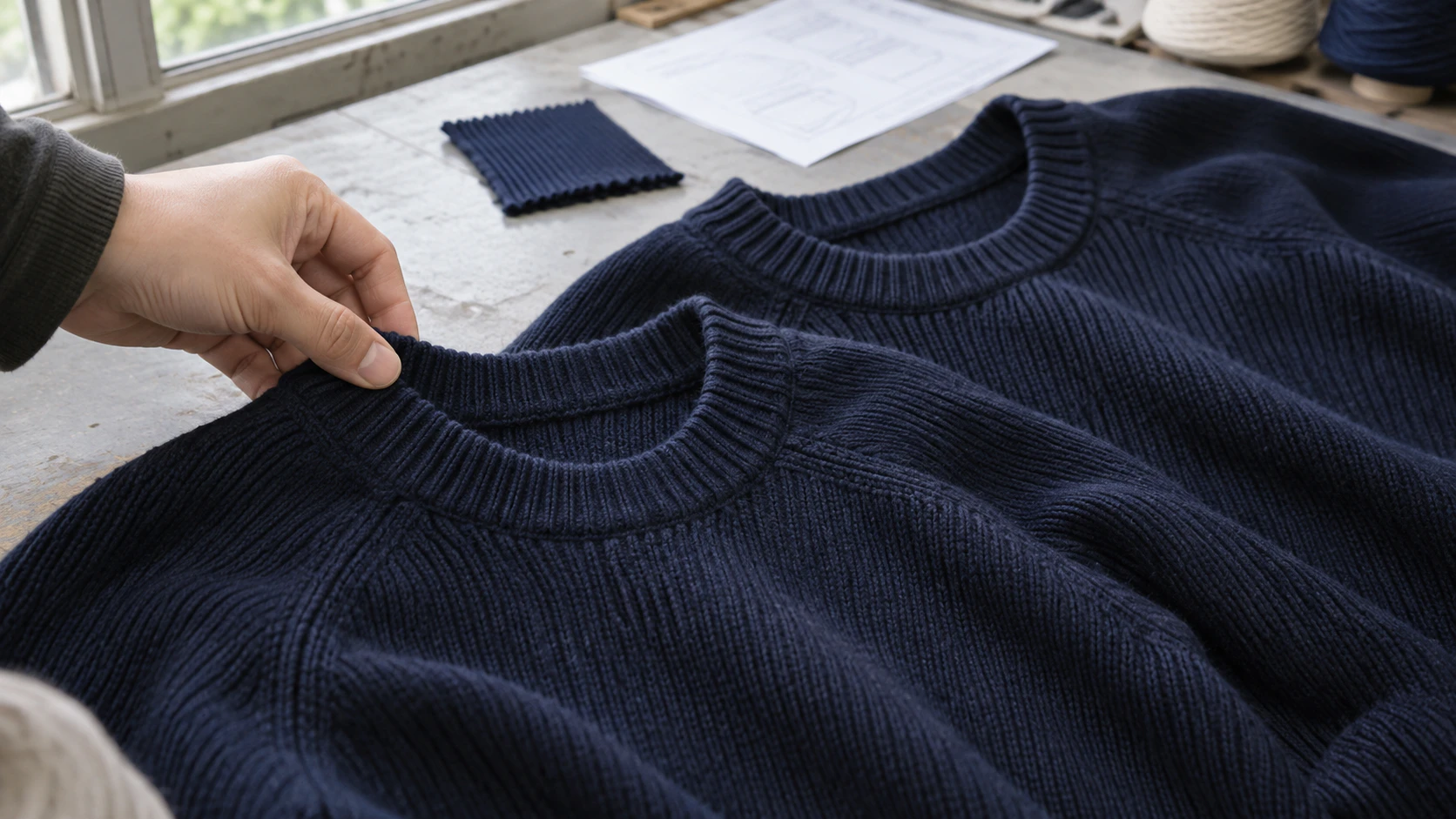
Quick Answer
One sweater is enough to ask a new factory what it can reproduce. Start with one color and a reference size. Send a sample reference, the specifications you are cleared to share, and the features the new sweater must retain. Ask the factory to return a written list of changes before you approve sampling. Then compare its sample with your approved reference, retest what changed, and run a limited trial using the intended production setup. Place a repeat order only for the colors, sizes and materials that the evidence supports.
Table of Contents
Key Takeaways
- Use the final approved production revision to set the target. If you only have a retail sweater, record what you can observe and have your technical approver establish the missing specifications.
- Ask the new factory to list what it will carry over, substitute or rebuild. Its reply determines which files to clear, which samples to request and which checks to repeat.
- Give wash performance, stock shade and size coverage their own approval records. A corrected body length leaves the stock-shade decision open until the finished garments have been compared.
- Give purchasing a written release with the approved style, color, sizes, revision and quantity. Keep unchecked sizes off the order until the specified evidence is signed.
1. Choose the First Color, Size and Reference
What should you collect before contacting the new factory?
Choose one color and a reference size for the first sample. If your immediate need is to replenish a shade already in stock, start there so you can test whether the two supplies can be sold together. Ask your product team for the last approved measurement chart, grading and bill of materials. Ask the incumbent factory for the production revision, yarn and color records, and any approved changes made after the sample was signed. Match those records to the style, color, size and shipment they cover.
Keep the approved sample and a traceable bulk piece if both are available. The signed sample shows what the brand approved. The bulk piece shows what was shipped. If new units will be picked against existing stock, set aside representative pieces from the inventory that will actually be sold. Photograph and log the condition of the only retained master before it leaves your control. Agree separately if any testing requires cutting or washing a reference.
What if all you have is one retail sweater?
Send its size, condition, photographs and any label information for a feasibility review. Ask the factory to identify the visible stitch, construction and measurement points, and flag which inputs it would have to estimate. Wear and laundering can change dimensions and recovery. Treat those measurements as observations, then have your technical approver set the target dimensions, tolerances, materials and grading before asking for a production-ready sample.
If a spec and retained sample disagree, first check that both were measured the same way and in the same condition. Look for a dated production approval that explains the difference. For example, a signed revision may have widened the neckline after the first tech pack was issued. If you cannot trace the difference, log both values and get a written decision on which one the new factory should target.
2. Decide What Must Stay the Same
Turn customer expectations into checks
Write down the features that would make a repeat customer notice the switch. If the sweater sells for its fit, identify the dimensions and fit points that matter, including after the agreed care procedure. If customers expect a close ribbed neckline, check the opening, how it feels when pulled on and how it recovers afterward. If old and new garments will share a SKU, agree how the finished shades will be compared against current stock.
For each feature, give the factory a reference, a check and a decision owner. For a neckline, specify where to measure and how to handle both samples before comparing recovery. For hand feel, have the designated reviewer compare the finished pieces in the same condition and record the difference they can feel, such as a stiffer rib or a rougher surface. Use the buyer’s agreed limits for measurable features and signed physical references for features best judged side by side.
Tell the factory which changes it can propose
Distinguish the result you need from the process the old factory used to achieve it. A different machine setting or yarn source may be acceptable if the finished garment meets the agreed conditions. A change to visible construction, declared fiber composition or care instructions needs a separate review of the product brief and applicable requirements. Record which changes the factory can develop for review and which require your approval before sampling.
3. Send the Sweater Tech Pack and a Sampling Brief
What Can You Share from the Sweater Tech Pack?
Mark every item as cleared to share, awaiting permission or missing. For an editable pattern, grading source file, knitting program or finishing instruction, ask the contract owner to verify what must be delivered, who may receive it and whether the new factory may use or modify it. Check the specific written terms alongside any development invoice and confidentiality agreement. Keep items with unresolved permissions out of the package. If you are considering a rebuild, confirm the scope of the work and the inputs it may use before authorizing it. The OEM and ODM guide explains how development responsibilities and design rights can differ.
A message you can send before approving sampling
We’re assessing whether to move a repeat order for [style and color] to your factory. Please start with [reference size]. We’ll share [sample ID and spec revision], along with [features the garment must retain]. The new units [will / will not] be sold alongside existing stock.
Before we approve sampling, please reply with the following:
- Which materials, measurements and construction details can you carry over? Which will you substitute or rebuild?
- What yarn, knitting setup and finishing route do you propose? Which changes need our approval before you start?
- Will your first submission be a swatch or a complete garment? What can we check from it, and what will remain open?
- Which measurements, care checks, stock-shade comparisons and additional sizes do you propose to verify before a trial or repeat order?
Please flag missing information and list proposed deviations in writing. We’ll use your reply to approve the sample scope and acceptance criteria.
A quote marked “same as sample” leaves key choices open. Before approving development, check whether the quoted work assumes a different yarn, a rebuilt program or a single sample size. Put each difference in the handover table with a person responsible for answering it. The approved sample brief should identify the first submission and the checks it is expected to support.
Build the four-part handover table
Use one row per item that can have its own permission, result or next step. The example follows a navy ribbed sweater, NR-01. Its original yarn is unavailable, permission to share the original knitting program remains open, and the buyer wants the new stock to sit alongside the old stock. All IDs, results and approvals below are illustrative.
| Category and item | Old reference | Permission or gap | Evidence to collect | Owner | Result and next step |
|---|---|---|---|---|---|
| Physical references Approved sweater and stock pieces |
Approved navy M sample REF-M and comparable stock from OLD-N1. | Cleared for comparison. Retain the master intact. | Reference log ties REF-M to Rev 3 and identifies the stock pieces used for shade review. | Brand technical team | References identified. Keep them available through trial review. |
| Shareable specifications and material records Tech pack and yarn details |
Rev 3, grading chart, bill of materials and original yarn record. | Records cleared for sharing. Original yarn unavailable. | Record replacement yarn, lot Y-N4 and the proposed finish. Capture the approved change in Rev 4. | Sourcing and technical teams | Rev 4 approved for the stated trial scope. |
| Files requiring permission Original knitting program |
Original supplier’s program for Rev 3. | Permission for third-party use remains open. Keep the original file with the incumbent factory. | Written clearance for development from the listed specs and REF-M. Link rebuilt program P-04 to Rev 4. | Contract owner and factory technician | Original file held. P-04 proceeds through sample and trial verification. |
| New-factory checks Body length after washing |
Approved body-length tolerance and agreed wash-and-dry procedure. | Replacement yarn and finishing route may affect the result. | Compare wash records W-01 and W-02 for samples NEW-M1 and NEW-M2. | Quality lead | W-01 outside tolerance. W-02 passes after correction. Verify the revised route in trial. |
| New-factory checks Shade alongside existing stock |
Representative finished pieces from OLD-N1. | A new yarn and dye lot require a separate shade decision. | SH-02 compares finished trial pieces with OLD-N1 under the agreed viewing conditions. | Brand color approver | Y-N4 approved alongside OLD-N1. Review a new dye lot separately. |
| New-factory checks Size coverage and neckline |
Approved grading chart and REF-M neckline reference. | The rebuilt program needs verification at the affected sizes. | T-01 covers M. Check affected measurements and neckline on finished S and L samples. | Brand fit approver | M verified in trial. S and L still open. |
4. Choose a Swatch or a Complete Sample
Ask for swatches when yarn or finish is the main uncertainty
If the original yarn is unavailable, give the new factory the yarn specification and ask for a documented substitute. Composition and nominal count help narrow the options. Ply, twist and surface can still change how the rib looks, feels and responds to finishing. Compare swatches knitted on the proposed setup before and after the intended finish. Review density, hand feel and recovery against the old reference. If the brand needs mixed stock, screen the shade at this stage using a piece from current inventory.
Choose the route that meets the priority requirements and that the factory can document for sampling. If the original yarn and finish are available and the setup has been confirmed, a complete reference-size garment may be the more useful first submission.
Ask for a full garment when shaping, joining or fit could change
Use a complete sweater to verify the areas affected by the rebuilt program. A rib swatch may recover well while the assembled neckline feels tight because of the opening or joining tension. Ask for the reference-size sweater in the proposed bulk yarn, construction and finish. Check how the panels hang, how the neck feels when worn and whether the finished garment holds its shape after the agreed care procedure. Where grading was rebuilt, agree which other sizes the factory will submit and what it must verify on each.
If the original program is eventually cleared for transfer, ask the new factory to confirm compatibility with its equipment and setup. If the program has to be rebuilt, record the version and recheck the affected shaping, construction and dimensions before approving that route.
5. Compare the Samples and Retest What Changed
Set up the side-by-side review
Lay out the original and new garments in the same size and agreed condition. Use the same measurement points and method. Record both sample IDs, the new spec revision, the observed difference and the decision. For a wash check, document the full wash-and-dry procedure and record the dimensions before and after. If the signed master is the only reference, preserve it and agree whether a traceable duplicate or the original test report can support the historical comparison.
Request evidence for each change
| If this changes | Ask the new factory for | Decision the evidence supports |
|---|---|---|
| Yarn or finishing route | Finished swatches and a garment made to the proposed route. Request wash dimensions, surface review and any pilling check required for the order. | Whether the substitute preserves the approved feel, appearance and care performance. |
| Program, construction or grading | Reference-size fit and construction checks, plus finished samples for affected sizes and measurement points. | Which sizes have enough evidence to enter trial or an approved order. |
| Shade or dye lot when mixing stock | Finished-garment comparison with representative saleable stock under the agreed viewing conditions. | Whether the lots can be sold together, need separate handling or should be held. |
Record the method and the acceptance limit separately. An old report is useful for comparison when you can identify the sample, material and conditions it covers. If the new input falls outside that scope, obtain fresh evidence for the affected requirement.
Illustrative retest decision
NEW-M1 meets the body-length requirement before washing, then falls outside the agreed limit in W-01. Hold that sample revision and ask the factory to investigate the yarn, knitting setup and finishing conditions. The factory documents its correction and submits NEW-M2. W-02 passes under the same wash-and-dry procedure, closing the sample-stage length issue for Rev 4. Stock shade stays open until SH-02 records the comparison of finished trial garments with OLD-N1.
6. Run a Trial on the Intended Production Setup
Tell the factory what the trial must prove
Once you approve the sample for trial, specify the quantity, color, sizes and revision covered by that approval. Ask the factory to use the intended yarn lot, knitting program, joining setup and finishing route. Agree which finished pieces will be checked, what the checks should represent and who receives the results. If more than one machine or finishing load is involved, make sure the inspection plan covers the relevant sources of variation. Put extra attention on the feature that failed or changed during development.
If one piece has a distorted neckline, trace it to its setup or finishing load and compare other pieces from that group. If the defect repeats, hold the affected group, investigate the shared operation and record which units the correction covers. Recheck those units before using the trial to support an order.
Use the results at the scope they cover
In the navy example, T-01 covers the trial pieces in M made with program P-04 and yarn lot Y-N4. Their checked neckline and body length meet the approved conditions, including the planned wash check. SH-02 clears the finished shade alongside OLD-N1. S and L still require finished samples because the altered panel shaping and neckline need to be verified at those sizes.
7. Write the Decision Purchasing Can Act On
State the next order and what is still held
Write the approved style, color, sizes, spec revision, material conditions, quantity and next permitted operation. Attach the supporting sample, test and trial IDs and name the approver. Confirm the available material and production slot before committing to delivery. If an issue remains, specify which order lines it affects and what evidence would clear them.
- Release the approved combinations. Issue the reorder within the signed scope once the relevant permissions, product checks, trial results, materials and production window are confirmed.
- Move in stages. Authorize a limited trial or replenish a verified subset. If shade compatibility is the only remaining issue, ask merchandising whether the new stock can be identified and sold separately before committing to it.
- Hold the affected lines. If the factory cannot meet a required wash result, a defining construction feature or an applicable permission condition, hold the relevant lines and state what the factory must resolve.
Illustrative purchase instruction for NR-01
Release navy M only. Issue the limited reorder to Rev 4 using P-04 and lot Y-N4, up to the quantity in the confirmed allocation. In this example, the brand technical lead signs the release after the contract owner clears the rebuilt route and W-02, SH-02 and T-01 meet the agreed conditions. Copy the allocated quantity and agreed delivery date into the purchase order.
Keep S and L off the order. Request finished S and L samples with measurements at the affected grading points and a neckline check. The brand fit approver signs those results before the technical lead extends the release. If the factory proposes another dye lot, reopen the stock-shade decision before adding it to mixed inventory.
Protect replenishment while checks remain open
Work back from the expected stockout. Put sample review, any retest, yarn booking, trial production and delivery on the same schedule. If the open approval pushes the new order past the replenishment date, check whether the incumbent factory can cover an interim reorder or the new factory can deliver an approved subset. Once the new route is stable, keep the approved sample, revision and release record together for the next reorder review.
Frequently Asked Questions
Can I get a quote before the new factory has made a sample?
Yes. Ask for a provisional quote that states the assumed yarn, construction, finish, size range and order quantity. Ask the factory to identify any separate charges for rebuilding the knitting program, sampling or testing. Once you approve the production sample, ask for an updated quote against that exact specification. This gives purchasing a clear basis for comparing the transfer cost with an incumbent-factory reorder.
Should I start with the easiest color or the hardest one to match?
Start with the color most likely to determine whether the switch can go ahead. If the immediate goal is to replenish navy alongside existing stock, start with navy and send a representative piece from the stock you still sell. If you are testing whether the new factory can reproduce the construction before committing to a shade, an available yarn in another color may be enough for that first check. Keep the selling shade open until you have reviewed a finished sample in the intended yarn and color.
Can I book yarn or reserve a production slot while approvals are open?
Ask the factory to separate the reservation from the production release. Confirm the amount at risk, the cancellation or reallocation terms, and the date the hold expires. If you authorize a reservation, state exactly what the factory may commit to and which operations must wait for written approval. This matters most when a shade or wash result could still force a different yarn or finishing route.
Preparing a sweater transfer?
Share the first style, color and size you want to assess, the source of your sample, the spec revision you can share, and the feature you most need to preserve. If the new units must match existing stock, include that requirement and your replenishment deadline.
ABOUT THE AUTHOR
Frank, Founder of YouTricot
Frank has 20 years of knitwear industry and operational experience across Prato, Italy and Dalang, Dongguan, China. He writes for fashion-brand founders, designers, product developers and sourcing teams that need to translate creative direction into commercially workable yarn, gauge, construction and production decisions.