

Quick Answer
Yes, an AI image can be a starting point for a knitted sweater. First ask whether the garment shape is feasible and whether the effect you care about can actually be knitted. Those answers can differ. Give the developer real sweater references for the fabric, fit, or pattern you want to match. Then use the swatch and fitted sample to see where the design comes close and where it needs to change.
Can You Knit the Sweater in an AI Image?
In 2026, I’ve been seeing more AI-generated sweater images in the tech packs customers send me. Some are beautifully done. You can see the relief of a cable, the shading in a motif, even the way the sleeve seems to fall. The image is useful because it shows me what the customer has in mind. It can also make the sweater look more settled than it is.
When I look at one of these designs, I ask two different questions. Can we make the sweater in that shape? And can we reproduce the detail that made the customer want it? A crewneck can be perfectly feasible while the artwork across the front needs to change. If the artwork is the reason the customer wants the sweater, telling them the crewneck is doable doesn’t answer their question.
I’m happy to start a development discussion with an AI image. Before taking on an order, though, I want to be able to tell the customer where I think the finished garment can get close and where I can already see a difference. The answer changes depending on whether we’re looking at a cable, a color design, or the way the garment hangs.
Oversized Cables in Computerized Flat Knitting
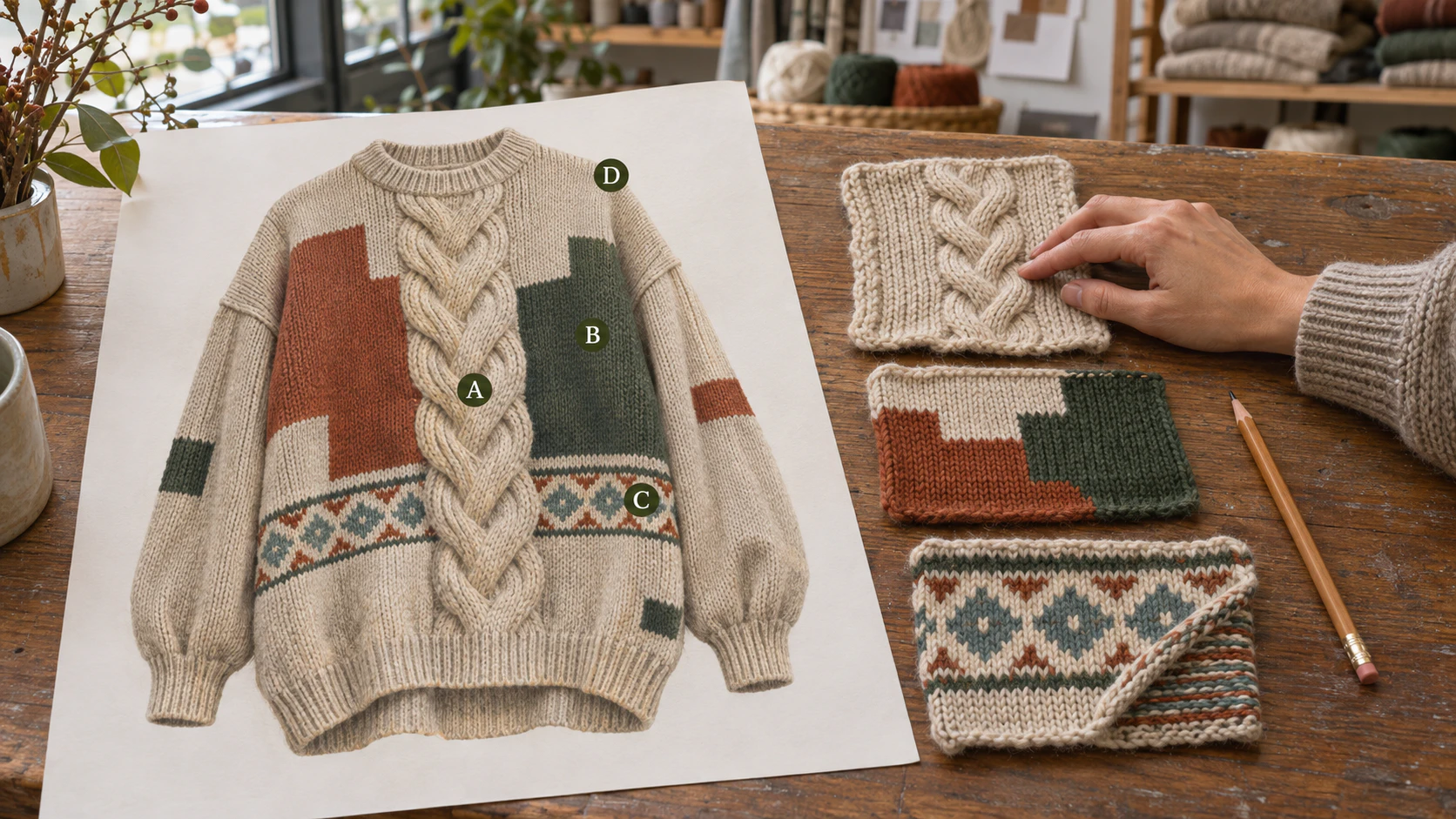
One thing an AI image can show very convincingly is a cable with a lot of height. The crossing looks deep and clean, and the fabric on either side looks as smooth as if nothing were pulling on it. In the real garment, the cable and the fabric around it are knitted together. You have to look at both.
A cable crossing moves groups of stitches. Whether a wide crossing works depends on the actual layout, the yarn, and the stitches next to it. In STOLL’s 4-by-4 cable example, the stitches alongside the cable can need their own transfer sequence. That’s why I wouldn’t give a yes or no from the apparent width of a cable in a picture. A cable down the middle of a plain panel is a different question from one that runs into a shoulder or an armhole.
If the cable is the detail you care about, say what makes it right for you. Is it the breadth of one continuous braid, the height of the relief, or the rhythm of the crossings? A smaller crossing and more space between crossings change different things. Neither is the default answer. A swatch with the intended fabric on either side can show whether the relief is close and whether the surrounding fabric pulls in after finishing. That’s more useful than trying to match the shadows in the render.
Intarsia: How Many Colors Can You Knit?
With intarsia, I want to see where the colors go, not just how many colors are listed. Suppose one row reads cream, red, cream, red, cream. That’s two yarn colors but five separate areas across the row. If you want those areas knitted independently without carrying yarn across the gaps, the same shade may need to be fed from more than one carrier. It doesn’t follow that every layout with five areas uses five carriers.
The rows above and below matter, too. A large block that continues up the front is different from a small island that appears, divides, and disappears. A programmer has to see how those areas join and where the carriers can move or park. STOLL’s intarsia carrier guide shows why that clearance depends on the carrier and setup.
If someone says your artwork has too many colors, ask them to point out the part they mean. You may be able to keep the large blocks that define the design and change one small isolated patch instead of dropping a color from the whole garment. If you review a swatch, check the boundary from the front and turn it over. The reverse matters if the garment is meant to feel clean on the inside. The knitwear stitch glossary explains how intarsia, jacquard, and printing differ if you’re weighing more than one way to put the artwork on the sweater.
Multicolor Jacquard: The Oil-Painting Order I Turned Down
A customer once asked me to knit a multicolor oil painting into a sweater. I told them we could keep the sweater style, but we couldn’t knit the painting as shown. There were too many colors across the garment and too much detail in the image. We couldn’t turn the artwork as supplied into a workable pattern layout for the knitting instructions.
I declined the order. I take on designs I believe we can make as agreed. In this case, I could see a route to making the sweater itself, but that wouldn’t deliver the picture the customer wanted. I’d rather say so before taking the order than have them find out when the sample arrives.
When I first look at a jacquard design, I check whether it’s an entire image or a motif in one part of the garment. I also check whether the whole garment stays within five colors in total. That’s my own first screen. It isn’t a five-color limit for knitting machines, and getting a design down to five colors doesn’t make it feasible by itself. Before reconsidering an artwork like this, I’d need to know whether it can be simplified and whether the customer would still want the result.
The total palette is also a different question from how many colors the programmer needs to work into a particular row. STOLL’s four-color net-back example works the four colors in sequence to complete one row of the picture. So if you’re asking how many colors the machine can handle, bring the artwork and ask how the most demanding row would be knitted and what the reverse would look like. For a painting, that still leaves the design question: which shapes and transitions have to survive for the simplified version to be worth making?
Why Can a Sample Fit the Measurements and Still Look Different?
With an AI sweater image, you’re often looking at one front view in one pose. On a real person, you can see where the shoulder actually drops, whether the sleeve hangs close to the arm, and whether the hem falls straight or stands away at the side. Those are separate observations, even when the sweater is meant to have a single overall look.
That’s why a sample can come back with the agreed chest width and body length and still look different from the picture. The measurements tell you how big the garment is. They don’t, by themselves, tell you how the yarn and fabric hang on a body. A thick area of patterning can behave differently from the plain fabric next to it. Changing the body width won’t necessarily fix what you’re seeing.
When you review a sample, point to the difference. “The sleeve sits farther out from the arm than in our reference” gives the developer a place to look. So does “the hem looks right from the front but stands away at the side.” Compare on the agreed size and fit model or form, and look at the side and back as well as the front. If the measurements are close but the fabric looks too firm, bring in a physical fabric reference before deciding what needs changing.
Why the Finished Sweater May Never Look as Perfect as the Image
What Computerized Flat Knitting Needs From a Design
I sometimes see a very polished AI image accompanied by words like luxurious, perfect silhouette, or natural drape. Those words tell me what the customer hopes the sweater will be. They can also make the expectation harder to meet: the sample is being compared with an idealized image and with everything the customer imagined when they wrote those words.
Before a sweater can be knitted, a technician has to use knitwear specification software to work out the stitch and row counts, the shaping, and where the pattern goes. That is part of what we call xia shu, or working out the knitting specifications. The computerized flat knitting machine then knits the programmed design with actual yarn. The image can show a clean outline and an ideal drape at the same time; it doesn’t tell the technician how to achieve both in the fabric. That’s the difference I try to explain before sampling.
I wouldn’t ask a designer to take the word “luxurious” out of the brief. I’d ask what a real sweater has to do for it to feel that way to them. If they mean a clean, fine surface, show a piece with that surface. If they mean a hem that falls softly instead of standing away, show a side view where it does that. Keep the original description, but give both sides something they can look at or handle when the sample arrives. The knitwear tech pack guide explains what else belongs in the garment specification once those choices are clear.
Use the AI Design Alongside Real Sweater References
Yes, you can use an AI image to develop a knitted sweater. If you want to get close to it, look for real examples of the effects you care about. They don’t need to come from one garment.
For stitch scale, use a reference with known machine gauge if you can get it, and compare the stitch and row density on a finished piece or swatch. A photograph can help you compare the appearance of fine and chunky knitwear, but it doesn’t establish the machine gauge or finished density. The yarn and gauge guide can help you discuss the material direction without guessing it from a render.
For shape, bring a real worn reference that shows the shoulder, sleeve, or hem you want. For pattern, look at real cables, intarsia, and jacquard. Look at the relief and the fabric beside a cable; the edge and reverse of an intarsia block; and both sides of a jacquard. If feel or thickness matters, use something the developer can handle.
Say what each reference is for: “Use this one for the side-view hem. Use this swatch for the cable relief. Use this jacquard for the reverse, not the colors.” Then say which detail you don’t want to give up. That gives the developer a way to tell you what looks achievable before you order a sample. It also gives you a better way to judge the real sweater when it arrives.
Discuss your sweater concept
Share a concept you are authorized to use, one detail that must stay, and a real sweater reference for fit or fabric. Tell us which part you are most unsure can be knitted as shown.
ABOUT THE AUTHOR
Frank, Founder of YouTricot
Frank has 20 years of knitwear industry and operational experience across Prato, Italy and Dalang, Dongguan, China. He writes for fashion-brand founders, designers, product developers and sourcing teams that need to translate creative direction into commercially workable yarn, gauge, construction and production decisions. Read more on the YouTricot Blog.