

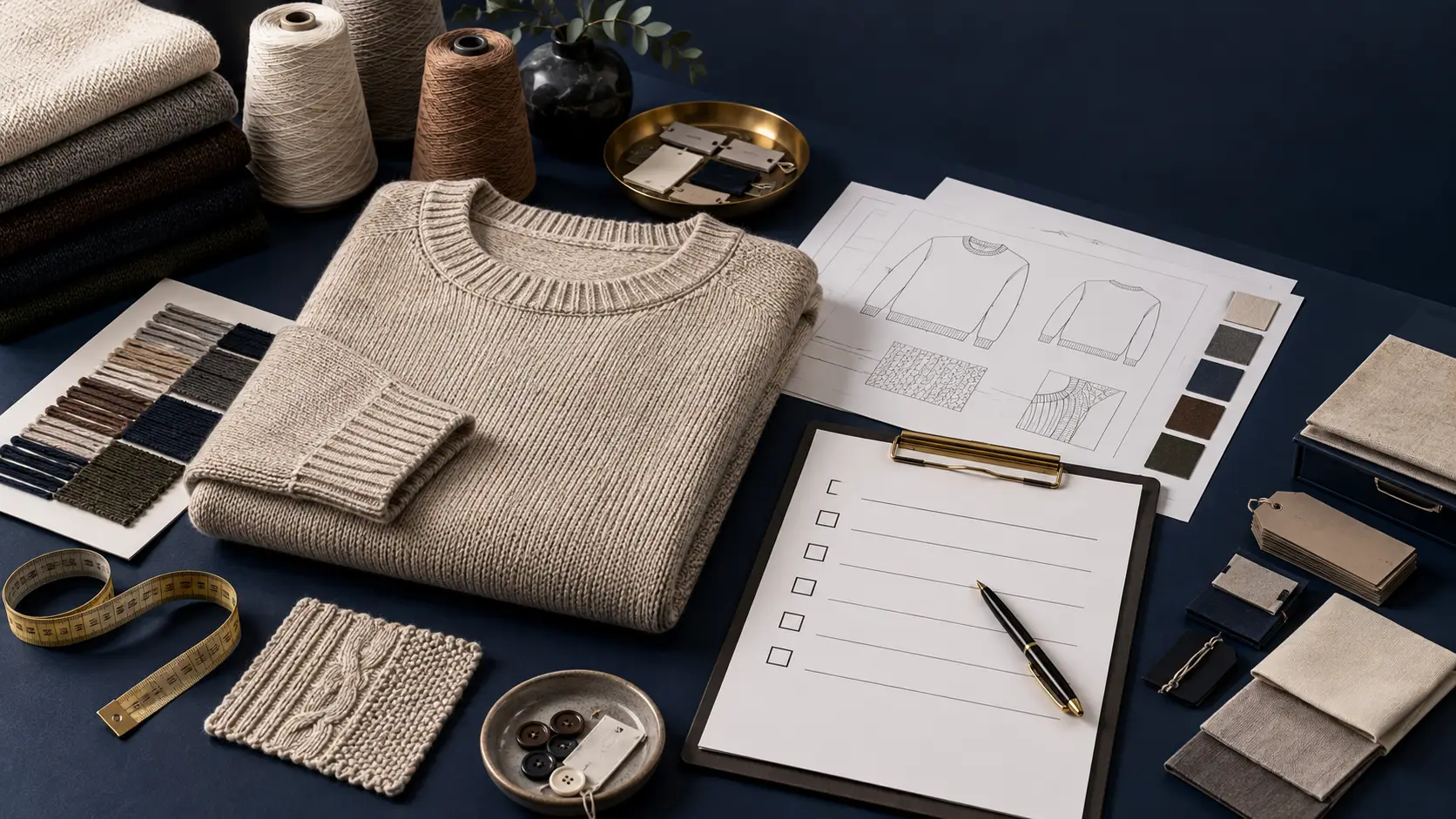
Quick answer: Before comparing low MOQ sweater factories, ask whether the minimum applies per style, per color, per yarn or per order. Give each shortlisted factory the same brief, verify where the sweater will be made, and use an approved sample and a trial order to check fit, quality and repeatability.
Key Takeaways
1. Low MOQ must be defined before suppliers are compared. A useful MOQ states the quantity basis, not just a headline number. Confirm whether the minimum applies per style, per color, per yarn, or per order. For YouTricot, 50 pieces per style per color is conditional on feasible yarn, color, structure, trims, testing, finishing and technical route; sizes are planned within an approved style-color combination. Custom-dyed yarn, uncommon fibers, complex intarsia or jacquard, special finishing, and unusual packaging can create separate minimums or extend the schedule. A supplier that explains these boundaries is more credible than one that promises any design at any quantity.
2. Verification needs documents, live evidence, and a product test. A business license alone does not prove that a company can make your sweater. Match the Chinese legal name, Unified Social Credit Code, registered address, payment beneficiary, and business scope. Then request a live video walkthrough that shows signage, knitting machines, gauge range, sample development, linking, washing, inspection, and packing. Validate certificate numbers and site scope with the issuing program. Finally, compare a physical sample and trial order with the approved tech pack. These evidence layers reduce identity, capability, quality, and delivery risk.
3. A safe trial order tests the working relationship, not only the garment. For an eligible YouTricot project, a trial could use one commercially important style in one color and 50–100 pieces. If 50 pieces per style per color is confirmed for both styles, two one-color styles require at least 100 pieces in total. Inspect fit across the approved size set, handfeel, seams, labels, packaging, defect handling, communication, and dispatch performance. Record the approved sample, measurement chart, shade reference, packing instructions, and defect resolution in writing so the second batch can be compared against the first.
Table of Contents
The 5-Step Safe Sourcing Methodology
Use this sequence to move from a search result to an evidence-backed supplier decision. The time column gives illustrative buyer review allowances, not measured benchmarks or factory lead-time promises. Set your own review window around document access and project risk.
| Step | Action | Tools | Required output | Suggested buyer time |
|---|---|---|---|---|
| 1. Define | Fix product type, MOQ basis, budget, timeline, target market, and compliance needs. | Tech pack, bill of materials, target-cost sheet, compliance brief | One comparable RFQ with must-haves and negotiables | 1–3 working days |
| 2. Discover | Build a shortlist through multiple channels, then screen for low-MOQ operating fit. | Alibaba filters, trade-show directories, Google advanced search, industry forums | Shortlist of 5–10 plausible factories | 3–7 working days |
| 3. Verify | Verify legal identity, site capability, documents, certificates, samples, and references. | Government registry, live video call, audit records, label checks, buyer references | Completed 20-item evidence file with open issues and approval decision | 5–10 working days |
| 4. Test | Approve a sample, agree a feasible trial quantity for one style-color, and inspect the result. | Approved sample, QC checklist, measurement report, photo record | Trial-order scorecard and corrective-action log | Style-specific written schedule |
| 5. Assess | Measure repeat-batch consistency, response to issues, and improvement discipline. | Batch scorecards, delivery records, CAPA log, review meetings | Approve, conditionally approve, or replace supplier | Review across 2–3 completed batches |
Step 1: Define the Low-MOQ Requirement Before You Search
Direct answer: Give every supplier the same product brief, including the planned size range, quantity per style and color, target cost, delivery date and testing needs. Use the knitwear tech pack checklist for factory quotes to assemble the garment specifications and flag open decisions. Ask each supplier to confirm its MOQ basis and the proposed quantities in writing.
The Minimum Viable RFQ
01
Product definition
Tech pack or authorized reference, measurements, yarn direction, gauge, stitches, construction, and sample purpose.
02
Commercial boundary
Proposed quantity per style and color, confirmed MOQ conditions, target cost, Incoterm, payment proposal, packaging and reorder plan.
03
Market and compliance
Destination market, care labeling, restricted-substance needs, requested certifications, and third-party testing.
04
Decision timeline
Latest sample dispatch, buyer fitting time, revision window, bulk approval date, and required delivery date.
Real limitation: YouTricot’s 50-piece-per-style-per-color route applies only when yarn, color, structure, trims, testing, finishing and the technical route are feasible. A custom Pantone dye lot, scarce or luxury yarn, engineered jacquard, complex intarsia, special brushing, printing, trims, testing, or packaging may introduce another supplier minimum or a longer development route. Confirm feasibility before treating the quantity as approved.
Read the full guide here : low MOQ knitwear rules
Step 2: How to Discover a Low MOQ Sweater Factory
Direct answer: When looking for a knitwear factory with low MOQ, build a broad list, then narrow it with evidence. On Alibaba, use the available product and supplier information as discovery signals, not proof of site ownership, capacity or order quality. Search trade-show exhibitor directories for knitwear, flat knitting, yarn, and private-label capabilities. Use Google operators such as site:, quotation marks, and combinations of product, location, gauge, and MOQ terms. Read professional sourcing communities and industry forums for recurring service patterns, then verify every claim independently. As a manageable starting point, shortlist five to ten suppliers whose product range resembles your design, whose stated MOQ matches your quantity basis, and whose team can explain sampling, production, QC, and compliance without changing the subject.
Five Operating Signals to Verify in a Low MOQ Sweater Factory
| Green flag | Why it matters | Evidence to request |
|---|---|---|
| 1. Stock yarn library | Available yarn programs can reduce exposure to yarn-mill lot minimums and shorten allocation time. | Current color cards, composition records, available quantities, lot policy, and reorder limitations |
| 2. Dedicated sample line | Sample development has assigned people and machines instead of waiting behind every bulk order. | Live sample-area video, development workflow, revision control, and current slot availability |
| 3. Clear technical and QC responsibility | Named technical, production and QC owners make approvals and issue handling traceable; team size alone does not establish scheduling flexibility. | Organization chart, named project owner, machine plan, and QC responsibility |
| 4. Planned shared-capacity scheduling | The factory can sequence several brands’ small programs across planned machine time without mixing customer materials or traceability records. | Scheduling method, lot segregation, style identification, and changeover controls |
| 5. DTC and e-commerce experience | The team understands launch quantities, size ratios, labels, barcodes, individual packing, and fast feedback. | Anonymized order workflow, packaging examples, and references from comparable buyers |
No single green flag proves ownership or reliability. Treat each one as a reason to request the next layer of evidence.
Step 3: Verify the Legal Entity, Factory, Quality System, and Claims
Direct answer: The safest answer to how to verify a knitwear factory before ordering is to connect four things: the company you contract with, the site making the garments, the capability required by your design, and the evidence supporting each compliance claim. Check a Chinese supplier’s legal name and Unified Social Credit Code in the official registry. Match the address and payment beneficiary to the quotation and contract. Conduct a live factory walkthrough and record machine count, gauge range, workforce, sample capability, and capacity for comparable products. Validate certificate holders, sites, dates, and scope. Finally, approve a physical sample and request authorized references or equivalent documented evidence.
For China business-license checks, use the National Enterprise Credit Information Publicity System. For material and social-compliance claims, use the OEKO-TEX Label Check, the Responsible Wool Standard information from Textile Exchange, and the amfori BSCI program information. Treat BSCI as an audit and improvement-system claim, not a product certificate. These tools support checks; they do not verify a supplier automatically. If a registry or program record cannot be accessed, record the check as pending rather than accepting a screenshot as sufficient proof.
Eight Red Flags When Evaluating Low-MOQ Factories
| Red flag | Why it matters | Buyer response |
|---|---|---|
| 1. Unexplained MOQ basis | A small quantity may cover samples, ready stock or a repeatable production route. The concern is an unexplained basis, omitted upstream minimums or no evidence that the same route can be repeated. | Ask how yarn minimums, programming, setup, QC, and repeat production are funded and scheduled. |
| 2. No factory address or current photos | You cannot connect the quotation to a production site. | Pause the shortlist until the address and live site evidence are supplied. |
| 3. No business license | The contracting identity and legal status cannot be checked. | Do not pay a bulk deposit until the entity is verified. |
| 4. Materially underpriced quotation | An unexplained gap versus specification-matched quotations needs clarification, not an automatic accusation of misconduct. It may hide a different fiber, garment weight, construction, finishing, QC scope, Incoterm, or omitted cost. | Normalize the specification and request a line-by-line clarification. |
| 5. No sample-production capability | Pattern making, needle drafting, knitting, washing, and measurement risks remain untested. | Reject the supplier for custom OEM/ODM work unless a disclosed, verified development partner is contractually included. |
| 6. Refuses a live video call or visit | Staged images cannot confirm current site control or equipment access. | Request a live route through the named address or use an independent auditor. |
| 7. No QC documentation | There is no controlled reference for measurements, defects, shade, handfeel, or release. | Ask for anonymized inspection forms, checkpoints, tolerances, and corrective-action records. |
| 8. Demands 100% upfront for a bulk trial | The buyer carries all performance risk without a milestone or inspection hold point. | Negotiate written milestones or protected terms. A small sample invoice may follow different terms from a bulk order. |
20-Item Factory Verification Checklist
Complete every row for the shortlisted supplier and proposed style. Retain each source file, screenshot, video, report or authorized contact note. In the evidence log, enter its file ID, issue or expiry date, verification date, reviewer and unresolved action. Use Pass, Fail or Pending; N/A requires a written reason and buyer approval. Certificate and audit rows apply when claimed or required. An optional scheme can be N/A; a required certificate that is missing stays open. A strong result in one group cannot cancel a material failure in another.
| # | Verification item | Acceptable evidence | Result | Evidence log |
|---|---|---|---|---|
| A. Legal and Commercial Identity | ||||
| 1 | Chinese legal company name | License name matches registry and contract | ☐ Pass ☐ Fail ☐ Pending ☐ N/A | File ID: ___ Checked: ___ Reviewer/action: ___ |
| 2 | Unified Social Credit Code | Code matches license and official registry | ☐ Pass ☐ Fail ☐ Pending ☐ N/A | File ID: ___ Checked: ___ Reviewer/action: ___ |
| 3 | Registration status | Active status with no material unexplained abnormality | ☐ Pass ☐ Fail ☐ Pending ☐ N/A | File ID: ___ Checked: ___ Reviewer/action: ___ |
| 4 | Registered address | Registered and operating addresses are mapped to named entities; differences are explained with records | ☐ Pass ☐ Fail ☐ Pending ☐ N/A | File ID: ___ Checked: ___ Reviewer/action: ___ |
| 5 | Business scope | Scope is consistent with garment or knitwear manufacturing and trade activities | ☐ Pass ☐ Fail ☐ Pending ☐ N/A | File ID: ___ Checked: ___ Reviewer/action: ___ |
| 6 | Payment beneficiary | Matches the contracting entity or a disclosed export arrangement documented in writing | ☐ Pass ☐ Fail ☐ Pending ☐ N/A | File ID: ___ Checked: ___ Reviewer/action: ___ |
| B. Factory and Production Capability | ||||
| 7 | Current factory identity | Live video shows exterior, signage, date context, and interior route | ☐ Pass ☐ Fail ☐ Pending ☐ N/A | File ID: ___ Checked: ___ Reviewer/action: ___ |
| 8 | Knitting-machine count | Current list plus site evidence of relevant machines, models, operating status and ownership or access; reconcile partner equipment | ☐ Pass ☐ Fail ☐ Pending ☐ N/A | File ID: ___ Checked: ___ Reviewer/action: ___ |
| 9 | Gauge range | Machines and samples demonstrate the gauges required by the project | ☐ Pass ☐ Fail ☐ Pending ☐ N/A | File ID: ___ Checked: ___ Reviewer/action: ___ |
| 10 | Sample line | Named sample team, workflow, machine access, and revision records | ☐ Pass ☐ Fail ☐ Pending ☐ N/A | File ID: ___ Checked: ___ Reviewer/action: ___ |
| 11 | Production processes | Knitting, linking, washing, finishing, inspection and packing sites and roles are disclosed, including subcontractors and buyer approval controls | ☐ Pass ☐ Fail ☐ Pending ☐ N/A | File ID: ___ Checked: ___ Reviewer/action: ___ |
| 12 | Workforce size and roles | Current headcount by technical, production, QC, and project-management function | ☐ Pass ☐ Fail ☐ Pending ☐ N/A | File ID: ___ Checked: ___ Reviewer/action: ___ |
| 13 | Monthly capacity | Comparable-style production records, bottleneck capacity and current booked load support the proposed slot; machine count alone is insufficient | ☐ Pass ☐ Fail ☐ Pending ☐ N/A | File ID: ___ Checked: ___ Reviewer/action: ___ |
| C. Quality, Materials, and Compliance | ||||
| 14 | Stock-yarn controls | Composition, supplier, color card, lot identity, availability, and reorder policy | ☐ Pass ☐ Fail ☐ Pending ☐ N/A | File ID: ___ Checked: ___ Reviewer/action: ___ |
| 15 | Quality-control documents | Measurement, inline inspection, final inspection, defect, and corrective-action forms | ☐ Pass ☐ Fail ☐ Pending ☐ N/A | File ID: ___ Checked: ___ Reviewer/action: ___ |
| 16 | OEKO-TEX claim | Certificate or label number, holder, validity, product class, article scope, and site match | ☐ Pass ☐ Fail ☐ Pending ☐ N/A | File ID: ___ Checked: ___ Reviewer/action: ___ |
| 17 | amfori BSCI claim | Current audit/report access, audited site, date, scope, findings, and improvement status | ☐ Pass ☐ Fail ☐ Pending ☐ N/A | File ID: ___ Checked: ___ Reviewer/action: ___ |
| 18 | Other material certification claims | Claimed or required material-scheme documents match the material, holder, validity and supply chain; check order or transaction evidence as applicable | ☐ Pass ☐ Fail ☐ Pending ☐ N/A | File ID: ___ Checked: ___ Reviewer/action: ___ |
| D. Product and Reference Evidence | ||||
| 19 | Sample evaluation | Physical sample matches approved measurements, construction, handfeel, color, labeling, and finish | ☐ Pass ☐ Fail ☐ Pending ☐ N/A | File ID: ___ Checked: ___ Reviewer/action: ___ |
| 20 | Comparable buyer-reference evidence | Authorized buyer reference or redacted comparable-order records with style, quantity, dates and scope. Match any result to its baseline; redacted orders alone do not prove customer satisfaction | ☐ Pass ☐ Fail ☐ Pending ☐ N/A | File ID: ___ Checked: ___ Reviewer/action: ___ |
Certificate boundary: Verify the holder, production site, validity date, covered product or material, and transaction scope. A logo in a presentation does not prove that your exact yarn, garment, order, or factory site is covered. Ask the supplier to explain the chain of evidence that will accompany your order.
Before approving the supplier: Summarize the contracting seller, manufacturer, exporter, payment beneficiary and certificate holder, including any differences between them. Link each role to the evidence file. Hold approval when identity or payment arrangements remain unresolved, a required claim cannot be verified, or the sample fails an agreed requirement. Conditional approval must name the open item, action owner, deadline and hold point; it cannot waive a legal requirement or justify an unsupported public claim. This checklist is a verification plan, not evidence that YouTricot or any other supplier has passed it.
Before approving a supplier, use the 64-point factory evaluation checklist to trace an active order and record evidence gaps.
Step 4: Approve the Sample and Run a Controlled Trial Order
Direct answer: Test the smallest order that still reflects normal production. Agree one commercially important style-color and a feasible trial quantity. As a planning example, 50–100 pieces may suit an eligible YouTricot route; two one-color styles require at least 100 pieces only when the 50-piece minimum is confirmed for each. Approve a physical development sample, measurement chart, material reference, and written construction standard before bulk knitting. Inspect fit across approved sizes, handfeel consistency, seams, labels, packaging, and order-level variation. Record defects by severity and track response times. The trial succeeds only when the garments and the supplier’s communication, documentation, corrective action, and dispatch performance meet the agreed acceptance criteria.
What to Order and What to Evaluate
01
Order scope
One priority style and one color at the confirmed trial quantity. Add a second style only when the team can evaluate two separate style-color references.
02
Fit and measurements
Check critical points across the approved size set, tolerance application, grading logic, garment balance, and recovery after finishing.
03
Material and construction
Compare handfeel, shade, stitch density, seams, linking, trims, washing, surface appearance, and finishing with the approved sample.
04
Identity and packing
Verify main labels, care labels, size labels, hangtags, barcodes, folding, polybags, carton marks, quantities, and assortment accuracy.
Define Trial-Order QC Criteria Before Bulk Knitting
A defect rate is meaningful only when the buyer and factory use the same defect definitions, measurement method, inspection sample, and disposition rules. Put these criteria in the approved specification or purchase order before production; otherwise, a percentage reported after delivery cannot show whether the lot met the agreed standard.
| QC element | What must be agreed | Required record |
|---|---|---|
| Defect classes | Define critical defects that create safety, legal, or identity risk; major defects that impair function, appearance, or saleability; and minor workmanship defects with limited effect. | Approved defect library with photographs where practical |
| Measurement tolerances | Set point-by-point tolerances, garment preparation, measuring position, and the condition in which finished pieces will be checked. | Controlled measurement chart and measurement method |
| Inspection sample | Define the lot, inspection stage, sample size, random-selection method, and acceptance rule. Use a buyer-approved sampling plan when one is required. | Signed inspection plan and completed report |
| Lot disposition | State when a lot is accepted, reworked, reinspected, replaced, credited, or rejected, including responsibility and completion timing. | Written release decision and remedy record |
| Corrective action | Record containment, root cause, action owner, due date, verification method, and evidence that the next production run changed. | Corrective and preventive action record |
Questions to Ask After Delivery
- What was the final defect rate by defect type, and how does it compare with the agreed acceptance criteria?
- Which defects were found during production, and what corrective action prevented recurrence?
- What replacement, repair, or credit route applies, and what is the written completion timeline?
- Were the sample, bulk approval, and dispatch milestones met? If not, when was the risk communicated?
- Did both teams receive clear, timely answers, updated documents, and one controlled version of the specification?
How Fast Sampling Fits the Trial Strategy
Ask for a style-specific sampling schedule with a defined start event, sample-ready or dispatch milestone, revision scope and confirmed slot. A current tech pack, available yarn and color, familiar construction and controlled approval scope make the plan easier to assess. International courier time, customs, buyer fitting and comments are separate from factory work; custom dyeing, complex jacquard or intarsia, special finishing and additional revisions must be included in the agreed route. YouTricot sampling uses a symbolic sampling fee, fully deductible from a later bulk production order of at least 500 pieces of the same approved style; the quotation should state the scope and deduction terms.
Read the full guide here : fast sampling knitwear
Step 5: Measure Long-Term Reliability Across Repeat Batches
Direct answer: Do not convert a successful sample into permanent supplier approval. Ask the shortlisted factory to reproduce the approved standard across repeat orders. Use two to three completed batches as an initial review window, then continue monitoring according to product risk. Track measurements, handfeel, yarn-lot and shade control, defect types, packing accuracy, milestone performance, document accuracy, response time and corrective-action closure. A dependable partner reports risk early, contains affected goods, identifies the cause and verifies the correction in the next batch. Reapprove materials when yarn lots or programs change. Retain a backup route until repeat performance supports your supplier decision.
| Dimension | What to compare | Approval signal |
|---|---|---|
| Batch consistency | Measurements, handfeel, shade, seams, finish, labels, and packing across orders | Variation stays within written standards and approved changes |
| Issue response | Time to acknowledge, contain, investigate, replace, repair, or credit | Clear owner, dated action, and written closure |
| Communication | Response quality, version control, milestone warnings, and decision records | Problems are raised before they affect shipment |
| Improvement | Corrective action from one batch compared with the next batch | Evidence shows the root cause was addressed, not merely discussed |
| Commercial reliability | Quoted scope, approved changes, invoices, material reservations, and delivery milestones | Changes are documented before cost or timing moves |
Keep Commercial Policy Separate from Supplier Approval
For MOQ policy, pricing drivers and available development routes, use our low MOQ manufacturing guide. Apply the verification steps above to your own style before committing.
Decision rule: Choose the supplier that provides the strongest match between evidence and your exact product, not the lowest headline MOQ or fastest unqualified promise. Approve long-term status only after repeat orders show consistent quality, transparent communication, on-time control, and measurable improvement.
Frequently Asked Questions
How do I find a reliable sweater factory with low MOQ?
Define a comparable technical and commercial brief, discover suppliers through more than one channel, verify the legal entity and live production site, approve a physical sample, and test a controlled bulk order. Continue measuring performance across repeat batches before granting long-term supplier status.
What MOQ should a startup brand plan for?
For an eligible YouTricot route, 50 pieces per style per color may apply only when yarn, color, structure, trims, testing, finishing and the technical route are feasible. Sizes can be discussed inside an approved style-color combination, but styles and colors cannot be combined to reach the minimum. Final feasibility depends on the yarn, construction, finishing, packaging, and schedule.
Does an MOQ below 30 pieces prove that the supplier is a trading company?
No. The quantity alone is not a reliability test or proof of trader status. The quote may cover a sample, ready stock, resale, or a special production slot. Ask how yarn minimums, programming, setup, quality control, and repeat orders work, then verify the legal entity and production site.
How can I verify a knitwear factory in China before ordering?
Check the Chinese legal name, Unified Social Credit Code, registration status, address, and business scope in the national registry. Match the contracting and payment entities, conduct a live factory walkthrough, validate capability and certificates, inspect a sample, and request buyer contacts shared with permission or equivalent evidence such as redacted orders and an authorized case study.
What certifications should a sweater factory provide?
Separate legal requirements for the target market, your buyer specification, voluntary material certifications and social audits. Check OEKO-TEX Standard 100, RWS or GCS only where claimed or required; amfori BSCI is a social audit and improvement system, not a certification. Verify the certificate holder, site, validity, product or material scope, and order-level chain of evidence instead of accepting a logo alone.
Do sweater factories offer fast sampling services?
Ask each supplier for a written sample-development route and style-specific dates. Confirm approved inputs, yarn availability, construction, machine access and revision scope before relying on a fast-sampling claim. Courier transit, customs, buyer review, custom dyeing, complex structures, and additional revisions are separate.
Should I pay 100% upfront for a trial order?
Treat a demand for 100% upfront bulk payment as a risk requiring negotiation and stronger protection. Use written milestones, inspection hold points, and clearly defined remedies where possible. A small sample invoice may use different terms, so separate sample-payment logic from bulk-order payment terms.
What should a trial-order QC agreement include?
Define critical, major, and minor defects; point-by-point measurement tolerances; the lot and sample-selection method; the acceptance rule; and the remedies for failed goods. Also require a corrective-action record with containment, root cause, owner, due date, and verification in the next production run.
Request a Style-Specific Low-MOQ Review
Send your tech pack or authorized reference, style and color count, yarn direction, size range, target market, testing needs, target quantity, budget, and required dispatch date. Request a development review of feasibility, evidence needed for your style and the appropriate sampling and quotation route. Quantity and timing must be confirmed for the actual specification.
Frank, Founder of YouTricot
Twenty years of knitwear industry and operational experience across Prato, Italy, and Dalang, Dongguan, China.