
Quick Answer
This German wholesaler process case examines how a knitwear OEM brief connects reference-led sampling, sample approval, a trial order and delivery planning. The useful lesson is to confirm specifications, materials, approval responsibilities and logistics before committing to production. The public account does not establish a verified delivery duration, inventory reduction or time-to-market improvement.
Originally published: .
Scope and evidence: The process narrative below is drawn from YouTricot’s published account of a German wholesale project. It is a first-party account, rather than independent verification. Order-level production records, shipment receipts, comparative business data and customer publication permission are not provided here. No numerical performance result or standard turnaround guarantee should be inferred.
The German Wholesaler’s Sourcing Brief
The published account describes a wholesaler seeking premium knitwear for European retailers, with a more controlled first purchase and a clearer route to replenishment. Its concerns included technical communication, physical sample review, order quantities and the relationship between production completion and warehouse arrival.
These are procurement objectives, not evidence of achieved commercial results. A smaller opening order changes the initial purchasing commitment; whether it improves stock turnover or cash flow depends on demand, selling prices, costs and subsequent buying decisions.
Connecting the Brief to Technical Development
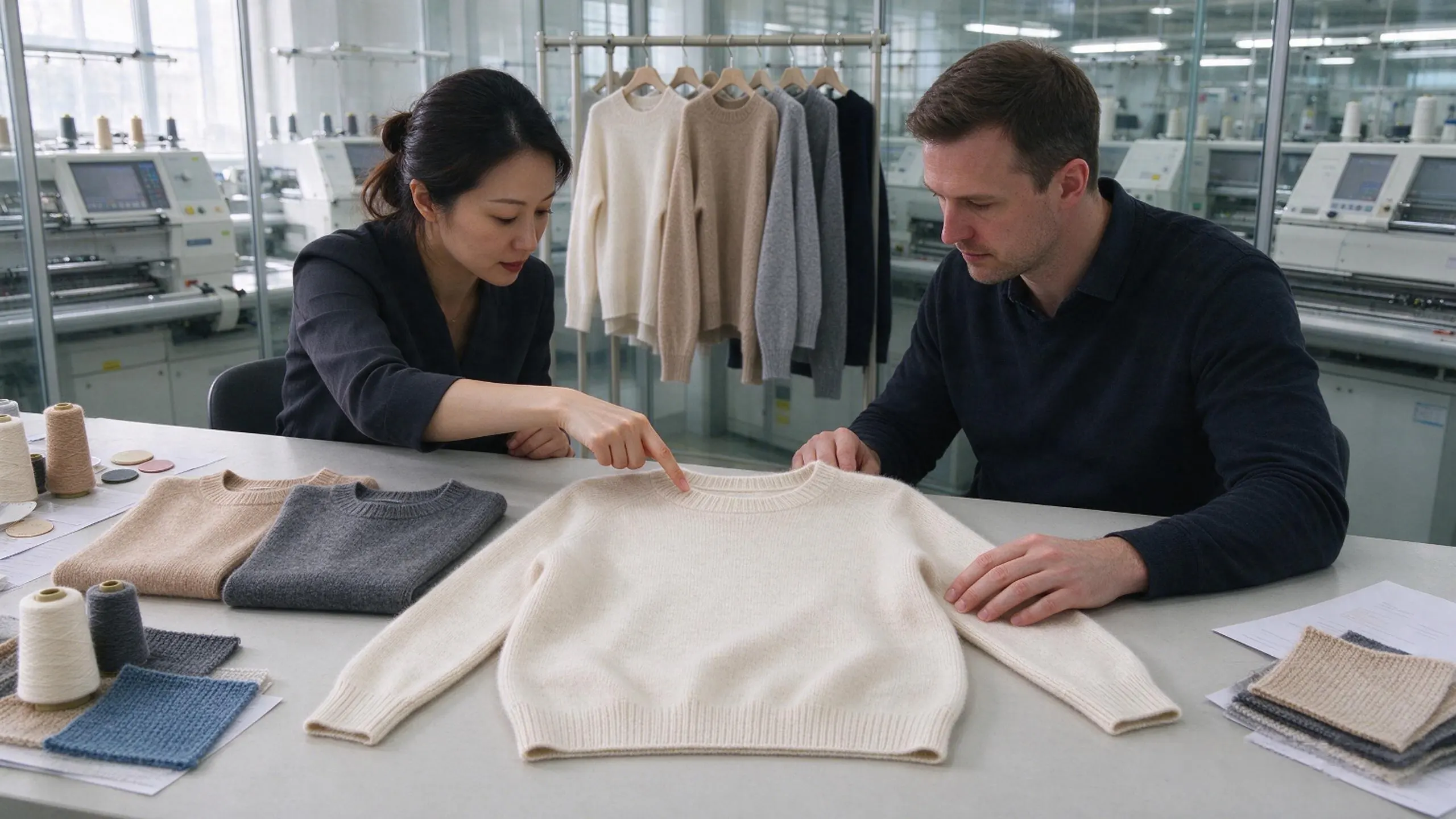
In the account, a reference photograph and notes on fit, hand feel and market positioning formed the starting brief. A photograph can communicate a silhouette or visible detail, but it cannot establish yarn composition, finished measurements, hidden construction or washing behaviour.
The development discussion therefore covered yarn direction, gauge, stitch structure, panel construction, pattern making, needle drafting and measurement tolerances. These decisions need an agreed technical specification and a physical sample before they become a bulk-production reference.
Workflow context: OEM and ODM knitwear workflow.
The Knitwear Sampling Process and Approval Gate
The account describes yarn matching, pattern development, knitting setup, panel review, linking, washing, finishing and measurement checks, followed by remote review and physical sample delivery. This sequence is retained as a process description, without assigning an unverified day-by-day schedule.
Sample completion, courier dispatch and receipt in Germany are different milestones. Buyer fitting, comments and revisions must also be scheduled. Before bulk release, identify the approved sample revision, yarn and colour reference, size specification, finishing requirement and person responsible for approval.
Prepare the brief using the knitwear tech pack and RFQ checklist.
Trial-Order Planning and Conditional MOQ
The published narrative places a focused trial order after sample approval. Small batch knitwear production can let a buyer review retailer feedback before deciding on repeat quantities. It does not guarantee lower unsold inventory, successful replenishment or improved sales. The actual quantity purchased in this project is not disclosed.
MOQ condition: YouTricot’s 50 pieces per style per colour option is subject to technical feasibility and upstream yarn, dyeing, trim, testing and finishing minimums. Confirm the proposed size allocation, material route, construction and order terms before treating that quantity as available. It is not a universal minimum or a statement of this client’s order size.
A separate first-party process account is available in the French small-batch knitwear case study. Its order details and reported outcomes do not establish results for the German project.
Production and Delivery: Define the Milestones
When planning knitwear for wholesalers, separate factory work from buyer approvals and international transport. The table below is a planning checklist, not a reconstructed project timetable or proof that a particular delivery window was achieved.
| Milestone | What to confirm | Supporting record |
|---|---|---|
| Production release | Approved sample and specifications, material availability and allocated capacity. | Dated approvals and order-release record. |
| Factory completion | Knitting, linking, finishing, inspection and packing scope. | Production log, inspection report and packing list. |
| Dispatch | Carrier handover, route and agreed delivery responsibilities. | Shipment booking and tracking record. |
| Warehouse receipt | Named destination, receipt date and any customs or transit delays. | Proof of delivery or warehouse receipt. |
A written schedule should define its start and end events, calendar or working days, revisions, buyer response time and transport exclusions. Custom yarn, complex structures, additional testing, finishing trials or changing capacity can alter the plan.
Quality Checks and Documentation Boundaries
The published workflow lists yarn-lot review, stitch density, panel dimensions, linking and seams, finished measurements, surface appearance, colour consistency and packing checks. These are described checkpoints; no order-linked inspection results or laboratory reports are presented here.
Agree the measurement tolerances, test methods, acceptance criteria and approval responsibilities before production. Visual inspection does not establish tested pilling performance, colour fastness or product safety.
Where relevant, request documentation for the selected material and order. The official OEKO-TEX STANDARD 100 and Responsible Wool Standard resources provide scheme context. These links do not establish that YouTricot, this order or its finished garments are certified. Check the holder, scope, validity and order applicability of any document supplied.
Buyer Checklist Before a Trial Order
- Provide a tech pack, reference images or a physical garment, with measurements and fit direction.
- Specify yarn, colour, gauge, structure, finishing and quantities by style, colour and size.
- Confirm labels, packaging, testing and destination-specific documentation requirements.
- Name the sample approver and record the approved revision before bulk release.
- Confirm the warehouse destination, required arrival date, delivery terms and written schedule.
Frequently Asked Questions
Can this knitwear OEM process case establish a delivery guarantee?
No. The account does not provide the dated records needed to verify a delivery duration. A new order needs its own feasibility review, material confirmation, approved sample, capacity allocation and logistics plan.
Are sampling fees free?
No. YouTricot charges symbolic sampling fees, fully deductible from later bulk production orders. Confirm the development scope, revision allowance, separate courier or external costs and how the deduction will be recorded in the written quotation.
Does a trial order prove lower inventory risk?
It provides a smaller purchasing scope for review, but the commercial result requires comparable inventory and sales records. Confirm the metric, period, style scope and baseline before presenting an inventory or launch-time improvement.
About the Author
Frank, Founder of YouTricot. Frank has 20 years of knitwear industry and operational experience across Prato, Italy and Dalang, Dongguan, China. YouTricot is a B2B high-end knitwear OEM/ODM manufacturer.
Request a Knitwear OEM Feasibility Review
Share your tech pack or reference images, yarn direction, target measurements, quantities by style and colour, warehouse destination and required arrival date. Request a review of technical feasibility, upstream minimums, sampling scope and the production and delivery plan before committing to an order.